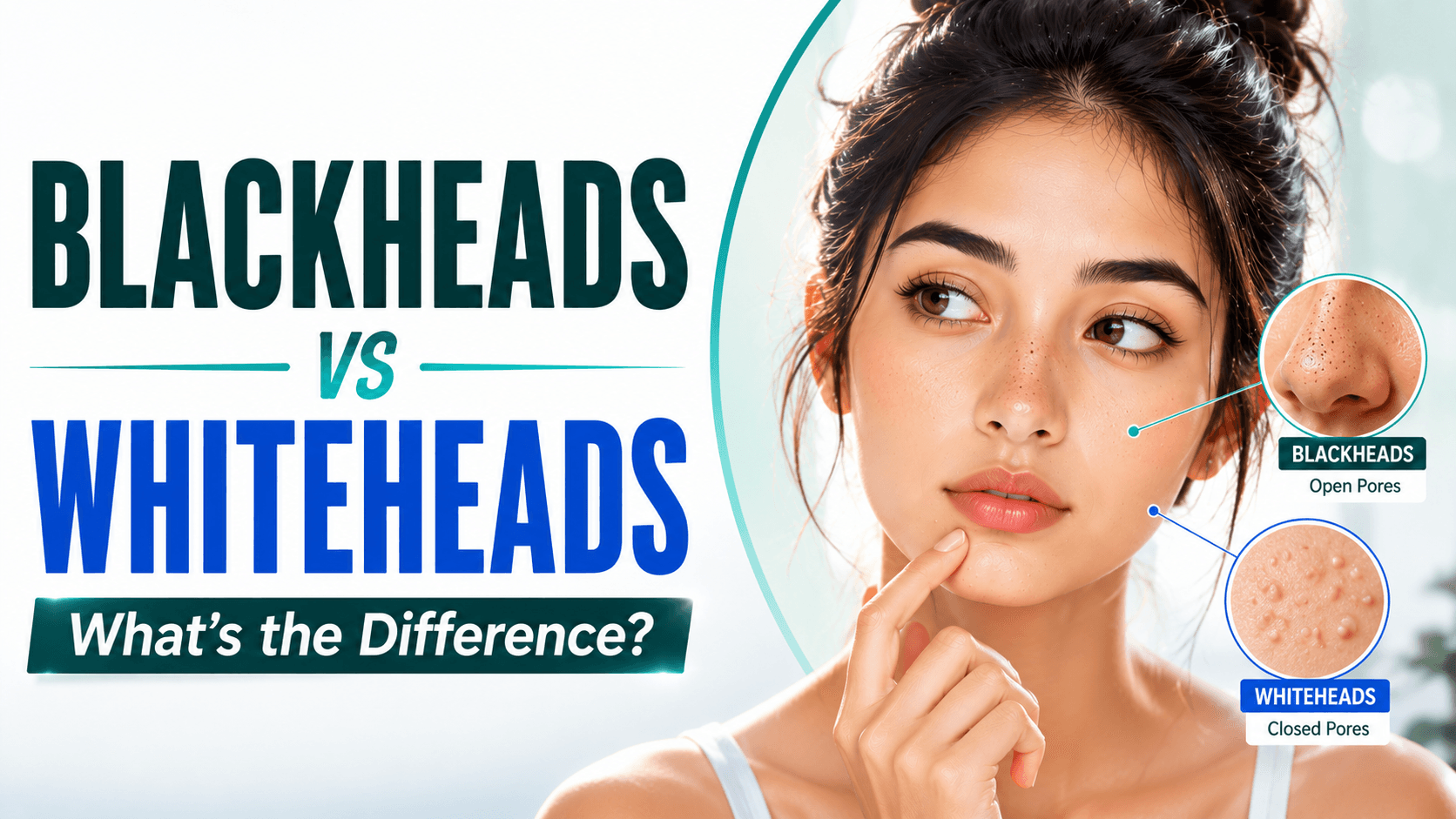
Discover the differences between blackheads and whiteheads, what causes them, and how to effectively treat and prevent these common skin concerns.

Maryam Mumtaz
Co-Founder & CEO
12 min read•7/28/2026
Marsa Empower · Skin Health & Acne Wellness · For Girls & Women Aged 13 and Above · 13 min read
"Blackheads are not dirt. Whiteheads are not infection. Both are simply your skin doing something very normal — in a way that can be managed with the right understanding and the right routine."
Look closely at almost any teenager's nose and chin — and you will almost certainly see them. Those small, dark spots on the nose. Those tiny white bumps under the skin on the chin and forehead. Blackheads and whiteheads are arguably the most universal skin experience of the teenage years — and two of the most persistent skin concerns for women well into their twenties, thirties, and beyond.
Yet despite how common they are, very few girls ever receive a proper explanation of what they actually are, what causes them, or how to manage them effectively. Instead, they are sold expensive skincare products, told to wash their face more, or warned not to squeeze — without ever understanding why any of these things matter.
This guide gives you the full explanation — clearly, simply, and with the practical guidance that makes a real difference to your skin.
Before understanding the difference between blackheads and whiteheads, it helps to understand what a pore is and how it gets clogged in the first place.
Your skin is covered in millions of tiny openings called pores. Each pore is connected to a hair follicle — the structure from which a hair grows — and to a sebaceous gland, which produces a natural oil called sebum. Sebum travels up through the follicle and out of the pore onto the skin surface, where it moisturises and protects the skin.
Under normal circumstances, this system works smoothly. But during puberty — when rising hormone levels significantly increase sebaceous gland activity — the glands produce considerably more sebum than the skin needs. At the same time, the skin sheds dead skin cells continuously as part of its normal renewal process.
When excess oil and dead skin cells mix inside the follicle, they can form a semi-solid plug that blocks the pore. This blockage is the starting point for both blackheads and whiteheads — and the difference between the two depends entirely on whether the pore at the top of that blockage is open or closed.
A blackhead — known medically as an open comedone — forms when a pore becomes partially blocked but the opening at the top of the pore remains open.
The plug of excess oil and dead skin cells sits inside the follicle but is exposed to the air at its surface. When the sebum and dead skin cells in that plug come into contact with oxygen in the air, a chemical reaction called oxidation occurs — the same process that makes a cut apple turn brown, or iron turn rusty. This oxidation turns the surface of the plug from its natural yellowish-white colour to a dark brown or black.
This is the most important thing to understand about blackheads: the dark colour is not dirt.
No matter how thoroughly you wash your face, no matter how aggressively you scrub, the dark colour of a blackhead will not wash away — because it is not surface contamination. It is a chemical change in the material inside the pore caused by exposure to air. The only way to remove a blackhead is to clear the material from inside the pore — not to scrub the surface above it.
The nose is the most common location for blackheads in teenage girls and young women — particularly the area across the bridge and on either side (the nose "wings"). The chin and forehead are also very common locations. This is because the T-zone — the forehead, nose, and chin — has the highest density of sebaceous glands on the face, produces the most oil, and is therefore most prone to clogged pores.
A whitehead — known medically as a closed comedone — forms when a pore becomes blocked and the opening at the top of the pore closes over the plug.
Because the plug of oil and dead skin cells is sealed beneath a thin layer of skin and has no contact with air, oxidation cannot occur. The material inside retains its natural white or yellowish-white colour — and the skin above it appears as a small, rounded white or flesh-coloured bump.
Whiteheads are the precursor to more inflamed forms of acne. If the plug continues to grow inside the sealed follicle, the pressure can cause the follicle wall to rupture, releasing the plug's contents into the surrounding skin tissue. This triggers an immune response — redness, swelling, and pain — that produces the red, inflamed pimples (papules and pustules) that are more severe forms of acne.
Many girls squeeze whiteheads thinking they are the same as pustules (the pus-filled pimples that are a more inflamed type of acne). They are not the same. A whitehead is simply a clogged pore — there is no infection or pus involved. Squeezing it does not remove the clog — it pushes the material sideways into surrounding tissue, worsening inflammation and often producing a larger, redder spot than was there before.
| Feature | Blackheads | Whiteheads |
|---|---|---|
| Pore status | Open | Closed |
| Colour | Dark brown or black | White, cream, or flesh-coloured |
| Why that colour | Oxidation — contact with air | No oxidation — sealed from air |
| Pain or tenderness | Usually none | Usually none — unless inflamed |
| Most common locations | Nose · T-zone · Chin | Face · Chest · Shoulders · Back |
| Texture | Flat or slightly raised · Visible pore | Rounded bump · No visible pore |
| Risk of inflammation | Lower — open pore relieves pressure | Higher — pressure builds inside closed pore |
| Treatment approach | Salicylic acid · Exfoliation · Pore strips | Retinoids · Salicylic acid · Patience |
| Response to squeezing | Can be carefully extracted — but risks scarring | Should not be squeezed — worsens inflammation |
Understanding the causes helps you make better choices about prevention and treatment — and stops you from wasting time and money on approaches that do not address the actual problem.
This is the primary reason blackheads and whiteheads are so common during the teenage years. During puberty, rising androgens — the group of hormones that includes testosterone — directly stimulate the sebaceous glands to produce significantly more sebum than before.
More sebum means more material available to mix with dead skin cells and form the plugs that cause both blackheads and whiteheads. This is a biological process — not something caused by poor hygiene or inadequate skincare — which is why almost every teenager experiences some degree of clogged pores regardless of how carefully they care for their skin.
Even beyond the hormonal surge of puberty, some people's sebaceous glands are genetically more active than others. Oily skin as a skin type — determined largely by genetics — means more sebum production and therefore a higher baseline risk of clogged pores throughout adulthood.
The skin continuously sheds dead cells from its surface as new cells form beneath. Normally, dead cells shed individually and invisibly. But when cell shedding is irregular, or when excess oil causes dead cells to stick together inside the follicle rather than shedding normally, they accumulate and contribute to pore blockage.
This is why exfoliation — removing dead skin cells from the surface — is a relevant tool in managing blackheads and whiteheads. Both physical and chemical exfoliants can help clear the cellular material that contributes to clogged pores.
Some skincare products, foundations, primers, sunscreens, and hair products contain ingredients that block pores when applied to the skin. When these products come into contact with the face — particularly on areas already prone to clogging — they can directly cause or worsen blackheads and whiteheads.
This is why the word "non-comedogenic" on product packaging matters. Non-comedogenic products are formulated specifically to avoid blocking pores. For girls with acne-prone or congestion-prone skin, choosing non-comedogenic skincare and makeup is one of the most practical preventive steps available.
Makeup — particularly full-coverage foundation, concealer, and primer — blocks pores when left on the skin for extended periods. Sleeping in makeup means the skin is covered by pore-blocking products throughout the night, during the period when the skin performs its most active renewal. Over time, this consistently worsens clogged pores and can turn mild congestion into established blackheads and whiteheads.
For girls with oily hair, hair products — dry shampoos, gels, oils, hairsprays — that come into contact with the forehead and cheeks can directly block pores in those areas. This is a less commonly discussed but genuinely relevant cause of persistent blackheads along the hairline and forehead.
Genetics influences pore size, sebum production levels, and the skin's tendency toward congestion. If your parents or close family members had significant blackhead and whitehead concerns, you are more likely to as well — and it is worth managing this proactively rather than waiting for it to become more severe.
The foundation of any blackhead management routine is twice-daily cleansing with a gentle, appropriate cleanser — one that removes excess oil without stripping the skin entirely.
For oily or blackhead-prone skin, a gel or foam cleanser containing salicylic acid is particularly effective. Salicylic acid is an oil-soluble ingredient that can penetrate into the pore and help dissolve the oil-dead cell mixture that forms the blackhead plug.
How to cleanse correctly:
After cleansing, applying a toner or serum containing salicylic acid (0.5% to 2%) directly addresses the oil-cell buildup inside pores. Salicylic acid is a BHA (beta hydroxy acid) — it is oil-soluble, meaning it can dissolve into the sebum inside the pore and break down the plug from within.
This is the most targeted and most effective over-the-counter ingredient for blackheads. Apply to the affected areas after cleansing, before moisturiser.
Regular exfoliation — one to three times per week depending on skin sensitivity — removes dead skin cells from the surface before they can accumulate inside pores.
Use a chemical exfoliant rather than a physical scrub:
Physical scrubs — with walnut shell, apricot, or sugar particles — are too abrasive for the face and cause micro-tears in the skin that worsen the overall condition. Avoid them entirely.
Pore strips — adhesive strips applied to the nose and removed to pull out blackhead plugs — can be satisfying and provide short-term results. However, they remove only the surface portion of the blackhead plug, not the sebaceous filament below. This means blackheads return quickly — often within one to two weeks — and repeated use can stretch or irritate pores.
If you use pore strips, use them infrequently (once a month maximum) and only on properly cleansed, slightly moist skin. Never use them on dry, irritated, or sensitive skin.
Retinol — a vitamin A derivative — is one of the most effective treatments for blackheads available without a prescription. It works by speeding up skin cell turnover, which prevents dead cells from accumulating inside pores and helps clear existing blackhead plugs over time.
Start with a low concentration (0.025% to 0.1%) applied two to three times per week at night. Always use sunscreen the following morning — retinol increases the skin's sensitivity to UV radiation.
Results from retinol take eight to twelve weeks to become noticeable — patience is essential.
The same twice-daily gentle cleansing as described above. Consistency is the most important factor — whiteheads are more stubborn than blackheads and respond most to sustained, patient routine rather than aggressive one-off treatments.
Salicylic acid also works for whiteheads — it softens the skin above the closed pore and helps the plug to loosen over time. However, because the pore is closed, it cannot penetrate as readily as it does with open blackheads. Be patient — consistent use over four to eight weeks produces noticeable results.
Retinoids (including over-the-counter retinol and retinoid-like adapalene) are particularly effective for whiteheads because they work by preventing the abnormal shedding pattern inside the follicle that causes the plug to form in the first place.
Adapalene 0.1% — available over-the-counter in most countries — is a newer-generation retinoid that is less irritating than older retinol formulations and specifically approved for acne treatment. It is applied once at night, starting with every other night to allow the skin to adjust.
Results typically take eight to twelve weeks. Initial purging — a temporary increase in whiteheads as the skin cell turnover accelerates — is common in the first two to four weeks and is a sign the treatment is working.
This cannot be emphasised enough. Squeezing a whitehead pushes the plug sideways into the surrounding tissue rather than out of the pore. The skin's immune system responds to this displaced material with inflammation — producing a red, swollen, painful papule or pustule where there was previously only a small, painless whitehead. The resulting spot is always worse than the original whitehead.
If a whitehead is large and particularly bothering you, a dermatologist can extract it safely and correctly using sterile instruments.
| Ingredient | How It Works | Best Used |
|---|---|---|
| Salicylic acid (BHA) | Oil-soluble · Penetrates pores · Dissolves oil-cell plugs | Morning or evening · Cleanser, toner, or serum |
| Retinol / Adapalene | Speeds cell turnover · Prevents plug formation · Unclogs existing pores | Evening only · Start low and slow |
| Niacinamide | Regulates sebum production · Reduces pore appearance · Anti-inflammatory | Morning and evening · Serum or moisturiser |
| AHA (glycolic or lactic acid) | Removes surface dead skin cells · Brightens · Smooths texture | Evening · 1 to 3 times per week |
| Benzoyl peroxide | Kills acne bacteria · Most useful when blackheads/whiteheads have become inflamed | Spot treatment · Evening |
| Azelaic acid | Reduces post-acne marks · Anti-inflammatory · Gentle | Morning or evening |
Introduce one new active ingredient at a time — with at least two weeks between introducing each new product. Using multiple actives simultaneously causes irritation, makes it impossible to know which product is helping, and can genuinely damage the skin barrier.
Start with salicylic acid. Use it consistently for six to eight weeks. If results are insufficient, add retinol or adapalene. Do not use AHA and BHA simultaneously every day — alternate them.
This is the most common and most damaging mistake. Squeezing:
The only exception: blackheads can occasionally be gently extracted at home after steaming the face to open pores — but this should be done with clean fingers (not nails), very gentle pressure, and only when the blackhead comes away easily without resistance. If it requires any significant force, leave it alone.
More scrubbing does not remove blackheads or whiteheads. Scrubbing irritates the skin, disrupts the protective barrier, and triggers more oil production as the skin tries to compensate — worsening the congestion. Gentle is always better.
Washing more than twice a day strips the skin of its natural oils. The sebaceous glands respond by producing more oil — increasing the material available to clog pores. Twice daily is the correct frequency for most skin types.
Layering ten different skincare products — particularly multiple active ingredients — overloads the skin, causes irritation, and prevents you from knowing what is working. Start with three products: a gentle cleanser, a salicylic acid treatment, and a lightweight moisturiser. Build from there slowly.
Blackheads and whiteheads develop over weeks and months. Treating them effectively requires four to eight weeks of consistent routine before meaningful improvement is visible. Abandoning a product after two weeks because "it is not working" prevents any treatment from ever having time to work.
Wearing pore-blocking foundation, primer, or sunscreen is unavoidable for many girls — but leaving it on the skin overnight is not. Remove all makeup every single night without exception, followed by a proper cleanse.
Pore strips, very high-concentration acids, and aggressive manual extraction tools used daily damage the skin's barrier, cause inflammation, and worsen both congestion and sensitivity. These tools — when used at all — should be used sparingly, not as daily skincare.
Prevention is significantly easier than treatment. These habits, maintained consistently, reduce new blackhead and whitehead formation:
Cleanse twice daily — morning and evening. Remove the oil, dead cells, and product residue that contribute to pore blockage every single day.
Remove all makeup every single night — no exceptions. Even one night of sleeping in makeup noticeably worsens congestion.
Use only non-comedogenic products — check all skincare, sunscreen, foundation, primer, and concealer packaging for this word. If it is not labelled non-comedogenic, it may be blocking pores.
Moisturise — even oily skin — dehydrated skin produces more oil. A lightweight, oil-free, non-comedogenic moisturiser keeps the skin balanced.
Apply SPF 30+ every morning — sun damage darkens the post-acne marks that blackheads leave behind, making them last much longer.
Exfoliate one to three times per week — with a salicylic acid product or gentle AHA to remove dead skin cells before they accumulate in pores.
Wash makeup brushes every week — dirty brushes deposit oil, bacteria, and old makeup directly onto the skin with every use.
Change your pillowcase every 2 to 3 days — pillowcases collect oil, dead skin cells, and hair product residue. Pressing your face against this for eight hours every night consistently contributes to clogged pores.
Clean your phone screen — phone screens carry significant bacterial contamination and oil and are pressed against the cheek and chin regularly. Wipe daily with an antibacterial wipe.
Drink enough water — adequate hydration supports skin cell function and helps maintain the skin's natural balance.
Eat a balanced diet — reducing high-glycaemic foods (sugary drinks, white bread, processed snacks) reduces insulin spikes that increase androgen activity and sebum production.
Manage stress — elevated cortisol from chronic stress increases oil production. Regular movement, adequate sleep, and genuine stress management directly support clearer skin.
Do not touch your face — hands transfer oil and bacteria to the skin with every touch, directly contributing to pore blockage.
Specific dietary choices influence sebum production, inflammation, and the skin's overall health — and therefore directly affect the frequency and severity of blackheads and whiteheads.
| Food | Key Nutrients | How They Help |
|---|---|---|
| Leafy green vegetables (spinach, methi) | Vitamins A, C, K · Antioxidants | Reduce inflammation · Support skin cell health |
| Berries (strawberries, blueberries) | Vitamin C · Antioxidants | Protect skin cells from oxidative damage · Brighten |
| Fish (salmon, sardines, mackerel) | Omega-3 fatty acids | Reduce skin inflammation · Support sebum balance |
| Pumpkin seeds and nuts | Zinc · Vitamin E | Regulate oil gland activity · Antioxidant protection |
| Eggs | Protein · Biotin · Zinc | Support skin cell production and repair |
| Sweet potato and carrots | Beta-carotene (Vitamin A) | Supports healthy skin cell turnover |
| Whole grains (brown rice, oats) | Low glycaemic · B vitamins | Stabilise blood sugar · Prevent insulin spikes |
| Green tea | Antioxidants · Anti-inflammatory | Reduces sebum production when consumed regularly |
| Water | Hydration | Supports every cellular process including skin renewal |
| Food | Why It May Worsen Blackheads and Whiteheads |
|---|---|
| Sugary drinks and sweets | Spike blood sugar → spike insulin → spike androgens → more oil production → more clogged pores |
| White bread, white rice, refined carbohydrates | Same insulin-spiking mechanism |
| Fast food and fried snacks | Pro-inflammatory · High glycaemic |
| Excessive dairy (particularly skimmed milk) | Some research links to increased comedonal (non-inflamed) acne |
The most meaningful dietary change for reducing clogged pores is reducing high-glycaemic foods — those that cause rapid blood sugar spikes. This dietary adjustment reduces the hormonal chain that increases sebum production and is supported by consistent research evidence.
| The Myth | The Truth |
|---|---|
| "Blackheads are caused by dirty skin" | Blackheads are caused by oxidation of oil and dead skin inside open pores — not by dirt on the surface. Washing more aggressively does not remove them and often makes the skin worse. |
| "The black colour means it is infected" | Black is the colour of oxidised sebum exposed to air — not infection. There is no bacteria, pus, or infection in a typical blackhead. |
| "You should squeeze blackheads to clear them" | Squeezing pushes material into surrounding tissue, causes inflammation, introduces bacteria, and almost always results in a worse spot and a dark mark afterward. |
| "Pore strips permanently solve blackheads" | Pore strips remove only the surface portion of the plug — not the sebaceous filament that refills the pore. Blackheads typically return within one to two weeks. |
| "Only teenagers get blackheads and whiteheads" | While puberty increases frequency and severity, adults develop blackheads and whiteheads throughout their lives — particularly in oily T-zone areas. |
| "If you have blackheads, your pores are too large" | Pore size is determined by genetics. It cannot be meaningfully changed by any skincare product, cold water rinse, or treatment — despite widespread claims. What can be changed is how blocked the pores are, which makes them appear smaller when clear. |
| "Natural oils like coconut oil clear blackheads" | Applying heavy oils to already oily, congestion-prone skin provides more material for sebaceous glands to work with and can worsen blackheads — not improve them. |
| "A higher-priced product works better for blackheads" | The effectiveness of a skincare product for blackheads depends on its active ingredient — salicylic acid, retinoid, or niacinamide — not its price. Many affordable products are as effective as expensive ones. |
Most mild blackheads and whiteheads can be managed effectively with a consistent home skincare routine using over-the-counter products. However, professional care is appropriate in the following situations:
See a dermatologist if:
A dermatologist can also safely extract stubborn blackheads and whiteheads using sterile instruments — a much safer and more effective approach than attempting extraction at home.
| Topic | Key Takeaway |
|---|---|
| What is a blackhead | Open clogged pore — dark from oxidation, not dirt |
| What is a whitehead | Closed clogged pore — white because sealed from air |
| Primary cause | Excess oil + dead skin cells + pore blockage — driven by hormones during puberty |
| Best treatment for blackheads | Salicylic acid toner or serum · Consistent exfoliation · Retinol at night |
| Best treatment for whiteheads | Salicylic acid · Adapalene or retinol · Patience — 8 to 12 weeks |
| Most effective ingredient | Salicylic acid for clearing existing congestion · Retinoids for preventing new formation |
| Biggest mistake | Squeezing — always makes things worse |
| Prevention essentials | Remove makeup nightly · Non-comedogenic products · Change pillowcase regularly · Reduce high-glycaemic foods |
| When to see a dermatologist | No improvement after 8 to 12 weeks · Inflamed acne developing · Scarring · Significant confidence impact |
| Most important myth | Blackheads are not dirt — they are oxidised sebum and cannot be removed by washing harder |
"Understanding what a blackhead actually is — and what a whitehead actually is — changes everything about how you approach them. They are not dirt. They are not failure. They are a common, manageable skin condition that responds beautifully to the right routine and the right patience."
Educational Disclaimer
This article is for educational and awareness purposes only. It does not constitute medical advice, diagnosis, or treatment. If you have persistent or worsening acne, scarring, or skin concerns significantly affecting your wellbeing, please consult a qualified dermatologist or healthcare professional for personalised evaluation and guidance.
Marsa Empower · Skin Health · Acne & Pore Wellness · Women's Health Education
Medical Disclaimer
This article is for general informational and educational purposes only and is not a substitute for professional medical advice, diagnosis, or treatment. Always seek the advice of a qualified healthcare provider with any questions you may have regarding a medical condition. Never disregard professional medical advice or delay seeking it because of something you have read on MARSA Empower.
Written By
Maryam Mumtaz
Co-Founder & CEO
Co-Founder of MARSA Empower who leads the visual and strategic evolution of the platform. Maryam bridges technical complexity with human-centric design, architecting the team's official roadmap and ensuring MARSA effectively addresses the real-world needs of women. With deep expertise in agentic AI, full-stack development, and UI/UX design, she has delivered 50+ projects for 30+ satisfied clients.
Enjoyed this story?