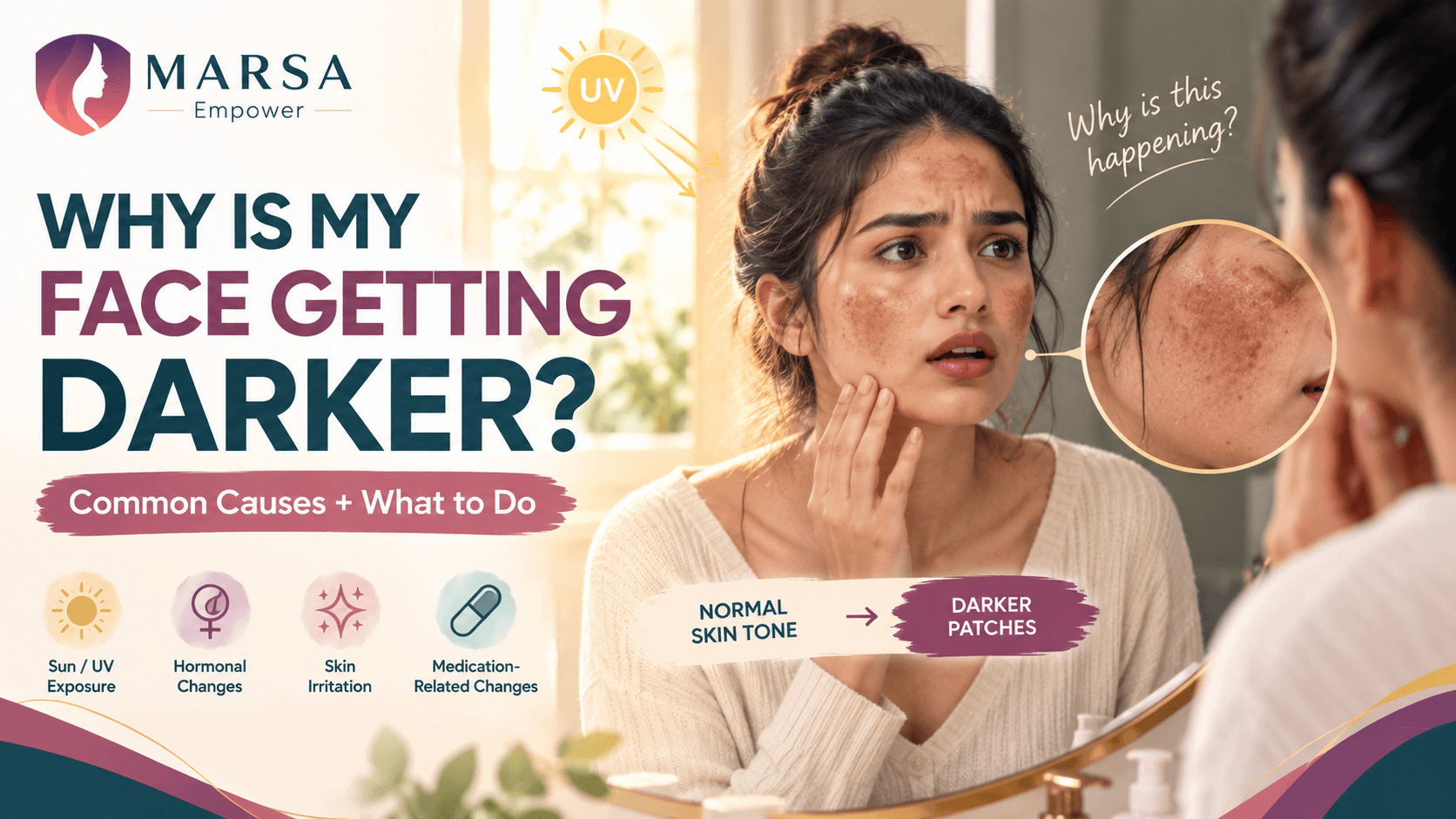
Discover why your face might be getting darker with insights into common causes and practical solutions.

Maryam Mumtaz
Co-Founder & CEO
13 min read•10/4/2026
Marsa Empower · Skin Health & Beauty · For Girls & Women Aged 13 and Above · 13 min read
Noticing that your face has become darker — whether gradually over months, suddenly in specific patches, or progressively across larger areas — is one of the most common skin concerns among South Asian women and girls. In Pakistan and the broader region, skin tone and evenness are topics of intense social and cultural attention, making facial darkening a source of real distress for many women.
The most important thing to understand is that facial skin darkening almost always has specific, identifiable causes — and most of those causes are addressable once identified. The skin has not changed permanently or inevitably. Understanding why it has darkened — sun exposure, hormonal changes, post-acne pigmentation, harsh skincare, a nutritional issue, or in some cases a health condition — is the essential first step toward improving it.
This guide provides clear, honest answers about the most common causes of facial darkening, what each cause looks like, what genuinely helps, what common "remedies" actually make things worse, and when darkening warrants medical investigation.
Skin colour is determined primarily by melanin — a pigment produced by specialised skin cells called melanocytes. Melanin production is triggered by UV radiation, hormonal signals, inflammation, and other stimuli. When any of these stimuli increase melanin production in a localised or widespread area, the skin in that area darkens.
Generalised facial darkening — the whole face appearing darker than before — typically reflects sun tanning, hormonal changes that affect melanin production throughout the face, or a nutritional or systemic factor.
Patchy or uneven darkening — specific areas of the face darker than others — more typically reflects post-inflammatory hyperpigmentation (dark marks after spots or irritation), melasma (hormone-driven pigmentation patches), sun-induced pigmentation on exposed areas, or friction-related darkening in specific zones.
Darkening relative to the body — the face being noticeably darker than the neck, chest, or arms — typically reflects the disproportionate UV exposure the face receives compared to covered areas of the body.
The most common cause of facial darkening worldwide. The face is the most consistently sun-exposed area of the body — it is not typically covered by clothing, and it receives direct UV radiation whenever outdoors. UV triggers melanin production as the skin's primary protective response. Cumulative unprotected sun exposure progressively darkens the face relative to covered skin, deepens existing marks, and creates new spots over time.
The absence of daily sunscreen is the single most significant modifiable cause of facial darkening in South Asian women. Many women who notice their face is getting darker have no consistent sunscreen habit — meaning that even brief daily sun exposure during commuting, walking, or outdoor activities accumulates into significant UV-driven pigmentation over months.
Female reproductive hormones — particularly oestrogen — directly stimulate melanin production. This produces the condition called melasma — symmetrical patches of brown pigmentation, most commonly on the cheeks, forehead, upper lip, and jawline — that develops or worsens with pregnancy, hormonal contraceptives, and perimenopausal hormonal fluctuations. Melasma is one of the most common causes of patchy facial darkening in South Asian women and is significantly worsened by sun exposure.
Any inflammatory process in the skin triggers a repair response that includes melanin production in the affected area. This is called post-inflammatory hyperpigmentation (PIH). The inflammation can come from acne, eczema, contact dermatitis, harsh products, rubbing, or any other source of skin irritation.
Acne is one of the most common causes of facial dark marks in South Asian women. After a pimple resolves, the inflammatory process it caused leaves behind melanin — producing the flat, brown, or greyish-brown marks that persist long after the active spot has gone. In women with naturally deeper skin tones, this post-acne pigmentation is darker, more persistent, and more difficult to fade than in those with lighter skin tones.
Manually picking, squeezing, or scratching spots and skin dramatically increases the inflammatory response and therefore the depth and persistence of the resulting dark mark. Picking is the single behaviour most responsible for the dark marks that follow acne.
Products containing high concentrations of alcohol, strong fragrances, harsh exfoliating acids, or ingredients the skin is sensitive to cause contact dermatitis — an inflammatory skin reaction that produces the redness, irritation, and subsequent post-inflammatory pigmentation that leaves the skin darker than before the product was used.
Repeated waxing, threading, plucking, or shaving of facial hair — particularly around the upper lip, chin, and sideburns — can cause repeated micro-inflammation in the follicles, leading to post-inflammatory pigmentation over these areas that presents as persistent darkening around the mouth and chin.
Chronically dry, dehydrated skin has a compromised barrier that makes it more reactive to environmental factors and more prone to inflammatory pigmentation from minor irritation that would not affect an intact, well-hydrated barrier.
Chronic stress elevates cortisol, which increases inflammatory signals in the skin and impairs barrier repair. Poor sleep prevents the overnight skin recovery that normally clears cellular debris, addresses minor damage, and maintains the even skin turnover that prevents pigment accumulation.
Certain nutritional deficiencies affect skin colour through specific mechanisms. Iron deficiency produces pallor that creates uneven contrast. Vitamin B12 deficiency can produce hyperpigmentation including on the face. Vitamin D deficiency affects skin metabolism broadly. Niacin (vitamin B3) deficiency can produce skin darkening.
Some medications cause drug-induced photosensitivity — making the skin react much more strongly to UV exposure than it would otherwise, producing faster and more significant darkening on exposed areas. Common photosensitising medications include certain antibiotics (tetracyclines), some antifungals, some blood pressure medications, and some diuretics.
Some medical conditions produce facial darkening as a skin manifestation. These are discussed separately below.
The most common causes of facial darkening in teenage girls are acne-related post-inflammatory pigmentation, sun exposure without sunscreen, hormonal changes driving melasma or general pigmentation in some girls, and harsh or inappropriate skincare products.
Teenage skin is more reactive than adult skin to inflammatory stimuli — acne during puberty produces the dark marks that are among the most common and most distressing skin concerns of adolescence. The most important preventive measures are managing acne early and gently before dark marks form, protecting skin from UV, and avoiding picking.
In the twenties, sun accumulation begins to show, post-acne marks from ongoing hormonal acne are prevalent, and hormonal contraceptive-related melasma can begin. Consistent daily sunscreen becomes progressively more important in this decade for preventing further pigmentation development.
Hormonal changes in the thirties — including pregnancy, changes in contraception, and subtle perimenopausal hormonal shifts — can trigger melasma. The cumulative UV exposure of two to three decades on an unprotected face becomes visible in the form of uneven skin tone, dark spots, and deepened pigmentation.
Age-related changes in skin cell turnover slow the natural shedding of pigmented surface cells, making dark spots and uneven pigmentation more persistent than in younger skin. Hormonal changes of perimenopause affect melanin activity. Sun damage accumulated over decades becomes more visible as the skin's ability to repair and renew declines.
The primary melanin stimulus. Each UV exposure event triggers melanin production in the outermost skin layers as photoprotection. Repeated exposure produces increasingly deep and persistent pigmentation. In South Asian skin tones, this tanning is often uneven and accumulates over years of unprotected exposure into significant darkening particularly on the forehead, cheeks, nose, and upper lip — the areas most directly exposed to overhead sun.
Melasma presents as bilateral symmetrical patches of brown or grey-brown pigmentation — most commonly on both cheeks, the forehead, the upper lip area, and the bridge of the nose. It is triggered by the combination of oestrogen exposure and UV light — meaning it is significantly worse in summer, improves somewhat in winter (when UV is lower), and worsens with hormonal contraceptives and during pregnancy.
Melasma is among the most difficult skin pigmentation conditions to treat, primarily because it continues to reform as long as the hormonal and UV triggers are present. Sunscreen is the most important management tool, alongside treating the hormonal driver where possible and using appropriate topical depigmenting agents under dermatological guidance.
Post-inflammatory hyperpigmentation from acne is the most common reason women in their teens, twenties, and thirties seek skin advice in South Asian populations. The marks are flat (not raised), range in colour from tan to dark brown to grey-brown depending on skin tone and depth, and are located precisely where a previous pimple was.
They typically fade over three to twelve months without treatment — longer in deeper skin tones — but sun exposure significantly slows and worsens this fading. Sunscreen, vitamin C, niacinamide, and patience are the most effective management approach.
Any repeated source of skin irritation — a harsh scrub, a fragrance-heavy product, rubbing from spectacle frames, chin-resting in the hand, religious practices involving repeated skin contact with certain surfaces — can produce localised post-inflammatory pigmentation in the affected area.
A compromised skin barrier from dryness, over-washing, or harsh products is more prone to inflammatory pigmentation. Maintaining adequate skin hydration and barrier integrity reduces the PIH response to minor triggers.
Highly concentrated AHAs, strong retinoids, benzoyl peroxide used without adequate moisturiser, and products containing known irritants can paradoxically cause the post-inflammatory pigmentation they are sometimes intended to treat, particularly in darker skin tones that are more reactive to inflammatory stimuli.
Threading, waxing, and shaving of the upper lip, chin, and sideburns areas causes repeated micro-trauma and inflammation in follicles. Over time, this produces hyperpigmentation in these specific areas that women often notice as darkening around the mouth and jaw. Reducing the frequency of hair removal, choosing gentler methods where possible, and applying sunscreen to these areas consistently reduces this effect.
Melanin is the skin's primary defence against UV radiation. When UV light hits the skin, it causes direct damage to DNA in skin cells. Melanocytes respond by producing and distributing melanin, which absorbs UV radiation and dissipates it as heat, protecting the cells beneath.
The face receives disproportionately high UV exposure compared to most of the body — it is rarely covered, is often at a vertical angle to overhead sun, and receives direct UV from both above and from reflective surfaces (roads, walls). Even on cloudy days, approximately 80 percent of UV radiation reaches the skin surface.
In South Asian women with Fitzpatrick skin types III to V — which describes the majority of Pakistani women — the melanin response to UV is vigorous and rapid. This means the face darkens relatively quickly with unprotected sun exposure, and the resulting pigmentation is persistent because the melanin produced is a darker variant with slower natural degradation.
How to protect your face from the sun: Daily application of SPF 30 to 50 broad-spectrum sunscreen (protecting against both UVA and UVB) to the entire face, neck, and hands every morning is the single most important and most evidence-supported measure for preventing facial darkening from sun exposure. Sunscreen should be reapplied every two hours during prolonged outdoor exposure, and physical sun protection (a wide-brimmed dupatta or hat when outdoors for extended periods) provides additional protection that sunscreen alone cannot match.
The forehead receives direct overhead sun exposure and is a common area for melasma. Hairline friction from tight hairstyles and headbands can also contribute.
Darkening around the mouth is one of the most common concerns in South Asian women. Causes include post-inflammatory pigmentation from repeated hair removal (threading and waxing of the upper lip area), sun exposure on the perioral area, friction from eating and drinking utensils in some cases, and hormonal pigmentation affecting this area. B12 deficiency specifically can produce darkening around the mouth.
The cheeks are the most common location for melasma patches — bilaterally symmetrical brown patches. Post-acne marks frequently appear on the cheeks. Sun-induced pigmentation concentrates on the cheekbones, which receive direct UV.
The nose, being the most prominent sun-exposed feature, frequently tans more deeply than surrounding areas. Sun-related spots and post-inflammatory pigmentation from blackhead management (harsh extraction) can also contribute.
Dark circles in the periorbital area reflect a combination of thin skin making blood vessels visible, post-inflammatory pigmentation, and melanin deposition from sun exposure and eye rubbing. This is discussed in detail in Marsa's dark circles guide.
Hormonal acne along the jawline frequently leaves post-inflammatory hyperpigmentation. Friction from accessories and repeated contact with hands can also contribute.
Uneven skin tone in most women reflects the uneven distribution of these multiple simultaneous contributors — melanin being produced at higher rates in some areas than others from acne, friction, hormonal triggers, and sun exposure all working together differently across different facial zones.
Yes — and this is one of the most significant skin concerns for South Asian women, where post-inflammatory hyperpigmentation from acne is more pronounced and more persistent than in lighter skin tones.
Dark marks after pimples are flat, pigmented marks that remain precisely where an acne lesion was. They are not scars in the textural sense — they are deposits of excess melanin left behind when the inflammatory process that produced the pimple resolved. They typically range from tan to brown to grey-brown in colour and can take three to twelve months to fade significantly without treatment.
Why picking pimples can leave dark marks — manually extracting pimples deepens and extends the inflammatory response, driving more significant melanin production in the area. Every picked pimple produces a darker, more persistent mark than the same pimple would leave if left alone. The most impactful thing a woman with acne-prone dark skin can do to prevent dark marks is to not pick her spots.
How to prevent new dark marks — treating acne as early as possible (before spots fully develop, using salicylic acid cleanser and appropriate acne management), never picking or squeezing spots, applying daily sunscreen (UV exposure significantly worsens and prolongs dark marks), and using niacinamide or vitamin C to reduce existing marks gradually.
Yes — particularly in women with medium to deep skin tones in whom the post-inflammatory pigmentation response is vigorous.
Harsh scrubs — physical exfoliants with large abrasive particles, rough muslin cloths, or vigorous scrubbing motions — cause micro-tears and inflammation in the skin that stimulate melanin production. Despite being marketed for brightening, harsh physical exfoliation is one of the most consistent causes of worsening uneven pigmentation in South Asian skin.
Strong products — high concentrations of glycolic acid, salicylic acid, retinoids, or vitamin C used on skin that is not yet conditioned for them cause irritant contact dermatitis, producing the redness, peeling, and subsequent post-inflammatory pigmentation that darkens rather than brightens the skin.
Products that irritate the skin — fragranced products, products with essential oils in reactive skin, alcohol-heavy toners — produce contact dermatitis that causes post-inflammatory pigmentation.
Using too many products simultaneously overwhelms the skin's ability to maintain its barrier, increasing reactivity and inflammatory responses to ingredients individually tolerable.
Why patch testing can help — applying a small amount of a new product to the jaw or neck area for several days before applying to the entire face identifies products that will cause irritation before they damage the whole face.
Choosing gentle skincare products — fragrance-free, alcohol-free, with minimal active ingredients introduced one at a time, and appropriate for South Asian skin tones — is the most important principle for women managing hyperpigmentation.
Yes — through specific physiological mechanisms that affect skin colour and evenness.
Stress and skin changes — elevated cortisol from chronic stress increases inflammatory signalling in the skin, worsens acne (the most common PIH trigger), impairs the skin barrier's ability to repair itself, and disrupts the overnight repair processes that maintain even skin cell turnover.
Poor sleep — skin has its most active cellular regeneration during deep sleep. Growth hormone secretion during deep sleep drives the cell turnover that brings fresh, even-toned cells to the skin surface. Consistent poor sleep reduces this renewal, allows pigmented surface cells to accumulate rather than being shed, and produces the dullness and uneven tone that women notice during sustained periods of sleep deprivation.
Daily habits that support skin — adequate sleep, stress management, consistent nutrition and hydration — directly support the cellular processes that maintain even, clear skin. These are not optional wellness recommendations separate from skincare — they are direct contributors to skin health.
The relationship is indirect but real.
Eating a balanced diet rich in vitamin C (from citrus, guava, amla, bell peppers), vitamin E (from nuts, seeds, olive oil), vitamin A (from eggs, dairy, and colourful vegetables), zinc (from meat, nuts, seeds), and antioxidants broadly supports the skin's capacity to manage inflammation and maintain even cell turnover.
Iron and other nutrients — iron deficiency produces the pallor and skin dullness that create uneven contrast. Vitamin B12 deficiency can directly cause hyperpigmentation. Niacin (vitamin B3) deficiency, though uncommon in adequate diets, is specifically associated with skin darkening.
Drinking enough water maintains skin plumpness and cellular function.
Avoiding extreme diets — very low-calorie or nutritionally restricted diets deprive the skin of the micronutrients needed for cellular maintenance and repair.
Use sunscreen every day. SPF 30 to 50 broad-spectrum sunscreen, applied every morning to the entire face and neck, regardless of whether you plan to go outside — UV comes through windows and during brief outdoor exposures that accumulate into significant pigmentation over time.
Protect your face from direct sun. A dupatta, wide-brimmed hat, or seeking shade during peak sun hours (10am to 4pm) provides the physical UV blocking that no sunscreen alone fully replicates.
Keep your skincare routine gentle. Fewer products, less irritating formulations, fragrance-free choices.
Avoid picking or scratching. The most preventable cause of new dark marks.
Moisturise your skin. A well-hydrated, intact barrier is more resilient to pigmentation triggers.
Avoid excessive scrubbing. Gentle, chemical exfoliation (salicylic acid, lactic acid) in appropriate concentrations is safer and more effective for South Asian skin than harsh physical scrubs.
Choose suitable skincare products. Formulated for your skin type, without known irritants, introduced one at a time.
Take care of acne early. Treating active acne before it becomes deeply inflamed reduces the severity of post-inflammatory pigmentation.
Identify possible triggers. Think through what has changed — a new product, increased sun exposure without sunscreen, hormonal changes, stress and sleep disruption, heavy hair removal in a specific area.
Protect your skin from the sun immediately. Whether or not sun was the primary cause, UV exposure will worsen any existing pigmentation and prevent it from fading.
Follow a simple skincare routine. Gentle cleanser, niacinamide serum, moisturiser, sunscreen. This combination addresses multiple pigmentation causes simultaneously without overwhelming the skin.
Avoid harsh home remedies. These almost always worsen rather than improve hyperpigmentation in South Asian skin — discussed below.
Give your skin time to recover. Post-inflammatory hyperpigmentation typically takes three to twelve months to fade significantly with appropriate care. Patience alongside consistent sun protection and gentle depigmenting ingredients is the realistic expectation.
Track changes in your skin. Noting when darkening began, where it appears, and what was happening at that time helps identify the cause and monitor whether the management approach is working.
The only genuinely safe home care for hyperpigmentation is protecting the skin from further UV damage (sunscreen, physical protection), keeping the skin barrier healthy (gentle cleanser, consistent moisturising), and using evidence-based OTC ingredients (niacinamide, vitamin C, gentle chemical exfoliants) appropriately.
Lemon juice is one of the most widely recommended and most consistently harmful "natural brightening" home remedies. Its pH of approximately 2 is dramatically more acidic than the skin's optimal pH of 4.5 to 5.5. Applying lemon juice to the face — particularly in South Asian skin tones with a vigorous PIH response — can cause chemical burns, severe irritation, and post-inflammatory hyperpigmentation that is darker and more persistent than the original concern. Never apply lemon juice directly to the face.
Baking soda (bicarbonate of soda) is strongly alkaline — its pH of approximately 9 is far above the skin's naturally slightly acidic pH. Applying it to the face disrupts the acid mantle that protects the skin barrier, causing irritation, dryness, and barrier damage that makes the skin more prone to darkening from any subsequent trigger.
Toothpaste contains fluoride, sodium lauryl sulfate, menthol, and other ingredients formulated for dental use that are highly irritating to facial skin. It is marketed online as a spot treatment but consistently causes burns and post-inflammatory darkening when applied to the face.
Physical scrubbing of areas with existing PIH stimulates the same inflammatory response that created the mark — deepening it rather than fading it. Dark marks should be treated with gentle chemical exfoliation (lactic acid, salicylic acid at appropriate concentrations) rather than abrasive physical scrubbing.
The most important product for any woman with facial darkening. A broad-spectrum (UVA and UVB) SPF 30 to 50 applied every morning is the non-negotiable foundation of managing hyperpigmentation of any cause. Without it, any other treatment is working against ongoing UV-driven pigmentation simultaneously.
A mild, fragrance-free cleanser that does not disrupt the skin barrier. Gel or cream cleansers without sulfates are appropriate for most South Asian skin types.
A lightweight, non-comedogenic, fragrance-free moisturiser supports barrier integrity and hydration, reducing the inflammatory reactivity that drives pigmentation.
Niacinamide (vitamin B3) reduces the transfer of melanin from melanocytes to skin cells, producing a gradual evening of skin tone over six to twelve weeks of consistent use. It is well-tolerated by virtually all skin types including sensitive and acne-prone skin, and is one of the most recommended ingredients for PIH in darker skin tones. Available in serums and moisturisers at 5 to 10 percent concentration.
L-ascorbic acid and its more stable derivatives (ascorbyl glucoside, sodium ascorbyl phosphate) inhibit the enzyme tyrosinase that produces melanin, providing a gradual brightening effect alongside antioxidant protection. Most effective when applied in the morning under sunscreen. Stable vitamin C requires careful storage away from light and air — vitamin C serums that have turned orange or brown have oxidised and are no longer effective.
Gentle chemical exfoliants — lactic acid (5 to 10 percent) or mandelic acid — are safer for South Asian skin tones than glycolic acid at equivalent concentrations, as they have lower irritancy and less PIH risk. Alpha arbutin is another effective melanin-suppressing ingredient with a good safety profile for darker skin. Azelaic acid (10 to 20 percent) addresses both acne and PIH simultaneously and is one of the most useful multi-purpose ingredients for South Asian skin.
Higher-strength retinoids, tretinoin, kojic acid, and hydroquinone (where available) can produce significant improvement in hyperpigmentation but also carry significant risk of PIH themselves if used incorrectly in darker skin tones. These should only be used under dermatological guidance with appropriate monitoring.
Most facial darkening reflects the external causes described throughout this guide — sun, hormones, inflammation, products. However, some patterns warrant medical evaluation to rule out underlying health conditions.
Rapid onset of significant facial darkening — over days to weeks rather than gradually over months — without obvious external cause warrants investigation.
Progressive darkening despite consistent sun protection and appropriate skincare may indicate an ongoing internal driver — hormonal, nutritional, or related to an underlying condition.
Facial darkening alongside significant fatigue, unexplained weight loss, nausea, or abdominal pain may indicate Addison's disease (adrenal insufficiency), which produces hyperpigmentation as a characteristic feature alongside these systemic symptoms.
Darkening specifically in skin folds — the neck, underarms, groin — in a velvety, rough-textured pattern may indicate acanthosis nigricans, which is associated with insulin resistance and PCOS. This specific pattern should be evaluated by a healthcare professional.
Any combination of skin darkening with profound, persistent systemic symptoms warrants blood testing and medical assessment.
Seek professional evaluation when any of the following apply.
Dark patches keep spreading despite consistent sun protection and appropriate skincare. Skin colour changes suddenly or significantly without an obvious external cause. Darkening does not improve after three to six months of consistent, appropriate management. Skin is painful, itchy, or inflamed alongside the darkening. Darkening is accompanied by other unusual symptoms — fatigue, weight changes, or systemic features. You want professional guidance on prescription-strength depigmenting treatments, laser, or chemical peels. You are pregnant and concerned about melasma management safe for pregnancy.
Daily sun protection — SPF 30 to 50 broad-spectrum sunscreen every morning, every day, regardless of season or planned outdoor time.
Gentle skincare — fewer products, gentle formulations, one new product introduced at a time, fragrance-free choices.
Healthy nutrition — adequate iron, vitamin C, zinc, and antioxidant-rich varied diet.
Enough sleep — seven to nine hours per night to support overnight skin renewal and repair.
Stress management — addressing chronic stress through exercise, adequate sleep, and appropriate support reduces cortisol-driven skin inflammation.
Avoiding harmful DIY treatments — lemon juice, baking soda, toothpaste, and harsh scrubs applied to the face consistently worsen pigmentation in South Asian skin. Patience with evidence-based products is more effective and safer.
Understanding your skin type — South Asian skin (Fitzpatrick types III to V) has more active melanin production and a stronger PIH response than lighter skin types. This means being gentler with active ingredients, more cautious about irritation, and more consistent with sun protection than advice written for lighter skin tones may suggest.
Marsa's Beauty and Glow resources provide skin-type-specific guidance for South Asian women on managing facial darkening — explaining the most effective evidence-based ingredients, the specific product choices most appropriate for deeper skin tones, and the comprehensive approach (sunscreen plus depigmenting ingredients plus gentle routine) that produces the best long-term results.
Marsa's Health Hub allows women to track skin changes over time — noting when darkening began, what was happening at that time, which products were being used, and how the skin responds to changes in routine. This documented pattern identifies the most likely triggers and allows assessment of whether management approaches are working.
By tracking menstrual cycle alongside skin observations, Marsa helps women recognise whether skin darkening worsens at specific cycle phases — which may indicate hormonal drivers including melasma triggered by the premenstrual oestrogen peak.
Marsa's Smart Nutrition resources explain the dietary factors most relevant to skin health — vitamin C, iron, zinc, vitamin E, and adequate hydration — in practical terms applicable to everyday South Asian eating.
Marsa's educational content and Digital Doctors guidance helps women distinguish skin darkening from common, manageable causes from patterns that warrant dermatological evaluation — including the specific features that suggest a medical condition rather than a skincare or lifestyle issue.
Important note. Marsa Empower is a health education and wellness companion. Significant, rapidly worsening, or systemically accompanied skin darkening requires evaluation by a qualified dermatologist or healthcare professional.
Why is my face getting darker?
The most common causes are sun exposure without adequate sunscreen, post-acne hyperpigmentation, hormonal changes (particularly melasma from oestrogen), skin irritation from harsh products, and repeated hair removal around the mouth and chin. Identifying which of these applies to your specific pattern guides the most effective approach.
Why is my face darker than before?
Progressive gradual darkening over months typically reflects cumulative sun exposure, ongoing post-acne pigmentation, or hormonal changes. Checking whether consistent daily sunscreen is being used, whether acne is being managed gently, and whether hormonal changes have occurred (pregnancy, contraceptive changes) identifies the most likely cause.
Can the sun make my face darker?
Yes — significantly and cumulatively. UV radiation triggers melanin production as a protective response, and each unprotected sun exposure event adds to the total. The face is the most consistently UV-exposed area of the body. Daily broad-spectrum sunscreen is the most important preventive measure.
Can acne make my face darker?
Yes. Post-inflammatory hyperpigmentation after acne is one of the most common causes of facial dark marks in South Asian women. The marks are flat and located precisely where previous spots were. They typically take three to twelve months to fade, are worsened by sun exposure, and are darkened by picking. Sunscreen and niacinamide are the most effective management tools.
Can hormones cause facial darkening?
Yes — melasma is directly driven by oestrogen stimulating melanocytes, combined with UV exposure as the trigger for melanin production. It is more common during pregnancy, on hormonal contraceptives, and in perimenopause.
Why is the skin around my mouth getting darker?
The most common causes are repeated micro-inflammation from hair removal (threading and waxing of the upper lip), sun exposure on the perioral area, and hormonal pigmentation affecting this zone. Less commonly, B12 deficiency can produce darkening around the mouth.
Why is my forehead getting darker?
The forehead receives direct overhead UV and is a classic melasma location. Sunscreen applied daily to the forehead, physical sun protection, and addressing hormonal factors where relevant are the most effective management approaches.
Can stress make my skin darker?
Stress does not directly trigger melanin production, but it worsens acne (the most common PIH cause), impairs overnight skin repair, and increases inflammatory skin reactivity — all of which increase the risk of post-inflammatory pigmentation.
Can skincare products cause skin darkening?
Yes. Harsh scrubs, strongly fragranced products, products with alcohol, and high-concentration active ingredients cause contact dermatitis that produces post-inflammatory hyperpigmentation — often darker and more difficult to treat than the original skin concern that prompted the product use.
Can I make my face lighter naturally?
Sun protection is the most impactful "natural" measure — consistently protecting the face from UV prevents new pigmentation and allows existing marks to fade at their natural rate. Niacinamide and vitamin C are evidence-based topical ingredients that gradually and gently reduce existing pigmentation over three to six months of consistent use. Avoiding the harsh DIY remedies described in this guide prevents further darkening from irritation-driven PIH.
Does sunscreen help prevent facial darkening?
Yes — it is the single most important preventive and management tool for virtually all forms of facial hyperpigmentation. UV exposure triggers or worsens every common form of facial darkening, making sunscreen not optional but foundational.
Can dark skin caused by sun exposure improve?
Yes. Sun-induced darkening and tanning fade over weeks to months when UV exposure is avoided and consistent sunscreen is used, as the pigmented surface cells are shed in normal skin cell turnover. Existing dark spots take longer but also improve with consistent sun protection and appropriate topical ingredients.
When should I see a dermatologist?
See a dermatologist when darkening is spreading or worsening despite appropriate sun protection, when it appeared suddenly without obvious cause, when it is accompanied by other symptoms, when it has not improved after six months of consistent appropriate management, or when you want professional guidance on prescription treatments or procedures.
Facial skin darkening is common, has specific identifiable causes, and in most cases responds well to the right approach once the cause is understood.
The foundation is always the same regardless of specific cause: daily broad-spectrum sunscreen, a gentle skincare routine without irritating products, avoiding picking or scratching the skin, and allowing enough time for even-toned cells to replace pigmented ones through normal skin renewal.
On top of this foundation, specific targeted interventions — niacinamide and vitamin C for post-inflammatory and hormonal pigmentation, managing acne early and gently, addressing hormonal triggers where possible, protecting the face from hair-removal-related inflammation — provide additional benefit appropriate to the specific cause.
And when skin darkening does not respond to appropriate, consistent management, or when it is accompanied by other symptoms, professional dermatological evaluation provides the specific diagnosis and treatment prescription that a general guide cannot.
Your skin is not darkening without reason. Finding the reason is the path to addressing it effectively.
Educational Disclaimer
This article is for educational and awareness purposes only. It does not constitute medical or dermatological advice. If you have significant, worsening, or systemically accompanied skin darkening, please consult a qualified dermatologist or healthcare professional for personalised evaluation and guidance.
Marsa Empower | Care. Safety. Growth.
Visit marsaempower.com to access skin health education, track health patterns, and explore wellness resources built for South Asian women at every stage of life.
Medical Disclaimer
This article is for general informational and educational purposes only and is not a substitute for professional medical advice, diagnosis, or treatment. Always seek the advice of a qualified healthcare provider with any questions you may have regarding a medical condition. Never disregard professional medical advice or delay seeking it because of something you have read on MARSA Empower.
Written By
Maryam Mumtaz
Co-Founder & CEO
Co-Founder of MARSA Empower who leads the visual and strategic evolution of the platform. Maryam bridges technical complexity with human-centric design, architecting the team's official roadmap and ensuring MARSA effectively addresses the real-world needs of women. With deep expertise in agentic AI, full-stack development, and UI/UX design, she has delivered 50+ projects for 30+ satisfied clients.
Enjoyed this story?