Learn how to stay safe when taking a taxi or ride-share alone. This guide provides expert insights and actionable tips to ensure your security.

Maryam Mumtaz
Co-Founder & CEO
9 min read•10/8/2026
Marsa Empower · Personal Safety · For Girls & Women Aged 13 and Above · 9 min read
For many girls and women, taking a taxi or ride-share alone is a regular part of daily life — getting to work, attending a class, visiting family, or travelling home late at night. Most trips are entirely routine. Most drivers are professional and unremarkable. Most journeys end safely with nothing worth remembering.
But knowing what to do when something feels wrong — and having simple habits that reduce risk before anything unusual even happens — makes a real difference. Feeling safe is not just about luck. It is about preparation, awareness, and knowing your options.
This guide is not about making every journey feel frightening. It is about giving you the practical tools to travel with more confidence.
The decisions you make before you ever step outside are among the most important for your safety.
Use the official app. Always book through the official app for the platform you are using — Careem, Uber, or any other verified local service. Do not accept rides from drivers who approach you directly at the roadside offering to take you for cash, even if they claim to be registered with a platform. There is no way to verify them.
Check your phone battery. Before booking any ride, make sure your phone has enough charge to last the journey and allow you to make calls or share your location if needed. Carry a small portable charger if you travel frequently alone.
Confirm the pickup location. Double-check that the pickup pin in the app is placed correctly at your actual location. A wrong pin can result in you standing in an incorrect location, which creates confusion and can attract unwanted attention.
Avoid sharing unnecessary personal information. When booking or communicating through an app, you do not need to share your home address, workplace, daily schedule, or any other personal details beyond what the journey requires.
This step is short, but it is one of the most important habits you can build.
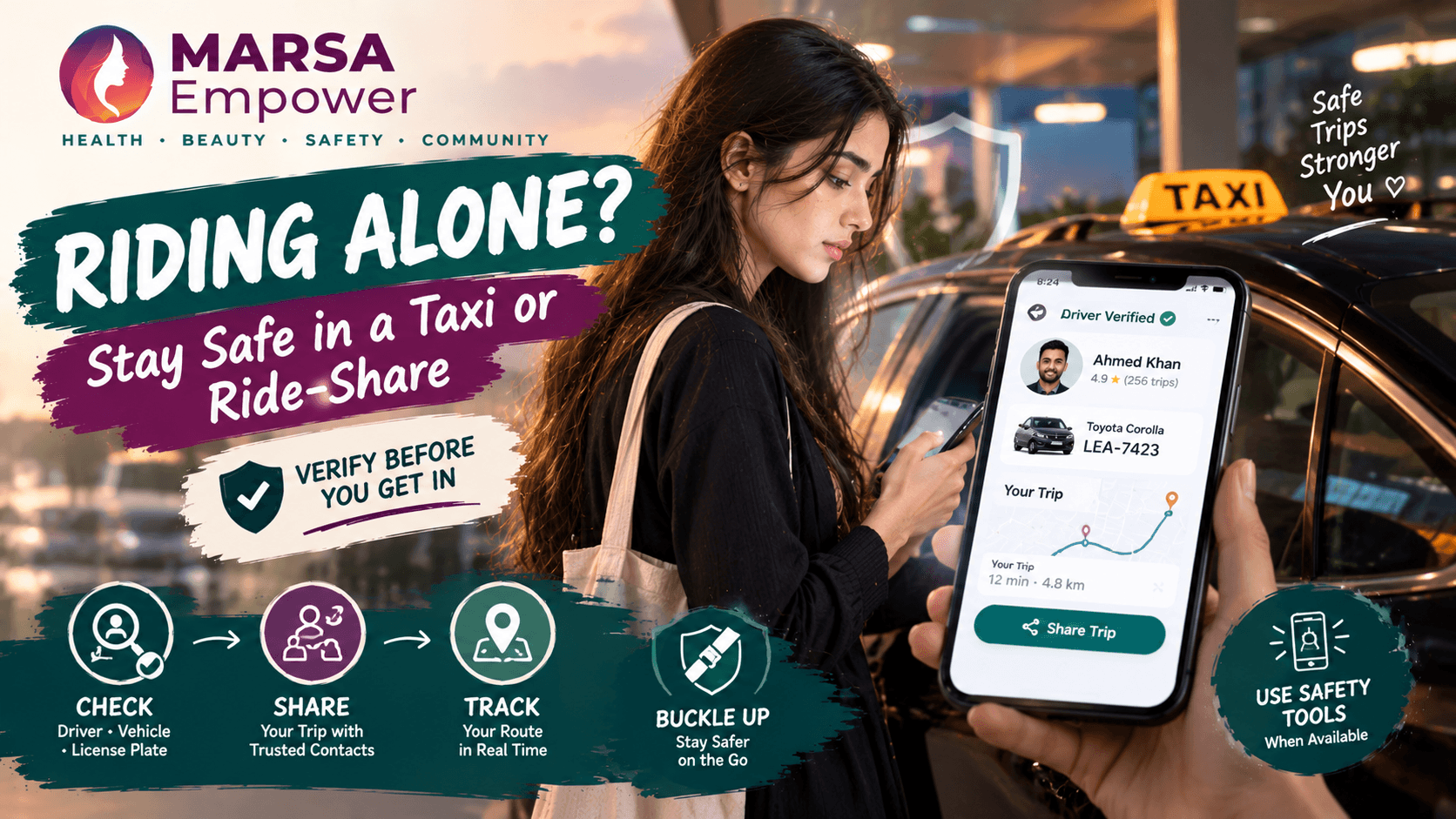
Match the vehicle and driver with the app before opening the door. Check the driver's name shown in the app against what the driver tells you. Check the vehicle make, model, and colour. Check the license plate number — compare it directly to the plate on the physical car in front of you.
Do not get in if the details do not match. If the driver's name, vehicle, or plate does not match what the app shows, do not get into the car. Step back, cancel the ride, and move to a safe, public, well-lit area before rebooking.
Ask "Who are you here to pick up?" rather than asking "Are you here for [your name]?" This ensures the driver confirms your name from their end without you providing it first. A legitimate, registered driver will know the name associated with the booking.
If something feels wrong, trust that feeling. You are not obligated to get into any vehicle. Cancelling a ride is always acceptable. Move to a busier, more visible location and rebook from there.
If someone else arranged the ride for you — a friend, a family member, a service — still check the vehicle and driver details independently before entering. The booking being arranged by someone you trust does not remove the need to verify the specific vehicle.
Once you are in the vehicle, staying aware is more important than any single action you can take.
Sit where you feel safest. For most women travelling alone, the back seat provides more physical distance from the driver and makes it easier to exit quickly if necessary.
Keep your phone accessible. Do not put your phone in a bag that requires you to search for it. Keep it in your hand or a pocket where you can reach it immediately.
Follow the route shown in the app. Open your navigation — Google Maps, Apple Maps, or the in-app route tracker — at the beginning of the journey and keep an eye on whether the driver is following it. Knowing the expected route means you will notice a deviation quickly.
Avoid unnecessary personal conversations. If the driver asks about your home address, your workplace, your daily schedule, your family situation, or any personal information that is not relevant to the journey, you are not obligated to answer. A polite "just heading to the destination" is sufficient. You do not owe a driver personal information in exchange for a ride you are paying for.
Keep your belongings with you. Do not put your bag in the boot unless it is unavoidable. Having your belongings with you means you can exit quickly without needing to retrieve anything.
One of the most effective and simple safety measures available is sharing your trip details with someone you trust.
Most major ride-sharing platforms — including Uber and Careem — have a built-in trip-sharing feature. This allows you to send a link to a contact who can then see your real-time location, the driver's name and photo, the vehicle details, and your estimated arrival time. Use this feature whenever you travel alone.
If the app does not have this feature, or if you prefer a more direct approach, send the driver's name, vehicle details, and your destination to a trusted contact before the journey begins. A simple message — "Going to [destination] in a [car colour] [car make], driver name [X], plate [X], should arrive by [time]" — takes ten seconds to send and ensures someone knows where you are.
Let that person know when you arrive safely. This is a small habit that requires minimal effort and provides a meaningful layer of protection.
Noticing a route deviation can feel alarming, but not every change in route is cause for panic. There can be legitimate reasons — traffic, a road closure, a construction diversion.
Stay calm and check your navigation. Compare the current route to what the app was showing at the start of the journey. If the deviation is visible and seems unexplained, ask calmly: "The route looks different from my app — is there a diversion?" A professional driver will explain without difficulty.
If the explanation does not satisfy you, ask to stop. You are entitled to ask to be dropped at the next busy, public location — a petrol station, a supermarket, a main road junction — rather than continuing.
Contact someone you trust and share your current location while this is happening.
Use the app's safety features. Both Uber and Careem have in-app emergency and safety options. Familiarise yourself with where these are before you ever need them.
Trust your instincts. If something feels wrong, it does not have to be something you can specifically identify. Discomfort is information.
Do not argue with or physically confront the driver. A verbal confrontation or physical escalation in a moving vehicle is dangerous.
Contact someone you trust and tell them what is happening and where you are. If you can share your live location, do so.
Ask the driver to stop at the next busy, well-lit, public location. Request this calmly and clearly: "Please stop at [petrol station / main road / shopping area] — I need to get out here."
If you believe you are in immediate danger, contact local emergency services. In Pakistan, the emergency number is 15 (Police), 115 (Rescue), or 1122 (Emergency). In India, 112 is the national emergency number. In the UK, 999. In the US and Canada, 911. In Australia, 000.
If you have asked to stop and the driver continues driving:
Stay as calm as you can. Panic and escalation rarely improve the situation in a confined moving space.
Contact emergency services immediately and tell them the vehicle details, your current location (use your navigation app), and what is happening.
Share your live location with a trusted contact.
Use the platform's in-app emergency feature. Both Uber and Careem have emergency assistance buttons within the app that connect to local services and simultaneously alert the platform.
Avoid escalating the situation physically. Your priority is to communicate your location to people who can help.
If the vehicle stops at any point, exit and move toward other people as quickly as possible.
When you reach your destination, do not rush out and immediately move on without a few brief checks.
Get out in a safe, populated, well-lit location. If the driver has stopped somewhere that feels isolated or unfamiliar rather than your stated destination, ask to be taken to the correct destination or to a busy nearby location.
Check that you have your phone, wallet, keys, and any other important belongings before closing the door.
Do not confirm your home address or give additional directions to your exact home to the driver once the journey is over.
If you feel that you are being watched or followed after exiting the vehicle, do not walk directly to your home. Move toward a busy public location — a shop, a restaurant, a populated street — and contact someone you trust.
Send the confirmation message to the person you shared your trip details with: "I've arrived safely."
Stay in a public place. Do not go home.
Enter a shop, a restaurant, a petrol station, or any other populated space where other people are present and staff can see you.
Contact someone you trust and tell them what is happening and where you are.
Contact local authorities if you believe you are being followed. This is a legitimate reason to call police — you do not need to wait until something has happened.
Stay around other people until you are certain it is safe to move.
Getting into a vehicle without checking its details. This is the most common and most preventable mistake. It takes fifteen seconds to verify the plate, name, and vehicle. Do it every time.
Ignoring a mismatch between the app and the vehicle. If the details do not match, do not get in. There is no reasonable explanation for a driver with the wrong name or the wrong plate.
Sharing too much personal information. Your route is the only information the driver needs. Where you live, work, study, or regularly travel is not part of the transaction.
Falling asleep when you are unfamiliar with the route. If you do not know the area and are travelling alone, stay alert enough to monitor the route. Sleep on routes you know well with someone you trust.
Wearing headphones that prevent awareness. Music and podcasts are fine on familiar routes with known drivers. On unfamiliar journeys or late at night alone, keep one ear accessible so you can hear what is happening.
Going directly home if you believe someone is following you. Your home address is private information. Do not confirm it by leading a follower to it.
Three things worth remembering every time you travel alone.
You do not need to ignore your discomfort in order to be polite. Politeness is a social courtesy. Your safety is a right. If something feels wrong, you are not being rude by acting on that feeling.
Leaving a ride or cancelling a trip is always acceptable. You are a paying customer who is entitled to cancel at any point. No driver, app, or social expectation requires you to stay in a situation that feels unsafe.
Asking for help is a safety decision, not an overreaction. Calling a friend, using an in-app emergency button, or contacting authorities is a practical response to a potential safety concern. It is not dramatic. It is sensible.
Most journeys are uneventful. Most drivers are professional. Most trips from A to B end exactly as expected.
But a few simple habits — checking the vehicle before entering, sharing your trip, monitoring the route, keeping your phone accessible — require almost no extra time and significantly improve your safety and your confidence when travelling alone.
You deserve to feel safe wherever you are going. Safety is not paranoia. It is preparation.
Uber Safety Features https://www.uber.com/us/en/ride/safety/
Careem Safety Features https://www.careem.com/en-ae/blog/safety/
Pakistan Emergency Numbers Police: 15 | Rescue: 115 | Emergency: 1122 | Women's Helpline: 1099
India Emergency Numbers National Emergency: 112 | Women's Helpline: 1091 | Police: 100
UK Emergency Emergency Services: 999 | Non-emergency police: 101
USA and Canada Emergency Services: 911
Australia Emergency Services: 000
Pakistan — NCCIA (for threats or digital harassment) https://www.nccia.gov.pk | Helpline: 1799
Disclaimer
This article is for educational and safety-awareness purposes only. Emergency procedures and contact numbers should be verified locally before relying on them. If you are in immediate danger, contact your local emergency services.
Marsa Empower | Care. Safety. Growth. Visit marsaempower.com for women's health, personal safety, and digital awareness resources.
Medical Disclaimer
This article is for general informational and educational purposes only and is not a substitute for professional medical advice, diagnosis, or treatment. Always seek the advice of a qualified healthcare provider with any questions you may have regarding a medical condition. Never disregard professional medical advice or delay seeking it because of something you have read on MARSA Empower.
Written By
Maryam Mumtaz
Co-Founder & CEO
Co-Founder of MARSA Empower who leads the visual and strategic evolution of the platform. Maryam bridges technical complexity with human-centric design, architecting the team's official roadmap and ensuring MARSA effectively addresses the real-world needs of women. With deep expertise in agentic AI, full-stack development, and UI/UX design, she has delivered 50+ projects for 30+ satisfied clients.
Enjoyed this story?