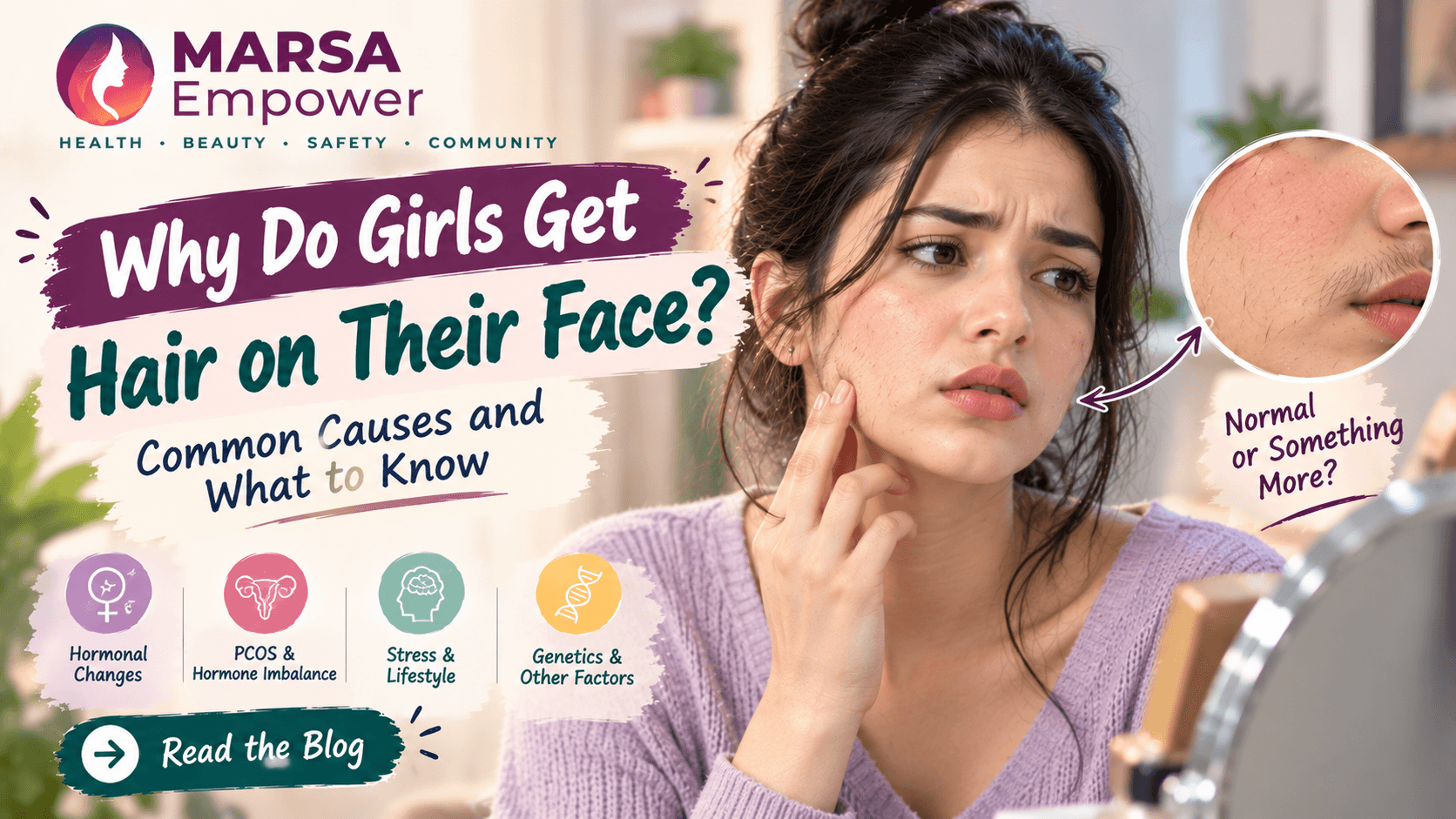
Facial hair in women can be surprising and concerning. Learn about the causes, expert insights, and practical solutions for managing this common issue.
Maryam Mumtaz
Co-Founder & CEO
12 min read•10/5/2026
Marsa Empower · Teen Girls' Health & Wellness · For Girls & Women Aged 13 and Above · 12 min read
Noticing hair on your face — on the upper lip, chin, cheeks, or sideburn area — can feel alarming or embarrassing, particularly when the messages around you suggest that women should not have facial hair.
The truth is that facial hair is a natural feature of the female body. Every girl and woman has hair on her face. The difference between individuals is in how visible, dark, or coarse that hair is — differences that are determined primarily by genetics, skin tone and hair colour contrast, and hormone levels. These differences are normal variations, not problems.
For most girls and women, facial hair is a minor cosmetic consideration — managed through personal preference with whatever method of removal or non-removal they choose. For a smaller number, significant coarse facial hair — particularly when it appears alongside other hormonal symptoms — may indicate a medical condition worth investigating.
This guide provides the honest information teenage girls and women need to understand facial hair: what is normal, what the causes are, when medical attention is appropriate, and how to make informed choices about removal if that is what you prefer.
Yes — completely. Every human body, regardless of sex, is covered in hair follicles. Most of the body's hair follicles produce very fine, light hair called vellus hair that is barely visible. Some follicles produce darker, coarser hair called terminal hair in response to hormonal signals.
On the face, most women have some combination of fine vellus hair and varying amounts of terminal hair. The visibility, colour, and coarseness of this hair varies significantly between individuals — determined primarily by genetics and the hair and skin colour of the individual. A woman with dark hair and light skin will have much more noticeable facial hair than a woman with the same amount of hair but a lighter hair colour or darker skin tone that reduces the visual contrast.
Women are not meant to be hairless on their faces. The normalisation of complete female facial hairlessness is a cultural construct that does not reflect natural biology.
The most common reason teenage girls notice new or increased facial hair is the hormonal changes of puberty. The adrenal glands begin producing androgens — a group of hormones that includes testosterone — in increasing amounts as puberty progresses, in a process called adrenarche.
Androgens signal certain hair follicles to produce visible, darker, coarser hair — a process that affects the underarms, pubic area, legs, arms, and face to varying degrees depending on the individual's genetic androgen sensitivity. Fine vellus hair on the upper lip, chin, and sideburn areas can gradually darken and become more noticeable during puberty as androgen levels rise.
Genetics are the single most significant factor in determining how much facial hair a woman has. If your mother, older sisters, aunts, or grandmothers have visible facial hair, you are likely to as well. This is particularly true in South Asian, Middle Eastern, Mediterranean, and Latin American families, where facial hair in women is significantly more common than in Northern European families — reflecting ancestral genetic differences in androgen receptor sensitivity and hair follicle characteristics.
Even among girls of similar ancestry and family background, individual variation in androgen levels and androgen receptor sensitivity produces significant differences in facial hair. Two girls of the same age and similar background can have very different amounts of facial hair and both be entirely normal.
Any change in hormonal balance — from puberty, the menstrual cycle, pregnancy, or health conditions — can affect facial hair growth. Some women notice their facial hair becomes slightly more noticeable at specific cycle phases, which reflects the cyclical variation in androgen levels throughout the month.
Some medications can increase hair growth as a side effect. These include corticosteroids (prednisolone), some anticonvulsant medications (phenytoin), minoxidil when used for scalp hair loss, and some hormonal treatments. If facial hair increased after starting a new medication, this connection is worth discussing with the prescribing doctor.
A smaller proportion of girls and women with significant coarse facial hair have an underlying hormonal condition — most commonly PCOS — that is driving elevated androgen levels. This is discussed in the health conditions section below.
Androgens stimulate hair follicles to produce terminal hair rather than the fine vellus hair that was previously present. This transition from vellus to terminal hair produces hair that is darker, coarser, and more visible in the follicle's area. Once a follicle has made this transition, the hair it produces tends to remain terminal unless the androgen stimulus is reduced.
During puberty and the teenage years, it is entirely normal to notice new facial hair that was not previously present, or fine hair that was previously invisible darkening and becoming more noticeable.
The pattern of new facial hair during puberty typically involves the upper lip area first — fine, dark hair that becomes more noticeable than the near-invisible vellus hair of childhood. The sideburn area, chin, and lower cheeks may follow. This is androgen-driven and reflects the body's normal hormonal development.
The amount and pattern of this puberty-related facial hair varies enormously between girls — from barely noticeable to quite prominent — and all of this variation is normal. Comparing the amount of facial hair you have to friends or classmates may create worry that is not justified — every girl's hair development is her own.
When a doctor's attention may be helpful: if facial hair is appearing before age 8 (possible early puberty), if it is very coarse and dark and spreading rapidly to new areas, or if it is accompanied by other changes like irregular periods, severe acne, or scalp hair thinning, a healthcare provider can assess whether everything is within the normal developmental range.
In the late teens and early twenties, facial hair typically reflects established adult hormone levels. Women with higher androgen levels or greater androgen receptor sensitivity — often genetically determined — will have more visible facial hair.
New or increasing facial hair in this age group alongside irregular periods, significant jawline acne, or other hormonal features may indicate PCOS developing or becoming more prominent.
Hormonal changes of the thirties — particularly changes related to pregnancies, postpartum hormone shifts, and the beginning of subtle perimenopausal changes in some women — can affect facial hair. Some women notice subtle changes in facial hair distribution in this decade.
During perimenopause and menopause, oestrogen levels fall while androgen levels decline less steeply. This relative androgen predominance — even though total hormone levels are falling — can produce new or increased coarse facial hair, particularly on the chin and upper lip. This is a normal hormonal feature of this transition for many women.
The upper lip is the most common area where women and girls notice increased facial hair. Fine vellus hair that was barely visible in childhood may darken and become more prominent during puberty and into adulthood. This is one of the most normal variations in female facial hair.
The chin is another common location, particularly in women with higher androgen activity. A few hairs on the chin are a normal variation for many women. A significant concentration of coarse, dark chin hair — particularly if increasing over time — may warrant a hormonal assessment.
Some women have fine to moderate hair on the cheeks, particularly toward the sideburn area. This is a normal variation, particularly in women of South Asian, Middle Eastern, and Mediterranean backgrounds. Coarse hair extending noticeably across both cheeks can be a feature of higher-androgen states.
The jawline is a common location for androgen-sensitive hair growth. Women with elevated androgens — particularly from PCOS — may notice coarse hair along the jawline and lower face alongside jawline acne.
The sideburn area and the sides of the face are normal locations for visible facial hair in many women. This reflects the androgen sensitivity of the hair follicles in this region.
Fine hair between the eyebrows and extending beyond their natural margins is a normal variation. The amount of hair between the brows varies between individuals based on genetic follicle density in this area.
The visibility of facial hair is determined as much by hair colour relative to skin tone as by the amount of hair present. A woman with black hair and light skin will have dramatically more noticeable facial hair than a woman with the same amount of hair but either lighter-coloured hair or a skin tone closer in colour to the hair.
When androgens stimulate a previously fine vellus follicle to produce terminal hair, the new hair is darker, coarser, and more visible than its predecessor. This is the mechanism through which puberty and other hormonal changes produce new visible facial hair.
The thickness and darkness of facial hair is largely genetically determined. Women from families where visible facial hair is common tend to have more of it — not as an abnormality but as a normal genetic trait.
Above-average androgen levels — whether from PCOS, adrenal conditions, or individual variation at the upper end of the normal range — stimulate more widespread and more vigorous terminal hair growth on the face.
Hair follicle size and androgen receptor density vary between individuals and between different areas of the face. This is why one woman might have only noticeable upper-lip hair while another with similar overall androgen levels has more diffuse facial hair — the distribution of androgen-sensitive follicles differs between individuals.
Yes — this is the fundamental mechanism through which most facial hair develops.
Androgen hormones — including testosterone, DHEA, and their metabolites — bind to androgen receptors in hair follicles. When an androgen-sensitive follicle receives this signal, it transitions from producing fine vellus hair to producing coarser terminal hair. The higher the androgen level and the greater the follicle's androgen receptor sensitivity, the more pronounced this transition.
All women produce androgens — the question is how much and how sensitive the follicles are to them.
During puberty, adrenal androgen production increases significantly (adrenarche), producing the androgen-driven hair changes of this period. This is normal and expected.
PCOS (Polycystic Ovary Syndrome) is the most common hormonal cause of increased facial hair in women of reproductive age. PCOS involves elevated androgen levels — particularly free testosterone — that stimulate more vigorous and more widespread terminal hair growth on the face.
Women with PCOS typically have facial hair alongside other androgen-related features: irregular or infrequent periods, persistent jawline acne, scalp hair thinning, and sometimes weight gain around the abdomen. Not every woman with PCOS has all of these features, and the severity varies significantly.
Adrenal conditions including congenital adrenal hyperplasia and Cushing's syndrome can cause elevated androgen production and significant hirsutism. Thyroid dysfunction can alter the hormonal environment in ways that affect hair growth. Elevated prolactin from a pituitary adenoma can produce facial hair alongside menstrual irregularity and sometimes milky breast discharge.
Medical evaluation of facial hair is warranted when it is coarse and increasing rapidly, when it is accompanied by other hormonal symptoms, when it appeared significantly before expected puberty timing, or when it is causing significant distress and the woman wants investigation of an underlying cause.
As described above — the most common hormonal cause of hirsutism (medically significant increased facial and body hair) in women. Diagnosed through a combination of clinical features, blood tests (testosterone, SHBG, LH, FSH, insulin), and pelvic ultrasound. Managed through a combination of dietary changes, exercise, medications to reduce androgen activity, and in some cases hormonal treatment.
Both hypothyroidism and hyperthyroidism can affect hair growth patterns. Hypothyroidism more commonly causes hair thinning including on the face, while some thyroid conditions produce hormonal effects that alter facial hair.
Adrenal conditions (particularly congenital adrenal hyperplasia — which can cause early puberty signs including facial hair before age 8), Cushing's syndrome (causing elevated cortisol that increases androgen activity), and pituitary conditions affecting prolactin or growth hormone can all cause more facial hair.
The clinical picture that most reliably indicates a medical cause — rather than normal individual variation — is significant coarse facial hair alongside two or more of the following: irregular or infrequent periods, severe or persistent jawline acne, scalp hair thinning, unexplained significant weight gain around the abdomen, and signs of insulin resistance (darkened skin in skin folds). This combination — particularly in a teenager or young adult — warrants hormonal assessment.
Hair suddenly becomes much thicker or darker — a significant change in a short period, particularly in a woman who previously had little facial hair.
Hair growth increases quickly — rapidly spreading to new areas of the face or becoming noticeably more coarse and dense within months.
New hair growth along with severe acne — particularly cystic acne along the jawline combined with new or increasing facial hair.
Irregular periods — cycles that are significantly longer than 35 days, unpredictable, or absent for months alongside facial hair changes.
Sudden weight changes — particularly abdominal weight gain that was not associated with any dietary change.
Hair thinning on the head — scalp hair thinning at the crown or parting alongside increased facial hair, suggesting androgen-related follicle changes in both areas simultaneously.
Other unusual body changes — very early puberty features in a girl under 8, or features suggesting Cushing's syndrome (facial puffiness, weight gain in specific areas, stretch marks, muscle weakness).
Hair removal from the face is a completely personal choice — there is no medical requirement to remove normal facial hair. If you choose to remove it, the following methods are available with varying degrees of permanence, skin impact, and cost.
The most accessible and least irritating method for many women. Shaving cuts hair at the surface without affecting the follicle — it does not change how the hair grows back or make it coarser or darker (see the myth-busting section below). A clean, sharp razor designed for facial use, used with a small amount of soap, cream, or gel as a lubricant, provides effective and affordable hair removal with results lasting one to three days. Dry shaving without lubrication increases irritation risk.
A traditional method using a twisted cotton thread to remove multiple hairs from the root simultaneously. Threading is effective for precise shaping (eyebrows, upper lip) and removes hair at the root, providing several weeks of smooth skin. It causes brief, moderate discomfort and may cause temporary redness. It produces the repeated micro-inflammation described elsewhere in this guide as a contributor to dark marks around the mouth when performed very frequently.
Removes hair from the root like threading, with results lasting three to six weeks. Home waxing kits are available; professional waxing is safer for sensitive or acne-prone facial skin. Hot wax should not be used on skin that is already irritated, sunburned, or has active acne.
Effective for removing individual hairs and small areas, but impractical for larger surface areas. Suitable for eyebrow shaping and individual stray hairs.
Chemical creams that dissolve the hair shaft at the skin surface. Results last slightly longer than shaving. Risk of skin irritation is significant, particularly on facial skin — always patch-test on the jaw or neck before applying to sensitive facial areas. Not suitable for use near the eyes.
Laser hair removal and IPL (intense pulsed light) provide significant long-term reduction in hair growth by damaging follicles with targeted light energy. Multiple sessions are required. Most effective on dark hair against lighter skin backgrounds. In women with elevated androgens (PCOS), results may be less permanent because ongoing hormonal stimulation can reactivate follicles. Electrolysis provides permanent hair removal follicle by follicle using an electrical current and is the only FDA-classified permanent method.
Women with sensitive skin or acne-prone skin should choose gentler methods (shaving or careful threading) and be particularly attentive to skin care after removal to minimise irritation and post-inflammatory pigmentation.
No. This is one of the most persistent and most incorrect beauty myths.
Shaving cuts the hair shaft at the skin surface — it has no effect whatsoever on the follicle beneath the skin that produces the hair. The follicle continues producing the same hair, in the same way, at the same growth rate. Shaving does not stimulate follicle activity, does not change hair colour, and does not alter hair diameter.
When hair is at its natural length, the tip has been tapered gradually through natural wear and environmental exposure. When shaving cuts the hair bluntly at the skin surface, the new growth emerges with a blunt cross-section rather than a tapered tip. This blunt end feels stubbly, catches the light differently, and appears more visible — creating the impression of thicker hair that is entirely an optical and tactile illusion, not a real change in hair diameter or density.
Dirty razors carry bacteria. Replace razor blades regularly and do not share razors. Threading with fresh thread from clean hands reduces bacterial contamination.
Minimal passes with the razor, gentle threading tension, and appropriate wax temperature reduce the irritation that contributes to post-inflammatory pigmentation.
Do not shave, wax, or thread skin that has active acne, sunburn, cuts, rashes, or recent irritation. Wait until the skin has fully recovered.
Applying a gentle, fragrance-free moisturiser after hair removal supports barrier repair and reduces the dryness and sensitivity that follow follicle trauma.
Freshly hair-removed skin is more UV-sensitive than usual. Applying sunscreen after any method of facial hair removal — particularly waxing or threading — prevents the post-inflammatory pigmentation that UV exposure on recently traumatised skin can trigger.
Do not apply fragranced products, retinoids, strong acids, or other active ingredients to recently hair-removed skin for 24 hours.
Yes — and understanding why helps prevent these common side effects.
Any hair removal method causes minor trauma to the follicle and surrounding skin. This triggers a localised inflammatory response that may produce redness, sensitivity, and in susceptible skin, small inflammatory spots.
Folliculitis — inflammation within the hair follicle from bacterial contamination or irritation — can occur after waxing, shaving, or threading if bacteria enter the opened follicle. Keeping tools clean and the skin clean after removal reduces this risk significantly.
When a cut or removed hair grows back and curls inward or becomes trapped beneath the skin surface rather than emerging normally, it produces the painful, sometimes infected ingrown hair. Ingrowns are more common in coarser, curlier hair and in areas where tight clothing creates friction. Regular gentle exfoliation (not harsh scrubbing) reduces ingrown hair risk by preventing dead skin cell buildup that traps emerging hairs.
Post-inflammatory hyperpigmentation from repeated hair removal — particularly around the upper lip from repeated threading and waxing — is extremely common in South Asian women and one of the most consistent causes of darkening around the mouth. The repeated micro-inflammation of frequent hair removal stimulates melanin production in the follicles, producing persistent brown marks in these areas.
Reducing the frequency of hair removal, choosing gentler methods, applying sunscreen consistently to the area (including after removal), and using niacinamide in the routine gradually addresses this pigmentation.
Patch test new removal products. Keep removal tools clean. Moisturise and apply sunscreen after removal. Avoid removal from already-irritated skin. Reduce removal frequency where possible. Apply gentle fragrance-free products after removal.
Many home remedies are widely shared for facial hair removal — particularly in South Asian beauty culture — and the vast majority either do not work as claimed or actively damage skin.
No home remedy removes hair permanently or significantly reduces hair growth. Egg white masks, sugar scrubs, and similar applications may remove fine surface vellus hair temporarily (similar to an adhesive strip) but have no effect on terminal hair follicles.
Many recommended home remedies for facial hair contain ingredients that are harmful to facial skin when applied directly.
Lemon juice — often recommended as a "natural bleach" or "hair remover" — is highly acidic (pH 2), which is dramatically below the skin's optimal pH of 4.5 to 5.5. Applying lemon juice to the face — particularly on recently hair-removed skin with open follicles — causes chemical burns, severe irritation, and post-inflammatory hyperpigmentation that is darker and more persistent than any hair-related concern it was meant to address.
Similarly, raw garlic, onion juice, and other strongly acidic or enzymatic ingredients applied to facial skin cause irritation and pigmentation rather than reducing hair.
After hair removal, the most appropriate skin care is gentle cleansing, fragrance-free moisturiser, and sunscreen. Nothing else is necessary or beneficial in the immediate post-removal period.
Adequate nutrition supports overall hormonal health. A low-glycaemic diet — reducing high-sugar and refined carbohydrate foods — supports insulin sensitivity, which is particularly relevant for women with PCOS whose elevated insulin drives androgen production. This dietary change, sustained consistently, can modestly reduce androgen levels and their stimulation of hair growth in women with PCOS and insulin resistance.
Regular physical activity improves insulin sensitivity. Maintaining a healthy weight reduces the adipose-tissue-related androgen production that worsens hormonal imbalance. Stress management reduces cortisol, which can stimulate adrenal androgen production. These lifestyle factors are genuinely relevant to the hormonal drivers of facial hair in women with PCOS or elevated androgens.
Dietary and lifestyle changes address hormonal drivers of facial hair production — they do not remove existing hair from follicles that have already transitioned to terminal hair growth. They can, over months, modestly reduce the stimulus for new hair development and slow the progression of hirsutism in hormonally driven cases.
For women with PCOS or other hormonal causes of significant hirsutism, medical management — through anti-androgen medications (spironolactone, cyproterone acetate), hormonal contraceptives with anti-androgenic effects, or other treatments — provides more meaningful reduction in androgen-driven hair growth than lifestyle measures alone. This requires medical assessment and prescription.
Seek medical evaluation for facial hair when any of the following apply.
Significant coarse, dark hair appears rapidly — within months — on previously smooth areas of the face. Facial hair is extensive and causing significant distress alongside other hormonal symptoms. New facial hair appears before age 8 — which may indicate early puberty or another hormonal condition. Facial hair is accompanied by irregular or absent periods, severe or persistent acne, scalp hair thinning, or unexplained abdominal weight gain. You want to understand whether your facial hair has a hormonal cause that could be treated medically. You have been told your cycles are irregular and wonder if PCOS may be affecting your facial hair.
When and how facial hair developed, its pattern and rate of progression, menstrual cycle regularity, other hormonal symptoms, family history, and current medications.
Assessment of the pattern and extent of facial and body hair using a standardised scoring system (Ferriman-Gallwey score) that provides an objective measure of androgen-driven hair distribution.
Total and free testosterone, SHBG (sex hormone binding globulin), LH and FSH ratio, DHEAS (adrenal androgen), prolactin, and fasting insulin are the most relevant hormonal investigations for a woman with significant facial hair. Thyroid function (TSH and free T4) is also appropriate.
Pelvic ultrasound if PCOS is suspected. Cortisol assessment if Cushing's syndrome is a possibility. Further adrenal or pituitary investigation if the clinical picture suggests these conditions.
The most important perspective this guide offers is this: having hair on your face is a normal feature of the female body. The cultural messaging that women should be completely hair-free from the neck up does not reflect natural biology — it reflects beauty standards that are culturally constructed and constantly changing.
Variation in how much facial hair a woman has is driven by genetics, skin tone, androgen levels, and androgen receptor sensitivity — all of which vary significantly between individuals in ways that have nothing to do with health, hygiene, or femininity.
Whether to remove facial hair and which method to use is entirely a personal decision. Women who remove facial hair because they personally prefer how they look are making a valid personal choice. Women who leave it are making an equally valid personal choice. Neither is medically right or wrong.
The distress that many girls and women feel about facial hair is real — but it is produced by social messaging rather than by the hair itself. If facial hair is causing significant distress affecting daily life or self-image, speaking with a supportive trusted adult, healthcare provider, or mental health professional provides a more constructive path forward than attempting to eliminate the hair with harsh remedies.
Marsa's health education resources explain puberty, hormonal changes, and the normal range of body hair development in accessible, reassuring language specifically designed for teenage girls — providing the honest information that reduces anxiety about normal body changes.
Marsa's Beauty and Glow resources provide guidance on safe, gentle facial hair removal methods suitable for South Asian skin, how to manage post-removal skin care to prevent dark marks and irritation, and the evidence-based skincare ingredients that can help reduce the pigmentation that sometimes follows hair removal.
Marsa's Health Hub allows teenage girls and women to track their menstrual cycle, skin changes, and other health observations over time. For a girl or woman who notices facial hair increasing alongside irregular periods, this documented pattern — across several months — provides the specific evidence that makes a hormonal assessment most productive.
Marsa's educational content explains PCOS, adrenal androgen production, and the hormonal mechanisms that drive increased facial hair in women with specific conditions — helping women recognise whether their pattern of symptoms warrants investigation and what that investigation typically involves.
Marsa's Digital Doctors and educational content help girls and women distinguish the normal variation of facial hair from the patterns that warrant medical evaluation — providing the health literacy to respond appropriately rather than with unnecessary alarm or inappropriate delay.
Important note. Marsa Empower is a health education and wellness companion. Medically significant facial hair — particularly alongside other hormonal symptoms — requires evaluation by a qualified healthcare professional. Marsa supports understanding and preparation for that process.
Is it normal for girls to have hair on their face?
Yes, completely. Every girl and woman has hair on her face — the difference between individuals is in how visible, dark, and coarse that hair is. Fine, barely visible facial hair is universal. More visible facial hair is a normal variation driven by genetics and hormone levels.
Why do girls get hair on their upper lip?
The upper lip is one of the most androgen-sensitive areas of the female face. During puberty, increasing androgen production stimulates the fine vellus hair in this area to darken and become more noticeable in many girls. This is a normal puberty change for many girls and women.
Why do I have hair on my chin?
A small number of hairs on the chin is a common and normal variation for many women. More significant or rapidly increasing coarse chin hair — particularly alongside irregular periods or acne — may warrant hormonal assessment.
Why is my face hair getting darker?
Androgens stimulate hair follicles to transition from fine vellus hair to darker, coarser terminal hair. This transition typically occurs during puberty or with rising androgen levels. Darker face hair is usually a normal part of development or a natural individual characteristic.
Does shaving make face hair thicker?
No. This is a myth. Shaving cuts hair at the surface without affecting the follicle. The blunt tip of regrowing shaved hair feels stubbly and looks more noticeable — but the hair is not thicker, darker, or denser than before shaving.
Can puberty cause more hair on the face?
Yes. The androgens produced during puberty stimulate hair follicles on the face (and elsewhere) to produce more visible hair. This is a normal developmental change.
Can PCOS cause more hair on the face?
Yes. PCOS is the most common medical cause of significant hirsutism (increased facial and body hair) in women. It is associated with elevated androgens that drive more widespread and coarser terminal hair growth on the face and body.
Can stress cause more hair on the face?
Stress elevates cortisol, which stimulates adrenal androgen production. Sustained high stress can modestly increase adrenal androgen levels and potentially contribute to increased hair growth in women already at the higher end of normal androgen levels, but stress is not a primary driver of significant new facial hair.
What is the safest way to remove hair from the face?
Shaving with a clean, sharp razor designed for facial use and appropriate lubrication is the least irritating method for most women. Threading provides longer-lasting results but may contribute to post-inflammatory pigmentation around the mouth with very frequent repetition. The safest method depends on individual skin type and sensitivity.
Can removing face hair cause pimples?
Yes — hair removal causes minor follicular trauma that can allow bacteria to enter and produce folliculitis or small inflammatory spots. Keeping tools clean, moisturising after removal, and avoiding hair removal on already-irritated skin reduces this risk.
Can face hair grow back thicker after shaving?
No — this is a myth. Shaving does not change hair thickness, colour, or growth rate. The blunt cut of regrowing hair simply looks and feels more noticeable than naturally tapered hair tips.
When should I see a doctor about extra face hair?
See a doctor when facial hair is increasing rapidly, is coarse and spreading to new areas, is accompanied by irregular periods, severe acne, scalp hair thinning, or weight gain — or when it appeared before age 8. Also seek evaluation if facial hair is causing significant distress and you want to understand whether a hormonal cause is present.
Facial hair is a normal part of the female body — and the amount, colour, and distribution that is "normal" varies enormously between individuals based on genetics, ancestry, and hormone levels.
For most girls and women, facial hair is simply a cosmetic consideration managed through personal preference. Understanding its normal causes — primarily genetics and the androgens of puberty — removes the unnecessary shame and alarm that cultural messaging creates around a natural biological feature.
For a smaller number of women, particularly those who notice significant, rapidly increasing coarse facial hair alongside other hormonal symptoms, facial hair is a clinical signal worth investigating — most commonly leading to a PCOS diagnosis and management that addresses both the hair and the underlying hormonal imbalance.
Whatever you choose to do with your facial hair — remove it, leave it, or something in between — is a valid personal choice. And understanding the safe, effective options for removal, alongside the realistic expectations for each, allows you to make that choice with accurate information rather than beauty industry myths.
Educational Disclaimer
This article is for educational and awareness purposes only. It does not constitute medical advice. If you have concerns about significant or rapidly changing facial hair, or facial hair alongside other hormonal symptoms, please consult a qualified healthcare professional for personalised evaluation and guidance.
Marsa Empower | Care. Safety. Growth.
Visit marsaempower.com to explore health education for teenage girls and women, access skin and beauty guidance, and track your health patterns at every stage of life.
Medical Disclaimer
This article is for general informational and educational purposes only and is not a substitute for professional medical advice, diagnosis, or treatment. Always seek the advice of a qualified healthcare provider with any questions you may have regarding a medical condition. Never disregard professional medical advice or delay seeking it because of something you have read on MARSA Empower.
Written By
Maryam Mumtaz
Co-Founder & CEO
Co-Founder of MARSA Empower who leads the visual and strategic evolution of the platform. Maryam bridges technical complexity with human-centric design, architecting the team's official roadmap and ensuring MARSA effectively addresses the real-world needs of women. With deep expertise in agentic AI, full-stack development, and UI/UX design, she has delivered 50+ projects for 30+ satisfied clients.
Enjoyed this story?