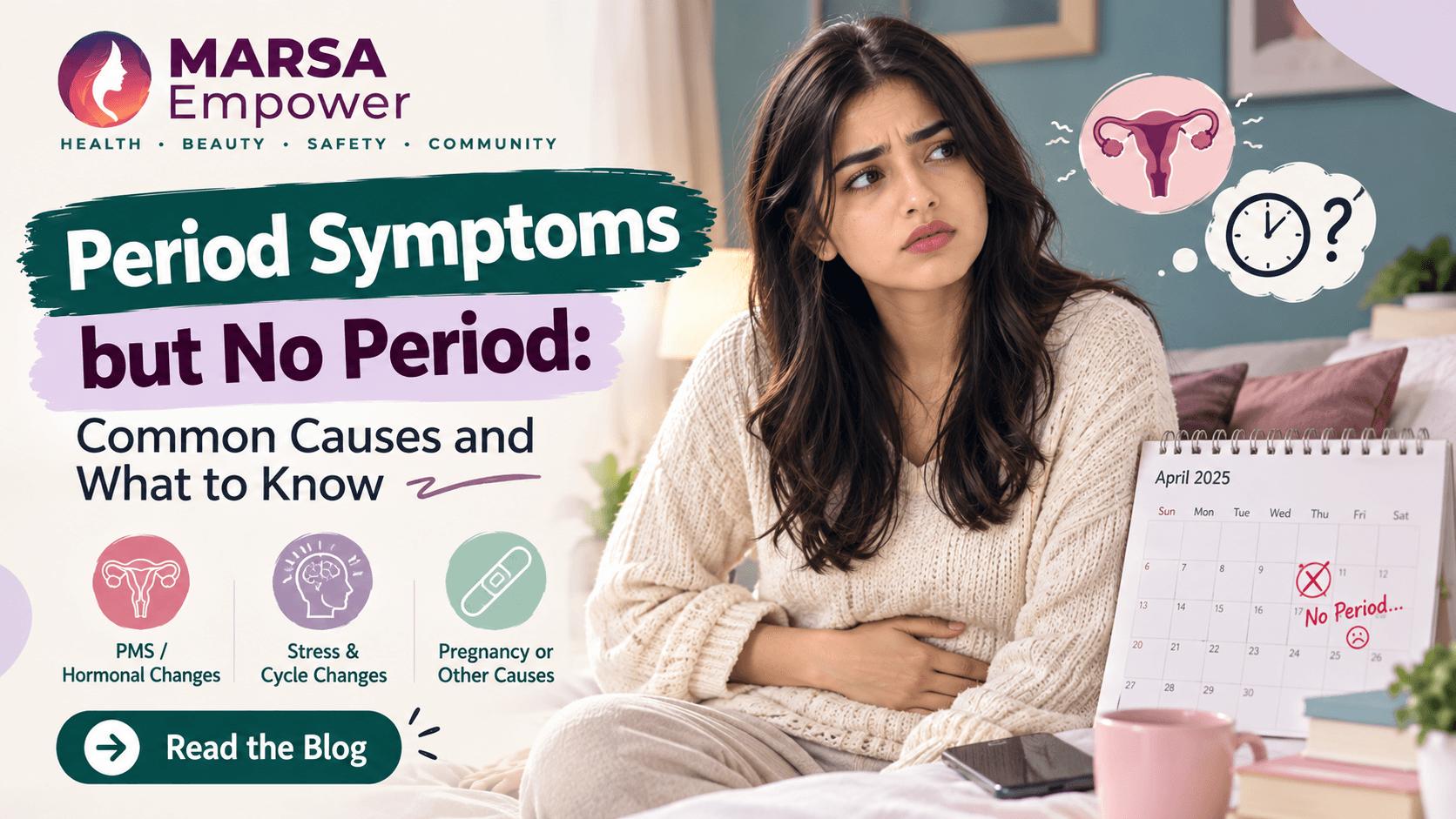
Experiencing period symptoms but no period? Discover common causes and expert insights to understand your body better.

Maryam Mumtaz
Co-Founder & CEO
13 min read•10/2/2026
Marsa Empower · Women's Menstrual Health · For Girls & Women Aged 13 and Above · 13 min read
Feeling like your period is about to arrive — cramping in the lower abdomen, breast tenderness, bloating, mood changes, back pain, acne — and then having it not come is one of the most common and most confusing menstrual health experiences women and girls report.
For many, it produces immediate anxiety: could something be wrong? Is the period just late, or is it not coming at all? Does this pattern indicate a health condition?
The answers depend significantly on context — your age, your usual cycle pattern, how long ago symptoms began, whether this is a one-off or a recurring pattern, and whether other symptoms accompany it. For most women and girls most of the time, period symptoms without a period reflect a delayed cycle from a common, manageable cause — stress, poor sleep, illness, nutritional changes, or simply the natural variation in cycle length. For a smaller number, the pattern reflects an underlying hormonal or medical condition that benefits from appropriate investigation.
This guide provides the clear information needed to understand what is happening, manage the most common causes effectively, and recognise when professional evaluation is the right next step.
"Period symptoms but no period" describes the experience of developing the physical and emotional symptoms commonly associated with the premenstrual phase — cramping, bloating, breast tenderness, mood changes, headaches, back pain, and others — at a time when a period would be expected, followed by the period not arriving on its anticipated schedule.
This differs from simply having irregular periods — it is the specific experience of the body preparing for a period, the symptoms building, and then the period being delayed or absent.
The experience is extremely common and has a wide range of possible explanations, most of which are entirely benign.
Period symptoms fall into two categories: premenstrual symptoms (PMS) that typically occur in the week or two before the period begins, and menstrual symptoms that occur during bleeding.
Common premenstrual symptoms include lower abdominal cramping or a heavy feeling in the pelvis, lower back ache, breast tenderness or swelling, bloating and digestive changes, headaches, mood changes (irritability, tearfulness, low mood), food cravings, fatigue, difficulty sleeping, acne, and increased emotional sensitivity.
Common menstrual symptoms include lower abdominal cramping, lower back pain, headaches, nausea, and fatigue.
When a period is delayed, premenstrual symptoms may persist — and may even worsen — beyond the expected period start date because the hormonal phase that produces them (the progesterone-dominant luteal phase) continues until the period begins or, if no period comes, until the hormonal cycle resolves in another way.
The physical symptoms associated with the premenstrual phase are produced by the hormonal changes of the luteal phase — the second half of the menstrual cycle following ovulation. These changes include rising and then falling progesterone, prostaglandin production, and the various effects these have on the uterine lining, breast tissue, the digestive system, and mood-regulating brain chemistry.
These hormonal changes — and the symptoms they produce — can occur normally even when the period itself is delayed or does not arrive at its expected time. The body has gone through the hormonal preparation for menstruation, but the bleeding has not yet begun. When the delay is temporary, the symptoms resolve when the period eventually arrives. When the period is absent for a longer period, the hormonal pattern will resolve through a different mechanism.
This is why experiencing classic period symptoms without the bleeding is not necessarily a sign that something is wrong — it often simply means the period is on its way, or has been delayed by an identifiable cause.
The most common explanation is simply that the period is late. A period that arrives later than expected is still coming. The premenstrual symptoms that precede it may arrive on schedule (reflecting that ovulation and the luteal phase hormonal changes occurred normally) while the bleed itself is delayed by a few days to two weeks beyond the expected date.
Menstrual cycles vary in length — most women's cycles are not the textbook 28 days, and even within the same woman cycles vary from month to month. A cycle that is consistently 30 to 35 days long will produce premenstrual symptoms that arrive when a 28-day cycle would normally produce bleeding — making the period seem "late" when it is simply arriving on a longer schedule.
Any change in the hormonal environment — from life stage transitions, PCOS, thyroid dysfunction, changes in contraception, or other causes — can alter the timing and regularity of the cycle while the hormonal preparation for menstruation continues to produce premenstrual symptoms.
Psychological stress is one of the most consistent causes of delayed periods. The hypothalamic-pituitary-ovarian (HPO) axis — the communication system between the brain and the ovaries that governs the menstrual cycle — is directly sensitive to stress hormones. Elevated cortisol can delay or suppress the LH surge that triggers ovulation, pushing back the entire second half of the cycle and delaying the period. The premenstrual symptoms may still develop once ovulation eventually occurs, but the period arrives later than expected.
Poor sleep disrupts the hormonal regulation that governs the menstrual cycle — including the pulsatile release of GnRH from the hypothalamus that drives the cycle. Prolonged sleep disruption can delay ovulation and therefore the period, while premenstrual symptoms occur once a delayed ovulation eventually takes place.
Sudden significant changes in caloric intake — particularly dramatic restriction — affect the HPO axis's assessment of whether sufficient energy is available for reproductive function. The body reduces reproductive hormone production when energy availability is insufficient, delaying or suppressing ovulation.
Significant rapid weight loss — or very low body weight — reduces the body fat needed for oestrogen production and can suppress ovulation. Significant rapid weight gain can alter insulin and androgen levels in ways that affect cycle regularity.
Very high levels of physical training — particularly endurance sports, competitive athletics, and training that significantly exceeds caloric intake — can suppress reproductive hormones and delay or prevent ovulation. This is related to the low energy availability of Relative Energy Deficiency in Sport (RED-S).
Travel across time zones, significant disruption to sleep and daily schedules, and major life changes all affect the circadian rhythms that are tightly coupled to the hormonal cycle and can temporarily delay a period.
Acute illness — including fever, significant infections, and other physical stressors — activates stress responses that can temporarily delay ovulation and the period. Recovery from illness similarly disrupts hormonal rhythms temporarily.
Several medications can affect cycle timing — including certain antidepressants, antipsychotics, hormonal treatments, and corticosteroids. New or changed medications that coincide with a delayed period are worth noting and discussing with the prescribing healthcare provider.
For teenage girls in the first two to three years after their first period, irregular cycles are entirely expected. The hypothalamic-pituitary-ovarian axis takes several years to mature and establish the consistent hormonal communication that produces regular cycles. During this time, cycles may be significantly longer or shorter than average, may be skipped entirely, and the pattern of premenstrual symptoms without predictable subsequent bleeding is very common.
Stress from school, competitive exam periods, changes in sleep from academic demands, and nutritional patterns that are common in adolescence all contribute to cycle irregularity on top of the normal developmental irregularity of the early menstruating years.
By the mid-twenties, most women have established a fairly consistent cycle pattern. Premenstrual symptoms without the period arriving on schedule in this age group typically reflect the lifestyle causes described above — stress, sleep disruption, dietary changes, or changes in exercise — or in a smaller proportion of cases, an underlying condition like PCOS or thyroid dysfunction.
Cycle changes in the thirties can reflect the same lifestyle causes but may also reflect the beginning of subtle hormonal changes of this decade, or the development of conditions including PCOS, thyroid dysfunction, or endometriosis that may not have been prominent before.
Cramping without bleeding is driven by the same mechanism that produces menstrual cramps — the prostaglandins and uterine smooth muscle activity that occurs as the body prepares for the period. When the period is delayed, cramps may come and go intermittently in the days or weeks before bleeding eventually begins.
Lower back ache is one of the most common premenstrual symptoms and reflects the pelvic and lumbar tension driven by prostaglandins and the hormonal changes of the luteal phase.
Breast swelling and tenderness are caused by progesterone-driven fluid retention in breast tissue during the luteal phase. They are among the earliest and most consistent premenstrual symptoms and may persist until the period arrives.
Progesterone relaxes smooth muscle throughout the body, including in the digestive tract — slowing transit and producing bloating, fullness, and digestive discomfort in the premenstrual phase.
Hormonal headaches driven by falling oestrogen are common in the premenstrual period and may occur repeatedly in the days around when the period would be expected.
Progesterone has sedating effects, and the premenstrual phase is associated with fatigue and reduced energy alongside the sleep disruption common at this cycle phase.
Falling oestrogen in the premenstrual phase reduces serotonin, producing the irritability, tearfulness, and low mood characteristic of PMS. These mood changes can persist and feel heightened when the period is delayed and the luteal phase hormones remain elevated.
Strong premenstrual cravings — particularly for carbohydrate-rich and sweet foods — reflect the brain's drive to raise serotonin as oestrogen falls. These cravings may intensify in an extended premenstrual period.
Premenstrual acne flares, driven by the relatively higher androgen activity of the luteal phase, may appear and persist beyond the expected period date in the same lower-face and jaw distribution.
Heightened emotional sensitivity — feeling more easily upset, more moved by things that would not normally provoke strong reactions — is a consistent premenstrual experience driven by the neurotransmitter effects of the luteal phase hormonal environment.
Cramping without bleeding has several possible causes beyond a delayed period.
The hormonal changes of the luteal phase produce uterine cramping through prostaglandin production regardless of whether bleeding has yet begun. When the period is delayed, cramps may reflect that the uterine lining has been prepared but the hormonal trigger for shedding (the drop in progesterone) has not yet occurred.
The most common cause — the period is coming, just later than expected.
Mittelschmerz — cramping or sharp pain during ovulation itself — occurs at mid-cycle rather than premenstrually. Some women experience significant ovulation pain that is easily confused with premenstrual cramping.
Cramping that occurs in the lower abdomen does not always originate from the uterus — gastrointestinal cramping from IBS, constipation, gas, or other digestive issues can produce very similar sensations to menstrual cramping and may occur at any point in the cycle.
Stress affects both the menstrual cycle and the digestive system — through the gut-brain axis — potentially producing abdominal cramping alongside delayed periods through different but simultaneous mechanisms.
Cramping that is severe, worsening progressively, accompanied by fever, accompanied by significant changes in bowel or bladder function, or that persists beyond what would be expected from premenstrual or menstrual cramping warrants medical evaluation to rule out gynaecological or gastrointestinal conditions requiring attention.
PMS symptoms are driven by the hormonal changes of the luteal phase — which occur after ovulation and before the period. If ovulation occurred normally but the period has been delayed by stress, illness, or another factor, the luteal phase hormonal changes continue to produce PMS symptoms while the bleeding has not yet begun.
The luteal phase typically lasts 12 to 16 days — this is the most consistent part of the menstrual cycle. If the period is delayed, the delay occurred before ovulation (in a longer follicular phase), meaning the luteal phase proceeds normally and produces its characteristic symptoms on schedule relative to ovulation, but later relative to the calendar.
This explains why you can feel classic PMS symptoms days or even a week or more beyond when your period "should have" arrived — your cycle is simply running longer than usual, and the PMS symptoms are arriving appropriately relative to ovulation even though they feel late relative to your expected period date.
PCOS is the most common hormonal condition affecting women of reproductive age, affecting approximately one in ten women. It is characterised by irregular or infrequent ovulation — cycles that are longer than 35 days, frequently irregular, or sometimes absent for months.
Women with PCOS often experience premenstrual-type symptoms and then have the period arrive much later than expected — or skip periods entirely — because ovulation is delayed or irregular. When periods do arrive, they may be heavier than usual because the endometrial lining has built up during the extended cycle.
PCOS is diagnosed through a combination of clinical assessment, blood tests (including testosterone, SHBG, LH, FSH, and fasting insulin), and in some cases pelvic ultrasound.
Both hypothyroidism (underactive thyroid) and hyperthyroidism (overactive thyroid) can affect menstrual cycle regularity. Hypothyroidism — which is significantly more common in women than men — can produce heavier, more irregular periods or, in some women, amenorrhoea (absent periods). The premenstrual symptoms may still occur as the body attempts to cycle, but the bleeding pattern becomes disrupted.
Thyroid function testing (TSH and free T4) is an important early investigation for any woman with new or worsening menstrual irregularity.
Elevated prolactin (hyperprolactinaemia) — from a benign pituitary growth or other cause — suppresses ovarian function and can produce irregular or absent periods. Abnormal FSH and LH levels from other pituitary conditions similarly affect cycle regularity. These are less common but important causes of amenorrhoea with persistent premenstrual-type symptoms.
Anovulatory cycles — cycles in which the hormonal buildup occurs but ovulation does not — produce premenstrual symptoms and sometimes irregular bleeding but without a true ovulatory-driven period. These are common during the perimenopausal transition and in women with PCOS, thyroid disorders, or other hormonal conditions.
Significant anaemia, very low body weight or eating disorders, autoimmune conditions, poorly controlled diabetes, and primary ovarian insufficiency (early menopause) are among the conditions that can disrupt menstrual cycle regularity.
Directly suppresses the HPO axis through cortisol and CRH (corticotropin-releasing hormone), delaying the LH surge that triggers ovulation and therefore delaying the period.
Disrupts the circadian-coupled GnRH pulsatility that drives the HPO axis, with potential effects on cycle regularity.
Caloric insufficiency signals the HPO axis that energy resources are inadequate for reproduction, reducing reproductive hormone production.
Even modest rapid weight loss can temporarily disrupt the HPO axis, delaying ovulation and the period.
Significant weight gain — particularly abdominal accumulation — alters insulin and androgen levels in ways that affect ovulation.
High training loads combined with insufficient caloric intake suppress reproductive hormones through low energy availability.
Circadian disruption from travel, shift work, or major schedule changes affects hormonal rhythms.
Acute illness activates stress responses that can temporarily suppress the HPO axis and delay ovulation.
Too much stress amplifies premenstrual mood changes, increases cortisol-driven inflammation that worsens cramping, and prolongs the hormonal phase that produces symptoms.
Lack of sleep worsens pain sensitivity, mood, and the inflammatory responses that contribute to cramping and general premenstrual discomfort.
Skipping meals destabilises blood sugar in ways that worsen mood, energy, headaches, and food cravings in the premenstrual phase.
Not drinking enough water worsens bloating, headaches, and the overall physical discomfort of premenstrual symptoms.
Excessive exercise when symptoms are present can worsen pain and fatigue.
Poor daily habits — inadequate sleep, high caffeine, high sodium diet promoting fluid retention, alcohol — all worsen premenstrual symptom severity.
Use a period tracking app, calendar, or notebook to record the first day of each period consistently. Over three to four months, you will be able to see your actual cycle length rather than comparing to an assumed 28-day cycle. Many women discover that their cycles are consistently longer than 28 days and their periods are arriving normally, just on a different schedule.
Note which symptoms you experience and when they begin relative to your period. This tracking, across multiple cycles, reveals whether symptoms follow a consistent pattern (suggesting a hormonal cause) or vary significantly from cycle to cycle (suggesting more variable lifestyle causes).
Protecting sleep during the premenstrual phase both reduces symptom severity and supports the hormonal regulation that governs cycle timing.
Consistent meal timing and adequate caloric intake maintains the blood sugar stability and energy availability that supports normal HPO axis function.
Adequate hydration reduces bloating and headaches and supports the kidney function that clears excess hormones and metabolites.
Reducing training intensity when symptoms are present both reduces discomfort and removes a potential contributor to cycle disruption.
Address acute and chronic stress through the most appropriate means available — exercise, breathwork, social support, adequate rest, and professional support where needed.
If symptoms are present and the period is only a few days late, and there is no reason for concern (no pregnancy risk, no unusual symptoms), waiting one to two weeks before seeking evaluation is reasonable.
Cycle length naturally varies — most women's cycles fall within a range of 21 to 35 days, and within an individual woman, variation of up to one week from one cycle to the next is very common. What feels like a "late period" is often simply a longer-than-usual cycle.
A period is generally considered meaningfully delayed when it is more than seven days beyond the expected date based on a consistent cycle length pattern. A period that has not arrived after fourteen or more days beyond the expected date — particularly with ongoing premenstrual symptoms — warrants attention if there is no clear explanation.
In the first two to three years after the first period, cycles varying by weeks from one cycle to the next and occasional skipped periods are entirely normal. This is the developmental maturation of the HPO axis and does not require investigation unless the irregularity is extremely pronounced or accompanied by other concerning features.
Occasional longer cycles — particularly during stressful periods, during illness, or following significant lifestyle changes — are normal. A cycle that is longer than usual once or twice per year without other symptoms is very unlikely to indicate a medical problem.
If periods are consistently late or irregular over three or more consecutive cycles, if periods are absent for three months or more without an obvious clear cause, or if the pattern of irregularity is worsening over time, professional evaluation is appropriate.
Arrange a medical appointment in the following circumstances.
Your period is frequently late. If periods are more than seven days late more often than not, over several consecutive cycles.
You miss several periods. Three months without a period (in the absence of pregnancy) always warrants evaluation.
Your cycles suddenly become very irregular. A significant change from a previously consistent pattern — becoming much longer, shorter, or unpredictable — warrants investigation.
You have severe or increasing pain. Cramping that is more severe than usual, worsening over time, or preventing normal daily activities warrants evaluation.
You have very heavy bleeding. When the period does arrive, very heavy flow with large clots soaking through pads frequently warrants assessment.
You have unusual vaginal discharge. Any discharge that is yellow, green, or grey, has an unusual smell, or is accompanied by itching or burning alongside menstrual irregularity suggests an infection or other condition requiring assessment.
You have fever or feel very unwell. Menstrual irregularity with fever suggests an infection.
You notice other unusual body changes. Significant acne alongside menstrual irregularity, excess facial or body hair, scalp hair thinning, or unexplained weight changes alongside irregular periods suggest PCOS or another hormonal condition worth investigating.
Most period-type pain without a period is the benign premenstrual cramping of a delayed cycle. However, the following features of pain warrant urgent medical attention.
Severe sudden abdominal or pelvic pain — particularly one-sided — that is out of proportion to usual menstrual cramping may indicate an ectopic pregnancy, ovarian cyst rupture, or other condition requiring emergency assessment.
Severe dizziness or fainting alongside abdominal pain should prompt emergency care.
Pain that keeps getting worse rather than fluctuating and resolving as typical premenstrual cramping does, particularly over hours or days without the arrival of a period.
Pain that interferes with normal daily activities — preventing walking, going to school or work, or causing significant distress — always deserves evaluation regardless of menstrual status.
Other symptoms along with severe pain — fever, nausea and vomiting, unusual bleeding, or feeling very unwell alongside severe pelvic pain — require prompt medical evaluation.
Initial investigations for a woman with period symptoms but absent or significantly irregular periods typically include:
Full blood count to assess for anaemia and general health markers. Thyroid function (TSH and free T4) — one of the most important investigations given how commonly thyroid conditions affect cycle regularity. Hormone tests including FSH, LH, oestradiol, prolactin, and testosterone/SHBG — to assess for PCOS, premature ovarian insufficiency, hyperprolactinaemia, and other hormonal conditions. Fasting glucose and insulin — to assess insulin resistance relevant to PCOS. A pregnancy test — which is appropriate whenever there is any possibility of pregnancy, even if it feels unlikely. Pelvic examination when appropriate — though this is not routinely necessary for every woman with an occasional late period. Ultrasound when indicated — pelvic ultrasound is part of the PCOS diagnostic workup and is used when structural causes of pelvic pain or menstrual irregularity are suspected.
Eat a balanced diet with consistent caloric intake, adequate protein, iron, and healthy fats — the nutritional foundation for normal HPO axis function.
Get enough sleep — seven to nine hours consistently supports the hormonal rhythms that govern the menstrual cycle.
Stay physically active — regular moderate exercise supports hormonal health, but excessive training without adequate nutrition suppresses reproductive function.
Manage stress actively through exercise, breathwork, sleep, social connection, and professional support where needed.
Maintain a healthy weight — both very low and significantly elevated body weight affect menstrual cycle regularity.
Track your menstrual cycle to understand your personal normal and to notice when patterns change.
Pay attention to changes — a cycle that was previously regular and has become significantly more variable, or periods that were previously manageable and have become severely painful or heavy, are changes worth discussing with a healthcare provider.
Marsa's Health Hub allows women to track their cycle start and end dates consistently over months, building the documented pattern that makes personal cycle variation visible and clearly distinguishes a genuinely delayed period from one that is simply on a longer personal schedule.
Alongside cycle tracking, Marsa allows women to log symptoms — cramping, bloating, breast tenderness, mood changes, acne, and others — with severity ratings and timing. Over several cycles, this creates a clear picture of the relationship between symptoms and cycle phase — confirming a hormonal pattern, revealing whether symptoms are becoming more or less severe over time, and providing the specific documented information most useful for healthcare consultations.
Marsa's educational resources explain the hormonal cycle — what happens in the follicular phase, at ovulation, and in the luteal phase — in clear, accessible language that helps women understand why they feel the way they do at different cycle phases and what delayed periods typically reflect.
By tracking consistently, the Health Hub makes changes from a personal baseline clearly visible. A woman who has had 28-day cycles for two years and suddenly has three consecutive 40-day cycles has documented information that distinguishes a meaningful change from normal variation.
Marsa's health education and AI health guidance through Digital Doctors provides educational information on the causes of delayed periods, when symptoms warrant medical evaluation, and what to expect from a medical consultation for menstrual irregularity.
Marsa helps women understand the difference between common, manageable causes of delayed periods and the patterns that warrant professional evaluation — providing the health literacy that allows women to make informed decisions rather than unnecessary worry or inappropriate delay in seeking help.
Important note. Marsa Empower is a health education and wellness companion. Absent or significantly irregular periods — particularly when accompanied by other symptoms — require clinical evaluation by a qualified healthcare professional. Marsa helps women prepare for and understand that process; it does not substitute for it.
Why do I have period symptoms but no period?
Most commonly because the period is slightly delayed — the body has gone through the hormonal preparation for menstruation but the bleed itself has not yet started. Common causes include stress, poor sleep, illness, changes in eating habits, or simply a longer-than-usual cycle that month. Less commonly, it may reflect a hormonal condition like PCOS, thyroid dysfunction, or another cause of cycle irregularity.
Why do I have cramps but no period?
Cramping without bleeding most often means the period is on its way but delayed. Cramps can also occur from ovulation pain, digestive changes in the premenstrual phase, or stress effects on the digestive system. Severe, worsening, or unusual cramping that does not resolve with the arrival of a period warrants medical evaluation.
Can stress delay my period?
Yes. Stress directly suppresses the hormonal axis that governs ovulation through cortisol and CRH signalling. Even moderate prolonged stress can delay ovulation and therefore delay the period while premenstrual symptoms proceed on the schedule of the delayed ovulation.
Can lack of sleep affect my period?
Yes. The circadian rhythm systems that regulate sleep also regulate the pulsatile hormone release that drives the menstrual cycle. Significant sleep disruption can delay or disrupt ovulation and therefore cycle timing.
Why is my period late even when I have PMS symptoms?
Because PMS symptoms are driven by the luteal phase hormones — which begin after ovulation and proceed regardless of when you expect your period. If ovulation was delayed (by stress, illness, or other causes), the luteal phase begins later and PMS arrives later — but the period will also arrive later than expected, which is why you have symptoms but the period has not yet come.
Is it normal for teen girls to have irregular periods?
Yes, very much so in the first two to three years after the first period. The hormonal axis governing the menstrual cycle takes time to mature and establish consistent communication. Cycles that vary significantly in length, occasional skipped cycles, and premenstrual symptoms without predictable bleeding timing are all normal in early adolescence.
Can PCOS cause period symptoms without a period?
Yes. Women with PCOS have irregular or infrequent ovulation, producing longer, unpredictable cycles. Premenstrual symptoms may develop once ovulation eventually occurs but the period may arrive weeks later than expected — or, in some cycles, not at all if ovulation was suppressed.
Can thyroid problems affect my period?
Yes. Both hypothyroidism and hyperthyroidism can disrupt menstrual cycle regularity, producing irregular periods, heavier periods, or in some cases, amenorrhoea. Thyroid function testing is an important part of any investigation of menstrual irregularity.
Why do I have breast pain but no period?
Breast tenderness is driven by progesterone in the luteal phase and is one of the earliest and most consistent premenstrual symptoms. It begins and persists during the luteal phase regardless of whether the period arrives on schedule.
Why do I feel bloated but have no period?
Bloating in the premenstrual phase is driven by progesterone's effect on the digestive tract and by hormonal fluid retention. It begins in the luteal phase and persists until the period begins and the hormonal changes resolve.
Why do I have acne and PMS symptoms but no period?
Your period is most likely on its way — delayed from its expected date for a common cause. The acne and PMS symptoms are following the hormonal cycle schedule (specifically the luteal phase after ovulation), while the period itself has been pushed back by a delayed ovulation.
How many days can a period be late?
A period is typically considered late when it is more than seven days beyond the expected date based on your usual cycle length. Cycles normally vary in length from 21 to 35 days, and variation of up to a week from one cycle to the next is common.
When should I worry about a missed period?
If a period has not arrived after three months (amenorrhoea), this always warrants medical evaluation. Before that point, if there is significant concern, unusual symptoms, any possibility of pregnancy, or if cycles have been very irregular for three or more consecutive months, a healthcare appointment is appropriate.
When should I see a doctor?
When periods are repeatedly more than seven days late, when three periods have been missed consecutively, when irregularity has changed significantly from a previously consistent pattern, when pain is severe or worsening, when there is unusual discharge or fever, or when menstrual irregularity is accompanied by signs of a hormonal condition.
Having period symptoms without a period is common and, most of the time, reflects a temporary delay in an otherwise normal cycle — driven by stress, sleep disruption, illness, dietary changes, or simply a longer-than-usual cycle that month. The symptoms are real and physiological, reflecting that the body has gone through the hormonal preparation for menstruation, and they will typically resolve when the period eventually arrives.
Understanding your personal cycle pattern — your typical length and variation — through consistent tracking is the most effective way to distinguish a period that is genuinely late from one that is simply arriving on its personal schedule. And recognising the specific features that warrant medical evaluation — absent periods for three months or more, severe or worsening pain, irregular patterns accompanied by other hormonal symptoms, or significant recent changes from a previously consistent baseline — allows you to seek appropriate help promptly when it is actually needed.
Track your cycle. Know your normal. Manage the most common causes through sleep, stress management, and consistent nutrition. And seek professional evaluation when the pattern goes beyond the common variation that most women experience at some point.
Educational Disclaimer
This article is for educational and awareness purposes only. It does not constitute medical advice, diagnosis, or treatment. If you have concerns about absent, irregular, or significantly late periods, or period symptoms accompanied by other concerning features, please consult a qualified healthcare professional for personalised evaluation and guidance.
Marsa Empower | Care. Safety. Growth.
Visit marsaempower.com to track your menstrual cycle and symptoms, access women's health education, and explore wellness resources at every stage of life.
Medical Disclaimer
This article is for general informational and educational purposes only and is not a substitute for professional medical advice, diagnosis, or treatment. Always seek the advice of a qualified healthcare provider with any questions you may have regarding a medical condition. Never disregard professional medical advice or delay seeking it because of something you have read on MARSA Empower.
Written By
Maryam Mumtaz
Co-Founder & CEO
Co-Founder of MARSA Empower who leads the visual and strategic evolution of the platform. Maryam bridges technical complexity with human-centric design, architecting the team's official roadmap and ensuring MARSA effectively addresses the real-world needs of women. With deep expertise in agentic AI, full-stack development, and UI/UX design, she has delivered 50+ projects for 30+ satisfied clients.
Enjoyed this story?