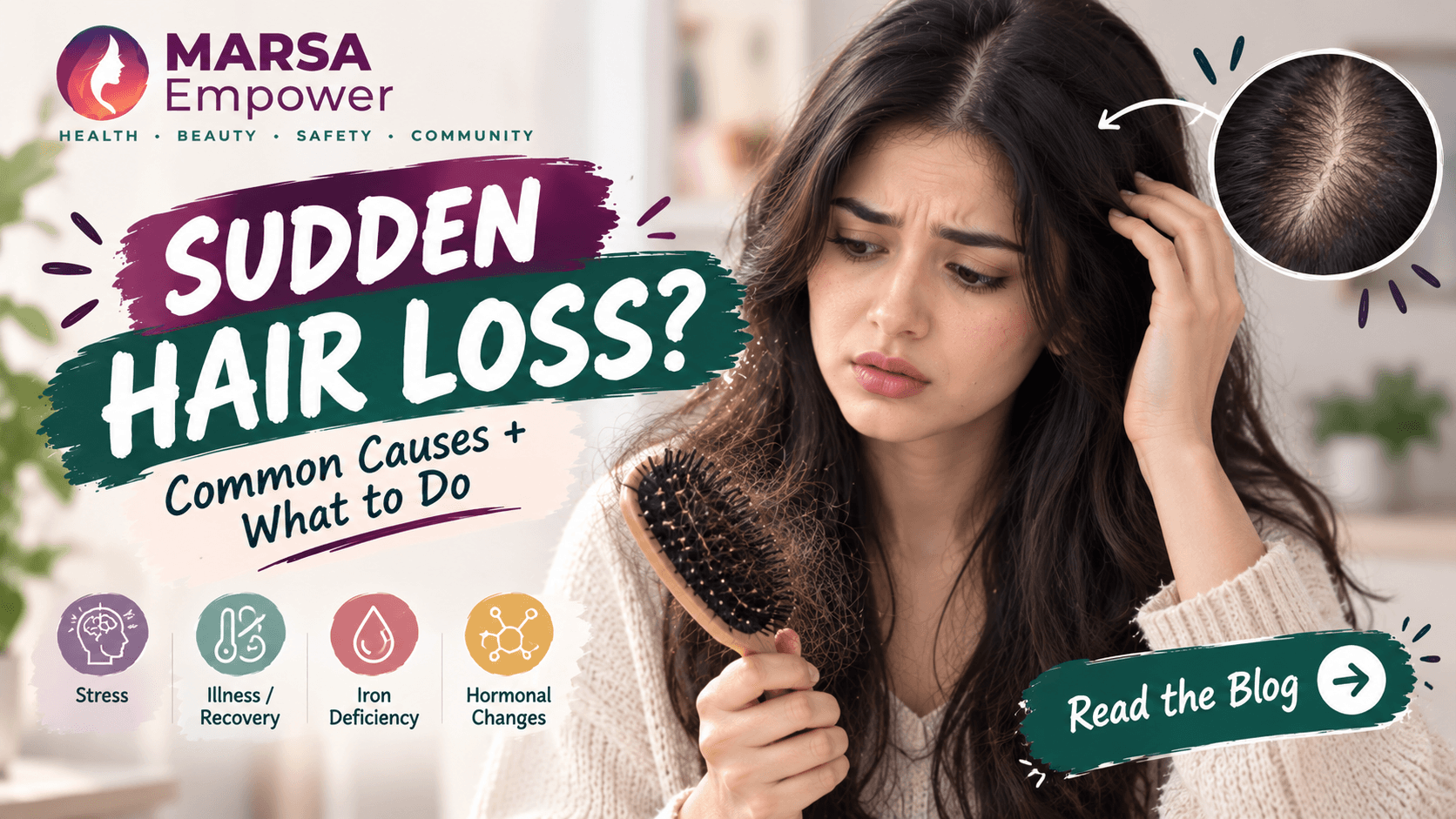
Explore the common causes of sudden hair loss in women and learn effective strategies to address and manage this condition with expert insights.
Maryam Mumtaz
Co-Founder & CEO
13 min read•10/3/2026
Marsa Empower · Women's Health & Skin · For Girls & Women Aged 13 and Above · 13 min read
Finding significantly more hair in the shower drain, on the pillow, on the hairbrush, or falling out while running fingers through it is one of the most alarming health experiences for women and girls. Hair is closely tied to identity and confidence, and sudden visible changes in hair volume and density produce genuine distress.
The most important thing to understand about sudden hair loss is that it almost always has a cause — and the majority of those causes are either naturally self-limiting or effectively treatable once identified. The common experience of sudden increased shedding two to four months after a stressful event, illness, or nutritional change is one of the most reversible hair changes a woman can experience. Iron deficiency, thyroid dysfunction, and hormonal conditions that cause hair loss are all identifiable through blood testing and manageable with appropriate treatment.
The missing piece for most women experiencing sudden hair loss is not a better shampoo or a new oil — it is understanding what is causing the loss in the first place. This guide provides that understanding.
Hair loss is considered sudden when it represents a significant increase from a person's established baseline — not the gradual, progressive thinning that may develop over years, but a noticeable, relatively rapid change in how much hair is being shed.
This may present as finding dramatically more hair in the shower drain than previously. Noticeably more hair on the brush or pillowcase. A thinner ponytail than before. Visible thinning of the hair on the scalp. A widening of the parting. Or in some cases, the appearance of distinct bald patches.
Sudden hair loss in this sense is a different category from gradual female pattern hair loss — which progresses slowly over years — and from the normal daily shedding that every person experiences.
Understanding the difference between normal shedding and problematic hair loss is the starting point for appropriate response.
Every person loses 50 to 100 hairs per day as part of the normal hair cycle. Hairs complete their growth phase (anagen, lasting two to seven years), enter a transition phase (catagen, lasting two to four weeks), and then enter a resting phase (telogen, lasting two to three months) before being shed. At any time, approximately 85 to 90 percent of follicles are in the active growth phase, with 10 to 15 percent in the resting and shedding phase.
Normal shedding does not produce visible thinning because the shed hairs are continuously replaced by new growth. What feels like "a lot" of hair in the drain on a given wash day is often simply the accumulated shedding from the two to three days since the previous wash, which is entirely normal.
Hair loss becomes a concern when the rate of shedding significantly exceeds the rate of replacement — producing the visible thinning, reduced density, and widening parting that characterise problematic hair loss. This typically occurs when a larger-than-normal proportion of follicles simultaneously shift into the telogen phase in response to a triggering event or condition.
Physical or psychological stress is the most common cause of sudden increased hair shedding in women. The mechanism — telogen effluvium — involves stress triggering a large proportion of actively growing follicles to simultaneously shift into the resting (telogen) phase. When these follicles complete their resting phase two to four months later, they shed their hairs simultaneously, producing the sudden increase in shedding that characterises telogen effluvium.
This timing delay is critically important: the shedding from a stressful event in June typically presents as dramatically increased hair loss in September or October — making the connection non-obvious without this knowledge. Many women experiencing stress-related hair loss attribute it to a product change or other recent event, not recognising the triggering event months earlier.
Chronic sleep deprivation elevates cortisol and impairs the overnight cellular repair processes — including follicle cell regeneration — that maintain healthy hair growth. Sustained poor sleep is both a direct contributor to increased shedding and a significant amplifier of stress-related hair loss.
Hair follicles are among the most metabolically active structures in the body and are exquisitely sensitive to nutritional status. Any nutritional deficiency or significant reduction in overall caloric intake disrupts the energy and raw material available for hair growth, triggering the shift of follicles from the growth to the resting phase.
Iron deficiency is the single most common nutritional cause of sudden hair loss in women and girls — more prevalent than any other individual cause. Iron is required for cellular energy production and DNA synthesis in the rapidly dividing follicle cells, and its deficiency specifically impairs the hair growth cycle.
The critical diagnostic point is that serum ferritin — not haemoglobin — is the most sensitive test for iron deficiency affecting hair. A woman can have a normal haemoglobin and still have ferritin levels low enough to cause hair loss. Many dermatologists consider ferritin below 30 to 40 µg/L as potentially contributing to hair loss even when technically within the "normal" laboratory range.
Protein is the building material of hair — keratin is a protein, and the follicle cells that produce it require a consistent amino acid supply. When protein intake is consistently low — from meal skipping, very restrictive eating, or low-protein dietary patterns — hair growth is compromised and shedding increases.
Crash dieting, dramatic caloric restriction, or rapid significant weight loss produces telogen effluvium through both the physical stress of caloric deprivation and the nutritional deficiencies that accompany insufficient food intake. Hair loss following a crash diet typically presents two to four months after the dietary restriction began.
Oestrogen supports the active growth phase of hair follicles. When oestrogen falls — postpartum, at menopause, or with certain hormonal conditions — a larger proportion of follicles shift to the resting phase and subsequent shedding increases. Elevated androgens from PCOS produce a different hair loss pattern — follicle miniaturisation causing progressive thinning rather than sudden shedding.
Significant illness — including COVID-19, flu, severe infections, and other febrile illnesses — is one of the most consistent triggers of telogen effluvium. The physical stress of illness signals follicles to exit the growth phase, with the resulting shedding occurring two to four months after the illness.
Blood thinners (anticoagulants), some antidepressants and antipsychotics, some blood pressure medications (beta-blockers, ACE inhibitors), high-dose vitamin A, lithium, and some hormonal medications are among those associated with hair loss as a side effect. If hair loss began two to four months after starting a new medication, this temporal relationship is worth discussing with the prescribing provider.
New hair products containing harsh ingredients, over-washing or under-washing, frequent colour treatments, or changes in styling technique can all contribute to increased breakage that presents as apparent hair loss — though breakage differs from true follicle-driven hair loss in that the hairs break along the shaft rather than falling from the root.
Consistently tight ponytails, braids, buns, and extensions place sustained mechanical tension on follicles — particularly along the hairline and temples — triggering traction alopecia. This pattern of hair loss is among the few that can become permanent if the tension is sustained for long enough.
Repeated heat styling at high temperatures and frequent chemical treatments (bleaching, relaxing, perming) progressively damage the hair shaft, causing breakage and apparent thinning — particularly when combined with tension from styling.
Seborrhoeic dermatitis (dandruff), psoriasis, and fungal infections of the scalp produce inflammation around follicles that impairs their function and increases shedding in the affected areas.
Androgenetic alopecia — female pattern hair loss — has a strong genetic component. Women with a family history of significant hair loss (particularly in mothers and maternal aunts) are more likely to develop progressive thinning in the characteristic female pattern of crown and parting thinning.
The most common causes of sudden hair loss in teenage girls are iron deficiency, nutritional insufficiency (from meal skipping, restricted eating, or low-protein dietary patterns), stress from academic and social pressures, and in some cases early-onset PCOS or thyroid dysfunction. Tight hairstyles causing traction alopecia along the hairline are also a significant cause in this age group.
The first two to three years after the first period are a time of significant hormonal flux, and some temporary increased shedding as the body adjusts to new hormonal patterns is normal. However, significant or worsening hair loss in a teenager — particularly one with heavy periods or dietary restriction — always warrants blood testing including serum ferritin.
In the twenties, sudden hair loss most commonly reflects the telogen effluvium causes described above — stress, illness, nutritional changes, and hormonal factors. PCOS presenting or worsening in this decade is a common hormonal cause of both sudden shedding and progressive thinning.
The thirties can bring additional hormonal changes alongside continued stress and lifestyle demands. Postpartum hair loss — one of the most dramatic presentations of telogen effluvium — typically affects women in their late twenties and thirties. PCOS-related hair changes, thyroid dysfunction (more common in women in this decade), and the nutritional impact of consecutive pregnancies can all contribute.
Perimenopause begins for many women in their mid-to-late forties and produces both the telogen effluvium-type shedding of hormonal fluctuation and the beginning of the androgenetic alopecia pattern from changing hormone ratios. New hair loss in this decade always warrants both thyroid and hormonal evaluation alongside assessment of the other common causes.
Hair shedding from the whole scalp — diffuse, increased shedding of hairs throughout the entire scalp — is the presentation of telogen effluvium from stress, illness, or nutritional causes. Hairs are falling from roots that are completing the telogen phase, not breaking along the shaft.
Thinning hair — gradual reduction in hair density over time, producing a visible reduction in hair volume without a specific bald area — is more characteristic of androgenetic alopecia or ongoing telogen effluvium from a persistent cause.
Hair breaking — hairs breaking along the shaft rather than falling from the root — is caused by hair damage from heat, chemicals, or mechanical stress, and is distinguished from true hair loss by the presence of short, broken hairs rather than complete hairs with white roots.
Hair loss in small patches — circular or irregular bald patches on the scalp — is the presentation of alopecia areata, an autoimmune condition in which the immune system attacks hair follicles.
Widening hair part — a wider gap along the parting that was not previously present — is a classic early sign of female pattern androgenetic alopecia.
Thinning around the hairline — particularly at the temples and frontal hairline — can indicate traction alopecia from tight hairstyles or frontal fibrosing alopecia, a specific scarring condition more common in postmenopausal women.
Described above — the most common nutritional cause of hair loss in women. Requires serum ferritin testing specifically (not haemoglobin alone) for identification, and responds to dietary iron improvement and supplementation where confirmed.
Both hypothyroidism and hyperthyroidism cause diffuse hair loss. Hypothyroidism reduces the metabolic rate that supports follicle activity and is characterised by diffuse thinning alongside fatigue, cold intolerance, weight gain, dry skin, and constipation. Hyperthyroidism accelerates metabolism in a way that disrupts the hair cycle alongside weight loss, anxiety, and rapid heartbeat.
PCOS-related hair loss involves both possible telogen effluvium from the hormonal irregularity of PCOS and androgenetic thinning from elevated androgens (particularly DHT) miniaturising scalp follicles over time. Women with PCOS who develop scalp hair thinning alongside other features — irregular periods, jawline acne, excess facial or body hair — should discuss PCOS management with their healthcare provider as a direct route to addressing the hormonal driver.
Elevated prolactin (hyperprolactinaemia) and other pituitary conditions that disrupt reproductive hormone balance can cause hair loss alongside menstrual irregularity.
Tinea capitis — fungal infection of the scalp — produces patchy hair loss with scaling and sometimes itching and is more common in children but can affect women. It requires antifungal treatment. Bacterial scalp infections can similarly impair follicle function in affected areas.
Autoimmune conditions (including lupus), significant anaemia from any cause, coeliac disease (through nutritional malabsorption), diabetes, and severe liver or kidney conditions can all produce hair loss as a systemic effect.
Surgery, significant injury, severe illness, childbirth, high-intensity exercise beyond the body's recovery capacity, and dramatic dietary restriction are all forms of physical stress that can trigger telogen effluvium. The body interprets these as threats to survival and down-regulates non-essential functions — including the energy-expensive process of growing hair — in response.
Chronic psychological stress elevates cortisol, which at sustained high levels disrupts the normal hair growth cycle and has been shown to affect follicle function directly. The cortisol-mediated mechanism is in addition to the telogen effluvium triggered by extreme acute emotional stress events.
As discussed, poor sleep elevates cortisol, impairs overnight cellular repair in follicles, and disrupts the hormonal environment supporting hair growth. Sustained sleep deprivation is a consistent but often unrecognised contributor to ongoing hair shedding.
The two-to-four-month delay between the triggering event and the presentation of increased shedding is the most critical piece of information for understanding stress-related hair loss. A woman who noticed sudden significant shedding in October and cannot identify a current cause should think back to what happened in July or August — an illness, a highly stressful period, a dramatic diet change — which is more likely to be the true trigger.
Hair is made of keratin — a protein. Insufficient protein means insufficient building material for hair growth, and follicles reduce their growth activity in protein-insufficient states. Including a quality protein source at every meal is the most fundamental dietary support for hair health.
Lentils and daal, chicken and red meat, eggs, sardines, chickpeas, spinach cooked alongside vitamin C — consistently including iron-rich foods prevents the progressive iron depletion that is the most common nutritional cause of hair loss in women who menstruate.
Zinc deficiency is associated with diffuse hair shedding. Zinc supports cell division and protein synthesis in follicles. Good sources include meat, eggs, pumpkin seeds, cashews, and lentils.
Vitamin D receptors are present in hair follicles and play a role in regulating the hair growth cycle. Significant vitamin D deficiency — very prevalent in South Asian women — is associated with hair shedding and has been shown in some studies to improve with supplementation in deficient individuals.
Biotin deficiency — genuinely rare in women eating varied diets — causes hair loss. Vitamin B12 deficiency impairs follicle cell metabolism alongside its other effects. Selenium deficiency and significant copper deficiency are rare but documented causes of hair loss.
The most evidence-supported dietary approach for hair health is a varied, adequate diet that provides sufficient calories, protein, iron, zinc, and the full range of micronutrients — not targeted supplementation without identified deficiencies.
The most important hair-care-related cause of hair loss in women — sustained tension on the hairline and temples from daily tight styling gradually damages follicles and can cause traction alopecia that, if prolonged, may produce permanent hair loss. Alternating tight and loose styles, using fabric hair ties rather than rubber bands, and regularly wearing the hair loosely prevents and reverses early traction alopecia.
Daily use of hairdryers at high heat, straighteners, and curling irons damages the hair shaft, producing breakage that appears as hair loss. Reducing heat styling frequency, using the lowest effective temperature, and applying heat-protective products before styling reduce this damage.
Chemical relaxers, perms, and frequent bleaching progressively weaken the hair shaft and can damage follicles at the scalp with very frequent use. Reducing the frequency of chemical treatments and ensuring adequate recovery time between them reduces cumulative damage.
Over-brushing — particularly of wet hair when it is most vulnerable to breakage — causes significant mechanical damage. A wide-toothed comb on wet hair, starting from the ends and working upward, dramatically reduces breakage compared to brushing wet hair from root to tip.
Rough towel-drying by rubbing rather than gently pressing and blotting, aggressive detangling, and any forceful handling of wet hair causes substantial breakage.
Shampoos containing sulfates, dry shampoos overused, hairsprays and styling products with drying alcohols — all strip moisture from the hair shaft and contribute to breakage over time.
A clean scalp free from product buildup, excessive sebum, and dandruff supports healthy follicle function. Washing frequency depends on hair type and sebum production — most women benefit from two to three washes per week, using a gentle sulfate-free shampoo.
The most impactful single step. Was there a stressful event, illness, dietary change, or dramatic weight change two to four months before the shedding began? Has a new medication been started? Are periods heavy suggesting possible iron deficiency? Are there other symptoms (fatigue, cold intolerance, irregular periods, acne) that suggest a hormonal condition? Identifying the likely cause guides the most appropriate management approach.
Ensure adequate protein at every meal, consistent iron-rich food intake (always alongside vitamin C for improved absorption, and avoiding chai for an hour after iron-rich meals), and adequate overall caloric intake. Do not follow a very restrictive diet while experiencing hair loss — nutritional restriction is likely to worsen it.
Seven to nine hours per night consistently, protected from late-night screens and with consistent sleep and wake times.
Regular exercise, adequate sleep, breathwork, social connection, and where needed, professional support. These are not optional wellness suggestions — they are direct interventions for the most common cause of sudden hair loss in women.
Switch to a wide-toothed comb for wet hair, gentle towel-blotting rather than rough drying, and careful handling throughout styling.
Give the hairline and temples recovery time from traction by alternating tight and loose styles.
Take a break from heat styling and chemical treatments during periods of significant shedding, allowing the hair to recover without additional damage.
Address dandruff, dryness, or scalp irritation with appropriate shampoos. A clean, healthy scalp provides the optimal environment for follicle function.
Note the timing, pattern, and severity of hair loss — and any potential triggers two to four months prior. This tracking is the most useful preparation for a medical or dermatological consultation.
Use a gentle, sulfate-free shampoo appropriate for your hair type. Wet the hair with lukewarm rather than hot water. Apply shampoo primarily to the scalp, working it through the lengths with gentle finger movements rather than vigorous scrubbing. Rinse thoroughly.
Use a wide-toothed comb on wet hair, starting from the ends and working gradually toward the roots, section by section. Never pull through tangles from root to tip on wet hair.
Sleep on a silk or satin pillowcase to reduce the friction that causes breakage during movement in sleep. Avoid sleeping with tightly secured hair. Avoid tight elastic bands directly on hair — use fabric-covered bands.
Lightweight leave-in conditioners, moisturising serums, and protective oils (applied to the lengths and ends rather than the scalp) help maintain hair shaft moisture and reduce breakage. Look for products without heavy silicones that cause buildup, without drying alcohols, and without strong fragrances that irritate the scalp.
As described — adequate protein, iron, zinc, and overall caloric sufficiency are the dietary priorities for hair health.
During a period of significant hair loss, postponing bleaching, colouring, relaxing, and other chemical treatments gives the compromised hair and follicles time to recover.
The home care measures described in this guide — dietary improvement, stress management, gentle handling, scalp cleanliness, and allowing the hair to recover from damage — address the most common causes of hair loss and support the conditions for healthy regrowth. These are genuine, evidence-supported actions.
Oils — castor oil, coconut oil, onion oil — are widely marketed for hair loss. They can improve hair shaft moisture and reduce breakage from dryness, and regular scalp massage (regardless of the oil used) may have modest circulation-improving effects. However, oils do not correct iron deficiency, thyroid dysfunction, or hormonal imbalances — the most common causes of significant hair loss. Using oils while the underlying cause is unaddressed does not produce the recovery that addressing the underlying cause does.
Home remedies involving raw eggs directly on the scalp, onion juice, lemon juice, garlic paste, and similar applications can cause scalp irritation, contact dermatitis, and worsening of follicle inflammation in sensitive scalps. None have clinical evidence comparable to the established treatments for the conditions causing hair loss.
Biotin, collagen, and "hair, skin, and nail" supplement combinations are marketed extensively but have meaningful evidence only in specific, confirmed deficiency states. Taking multiple supplements without identifying deficiencies through testing can cause side effects (high-dose biotin interferes with several blood tests, producing misleading results) and is less effective than addressing identified deficiencies specifically.
If significant hair loss begins within a clearly defined short period — noticeably different from before within weeks — this warrants evaluation to identify the cause, particularly when no clear trigger such as a recent illness or stressful event is identifiable.
Progressive worsening over weeks to months without improvement suggests either an ongoing trigger (persistent stress, ongoing nutritional deficiency, an unaddressed medical condition) or a condition requiring specific treatment.
Hair loss producing visible thinning, a significantly thinner ponytail, or noticeably reduced scalp coverage warrants evaluation.
Discrete circular or irregular patches of complete hair loss indicate alopecia areata or a scalp condition requiring specific diagnosis and management.
Scalp symptoms alongside hair loss suggest a scalp condition — seborrhoeic dermatitis, psoriasis, tinea capitis, or contact dermatitis — that requires dermatological assessment.
The combination of significant hair loss and severe, persistent fatigue most commonly suggests iron deficiency anaemia or hypothyroidism — both readily identified by blood testing.
Hair loss alongside weight gain, cold intolerance, and fatigue — or alongside irregular periods, jawline acne, and excess body hair — points toward thyroid or PCOS-related hormonal causes that respond best to specific medical management.
Hair loss that continues beyond four to six months without any improvement despite addressing identifiable lifestyle and nutritional factors warrants dermatological evaluation.
Full blood count — haemoglobin, red blood cell indices — to assess for anaemia and general health markers.
Serum ferritin — the most important single test for hair loss in women — to assess iron stores specifically. Serum iron and transferrin saturation for additional context. Vitamin D (25-OH vitamin D) and vitamin B12 where dietary patterns suggest possible deficiency.
TSH and free T4 — essential early investigations for any woman with significant unexplained hair loss.
In women with features suggesting PCOS (irregular periods, acne, hirsutism), testing of testosterone, SHBG, LH, FSH, and prolactin. Anti-thyroid antibodies where autoimmune thyroid disease is suspected.
Clinical examination of the scalp and hair under magnification (dermoscopy or trichoscopy) provides important information about follicle structure, miniaturisation patterns, and scalp condition.
Zinc, copper, inflammatory markers, and other investigations based on the clinical picture.
Telogen effluvium — the most common form of sudden hair loss from stress, illness, or nutritional causes — is in most cases reversible. Once the triggering cause is resolved and the follicles receive the nutritional and physiological support they need, they return to the active growth phase and hair regrows. Shedding typically slows over two to three months after the trigger resolves, and visible density improvement follows over the next three to six months.
Even after the trigger resolves and shedding reduces, new hair growth is visible at approximately one centimetre per month. Full visible recovery from a significant telogen effluvium episode takes six to twelve months from the point of shedding reduction — a timeline that requires patience but is genuine recovery.
Hair does not regrow effectively if the underlying cause is not addressed. Treating the symptoms of iron deficiency hair loss without correcting the iron deficiency produces negligible improvement. Addressing stress, sleep, and nutrition while an unrecognised thyroid condition continues to impair follicle function produces disappointing results. Identifying and treating the cause is the prerequisite for effective regrowth.
Androgenetic alopecia — female pattern hair loss from genetic androgen sensitivity — does not reverse spontaneously and typically requires specific treatment (topical minoxidil, hormonal management, or other dermatological interventions) to slow or partially reverse. Alopecia areata, traction alopecia identified late, and scarring alopecias similarly require specific dermatological management.
Eat a balanced diet with adequate protein, iron, zinc, and overall caloric sufficiency. Never follow a crash diet or very restrictive eating pattern.
Get enough sleep — seven to nine hours consistently is one of the most impactful preventive measures for hair health.
Manage stress actively, treating it as a health priority rather than an inevitable feature of a busy life.
Avoid tight hairstyles as a daily default — rotate between styles that place different tensions on different areas.
Limit heat and chemical treatments to necessary occasions, always using heat protection and allowing adequate recovery between chemical treatments.
Handle hair gently at all times — particularly when wet.
Take care of your scalp with regular cleaning and addressing dandruff or scalp inflammation promptly.
Treat health problems early — particularly iron deficiency, thyroid conditions, and PCOS, all of which affect hair when unmanaged and respond well to appropriate treatment.
Marsa's Health Hub allows women to track hair and skin changes over time alongside menstrual cycle data, energy levels, and other health patterns. For women experiencing sudden hair loss, this tracking builds the timeline most useful for identifying two-to-four-month-prior triggers and for documenting the pattern of improvement once management is underway.
Marsa's Smart Nutrition resources explain the specific dietary factors most relevant to hair health — iron (and the vitamin C pairing that maximises its absorption), protein, zinc, vitamin D — alongside practical Pakistani food-context guidance on meeting these requirements through everyday eating.
By tracking stress, sleep quality, illness episodes, and dietary patterns alongside hair changes in the Health Hub, women can identify the connections between these factors and their hair loss that are not obvious without documentation.
For women who have identified a cause and are addressing it, consistent tracking over three to six months provides the documented pattern of improvement — or the evidence of continued worsening that warrants further professional investigation.
Marsa's educational content and Digital Doctors guidance helps women understand which patterns of hair loss — which symptoms, which co-occurring features, which timelines — fall within the range of expected self-resolving changes versus those requiring dermatological or hormonal evaluation.
Important note. Marsa Empower is a health education and wellness companion. Significant, progressive, patchy, or medically concerning hair loss — particularly when accompanied by other symptoms — requires evaluation by a qualified dermatologist or healthcare professional.
Why am I suddenly losing so much hair?
The most likely causes are telogen effluvium from a stressful event, illness, or nutritional change two to four months before the shedding began. Iron deficiency is the most common nutritional cause and requires serum ferritin testing to identify. Thyroid dysfunction, PCOS, and hormonal changes are other important causes. A clear increase from baseline always warrants consideration of these possibilities.
Is some hair shedding normal?
Yes. Losing 50 to 100 hairs per day is completely normal and does not produce visible thinning because shed hairs are continuously replaced. Hair loss becomes a concern when shedding clearly increases beyond this range and is not replaced at the same rate, producing visible thinning or reduced density.
Can stress cause sudden hair loss?
Yes, through the specific mechanism of telogen effluvium — where stress triggers follicles to shift to the resting phase, with the resulting shedding appearing two to four months later. Both severe acute stress and chronic sustained stress can trigger this response.
Can poor diet cause hair loss?
Yes. Iron deficiency, insufficient protein, very low calorie intake, crash dieting, and crash weight loss are all direct dietary causes of telogen effluvium-type hair shedding.
Can iron deficiency cause hair loss?
Yes — it is the most common nutritional cause of hair loss in women. It requires serum ferritin (not haemoglobin alone) to detect accurately. Women with heavy periods are at highest risk. Treating iron deficiency through dietary improvement and supplementation where confirmed typically produces visible hair improvement over six to twelve months.
Can PCOS cause hair loss?
Yes. PCOS causes both possible telogen effluvium from hormonal irregularity and, in women with significant androgen excess, progressive follicle miniaturisation producing thinning in the female androgenetic alopecia pattern (crown and parting).
Can thyroid problems cause hair loss?
Yes. Both hypothyroidism and hyperthyroidism cause diffuse hair loss. Thyroid function testing (TSH and free T4) is one of the most important early investigations for unexplained hair loss in women.
Why is my hair thinning at the front?
Frontal thinning may reflect traction alopecia from tight hairstyles — particularly along the hairline from repeated tight styling — or early androgenetic alopecia. Frontal fibrosing alopecia (a specific scarring condition more common in middle-aged and older women) also produces a receding frontal hairline. A dermatologist can distinguish these through examination.
Why is my hair falling out when I wash it?
Finding hair in the shower is normal — this is typically the accumulated shed hairs from several days that are released when the hair is wet and manipulated. An increase in the amount found during washing that is clearly different from the previous baseline suggests increased shedding worth monitoring and, if it continues, investigating.
Can tight hairstyles cause hair loss?
Yes. Traction alopecia from chronic tight hairstyles — ponytails, braids, buns, extensions — is one of the few hair loss patterns that can become permanent if the traction is sustained long enough. Early traction alopecia recovers with style changes. Late-stage scarring from prolonged traction does not.
Can hair loss from stress grow back?
In most cases, yes. Telogen effluvium from stress is typically reversible — once the trigger resolves and the follicles return to the growth phase, hair regrows. Shedding typically slows two to three months after trigger resolution, with visible density improvement over the following three to six months.
Do hair oils stop hair loss?
Hair oils can reduce breakage from dryness and shaft damage, and scalp massage has modest supportive evidence, but oils do not address the root causes of follicle-driven hair loss — iron deficiency, thyroid dysfunction, PCOS, or stress. Treating the root cause is the most effective path to stopping hair loss and supporting regrowth.
Should I take vitamins for hair loss?
Only if a specific deficiency has been identified through blood testing. Targeted supplementation to correct confirmed deficiency (iron, vitamin D, B12, zinc) is appropriate and effective. Taking random "hair vitamins" without identified deficiencies provides no proven benefit and high-dose biotin specifically interferes with certain blood test results.
When should I see a doctor about hair loss?
See a doctor when hair loss is sudden, worsening, producing visible thinning, accompanied by bald patches, scalp symptoms, or systemic symptoms such as fatigue or hormonal changes, or when it has continued for more than four to six months without improvement despite appropriate lifestyle attention.
Sudden hair loss is alarming, distressing, and almost always telling you something specific about what has been happening in your body. The two-to-four-month delay between trigger and shedding, the nutritional causes that are common and correctable, the hormonal conditions that are identifiable and manageable, and the hair-care habits that amplify damage — all of these are understandable, addressable, and in most cases reversible when the cause is correctly identified and treated.
The most productive response to sudden hair loss is neither panic nor passive acceptance — it is investigation. Think back to what happened two to four months ago. Get a blood test including serum ferritin, thyroid function, and vitamin D. Assess your diet, sleep, and stress patterns honestly. Be gentle with your hair while its cause is being identified and addressed.
And when the hair loss is significant, worsening, unusual in pattern, or accompanied by other symptoms — seek dermatological or medical evaluation rather than extended self-management.
Your hair is reflecting the state of your body. Listen to what it is telling you.
Educational Disclaimer
This article is for educational and awareness purposes only. It does not constitute medical or dermatological advice. If you have significant, worsening, or medically concerning hair loss, please consult a qualified healthcare professional or dermatologist for personalised evaluation and guidance.
Marsa Empower | Care. Safety. Growth.
Visit marsaempower.com to track your hair, health patterns, and menstrual cycle, access women's health education, and explore wellness resources at every stage of life.
Medical Disclaimer
This article is for general informational and educational purposes only and is not a substitute for professional medical advice, diagnosis, or treatment. Always seek the advice of a qualified healthcare provider with any questions you may have regarding a medical condition. Never disregard professional medical advice or delay seeking it because of something you have read on MARSA Empower.
Written By
Maryam Mumtaz
Co-Founder & CEO
Co-Founder of MARSA Empower who leads the visual and strategic evolution of the platform. Maryam bridges technical complexity with human-centric design, architecting the team's official roadmap and ensuring MARSA effectively addresses the real-world needs of women. With deep expertise in agentic AI, full-stack development, and UI/UX design, she has delivered 50+ projects for 30+ satisfied clients.
Enjoyed this story?