Navigate the journey of growing up as a girl with these 10 truths. From body confidence to social media reality, find the support you need.

Maryam Mumtaz
Co-Founder & CEO
12 min read•6/30/2026
"You are not behind. You are not too much. You are not broken. You are becoming."
There is a strange kind of loneliness in growing up. Not the loneliness of having no one around — but the loneliness of feeling like everyone around you somehow got a manual you never received. Your body is changing in ways you did not ask for and cannot always predict. Your friendships shift without warning. Your mind feels louder some days than you know how to explain. And through all of it, you are expected to simply figure it out.
No one sits you down and says: this is normal, this happens to almost everyone, you are not the only one. Instead, you piece it together — from whispered conversations, from comparing yourself to other girls, from social media posts that never show the full picture, from quiet nights wondering if something is wrong with you.
Nothing is wrong with you. You are simply growing up — and growing up as a girl comes with a specific set of unspoken truths that deserve to be said out loud, clearly, and without shame.
This is everything you wish someone had told you sooner.
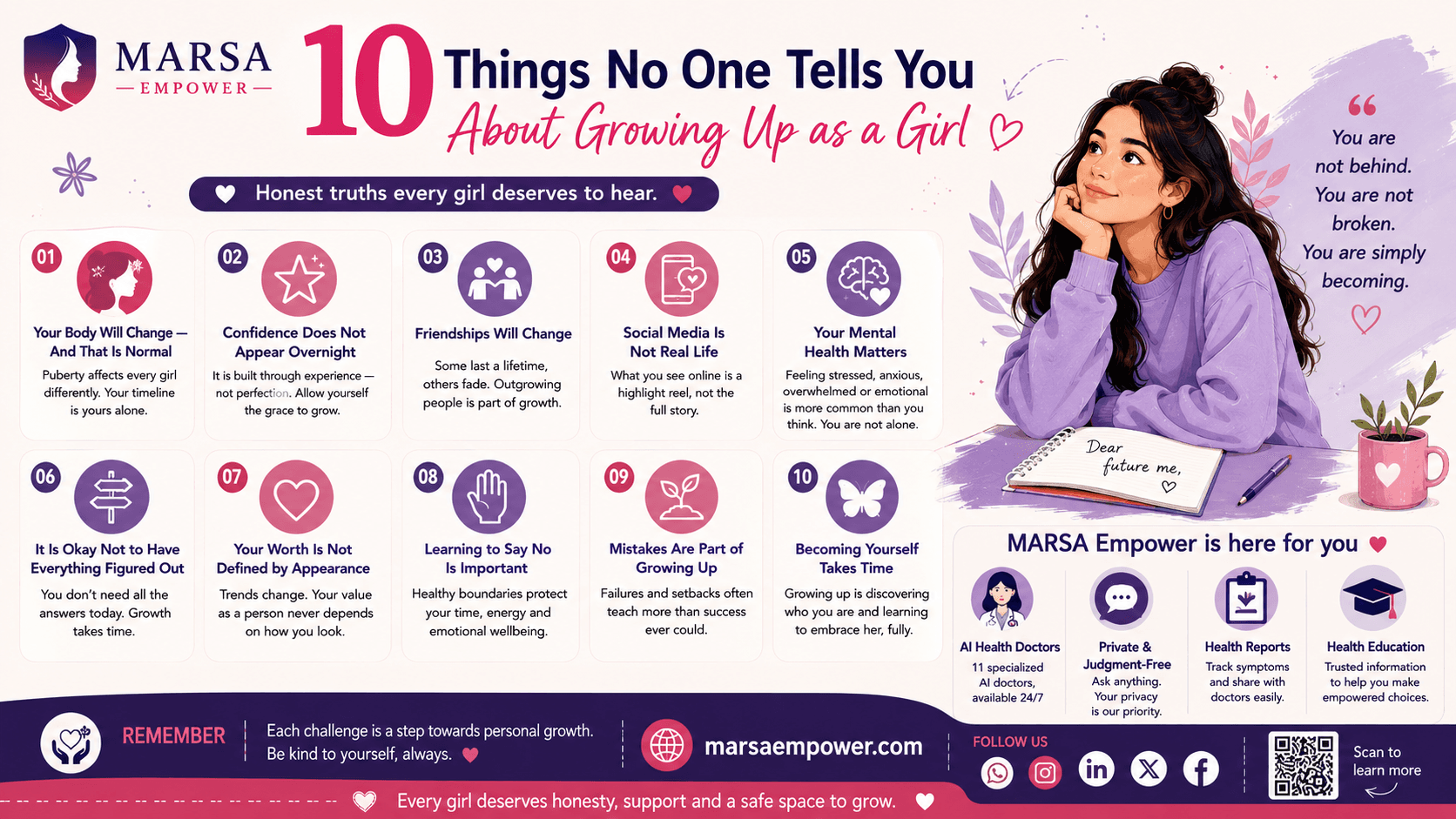
Your body is going to change in ways that feel sudden, confusing, and sometimes embarrassing. Height, weight, skin, body shape, body hair, breast development, periods — all of it arrives on its own timeline, and that timeline is different for every single girl.
The instinct to compare your body to your friends', to girls on social media, or to some imagined "normal" is almost universal — and almost universally unhelpful. Puberty is not a race with a correct pace. Some girls develop early. Some develop late. Some go through changes gradually; others feel like everything happened in a single summer. None of these timelines are wrong.
Comparing your body to others during a period when your body is changing the most is one of the surest ways to create insecurity that has no real basis. Your body is not behind. It is simply on its own schedule.
Almost every girl believes, at some point, that other girls were simply born more confident — that confidence is a trait some people have and others do not. This is one of the most common and most untrue beliefs of growing up.
Confidence is not a personality trait you either have or lack. It is a skill built slowly through experience — through trying things, getting them wrong, trying again, and slowly discovering what you are capable of. The girls who appear confident are very rarely girls who never feel insecure. They are girls who have practiced moving forward despite insecurity.
Confidence does not require perfection. It requires repetition. Every awkward moment, every mistake, every time you try again — that is confidence quietly being built, even when it does not feel like it.
Few things feel as disorienting as watching a close friendship fade. The friend who knew everything about you in middle school may feel like a stranger by the time you reach university. This does not mean either of you did something wrong.
As you grow, your interests, values, and needs shift. The friendships that once fit perfectly may simply no longer match who you are becoming — and that is not betrayal, it is biology and psychology working exactly as they should. Some friendships are built to last a lifetime. Others are built to last a season, and that is enough.
Grieving a friendship that has faded is allowed. But outgrowing people as you grow yourself is not a personal failure — it is one of the most natural parts of becoming who you are meant to be.
Every scroll through social media presents a curated, filtered, carefully chosen version of someone else's life — the best lighting, the best angle, the best moment of an otherwise ordinary day. What almost never makes it onto the screen is the struggle behind it: the bad days, the self-doubt, the arguments, the tears, the body that does not look like the photo without editing.
When you compare your full, complicated, real life to someone else's highlight reel, you are comparing two fundamentally different things — and you will almost always lose that comparison, because it was never a fair one to begin with.
What you see online is a performance of a life, not the life itself. Comparing your behind-the-scenes to someone else's highlight reel will only ever leave you feeling like you are falling short of a standard that does not actually exist.
Stress, anxiety, sadness, overwhelm, irritability, emotional exhaustion — these are not signs of weakness or dramatics. They are some of the most common experiences among teenage girls and young women, and they deserve the same attention as any physical health concern.
Many girls grow up believing they should simply "push through" emotional difficulty, that talking about it is attention-seeking, or that everyone else seems to be coping fine, so something must be uniquely wrong with them. None of this is true. Mental health struggles are widespread, they are real, and they are treatable.
If you are feeling persistently anxious, low, or overwhelmed, that feeling is valid and worth talking about — to a trusted friend, a parent, a school counsellor, or a mental health professional. Asking for support is not weakness. It is self-awareness.
There is enormous pressure, especially in the teenage and early adult years, to already know exactly who you are, what you want to study, what career you want, and what kind of life you are building. Many girls feel like everyone else has a clear plan while they are still figuring things out.
Almost no one actually has it all figured out — even the people who appear to. Direction in life is built gradually, through trial, error, curiosity, and changing your mind more than once. Not having a five-year plan at sixteen, eighteen, or even twenty-two does not mean you are behind. It means you are exactly where most people actually are.
You are allowed to change your mind, change direction, and take your time. Growth is not a race against a deadline — it is a process that unfolds at its own pace, and that pace is allowed to be yours.
Beauty standards shift constantly — what is considered ideal changes from decade to decade, platform to platform, and culture to culture. Tying your sense of worth to a standard that is, by definition, temporary and inconsistent sets you up for a struggle that can never actually be won.
Your value as a person has nothing to do with your appearance — not your weight, your skin, your height, or how closely you match whatever trend is currently popular. It has to do with your character, your kindness, your mind, your resilience, and the way you treat the people around you.
Appearance will always be subjective and constantly changing. Self-worth that depends on something so unstable will always feel unstable too. Build your sense of worth on something steadier — who you are, not how you look.
Many girls are raised to be agreeable — to say yes, to avoid conflict, to prioritise everyone else's comfort over their own. Over time, this habit can quietly erode your time, your energy, and your emotional wellbeing.
Saying no to things that drain you, that compromise your values, or that simply do not serve you is not rudeness. It is self-respect. Healthy boundaries protect your ability to show up fully for the things and people that genuinely matter to you, rather than spreading yourself thin trying to please everyone.
You do not owe everyone a yes. Learning to say no — calmly, clearly, without over-explaining — is one of the most powerful skills you can build, and the earlier you learn it, the more energy you protect for the things that truly matter.
Every girl makes mistakes — academic, social, personal. The instinct is often to feel like each mistake is evidence of failure, of not being good enough, of falling behind everyone else who seems to have it together.
Mistakes and setbacks are frequently the moments that teach the most valuable lessons — far more than the moments when everything goes smoothly. Resilience, problem-solving, humility, and self-understanding are almost always built in the aftermath of getting something wrong, not in the comfort of getting everything right.
A mistake is not the end of your story — it is often the beginning of a more interesting chapter. The goal was never to avoid every mistake. It was always to learn how to recover from them.
Perhaps the most important truth of all: growing up is not a process of becoming flawless, polished, or finished. It is a process of discovering who you actually are — your values, your interests, your boundaries, your voice — and slowly learning to embrace that person, imperfections included.
Self-discovery is not a single moment of realisation. It is years of small experiences accumulating — trying things, changing your mind, outgrowing old versions of yourself, and becoming more comfortable with who you are along the way. There is no finish line where you arrive fully formed. There is only the ongoing, lifelong process of becoming.
You do not need to have yourself completely figured out right now. You are allowed to still be becoming. That is not a flaw in the process — it is the entire process.
If there is one thing worth carrying away from everything above, it is this: nearly every confusing, uncertain, insecure moment you have experienced while growing up has also been experienced — quietly, privately — by countless other girls around you. You are not uniquely behind. You are not the only one who feels unsure. You are simply living through a part of life that is genuinely difficult, and that difficulty deserves acknowledgment rather than silence.
Your body, your friendships, your mental health, your sense of direction, your self-worth — all of it is allowed to still be in progress. Growing up is not about arriving at some perfect, finished version of yourself by a certain age. It is about gradually, patiently, becoming more fully who you already are.
"You are not behind. You are not too much. You are not broken. You are becoming — and that is exactly where you are supposed to be."
If you are struggling with anything mentioned in this article — body image, anxiety, friendship loss, or feeling overwhelmed — please know that reaching out to a trusted adult, school counsellor, or mental health professional is a sign of strength, not weakness. You deserve support, and you do not have to navigate any of this alone.
MARSA Empower is an AI-powered women's empowerment platform offering private, multilingual tools for health, beauty, and safety. From 11 specialized AI health doctors and a personalized Beauty & Glow advisor to a built-in safety system with SOS alerts, MARSA helps women take charge of their wellbeing — accessibly and securely.
Medical Disclaimer
This article is for general informational and educational purposes only and is not a substitute for professional medical advice, diagnosis, or treatment. Always seek the advice of a qualified healthcare provider with any questions you may have regarding a medical condition. Never disregard professional medical advice or delay seeking it because of something you have read on MARSA Empower.
Written By
Maryam Mumtaz
Co-Founder & CEO
Co-Founder of MARSA Empower who leads the visual and strategic evolution of the platform. Maryam bridges technical complexity with human-centric design, architecting the team's official roadmap and ensuring MARSA effectively addresses the real-world needs of women. With deep expertise in agentic AI, full-stack development, and UI/UX design, she has delivered 50+ projects for 30+ satisfied clients.
Enjoyed this story?