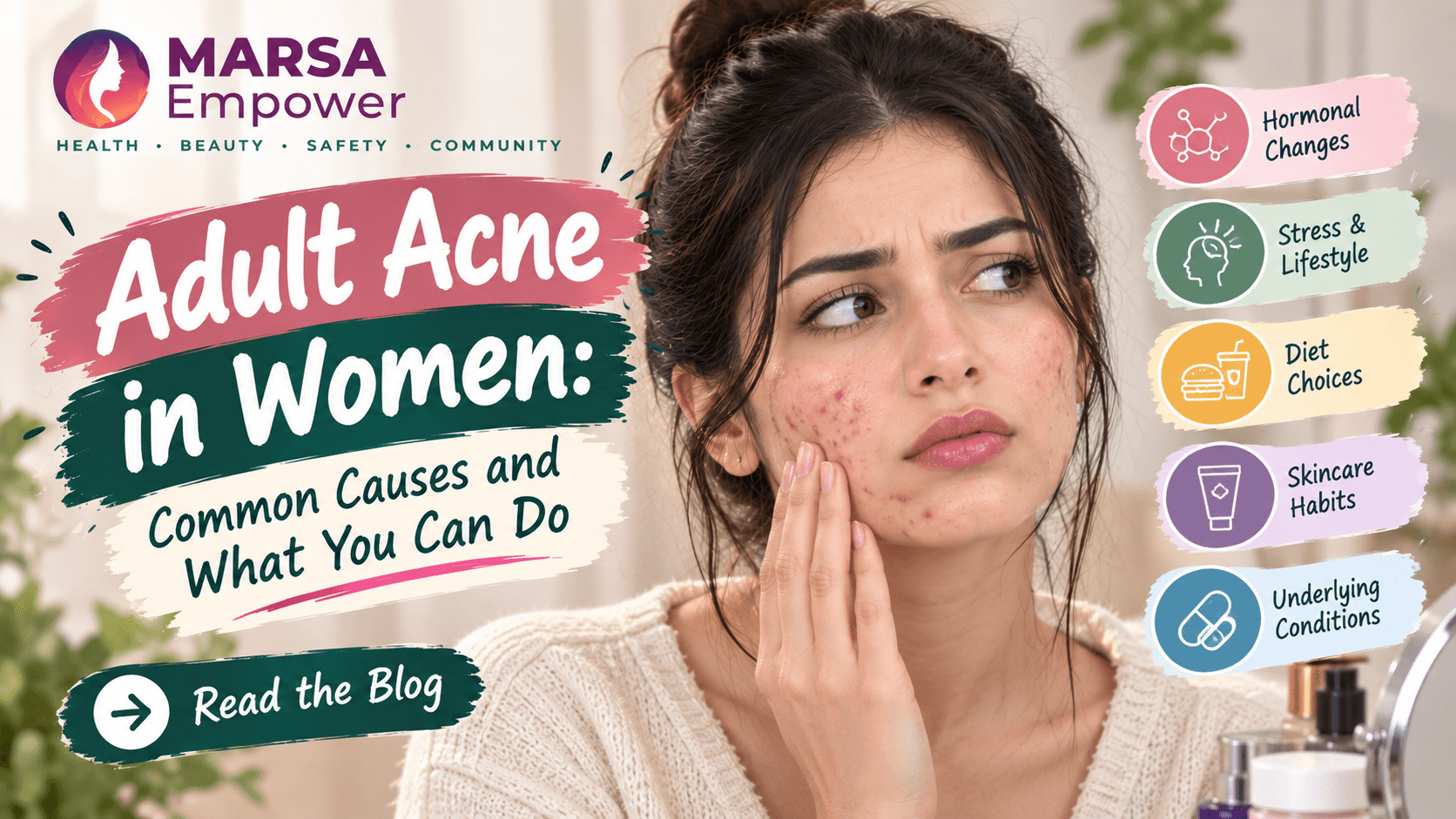
Adult acne affects many women. Learn about its common causes and discover actionable solutions.
Maryam Mumtaz
Co-Founder & CEO
14 min read•10/2/2026
Marsa Empower · Skin Health & Beauty · For Women Aged 18 and Above · 14 min read
Many women go through their teenage years expecting that acne will eventually resolve — and feel confused and frustrated when it does not, or when it disappears during the twenties only to return in the thirties or forties. Some women experience acne for the first time well into adulthood, having had clear skin throughout their teenage years.
Adult acne — particularly in women — is significantly more common than most people realise. Studies estimate that up to 50 percent of women experience acne during their adult years, making it one of the most prevalent skin concerns across the female population. Yet many adult women with acne feel alone, embarrassed, or dismissed — particularly in a culture where acne is associated primarily with teenagers.
Adult acne in women is predominantly driven by hormonal fluctuations, making it somewhat different in pattern, location, and management from typical teenage acne. Understanding this hormonal dimension — alongside the other factors that contribute — is the starting point for managing it effectively.
Acne is a skin condition that occurs when hair follicles become clogged with oil (sebum) and dead skin cells. This creates the environment in which bacteria — primarily Cutibacterium acnes (formerly Propionibacterium acnes) — that normally live harmlessly on the skin multiply inside the blocked follicle, triggering an inflammatory response. The result is the visible, and sometimes painful, skin changes that characterise acne.
Adult acne is defined as acne occurring in women aged 25 and above. It encompasses two patterns:
Persistent acne — acne that began in the teenage years and has continued into adulthood without fully clearing.
Late-onset acne — acne that appears for the first time in adulthood, often in the thirties or forties, in women who had largely clear skin as teenagers.
Both patterns are common, both are primarily driven by hormonal factors in adult women, and both respond to the same range of management approaches — though late-onset acne more consistently suggests an underlying hormonal driver that may benefit from specific investigation.
Androgens — the group of hormones that includes testosterone and its metabolites — are the primary driver of acne at any age. They stimulate the sebaceous glands to produce more oil, and this excess oil is the foundational ingredient of the acne process.
Women produce androgens in their ovaries and adrenal glands, and the balance between androgens and oestrogen in the body directly influences skin oil production. When androgens are elevated relative to oestrogen — as occurs premenstrually, with PCOS, with certain medications, or in the hormonal transition of perimenopause — sebum production increases and acne risk rises.
The menstrual cycle produces predictable hormonal fluctuations that directly affect the skin. The premenstrual drop in oestrogen combined with the relatively higher progesterone and androgen activity of the luteal phase drives the cyclical acne flares that most women with hormonal acne experience consistently in the week before their period.
Stress is one of the most consistent and most commonly reported triggers for adult acne flares. The mechanism is direct: psychological stress elevates cortisol, which stimulates sebaceous glands to produce more oil through androgen receptor signalling. Stress also impairs the skin's barrier function and increases skin inflammation — both of which worsen acne independently of sebum production.
Poor sleep elevates cortisol and impairs the overnight skin repair that normally clears cellular debris from follicles. Women who consistently under-sleep often notice that their skin is more prone to breakouts during and after periods of poor sleep.
Products that are comedogenic — meaning they block pores — are a significant cause of adult acne that is often overlooked because the connection is not immediately obvious. The acne from pore-blocking products may appear weeks after introducing the product rather than immediately.
Foundation, concealer, sunscreen, and moisturisers that contain comedogenic ingredients — including certain silicones, mineral oils, some plant oils, and occlusive waxes — can block follicles and trigger breakouts, particularly in the areas where the product is most heavily applied.
Hair oils, conditioning treatments, and styling products that come into contact with the face — along the hairline, forehead, temples, and back — can block follicles in these areas. This pattern, called pomade acne, produces breakouts specifically where hair products have touched the skin.
Heavy body lotions, fragranced products, and thick skincare ingredients on the neck, chest, and back can similarly cause breakouts in these areas.
Sweat itself does not cause acne, but sweat mixed with sebum and dead skin cells in blocked follicles can worsen existing acne. In hot, humid weather or after exercise, washing the face within 30 minutes prevents this accumulation.
The relationship between diet and acne is modest but real for some women — discussed in more detail in the diet section below.
Several medications can cause or worsen acne in women. These include corticosteroids, some progestogen-only contraceptives, lithium, some antidepressants, and B vitamins in very high doses. If acne began or significantly worsened after starting a new medication, this is worth discussing with the prescribing healthcare provider.
Genetic factors influence acne risk — women with close family members who had significant or persistent acne are more likely to experience it themselves. This genetic contribution affects sebaceous gland activity, follicle size, and the inflammatory response to blocked follicles.
Closed comedones — small, flesh-coloured or white bumps with no visible opening on the surface. They occur when a follicle is completely blocked by oil and dead cells, with no exposure to air. They are common in adult hormonal acne and often appear along the jawline and chin.
Open comedones — clogged follicles with an opening at the surface. The dark colour is from oxidation of the sebum and melanin exposed to air, not from dirt. Contrary to a common misconception, scrubbing does not remove blackheads and typically worsens them.
Papules — small, raised red spots without a visible head. They represent early inflammatory acne where the immune response has begun inside a blocked follicle but pus has not yet accumulated.
Pustules — pimples with a visible white or yellow head of pus. These form when the follicle's inflammatory response produces neutrophil accumulation. They are more painful than comedones and more tempting to squeeze — though squeezing worsens scarring risk significantly.
Nodules and cysts — the most severe forms of acne. These are large, deeply seated, painful inflamed masses that do not come to a surface head. They cannot be extracted and should not be squeezed. They are the most likely form to leave permanent scarring and most consistently require prescription treatment.
The classic distribution of adult hormonal acne in women is the lower face — the chin, jaw, and lower cheeks, sometimes extending to the neck. This pattern — sometimes called the "adult acne U-zone" — reflects the concentration of androgen-sensitive sebaceous glands in this area.
Inflammatory acne — papules, pustules, nodules, and cysts — is painful because of the immune response occurring inside the blocked follicle. Inflammatory cytokines, increased blood flow, and tissue pressure from the accumulated pus or inflammatory cells stimulate pain receptors in the surrounding skin.
Nodules and cysts that form deep in the dermis produce pain because they exert pressure on surrounding tissue from within, without the release that surface eruption would provide. This deep pressure against sensory nerve endings produces the characteristic throbbing pain of cystic acne.
Premenstrual acne is often more painful than acne at other cycle phases because the hormonal environment of the luteal phase — with elevated progesterone and androgens — specifically promotes the inflammatory type of acne lesion rather than simple comedones.
Teenage acne typically involves the T-zone (forehead, nose, and chin), is driven by the overall androgen surge of puberty, and often involves a mix of comedonal and inflammatory lesions across the face and sometimes the back and chest. It affects boys and girls at similar rates during early puberty, though girls tend to have more persistent acne into later adolescence.
In the twenties, acne either continues from the teenage years (persistent acne) or begins to shift toward the lower-face, hormonal pattern characteristic of adult women. Stress, hormonal contraceptive choices, and the beginning of career and life demands all influence acne patterns in this decade.
Acne that persists or appears for the first time in the thirties is almost always hormonally driven — with the lower-face, cyclical pattern characteristic of androgen-driven adult acne. PCOS, stress, sleep disruption, and the subtle hormonal changes of the mid-thirties all contribute. Late-onset acne in the thirties without a previous history can sometimes indicate an underlying hormonal condition worth investigating.
As perimenopause begins in the forties, hormonal fluctuations become more erratic — and for many women, this produces a worsening of acne rather than improvement. The increased androgen-to-oestrogen ratio that characterises early perimenopause drives sebum production during a period when many women expected their acne to finally resolve.
Many women experience a paradox of acne and dry skin simultaneously during perimenopause and menopause — acne in androgen-sensitive areas of the lower face alongside dryness and thinning elsewhere. After menopause, once hormone levels stabilise at their new postmenopausal baseline, acne often improves — but the years of hormonal transition can involve significant acne flares.
Premenstrual acne flares are one of the most consistently reported experiences of adult women with hormonal acne. In the seven to ten days before the period begins, oestrogen falls and the relative androgen activity increases — stimulating more sebum production and promoting the inflammatory follicular responses that produce acne.
For women who track their cycle, the predictable timing of premenstrual breakouts — appearing in the same locations at the same cycle phase reliably — is one of the strongest indicators that their acne is hormonally driven.
Some women notice continued breakouts in the first few days of the period, driven by the prostaglandins and remaining hormonal changes of menstruation. For others, the rise in oestrogen after the period begins produces the beginning of skin clearing.
The hormonal jawline and chin distribution of adult female acne reflects the high density of androgen receptors in the sebaceous glands of this area. These glands respond most strongly to the androgen fluctuations of the menstrual cycle, producing the pimples that appear cyclically in this location. Women with PCOS — who have elevated androgens — often have more severe and more persistent jawline and chin acne than those with normal androgen levels.
Acne that occurs alongside irregular or absent periods, excess facial or body hair, scalp hair thinning, or unexplained weight changes should prompt evaluation for PCOS and other hormonal conditions. The acne of PCOS responds best to management that addresses the underlying hormonal imbalance rather than topical treatment alone.
The hands carry bacteria, and repeated touching of the face — resting the chin in the hand, touching pimples throughout the day, or picking — introduces bacteria to follicles, disrupts the skin barrier, and worsens inflammation. Picking pimples is the single behaviour most directly associated with acne scarring.
Physical scrubbing of acne-prone skin with rough exfoliants, flannels, or brushes spreads bacteria across the skin surface, disrupts the barrier, and increases inflammation — all of which worsen acne rather than improving it.
Using multiple active products simultaneously — different acids, retinoids, benzoyl peroxide, vitamin C — on acne-prone skin creates barrier disruption and irritation that worsens inflammation and makes the skin more reactive.
Comedogenic foundation, thick moisturisers, silicone-heavy makeup primers, and hair oils that touch the face are among the most consistent causes of product-related acne in adult women.
Sleeping with makeup on blocks follicles directly and is one of the most straightforward preventable causes of breakouts.
Sweat mixed with sebum and dead skin cells in blocked follicles can worsen breakouts. Washing the face promptly after exercise or heavy sweating reduces this contribution.
Both elevate cortisol, increase sebum production, and impair skin repair — making these among the most significant lifestyle contributors to persistent adult acne.
Cleanse twice daily — morning and evening — with a gentle, non-stripping cleanser appropriate for acne-prone skin. A gel or foam cleanser with salicylic acid provides both cleansing and mild exfoliation of blocked follicles. Do not wash more than twice daily — over-washing strips the barrier and triggers compensatory sebum production.
Many women with acne avoid moisturiser, believing it will worsen breakouts. This is a significant mistake. Unhydrated, barrier-compromised skin is more inflamed, more reactive, and produces more sebum in compensation. A lightweight, non-comedogenic, oil-free moisturiser supports the barrier without clogging pores — and is an essential step in any acne skincare routine.
Sun protection is non-negotiable for acne-prone skin, for two reasons. UV exposure worsens post-inflammatory hyperpigmentation (the dark marks that remain after pimples resolve) — making existing acne marks darker and more persistent. And many acne treatments (retinoids, salicylic acid) increase sun sensitivity. A non-comedogenic, fragrance-free SPF 30 or higher applied daily protects against both of these effects.
This is the single most important behavioural change for preventing acne scarring. Every pimple picked has a significantly higher chance of leaving a lasting mark than one left alone. Use a spot treatment instead.
Pillowcases accumulate sebum, dead skin cells, and bacteria over multiple nights. Changing pillowcases every two to three days — or using one side on night one and the other on night two — reduces bacterial reintroduction to the face during sleep. Towels used on the face should be changed regularly and never shared.
Complete, gentle makeup removal every evening — using a micellar water, cleansing oil, or gentle makeup remover followed by a mild cleanser — is a foundational habit for preventing product-related follicle blockage.
A beta-hydroxy acid (BHA) that exfoliates inside the follicle rather than only on the skin surface — making it particularly effective for blackheads and whiteheads. Available in cleansers, toners, and spot treatments at concentrations of 0.5 to 2 percent. Well-tolerated by most acne-prone skin types, including combination and sensitive skin. It also has mild anti-inflammatory properties.
One of the most effective over-the-counter acne treatments available — it kills acne bacteria directly and helps clear blocked follicles. Available in gels, washes, and spot treatments at concentrations of 2.5 to 5 percent (equally effective to higher concentrations and significantly less irritating). Begin with 2.5 percent. Important: benzoyl peroxide bleaches fabric — anything it contacts (towels, pillowcases, clothing) will be permanently bleached.
A retinoid (vitamin A derivative) available over the counter at 0.1 percent concentration. It normalises follicle cell turnover, preventing the follicle clogging that produces both comedonal and inflammatory acne. It takes eight to twelve weeks to show significant improvement and causes initial dryness, peeling, and purging in many users. Introduce slowly (every third night initially) alongside a non-comedogenic moisturiser. Not appropriate during pregnancy.
Vitamin B3 in a topical form. Reduces sebum production, has anti-inflammatory properties, reduces the transfer of melanin to skin cells (helping with post-acne dark marks), and improves barrier function. Well-tolerated, non-irritating, and appropriate for all skin types including sensitive. Available in serums and moisturisers at concentrations of 5 to 10 percent.
A lightweight, non-comedogenic moisturiser is essential rather than optional in an acne routine. Look for fragrance-free formulations with hydrating but non-clogging ingredients like glycerin, hyaluronic acid, and niacinamide.
A gel or fluid SPF 30 or higher that is specifically labelled non-comedogenic and fragrance-free. Chemical (invisible) sunscreens in lightweight fluid formulations tend to suit acne-prone skin better than thick mineral sunscreens, though both can work if the formulation is appropriate.
Non-comedogenic means the product has been formulated to avoid ingredients that commonly block pores. While the standard is not universally regulated, the label is a useful starting indicator. Look for it on moisturisers, foundations, and sunscreens.
Fragrances — whether synthetic or natural — are a common cause of skin irritation and can worsen acne inflammation. Fragrance-free products reduce this risk.
Avoid products containing high concentrations of alcohol, menthol, eucalyptus, peppermint, or physical scrubbing particles in an active acne routine. These increase irritation and barrier disruption.
When changing skincare, introduce one new product every two to four weeks and monitor the skin's response. This allows clear identification of any product that worsens acne or causes irritation — which is impossible to identify when multiple products are introduced simultaneously.
A clean cloth soaked in cold water applied to a painful, inflamed pimple for a few minutes reduces swelling and discomfort through vasoconstriction. This is a simple, accessible approach for managing acute painful acne without risk of worsening it.
During a painful acne flare, reducing the active ingredients in the routine — applying only a gentle cleanser, a non-comedogenic moisturiser, and sunscreen — and pausing any potentially irritating treatments allows the inflammation to subside before reintroducing actives.
Resting objects against acne-affected areas — a phone screen against the jaw, glasses frames against the nose and cheeks — can worsen both individual pimples and the overall acne pattern in those areas. Cleaning phone screens regularly reduces bacterial transfer to the face.
Maintaining adequate barrier moisture reduces the inflammatory reactivity of acne-prone skin and supports faster resolution of individual lesions.
Keeping the skin clean and moisturised, using over-the-counter actives appropriately (salicylic acid, benzoyl peroxide, niacinamide), and protecting from the sun constitute the safe, evidence-based home care approach for adult acne.
Lemon juice has a pH of approximately 2 — extremely acidic for the skin's pH of 4.5 to 5.5. Applying it to acne-prone skin can cause chemical burns, significant irritation, and post-inflammatory hyperpigmentation that leaves darker marks than the original pimple. It should never be applied to the face.
Toothpaste contains ingredients including fluoride, sodium lauryl sulfate, menthol, and baking soda that are highly irritating to facial skin and can cause chemical burns, dryness, and skin reactions. Despite being a widely shared home remedy, it worsens rather than treats acne.
Physical scrubbing distributes acne bacteria from one follicle to adjacent skin, disrupts the already-compromised barrier of acne-prone skin, and increases the surface inflammation that worsens existing lesions. Acne-prone skin should be treated with the gentlest possible physical contact.
The relationship between diet and acne is modest in overall effect but relevant for specific dietary patterns.
High-glycaemic foods — white bread, white rice, sugary drinks, sweet biscuits, candy, and other rapidly absorbed carbohydrates — raise blood sugar and insulin rapidly. Elevated insulin increases androgen activity and stimulates sebum production through IGF-1 signalling. Several studies have found that switching to a low-glycaemic dietary pattern reduces acne severity in susceptible individuals. This is one of the most consistently supported dietary relationships in acne research.
Dairy — particularly skimmed milk — has been associated with acne in some studies, with the proposed mechanism involving the hormonal content of milk and the insulin-stimulating effect of whey protein. The evidence is more modest than for glycaemic load, and not all women with acne respond to dairy reduction. It may be worth trialling in women with persistent acne that has not responded to standard management.
Omega-3 fatty acids from fatty fish, walnuts, and flaxseed reduce systemic inflammation — including the inflammatory component of acne. Regular consumption over weeks may modestly reduce inflammatory acne severity.
Balanced overall nutrition — including adequate zinc (from meat, nuts, and seeds), vitamin A (from eggs, dairy, and vegetables), and antioxidants from a variety of plant foods — supports skin health broadly.
Drinking enough water supports cellular function but does not directly treat acne.
Yes — through a direct hormonal mechanism. Stress elevates cortisol, which stimulates androgen production from the adrenal glands, increases sebaceous gland activity, and promotes the inflammatory follicular responses that produce acne. This is not simply a correlation — it is a documented biological pathway.
Managing stress is therefore a genuine component of managing persistent adult acne, not merely a general wellbeing recommendation. Regular exercise, adequate sleep, breathwork, social support, and professional therapeutic support for significant anxiety or stress all directly reduce the cortisol burden that drives stress-related acne.
As described earlier — the premenstrual phase is the most common and most consistently reported trigger for acne flares in adult women with hormonal acne. The drop in oestrogen and the relative increase in androgen activity in the seven to ten days before the period stimulates increased sebum production and inflammatory follicular responses, producing the predictable cyclical breakouts along the lower face.
Tracking acne severity alongside the menstrual cycle — noting the relationship between cycle days and breakout timing — confirms whether acne is following a hormonal pattern and provides the information most useful for a dermatology or gynaecology consultation.
Pregnancy produces significant hormonal changes that affect acne in different directions for different women.
Some women find that pregnancy dramatically improves their acne — driven by the elevated progesterone of the first trimester suppressing androgen activity in some cases.
Others experience worsening acne in the first trimester from the initial hormonal surge.
Management of acne during pregnancy is significantly limited by the teratogenic risk (risk of fetal harm) of several effective acne treatments. Topical retinoids (adapalene, tretinoin) and oral retinoids (isotretinoin) are absolutely contraindicated during pregnancy. Oral antibiotics used for acne are also restricted. Topical azelaic acid and topical erythromycin or clindamycin are generally considered safer options during pregnancy, but any treatment should be discussed with the healthcare provider managing the pregnancy before use.
For many women, acne improves after menopause as hormone levels stabilise at their new postmenopausal baseline — lower androgen activity alongside lower oestrogen often produces less acne than the fluctuating perimenopausal period.
However, some postmenopausal women continue to experience acne — driven by the remaining adrenal androgen production that continues after menopause. Post-menopausal acne that is new or persistent warrants dermatological assessment, and in some cases, hormonal evaluation.
Acne that is consistently painful — not merely uncomfortable — and particularly nodular or cystic acne that produces significant swelling and tenderness, warrants dermatological evaluation and prescription treatment rather than extended home management.
Nodules and cysts that do not come to a head and persist for weeks are unlikely to resolve with over-the-counter management and require prescription treatment to prevent scarring.
Any acne pattern that is leaving persistent marks — post-inflammatory hyperpigmentation (flat dark marks) or true scarring (textural changes including ice-pick, rolling, or boxcar scars) — warrants dermatological management to prevent further scarring and to discuss available treatment for existing marks.
Acne that is progressively worsening despite consistent appropriate skincare for eight to twelve weeks warrants professional evaluation.
After eight to twelve weeks of consistent gentle cleansing, appropriate non-comedogenic products, and over-the-counter actives (salicylic acid, benzoyl peroxide, adapalene) without meaningful improvement, professional treatment is appropriate.
See a dermatologist if your acne includes painful nodules or cysts. If it has been leaving marks or scars. If it has not improved meaningfully after eight to twelve weeks of consistent appropriate home management. If it occurs alongside other hormonal features suggesting PCOS or another condition. If it is causing significant emotional distress affecting your daily life, confidence, or social functioning. If it is worsening on a contraceptive that was hoped to help.
Prescription-strength topical retinoids (tretinoin, tazarotene) are stronger and more effective than over-the-counter adapalene. Topical antibiotics (clindamycin, erythromycin) reduce bacterial load in follicles. Topical azelaic acid addresses both inflammatory acne and post-inflammatory pigmentation.
Oral antibiotics (doxycycline, lymecycline) are used for moderate to severe inflammatory acne for limited periods. Oral isotretinoin is used for severe, scarring, or treatment-resistant acne and is the most effective treatment available — but requires specific monitoring and is absolutely contraindicated in pregnancy.
Combined oral contraceptive pills containing anti-androgenic progestogens (such as drospirenone or cyproterone acetate) reduce androgen activity and are specifically effective for women with hormonally-driven lower-face acne. Spironolactone, an anti-androgen medication, is used off-label for hormonal acne and can produce significant improvement in women with androgen-driven patterns.
In-clinic treatments including chemical peels, laser, intense pulsed light (IPL), and comedo extraction can address both active acne and post-acne marks. These are adjuncts to medical management rather than primary treatments.
A consistent, simple routine — gentle cleanser, non-comedogenic moisturiser, sunscreen, and one or two targeted actives appropriate for your acne type — is more effective than complicated multi-step routines that overwhelm the skin.
The single most important prevention habit for reducing acne marks and scarring. Use a spot treatment and leave the pimple to resolve rather than manually extracting it.
Makeup brushes and sponges accumulate sebum, dead cells, and bacteria rapidly and should be washed weekly. Using dirty tools is one of the most consistent and most overlooked causes of persistent acne in makeup-wearing women.
Non-comedogenic, fragrance-free formulations for all products that contact the face — including makeup, sunscreen, moisturiser, and any product that contacts the jawline and chin area from hair products.
Regular exercise, adequate sleep, breathwork, and social connection address the cortisol-driven sebum production that drives stress-related acne.
Seven to nine hours of consistent quality sleep supports overnight skin repair, reduces cortisol, and gives the skin the recovery time it needs to clear cellular debris from follicles.
Noting which cycle days acne is worst, which products correlate with flares, and which lifestyle factors (stress, sleep, diet) coincide with worsening or improvement builds the insight that guides more targeted management.
Marsa's Beauty and Glow resources provide skin-type-specific guidance on managing adult acne — explaining the mechanisms behind the most effective over-the-counter ingredients, how to build a non-irritating acne routine, and the specific approaches most relevant for hormonal acne in women at different life stages.
Marsa's Health Hub allows women to track their acne alongside their menstrual cycle over multiple months. For women with hormonally-driven acne, this tracking makes the premenstrual flare pattern clearly visible — providing the documented evidence most useful for a dermatology or gynaecology consultation about hormonal management options.
Marsa's nutritional resources explain the dietary patterns most relevant to acne — the glycaemic index evidence, the omega-3 and zinc relationship with skin inflammation, and the broad principles of balanced nutrition that support skin health — in practical, accessible terms.
By tracking acne severity alongside sleep quality, stress level, cycle phase, and lifestyle factors, Marsa helps women identify their personal most significant acne triggers — moving from general frustration to specific, actionable insight.
Marsa's educational content and AI health guidance through Digital Doctors helps women understand when their acne has moved into the territory requiring professional dermatological or hormonal management — and what to expect from those consultations.
Important note. Marsa Empower is a health education and wellness companion. Significant, painful, scarring, or persistent acne requires evaluation by a qualified dermatologist. Suspected hormonal causes should be assessed by a healthcare professional.
Why am I suddenly getting acne as an adult woman?
Adult acne in women is predominantly hormonal. The most common triggers are the premenstrual hormonal shift, PCOS, perimenopause, stress, sleep deprivation, or a change in contraception. Late-onset acne in the thirties or forties often reflects changing hormonal balance rather than a new skin problem, and may benefit from hormonal assessment alongside topical management.
Why is my acne painful?
Pain in acne reflects the inflammatory response inside the blocked follicle — immune cells, increased blood flow, and tissue pressure producing the soreness characteristic of papules, pustules, and particularly nodules and cysts. The deeper and more inflamed the lesion, the more painful it typically is.
Why do I get acne around my chin and jaw?
This is the characteristic distribution of androgenic adult female acne. The lower face has the highest concentration of androgen-sensitive sebaceous glands, making it the area most responsive to the hormonal fluctuations of the menstrual cycle and to elevated androgen activity from conditions like PCOS.
Can periods cause acne?
Yes. The premenstrual drop in oestrogen and increase in relative androgen activity drives sebum production and follicular inflammation in the seven to ten days before the period in most women with hormonal acne.
What products are good for adult acne?
Salicylic acid for blackheads and whiteheads, benzoyl peroxide (2.5 to 5 percent) for inflammatory acne, adapalene for preventing new comedones and inflammatory lesions, niacinamide for oil control and post-acne marks, a lightweight non-comedogenic moisturiser, and a non-comedogenic SPF 30 or higher sunscreen daily.
Can I treat acne at home?
Mild to moderate acne — blackheads, whiteheads, small papules and pustules — often responds well to consistent home management with appropriate over-the-counter products. Severe, nodular, cystic, or scarring acne requires professional treatment.
Can I use salicylic acid for acne?
Yes. Salicylic acid is one of the most effective and most accessible over-the-counter acne ingredients, particularly for comedonal acne. It is available in cleansers, toners, and spot treatments and is well-tolerated by most skin types.
Can I use benzoyl peroxide for painful pimples?
Yes, benzoyl peroxide is effective for inflammatory acne including painful papules and pustules, as it directly kills acne bacteria. Use at 2.5 to 5 percent concentration. Be aware of its bleaching effect on fabric.
Can home remedies remove acne?
Gentle, evidence-based home care (cleanser, appropriate actives, moisturiser, sunscreen) manages mild to moderate acne effectively. DIY home remedies involving lemon juice, toothpaste, baking soda, or harsh scrubs worsen acne and should be avoided.
Should I pop a painful pimple?
No. Popping pimples — particularly painful, deep ones — significantly increases the risk of scarring, spreading bacteria to adjacent follicles, and worsening the inflammation. A spot treatment containing benzoyl peroxide or salicylic acid, and a cool compress for pain, are more effective and less harmful approaches.
Can stress cause adult acne?
Yes. Stress elevates cortisol, which stimulates androgen production and sebaceous gland activity through a direct biological pathway. Managing stress is a genuine, direct component of managing stress-related acne.
Why does my acne keep coming back?
If the underlying cause — typically hormonal fluctuation, a pore-clogging product, stress, or poor sleep — is not addressed, acne will recur after individual lesions resolve. Consistent skincare maintains the acne management achieved; and where hormonal factors are driving persistent recurrence, medical hormonal management may be the most effective approach.
When should I see a dermatologist?
See a dermatologist for painful nodular or cystic acne, acne leaving scars or persistent dark marks, acne not improving after eight to twelve weeks of consistent appropriate home management, or acne causing significant emotional distress.
Adult acne in women is common, hormonally influenced, and often more treatable than the years many women spend managing it alone without improvement suggest. The key is understanding that adult female acne has a specific character — predominantly lower-face, often cyclically timed, driven by androgen fluctuations — that responds best to management targeting both the hormonal dimension and the skin surface dimension simultaneously.
Consistent, gentle skincare with evidence-based actives, non-comedogenic products, sun protection, and lifestyle attention to sleep and stress management addresses the most significant modifiable contributors. And when this is insufficient — when acne is painful, leaving marks, or persistent despite appropriate home management — dermatological treatment including hormonal options can produce the improvement that topical care alone cannot achieve.
You do not have to simply live with adult acne. Understanding its cause, managing it appropriately, and seeking professional support when it is needed is the path from frustration to clear skin.
Educational Disclaimer
This article is for educational and awareness purposes only. It does not constitute medical or dermatological advice. For significant, painful, scarring, or persistent acne, please consult a qualified dermatologist for personalised evaluation and treatment guidance.
Marsa Empower | Care. Safety. Growth.
Visit marsaempower.com to track your skin and menstrual cycle, access skin health education, and explore resources built for every stage of a woman's life.
Medical Disclaimer
This article is for general informational and educational purposes only and is not a substitute for professional medical advice, diagnosis, or treatment. Always seek the advice of a qualified healthcare provider with any questions you may have regarding a medical condition. Never disregard professional medical advice or delay seeking it because of something you have read on MARSA Empower.
Written By
Maryam Mumtaz
Co-Founder & CEO
Co-Founder of MARSA Empower who leads the visual and strategic evolution of the platform. Maryam bridges technical complexity with human-centric design, architecting the team's official roadmap and ensuring MARSA effectively addresses the real-world needs of women. With deep expertise in agentic AI, full-stack development, and UI/UX design, she has delivered 50+ projects for 30+ satisfied clients.
Enjoyed this story?