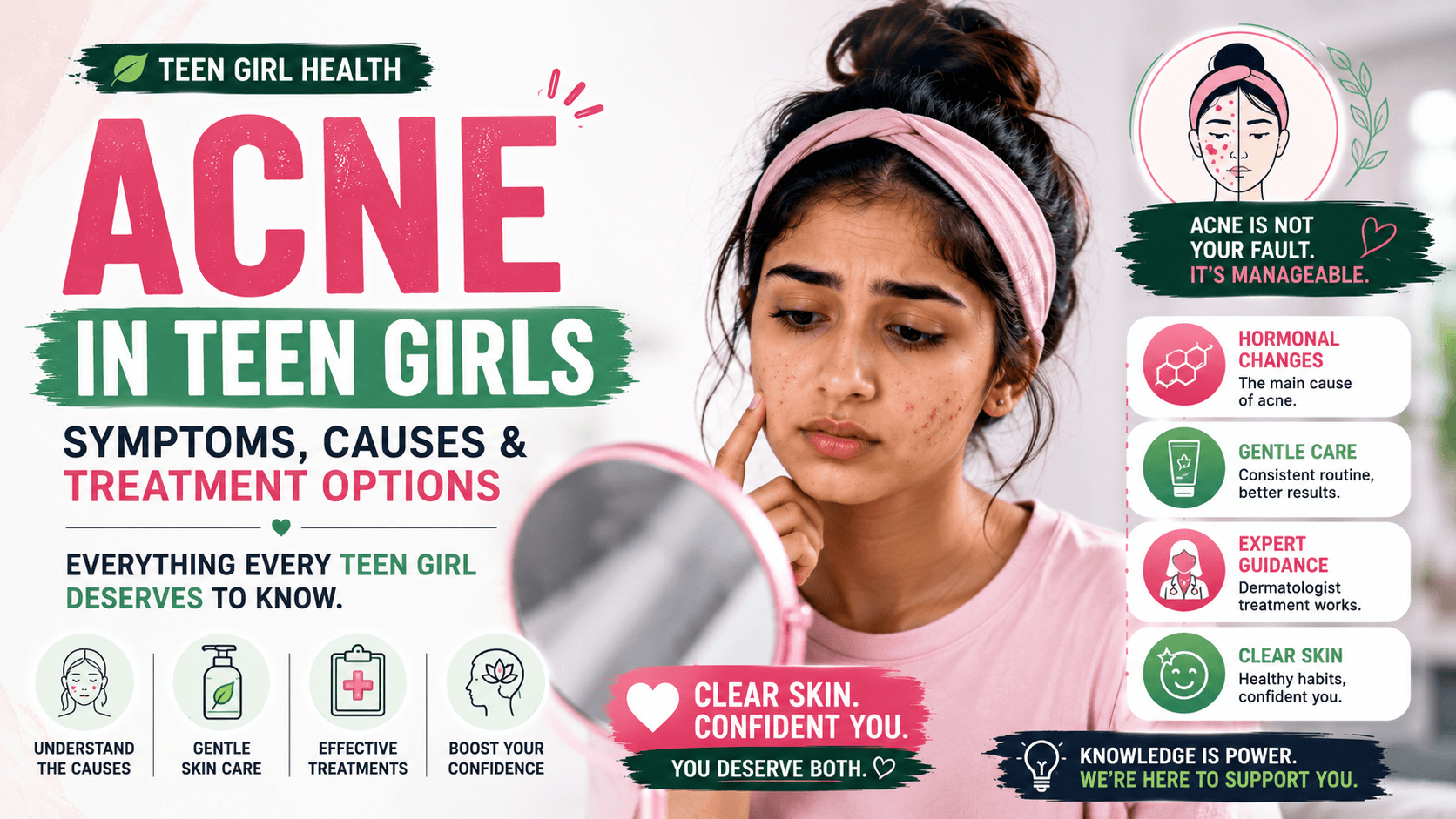
Dive into the world of acne in teen girls. Explore causes, symptoms, and effective treatments to help manage this common skin condition.
Maryam Mumtaz
Co-Founder & CEO
12 min read•7/20/2026
Marsa Empower · Skin Health & Hormonal Wellness · For Girls & Women Aged 13–50 · 14 min read
"Acne is not about being dirty. It is not your fault. It is one of the most common skin problems in the world — and it can be treated."
Acne is a very common skin problem. Almost every teenager gets it at some point in life. Many adults get it too, even in their thirties, forties, or fifties.
Let us understand it in a simple way.
Your skin has tiny holes called pores. Under each pore, there is a small gland. This gland makes an oil called sebum. This oil is not bad. It keeps your skin soft.
But during the teenage years, the body's hormones change. Hormones are chemicals inside your body that control growth and many other things. When hormones rise, the oil gland starts making too much oil.
Here is what happens, step by step:
This redness and swelling is what we call a pimple.
So please remember this: Acne is caused by oil, hormones, and blocked pores. It is not caused by being dirty. Washing your face many times a day will not stop it, because the real cause is inside the body, not on top of the skin.
Acne appears where the skin has the most oil glands. It is not random. There is a clear pattern.
| Body Part | Why Acne Appears Here |
|---|---|
| Face (forehead, cheeks, chin, jaw) | This area has the most oil glands on the whole body |
| Chest | Also has many oil glands |
| Shoulders and upper back | Oil glands here are large and react strongly to hormones |
| Neck | A common spot for acne caused by hormones |
If your pimples mostly appear on the jawline and chin, this usually means hormones are the main cause. This is very common in teenage girls and young women.
Acne does not look the same on every person. Some people get a few small bumps. Others get many painful bumps. Here are the common signs:
| Symptom | What It Looks Like |
|---|---|
| Pimples | Red bumps, sometimes with a white top |
| Whiteheads | Small closed bumps under the skin |
| Blackheads | Small dark spots in open pores (this is not dirt) |
| Red, swollen bumps | Sore and puffy areas of skin |
| Deep, painful lumps | Hard bumps under the skin, called cysts or nodules |
| Oily skin | A shiny look on the forehead and nose |
| Dark marks | Brown or dark spots left behind after a pimple heals |
| Body acne | Pimples on the chest, back, or shoulders |
If you see more than one of these on your skin, it is still all part of acne. These are just different stages of the same problem.
Doctors divide acne into six main types. Knowing the type helps you understand how serious it is.
Whiteheads — Small, closed bumps under the skin. They look like tiny white or skin-colored dots.
Blackheads — Open pores with dark material inside. The dark color comes from air touching the oil, not from dirt.
Papules — Small red bumps that feel tender. There is no pus yet.
Pustules — This is what most people call a normal "pimple." It has a white or yellow center full of pus.
Nodules — Large, hard, painful lumps deep under the skin. Never squeeze these. Squeezing pushes the problem deeper and causes scars.
Cysts — The most serious type. Large, soft, painful lumps filled with pus, deep in the skin. These always need a doctor's help.
| Type | How Serious | Can You Treat It at Home? | Do You Need a Doctor? |
|---|---|---|---|
| Whiteheads | Mild | Yes | Usually not |
| Blackheads | Mild | Yes | Usually not |
| Papules | Mild to Medium | Yes | Sometimes |
| Pustules | Medium | Yes | Sometimes |
| Nodules | Serious | No | Yes |
| Cysts | Very Serious | No | Yes, urgently |
Acne is almost never caused by just one thing. It is usually a mix of these six causes.
Cause 1 — Hormonal Changes This is the biggest cause in teenage girls. During puberty, the body makes more hormones called androgens. These hormones tell the oil glands to make more oil. More oil means more blocked pores. This is also why acne often gets worse right before a period.
Cause 2 — Too Much Oil Once the hormones push the oil glands to work harder, the skin makes more oil than it can clear away naturally. This extra oil is the starting point of most pimples.
Cause 3 — Blocked Pores Skin sheds dead cells every day. This is normal. But when there is too much oil, these dead cells stick together inside the pore instead of washing away. This blocks the pore.
Cause 4 — Family History If your parents had acne, you have a higher chance of getting it too. This is because genetics affects your skin type, your pore size, and how your oil glands react to hormones.
Cause 5 — Stress Stress does not directly cause pimples, but it makes existing acne much worse. When you are stressed, your body makes a hormone called cortisol. This hormone tells your oil glands to make more oil. This is why skin often gets worse during exams or hard times in life.
Cause 6 — Heavy Skincare or Makeup Some thick creams, oily sunscreens, and heavy makeup can block your pores. Always choose products that say "non-comedogenic" or "oil-free" on the label. These words mean the product will not block your pores.
Hormonal acne behaves differently from regular acne, so it often needs a different kind of treatment.
| Feature | Hormonal Acne | Regular Acne |
|---|---|---|
| Where it appears | Jawline, chin, lower cheeks, neck | Forehead, nose, T-zone |
| Pattern | Gets worse before your period | Not linked to your monthly cycle |
| Feel | Often deep and painful | Mostly on the surface |
| Response to skincare | Limited help from normal skincare | Often improves with skincare |
| Linked to other issues | PCOS, irregular periods, extra hair growth | Usually not linked to other health issues |
If your acne mostly shows up on the jawline and chin, gets worse before your period, and comes together with irregular periods or extra hair growth, this could point to a condition called PCOS (Polycystic Ovary Syndrome). In this case, skincare alone will usually not be enough. It is best to talk to a doctor.
A good routine does not need to be expensive. It does not need many products. What matters most is doing the same simple steps every single day.
Step 1 — Wash Your Face Twice a Day
Wash your face once in the morning and once before bed. Use a mild, gentle face wash made for acne-prone skin.
How to wash correctly:
Do not wash your face more than twice a day. Washing too much removes the skin's natural oil. In response, the skin makes even more oil, which can make acne worse.
Step 2 — Use a Treatment Product
After washing, a treatment product can help clear pimples and stop new ones from forming.
| Ingredient | Best For |
|---|---|
| Salicylic acid | Blackheads, whiteheads, blocked pores |
| Benzoyl peroxide | Red, swollen pimples |
| Niacinamide | Redness and dark marks after pimples heal |
Start with only one product. Use it three nights a week at first. This gives your skin time to adjust without becoming dry or irritated.
Step 3 — Always Use Moisturizer
Many people think oily skin should not use moisturizer. This is wrong. Every skin type needs moisturizer, even oily skin. If you skip it, your skin can dry out and make even more oil to make up for it.
Choose a light, oil-free moisturizer. A gel type usually works best for oily skin.
Step 4 — Use Sunscreen Every Day
Sunscreen is important, even with acne. Many acne treatments make your skin more sensitive to sunlight. Sun without protection can make dark marks worse and slower to fade.
Use a sunscreen with SPF 30 or higher, and choose one that says "non-comedogenic."
Step 5 — Remove Makeup Every Night
Never sleep with makeup on your face. Use a gentle makeup remover first, then wash your face with your normal face wash.
Products You Can Buy Without a Doctor's Note
| Product | Main Ingredient | Best For |
|---|---|---|
| Gentle face wash | Salicylic acid or benzoyl peroxide | All types of acne |
| Spot treatment | Benzoyl peroxide 2.5% to 5% | Active pimples |
| Toner | Salicylic acid 0.5% to 2% | Blackheads and blocked pores |
| Moisturizer | Hyaluronic acid, niacinamide | All skin types |
| Sunscreen | Zinc oxide, SPF 30+ | Daily use |
Treatments a Doctor Can Prescribe
If your acne is moderate to severe, or has not improved after 2 to 3 months of home care, a skin doctor (dermatologist) can give you stronger treatment:
| Treatment | What It Does | Best For |
|---|---|---|
| Retinoid cream | Speeds up skin renewal, clears pores | Blackheads, moderate acne |
| Antibiotic cream | Reduces acne bacteria | Red, swollen pimples |
| Antibiotic tablets | Fights bacteria and swelling from inside the body | Moderate to severe acne |
| Birth control pill | Balances hormones | Hormonal acne in women |
| Spironolactone | Lowers the hormones that cause oil | Long-lasting hormonal acne |
| Isotretinoin (Roaccutane) | Shrinks oil glands | Severe, deep acne |
A doctor will choose the right treatment for you. Do not use these medicines without medical advice.
Food does play a role in acne, but it is often talked about too much online. Eating one sweet or one fried snack will not give you a pimple the next day. But what you eat regularly, over weeks and months, can affect your oil, your hormones, and swelling in the skin.
Foods That Help Your Skin
| Food | Why It Helps |
|---|---|
| Green vegetables (spinach, methi) | Reduces swelling, full of vitamins |
| Berries | Fight inflammation in the skin |
| Fish like salmon and sardines | Contain healthy fats that reduce swelling |
| Nuts and pumpkin seeds | Contain zinc, which helps skin repair itself |
| Sweet potato and carrots | Help skin cells renew |
| Eggs | Good source of protein and zinc |
| Green tea | Fights inflammation |
| Brown rice and oats | Keep blood sugar steady |
| Water | Keeps skin hydrated |
Foods to Limit
| Food | Why to Limit It |
|---|---|
| Sugary drinks and sweets | Raise blood sugar and hormone levels that increase oil |
| White bread, white rice | Same effect as sugar |
| Too much dairy | Some studies link it to more acne |
| Fried and fast food | Increases inflammation |
| Too much caffeine | Raises stress hormones |
The single best change you can make is eating less sugar and fewer white, processed foods. This has the strongest link to clearer skin.
Acne is not only a skin problem. It can affect how a girl or woman feels about herself. This is very real, and it should never be ignored.
Studies show that acne is linked to:
These feelings are real, and they matter.
If your acne is affecting your mood or confidence, tell your doctor. Feeling upset about your skin is a good enough reason on its own to ask for better treatment. You do not need to just "live with it."
And please remember: your skin does not decide your value as a person. Acne is a medical condition. It does not say anything about who you are.
| The Myth | The Truth |
|---|---|
| "Dirty skin causes acne" | False. Acne comes from oil and bacteria, not dirt. Washing too much makes it worse |
| "Greasy food causes acne" | Mostly false. Sugar and processed food may make it worse over time, but one meal will not cause a pimple |
| "Only teenagers get acne" | False. Many adult women get acne too, even in their thirties and forties |
| "Popping pimples makes them heal faster" | False. Popping pushes bacteria deeper and causes scars |
| "Sunlight clears acne" | False. A tan may hide acne for a short time, but the sun makes it worse in the long run |
| "You will grow out of it" | Sometimes true, sometimes false. Many adults still have acne for years without treatment |
| "Expensive products work better" | False. Price does not decide how well a product works |
| "Acne means you don't care for your skin" | False. Acne is mostly caused by genes and hormones, not by how clean you are |
You should see a doctor or skin specialist if:
Treating acne early helps prevent scars. Scars are much harder to treat than acne itself. The best time to treat acne is before it becomes severe.
| Topic | Key Point |
|---|---|
| Root cause | Hormones, extra oil, blocked pores, bacteria, genetics — not dirt |
| Most common pattern in teens | Hormonal acne on the jawline and chin |
| Basic routine | Wash gently twice a day, treat, moisturize, use sunscreen |
| Biggest mistakes | Washing too much, using harsh products, popping pimples |
| Best diet change | Eat less sugar and fewer processed foods |
| When to see a doctor | Severe acne, scars, no improvement, or hormone symptoms |
| Medical treatments | Retinoids, antibiotics, birth control pill, spironolactone, isotretinoin |
| Mental health | A real concern, and a valid reason to seek treatment |
| Most important truth | Acne is a medical condition, not a sign of poor hygiene or low worth |
"Acne does not define you. It is one of the most common skin conditions in the world, and it can be treated. You deserve clear skin, and you deserve to feel confident."
This article is for education and awareness only. It is not medical advice, diagnosis, or treatment. If you have moderate to severe acne, or acne that is affecting your wellbeing, please speak with a qualified skin doctor or healthcare professional.
Marsa Empower · Skin Health · Teen Wellness · Women's Hormonal Health
Medical Disclaimer
This article is for general informational and educational purposes only and is not a substitute for professional medical advice, diagnosis, or treatment. Always seek the advice of a qualified healthcare provider with any questions you may have regarding a medical condition. Never disregard professional medical advice or delay seeking it because of something you have read on MARSA Empower.
Written By
Maryam Mumtaz
Co-Founder & CEO
Co-Founder of MARSA Empower who leads the visual and strategic evolution of the platform. Maryam bridges technical complexity with human-centric design, architecting the team's official roadmap and ensuring MARSA effectively addresses the real-world needs of women. With deep expertise in agentic AI, full-stack development, and UI/UX design, she has delivered 50+ projects for 30+ satisfied clients.
Enjoyed this story?