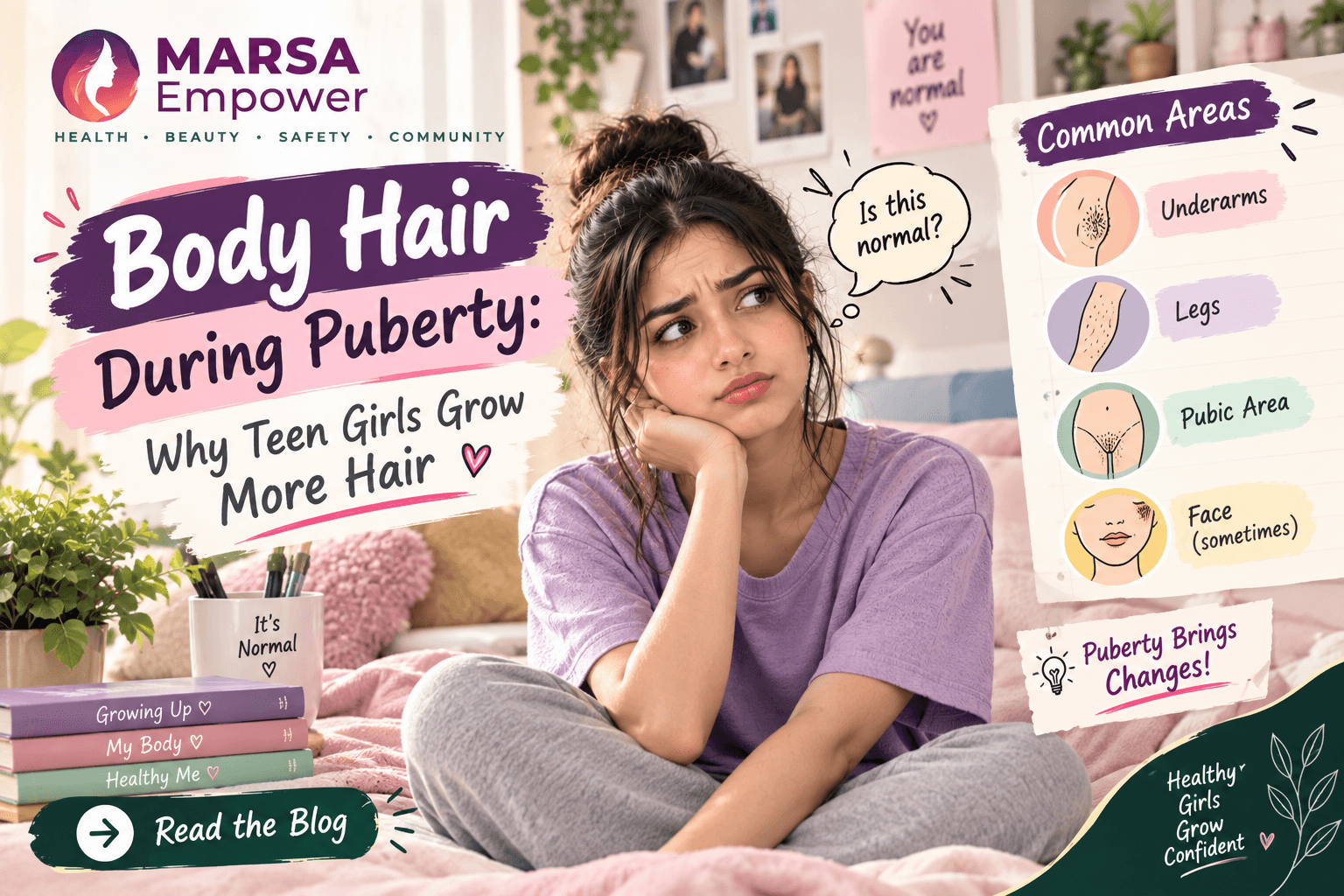
Explore the reasons behind increased body hair in teen girls during puberty. Learn expert insights and practical tips for healthy management.
Maryam Mumtaz
Co-Founder & CEO
8 min read•10/1/2026
Marsa Empower · Teen Girls' Health · Growing Up Guide · For Girls Aged 10 and Above · 8 min read
Puberty brings a lot of changes — and one of the most noticeable is the growth of new body hair in places that previously had none, and the darkening and thickening of hair that was already there.
This can feel surprising, and sometimes uncomfortable — particularly when you compare yourself to friends who seem to have less hair, or when you notice hair appearing in places you did not expect.
This guide is here to give you clear, honest answers. Body hair during puberty is a completely normal, healthy part of growing up. Understanding why it happens, what is normal, and when (if ever) it is worth speaking to a doctor helps you approach this change with knowledge rather than worry.
The human body is covered in hair follicles — small structures in the skin that produce hair. Most of this hair is very fine and light, barely visible under normal circumstances. This fine hair is called vellus hair.
During puberty, some of this vellus hair transforms into terminal hair — darker, thicker, coarser hair that is more visible. This transformation happens in specific areas of the body and is driven by the hormonal changes of puberty.
Hair varies between people in texture, colour, and thickness — and it varies between different areas of the same body. All of this variation is entirely normal.
The growth of new body hair during puberty is directly caused by hormones — specifically a group of hormones called androgens.
Androgens are sometimes called "male hormones," but this name is misleading because everyone produces androgens — including girls and women. The difference is in the amount. During puberty, the adrenal glands (small glands above the kidneys) begin producing more androgens, particularly DHEA and DHEA-S. These androgens travel through the blood to hair follicles in specific areas of the body and signal them to produce visible, darker, coarser hair.
This process is called adrenarche, and it is a normal and expected part of pubertal development for all girls.
The most common areas where androgen-driven hair growth occurs are the underarms, the pubic area, and to varying degrees the legs, arms, face, and abdomen. The specific amount and distribution of this hair varies significantly from girl to girl — from barely visible to quite noticeable — depending on genetics and individual hormone levels.
Body hair growth during puberty typically begins in the following order, though the timing varies considerably between individuals.
Pubic hair — fine, lighter hair in the pubic area — is often one of the first visible signs of puberty, typically beginning around ages 8 to 13. It gradually becomes darker and coarser over the following years.
Underarm hair typically appears a year or two after pubic hair begins growing, usually between ages 10 and 14.
Leg hair darkening and thickening, and visible growth on the arms, typically continues throughout the teenage years.
Some girls notice fine, darker hair on the upper lip, chin, or sides of the face during puberty. A small amount of facial hair growth is a normal androgen-driven change for many girls and women.
The timing of all these changes varies widely between girls. Beginning earlier or later than your friends, or having more or less hair than others your age, does not mean anything is wrong.
Yes — very much so.
The increase in body hair during puberty is one of the most universal and consistent changes of female pubertal development. Every girl who goes through puberty experiences some degree of new body hair growth. How much, how visible, how dark, and in exactly which areas varies significantly between individuals — but the fundamental change of having more and more visible body hair than in childhood is entirely normal.
It is also important to know that the images of women you may see in films, advertising, and social media often represent bodies where body hair has been removed or is not shown. This creates the false impression that adult women naturally have no body hair. They do. Hair removal is a personal choice — not something the body requires, and not something every woman or girl chooses. What is "normal" in real life includes women with varying amounts of visible body hair in various areas.
It is common to look around and notice that friends seem to have more or less body hair than you do. This variation is real and has straightforward explanations.
Genetics are the most significant factor in how much body hair you have and how visible it is. Girls who come from families with more visible body hair — often correlating with certain ethnic or regional ancestries — will naturally tend to have more body hair themselves. Girls from South Asian, Middle Eastern, Mediterranean, and Latin American backgrounds, for example, often have darker and more visible hair on the arms, legs, and face than girls from Northern European backgrounds. This is entirely a genetic and ancestral variation, not a health problem.
If your mother, older sisters, or aunts have more visible body hair, it is very likely that you will too. If you come from a family with less visible body hair, your own is likely to be similar.
The amount of androgens produced during puberty varies between individuals — driven partly by genetics. Girls who produce slightly higher androgen levels during puberty naturally develop more visible body hair in androgen-sensitive areas. This is a normal variation within the healthy range of puberty.
Hair visibility also depends on skin tone and hair colour. Girls with darker hair and lighter skin tones will have more visibly noticeable body hair than girls with lighter hair or darker skin tones, even if the actual amount of hair is similar. This is a visual effect of contrast rather than a difference in the amount of hair present.
Before puberty begins, most girls have only fine, light vellus hair on most of the body. The transformation to more visible terminal hair has not yet been triggered by androgen production.
The teenage years are when the most significant body hair changes occur. Most of the visible body hair a woman will have in adulthood develops during the teenage years in response to the androgen surge of puberty. This development continues gradually throughout the teens.
By the early twenties, body hair development is generally complete. The pattern of body hair in adulthood reflects the combination of genetics, androgen levels, and the skin and hair characteristics of the individual.
Adult women have variable amounts of body hair in various areas. Body hair does not disappear with age in the way that it might seem from media representation. Hair removal is a choice that many adult women make for various reasons — cultural, personal, or practical — but it is a choice rather than a biological necessity.
During and after puberty, girls and women may notice more visible body hair in the following areas.
The pubic area — hair in the genital area develops in stages through puberty, beginning with fine lighter hair and becoming darker and coarser over several years.
The underarms — underarm hair typically begins growing one to two years after pubic hair appears. Its development is very common and normal.
The legs — leg hair that was previously fine and barely visible often becomes darker and more noticeable during puberty. The amount and distribution varies significantly between individuals.
The arms — arm hair similarly may become more visible. Many girls have quite visible arm hair as a normal feature of their natural body hair.
The upper lip and face — fine hair on the upper lip and sides of the face is a normal variation for many girls and women, particularly those with darker hair and certain ancestral backgrounds.
The abdomen — some girls notice fine or darker hair between the navel and the pubic area, or more broadly on the lower abdomen. A small to moderate amount of this is a normal variation.
The lower back — some girls notice hair on the lower back, which is a normal variation.
What you do with your body hair is entirely your personal choice. There is no medical requirement to remove body hair, and no hygiene reason that makes removal necessary. The decision to remove, keep, or manage body hair in any way is a personal one.
Whatever you choose to do with your body hair, keeping the skin in those areas clean is important. Regular washing with mild soap and water removes sweat, bacteria, and dead skin cells that can accumulate around hair follicles — preventing the irritation or folliculitis (infected hair follicles) that can sometimes occur.
The skin in areas like the underarms, bikini area, and legs is sensitive. Whatever hair care approach you choose, being gentle with the skin — avoiding harsh scrubbing, irritating products, or aggressive techniques — prevents the ingrown hairs, redness, and irritation that can occur from harsh treatments.
If you choose to shave, using a clean, sharp razor specifically designed for body use, applying a gentle soap or shaving gel to the area first, shaving in the direction of hair growth where possible, and moisturising the area afterward all reduce the skin irritation and ingrown hair that can accompany shaving. Sharing razors is not recommended as it can transmit bacteria and infection.
Other hair removal options available for older teenagers with parental guidance include hair removal creams, waxing, and threading. Any method chosen should be appropriate for the skin area and the individual's skin sensitivity.
Body hair is one of the areas where social and cultural pressure on teenage girls can be intense. You may see messages suggesting that body hair is something to hide or be ashamed of, and you may feel pressure to remove it so that you look like the images you see in media.
It is worth remembering a few important things.
Body hair is a natural part of the female body. Every woman has it. What you see in media is often not representative of real, unedited women's bodies — and the absence of body hair in those images reflects editing and removal choices, not natural biology.
Body hair removal is a personal choice, not a medical requirement. Many women and girls remove some or all of their body hair because they prefer the way it looks or feels. Many others do not. Both are valid.
Your body is not less clean, less healthy, or less worthy of respect because it has body hair. The way you choose to manage your body hair — any choice you make — is not a reflection of your hygiene, your attractiveness, or your worth.
If you feel significant distress or shame about your body hair, talking to a trusted adult — a parent, guardian, school counsellor, or healthcare professional — is a supportive step.
In the vast majority of cases, body hair in teenage girls is simply a normal feature of pubertal development and requires no medical attention.
However, there are some specific patterns of hair growth that are worth discussing with a healthcare provider. These include:
Significant coarse, dark hair growing on the chin, upper lip, cheeks, jaw, or neck — particularly if it is appearing rapidly or is noticeably thick and coarse rather than fine. A small amount of fine hair in these areas is a normal variation, but significant coarse facial hair alongside other symptoms may warrant investigation for a hormonal condition.
Dark hair growing on the chest, upper abdomen, or back in significant amounts — particularly if accompanied by other changes.
Body hair growth that began very early — before age 8 — which may indicate precocious (early) puberty or another hormonal condition that a doctor should assess.
Body hair changes that are accompanied by other symptoms such as irregular or absent periods, persistent severe acne particularly along the jawline, unexplained weight gain, scalp hair thinning, or significant mood changes. These combined features can sometimes indicate conditions including PCOS (Polycystic Ovary Syndrome) that respond well to appropriate medical management.
The key distinction is between the gradual, distributed body hair growth that is part of normal puberty — which involves most or all of the areas described in this guide — and a specific pattern of excessive, coarse hair growth in typically androgen-sensitive areas (face, chin, chest) alongside other hormonal symptoms. The latter pattern is called hirsutism and warrants professional evaluation.
There is no situation in which a question about your body is too small, too embarrassing, or not important enough to ask. Every teenage girl deserves access to clear, honest information about her own body, and every question deserves a real answer.
Talk to a parent, guardian, school nurse, or doctor if:
You are concerned about body hair that seems significantly more than what your peers have, and you want guidance on whether it warrants investigation. You have noticed coarse, dark hair growing on your face, particularly your chin or cheeks, alongside other symptoms. You have started developing body hair before age 8. You are experiencing other changes alongside unusual body hair — irregular periods, severe jawline acne, scalp hair thinning, or unexplained weight gain — and you want these patterns assessed together. You feel significant distress about your body hair that is affecting your daily life, confidence, or wellbeing.
Questions about your body are never silly or embarrassing. Healthcare professionals and trusted adults have heard every question before, and their role is to provide you with accurate, supportive information — not to judge.
Marsa Empower provides health education and wellness resources for girls and women at every life stage — including the teenage years when questions about body changes are most common and most deserving of clear, honest answers.
Where Marsa helps — Health Hub cycle tracking. Once periods begin, Marsa's Health Hub allows teenage girls to track their menstrual cycles over time. If body hair concerns are accompanied by irregular periods or other hormonal features, having a documented cycle history provides the most useful information for a healthcare consultation.
Health education resources. Marsa's educational content explains puberty, hormonal health, PCOS, and the normal range of body changes in the teenage years — in language that is accessible and non-judgmental, helping girls understand what is happening to their bodies clearly and accurately.
AI health guidance — Digital Doctors. Girls who have questions about body hair changes, puberty, or whether specific features might warrant medical attention can access Marsa's Digital Doctors for private, educational guidance in a comfortable, non-embarrassing format.
Important note. Marsa Empower is a health education and wellness companion. Any teenage girl with concerns about significant or unusual body hair patterns, or body hair accompanied by other hormonal symptoms, should be evaluated by a qualified healthcare professional or paediatric endocrinologist who can provide a thorough clinical assessment.
Is body hair normal for teen girls?
Yes, completely. Body hair development during puberty is a universal feature of female pubertal development — every girl who goes through puberty develops more body hair in various areas. The specific amount, distribution, and visibility varies between individuals, but the presence of body hair is entirely normal.
Why is my body hair getting darker?
Body hair darkens during puberty because hormones called androgens trigger the transformation of fine, light vellus hair into darker, thicker terminal hair. This is a completely normal and expected part of pubertal development.
Why do some girls have more body hair than others?
Genetics are the most significant factor. Girls from families with more visible body hair — often associated with South Asian, Middle Eastern, Mediterranean, and other ancestral backgrounds — naturally tend to have more visible hair themselves. Individual variation in androgen levels during puberty also contributes. Hair and skin tone further affect how visible the hair appears.
Is it normal to have body hair on the arms and legs?
Yes. Hair on the arms and legs is entirely normal for girls and women. Leg and arm hair often becomes more visible during puberty as it darkens and thickens. Many women have quite visible body hair on their arms and legs throughout their lives — this is normal biology, not a health problem.
Should I worry if I have more body hair than my friends?
In most cases, no. Variation in body hair between girls of the same age is very common and almost always reflects genetic and individual differences rather than a health problem. If you have significantly more coarse, dark hair on your face or other specific areas alongside other symptoms like irregular periods or significant acne, it is worth mentioning to a doctor — but simply having more visible body hair than some of your peers, without other symptoms, is unlikely to indicate anything medically significant.
When should I talk to a doctor about body hair?
Talk to a doctor if you have significant coarse, dark hair growing on your face, chin, or cheeks alongside other hormonal symptoms. If body hair began before age 8. If body hair is accompanied by irregular or absent periods, severe acne particularly along the jawline, scalp hair thinning, or unexplained weight gain. Or if you are simply worried and want reassurance from a healthcare professional — that is always a valid reason.
Body hair during puberty is not something unusual, embarrassing, or wrong. It is a completely normal, expected, and universal part of growing up — driven by the same hormonal changes that produce all of the other physical changes of puberty.
Every girl develops more body hair during puberty. How much, how visible, and in exactly which areas varies from girl to girl — shaped by genetics, individual hormone levels, and skin and hair characteristics. This variation is normal and does not reflect anything about hygiene, health, or worth.
What you choose to do with your body hair is entirely your own decision. There is no right or wrong answer. Many women remove some body hair. Many do not. Both are completely valid choices.
Understanding what is happening to your body — and why — is the most important thing. And knowing when a pattern of hair growth is simply normal variation versus when it is worth discussing with a doctor gives you the knowledge to take care of your own health confidently.
Your body is not doing something wrong. It is doing exactly what a healthy, developing body does.
Educational Disclaimer
This article is for educational and awareness purposes only. It does not constitute medical advice. If you have concerns about body hair changes during puberty, or if body hair is accompanied by other symptoms, please speak with a trusted adult and consult a qualified healthcare professional for personalised guidance.
Marsa Empower | Care. Safety. Growth.
Visit marsaempower.com to explore health resources for teenage girls, access educational guidance about growing up, and find support for every stage of your health journey.
Medical Disclaimer
This article is for general informational and educational purposes only and is not a substitute for professional medical advice, diagnosis, or treatment. Always seek the advice of a qualified healthcare provider with any questions you may have regarding a medical condition. Never disregard professional medical advice or delay seeking it because of something you have read on MARSA Empower.
Written By
Maryam Mumtaz
Co-Founder & CEO
Co-Founder of MARSA Empower who leads the visual and strategic evolution of the platform. Maryam bridges technical complexity with human-centric design, architecting the team's official roadmap and ensuring MARSA effectively addresses the real-world needs of women. With deep expertise in agentic AI, full-stack development, and UI/UX design, she has delivered 50+ projects for 30+ satisfied clients.
Enjoyed this story?