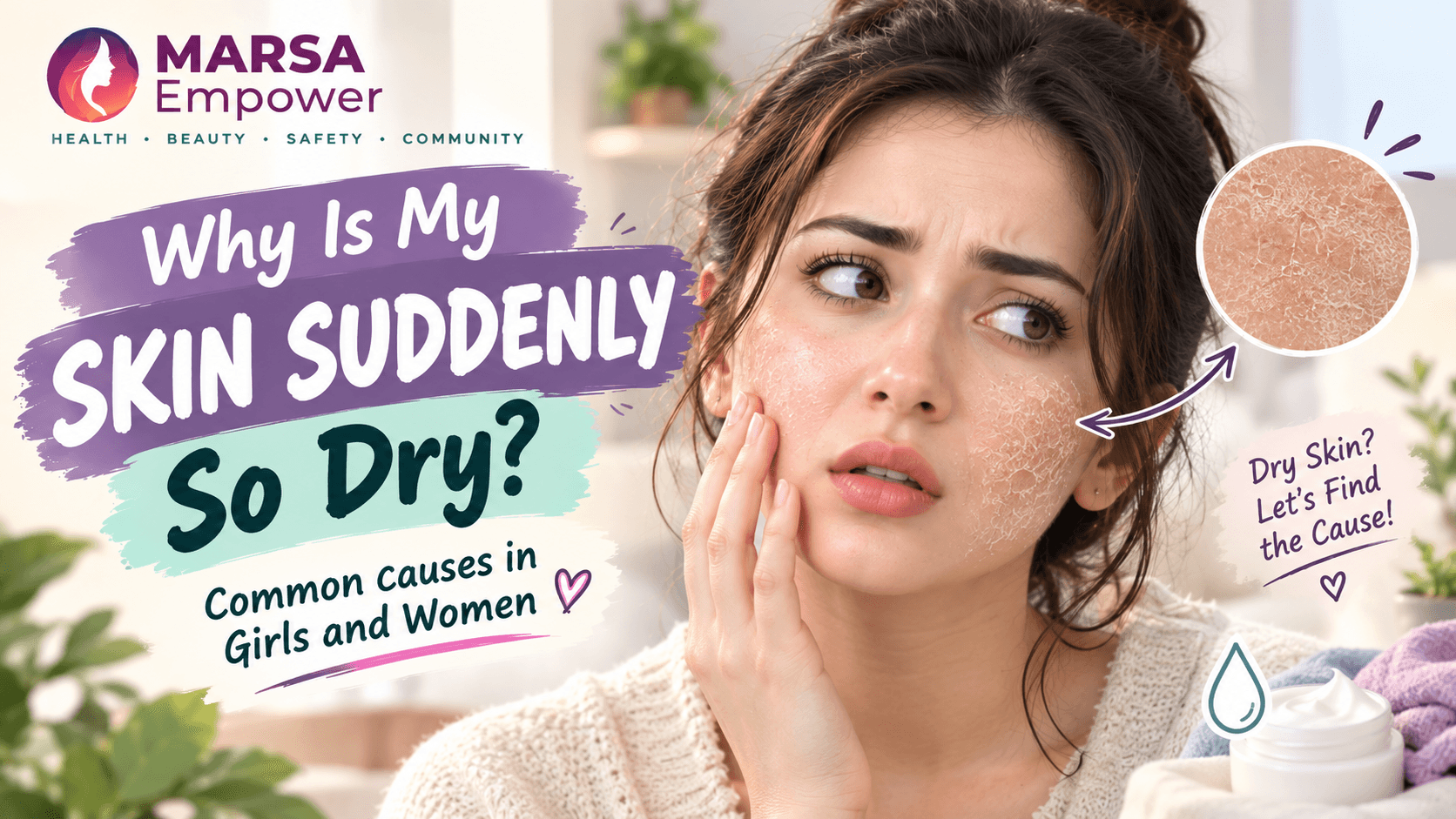
Sudden dry skin can be puzzling. Discover the common causes affecting women and girls, including environmental factors and lifestyle changes, with expert insights and actionable solutions.

Maryam Mumtaz
Co-Founder & CEO
11 min read•10/2/2026
Marsa Empower · Skin Health & Everyday Wellness · For Girls & Women Aged 13 and Above · 11 min read
Dry skin is one of the most common skin concerns among women and girls — and one of the most frequently managed with the wrong approach because its cause has not been identified.
Many women reach for a richer moisturiser when their skin becomes dry, only to find that the dryness returns quickly or does not fully resolve. This often happens because moisturising treats the surface symptom without addressing the underlying cause — whether that is a change in the weather, a harsh cleanser stripping the skin barrier, a thyroid condition reducing sebum production, or hormonal changes during puberty or menopause altering the skin's moisture-retaining capacity.
Understanding why skin has become dry — and distinguishing a simple environmental trigger from a persistent medical or hormonal cause — is the most efficient path to actually improving it.
Healthy skin maintains its moisture and softness through two mechanisms: the production of natural oils (sebum) by sebaceous glands that coat the skin surface and reduce water evaporation, and the skin barrier — the outermost layer of the skin (stratum corneum) — which is composed of skin cells embedded in a lipid matrix that acts as a seal against water loss and external irritants.
Dry skin occurs when either of these mechanisms is insufficient — when sebum production is reduced, when the skin barrier is damaged or depleted of its lipid components, or when the rate of water evaporation from the skin surface exceeds the skin's ability to replenish it.
The result is skin that is rough, tight, sometimes flaky, and more reactive to external factors because the compromised barrier allows irritants and allergens to penetrate more easily.
The most common cause of sudden or seasonal dry skin. Cold air holds less moisture than warm air, and indoor heating further reduces humidity — creating an environment in which water evaporates rapidly from the skin surface. Many women notice that their skin becomes significantly drier in winter or in air-conditioned environments — this is directly driven by the low humidity of these environments.
Hot water dissolves and strips the natural oils (lipids) from the skin surface more efficiently than lukewarm water — removing the barrier components that retain moisture. Women who take long, hot showers and do not moisturise immediately afterward frequently experience post-shower dryness that accumulates into persistent dryness over time.
Soaps and cleansers that contain sulfates, alcohol, fragrances, or other stripping ingredients remove skin lipids alongside dirt and oil — leaving the skin surface depleted of its natural barrier components. This is particularly common with antibacterial soaps and harsh body washes. The tight, dry feeling immediately after washing with a harsh cleanser is the direct sensation of stripped skin lipids.
Even with a mild cleanser, washing too frequently — particularly the face — removes more lipids than the skin can replace between washes, progressively depleting the barrier. Over-washing the face (more than twice daily) is a common cause of facial dryness in women who may actually have normal or combination skin but have inadvertently created dryness through excessive cleansing.
While skin dryness is primarily driven by barrier function and sebum production rather than by total body hydration alone, significant chronic dehydration does affect skin appearance — producing a duller, more sunken appearance that emphasises surface texture. Adequate daily hydration supports overall cellular function, including the metabolic processes that maintain skin cells.
Cold wind strips moisture from the skin surface and damages the barrier through physical stress. Women who spend significant time in cold, windy conditions without protecting exposed skin often experience windburn — a specific form of barrier damage and dryness from sustained wind exposure.
Chronic psychological stress elevates cortisol, which impairs the skin barrier's ability to repair itself. Elevated cortisol reduces ceramide production — ceramides are the primary lipids of the skin barrier — directly weakening the barrier's moisture-retaining capacity. Poor sleep similarly impairs overnight skin repair, since the skin's most active cellular regeneration occurs during deep sleep. Women who go through periods of high stress or sustained poor sleep commonly notice their skin becoming drier and more reactive.
Hormones directly regulate sebum production and skin barrier function. This is one of the most significant and most frequently missed causes of new or worsening dry skin in women. Oestrogen supports sebum production and skin thickness — when it falls (during the premenstrual phase, at menopause, or when body weight or fat percentage is very low), the skin produces less oil and retains moisture less effectively.
The skin naturally produces less sebum and has a less efficient barrier function with increasing age. These changes accelerate significantly at and after menopause. Dryness that develops or worsens in the mid-forties and beyond often reflects these age-related and menopause-related changes rather than external skin care habits.
Several commonly used medications list dry skin as a side effect. Retinoids (used for acne and anti-ageing), diuretics, antihistamines, statins, and some blood pressure medications all have the potential to reduce sebum production or alter the skin's moisture balance.
Several medical conditions can cause or significantly worsen dry skin. Hypothyroidism (underactive thyroid) reduces sebum production throughout the body, producing the dry, rough skin that is a characteristic feature. Diabetes affects skin circulation and nerve function in ways that impair skin moisture regulation. Eczema (atopic dermatitis) is a chronic inflammatory skin condition characterised by impaired barrier function and severe dryness. Psoriasis and ichthyosis are other skin conditions that produce significant dryness as a primary feature.
New, significant dry skin — particularly when accompanied by other symptoms like fatigue, weight changes, cold intolerance, or hair changes — warrants thyroid function testing and a broader medical assessment.
Teenage girls experience dry skin from several specific causes that intersect with their particular life circumstances.
The hormonal changes of puberty more commonly increase sebum production (driving acne) than reduce it. However, some teenage girls experience hormonally driven skin changes that include areas of dryness alongside oilier zones — combination skin that requires targeted rather than blanket approaches.
The most common cause of dry skin in teenage girls is the products they are using. Many over-the-counter acne products — benzoyl peroxide, salicylic acid, astringents, alcohol-based toners — are effective for reducing acne bacteria and oil but also strip the skin barrier significantly when used in excess or in combination. A teenage girl using multiple acne products simultaneously on top of a harsh cleanser is very likely damaging her barrier and creating the "combination" pattern of oily in the T-zone but dry and flaky in other areas.
Prescription retinoids (tretinoin) — widely used for acne — are potent barrier-disrupting ingredients that consistently cause dryness, peeling, and sensitivity when first introduced. This is a predictable and manageable side effect that improves with time and appropriate supporting skincare, but it is a common and significant cause of dry skin in teenagers receiving retinoid treatment for acne.
Exam stress, social pressure, and the often-insufficient sleep of the teenage years all elevate cortisol and impair overnight skin repair — contributing to the dry, dull skin that many teenagers notice during demanding periods.
Air-conditioned school and study environments, and winter weather, affect teenage skin in the same ways they affect adult skin.
Young adult women most commonly experience dry skin from environmental factors (air conditioning, winter weather), skincare choices (over-cleansing, harsh products), and lifestyle factors (stress, poor sleep). Identifying and changing the causative skincare or lifestyle factor typically resolves the dryness efficiently.
Pregnancy produces significant hormonal changes that affect skin in different ways for different women. Some women experience oilier skin from elevated progesterone. Others — particularly in the third trimester — notice significant abdominal skin dryness and tightness as the skin stretches. Changes in bathing habits, nausea reducing water intake, and the physical demands on the skin from stretching all contribute.
The hormonal fluctuations of perimenopause — with declining oestrogen — begin the process of reducing sebum production and skin barrier efficiency. Many women notice their skin becoming noticeably drier in their mid-to-late forties compared to previous decades. This is a real, hormonally driven change that requires adjustment of skincare habits toward richer, more barrier-supporting formulations.
Postmenopausal skin — with sustained low oestrogen — is characteristically drier, thinner, and more prone to sensitivity than premenopausal skin. This is one of the most consistent skin changes of menopause and affects the face, body, and intimate areas. Skincare that focuses on barrier support, rich moisturisation, and sun protection becomes progressively more important after menopause.
A sensation of tightness — particularly after washing — is one of the earliest signs that the skin's barrier is insufficient. Rough texture, visible when touching the skin or looking closely at the surface, reflects the loss of the smooth, even surface of well-hydrated skin.
Visible flaking or peeling of the skin surface occurs when the outer layers of skin cells lose their moisture content and begin to separate. This can appear as fine flakes, larger peeling patches, or a general powdery texture on the skin surface.
Dryness-related itching is driven by the activation of sensory nerve fibres in the skin when moisture levels fall below the threshold needed for normal nerve function. It can range from mild background itchiness to intense, sleep-disrupting itch in severe cases such as eczema or very advanced barrier damage.
Reactive redness from dry, compromised skin reflects the low-level inflammatory response that the barrier triggers when it is damaged and external irritants penetrate more easily. The skin becomes hypersensitive and reacts to products, water temperature, and environmental factors that would not affect intact skin.
In severe dryness — particularly on the hands, heels, and lips — the skin can develop small cracks or fissures. These are painful, prone to infection, and indicate significant barrier damage.
A compromised barrier allows more external agents to penetrate the skin than it normally would — making dry skin much more reactive to skincare products, water, and environmental factors than normal skin.
These terms are often used interchangeably, but they describe different conditions with different causes and slightly different management approaches.
Dry skin refers to a skin type or condition where the skin is deficient in oil (sebum). It is characterised by consistently insufficient sebum production — from genetics, age, hormones, or medical conditions — and responds primarily to oil-based moisturisers that supplement the missing lipids.
Dehydrated skin refers to a temporary state where skin lacks water — not oil — in its deeper layers. Dehydrated skin can occur even in oily skin types and is characterised by a papery, dull appearance, fine lines that were not previously noticeable, and a general lack of plumpness. It responds to humectant ingredients (glycerin, hyaluronic acid) that draw water into the skin alongside increased overall hydration.
In practice, skin can be both dry and dehydrated simultaneously, which is why a layered skincare approach — hydrating ingredients followed by oil-based moisturisers — addresses both components more effectively than either alone.
The most important and most consistently impactful change for dry skin from skincare causes is switching to a gentle, non-stripping cleanser. Look for cream or milk cleansers, cleansing oils, or mild foam cleansers without sulfates, alcohol, or fragrance. A cleanser that does not leave skin feeling tight after use is the correct choice for dry skin.
Moisturiser should be applied within two to three minutes of washing, while the skin is still slightly damp. This timing allows the moisturiser to seal in the water absorbed during washing rather than waiting until the skin has dried completely. Applying to damp skin — at least to the body — is one of the most underutilised strategies for maximising moisturiser effectiveness.
Reducing shower temperature from hot to lukewarm and limiting shower time to five to ten minutes significantly reduces the lipid stripping that hot water causes. This is one of the most practically impactful changes for women with body skin dryness and post-shower tightness.
Removing alcohol-based toners, harsh exfoliants, fragranced products, and any product that stings or produces strong sensation on the skin eliminates ongoing barrier damage that prevents healing.
Covering exposed skin in cold, windy weather with gloves, scarves, and appropriate layers prevents the physical barrier stress and moisture stripping of cold wind exposure.
UV radiation damages the skin barrier and impairs its repair processes. Daily sunscreen use — at SPF 30 or above — both prevents further barrier damage and allows the barrier to repair without the additional stress of UV exposure. For women with dry skin, a cream-based SPF formulation rather than a drying spray or alcohol-containing sunscreen is the most appropriate choice.
While moisturiser works from the outside in, adequate hydration supports the skin from the inside — maintaining the cellular metabolism of skin cells and ensuring that the baseline water content of the skin's deeper layers is maintained.
In dry indoor environments — particularly in winter with heating running — a humidifier in the bedroom raises ambient humidity, reducing the rate of transepidermal water loss from the skin during sleep. Even a modest increase in room humidity can produce noticeable improvement in morning skin dryness.
Ceramides are the primary lipids of the skin's barrier layer — accounting for approximately 50 percent of its lipid composition. Moisturisers containing ceramides directly replenish the barrier lipids that are depleted by harsh products, hot water, and certain medical conditions. CeraVe, Cetaphil, and many other accessible products contain ceramides.
Glycerin is a humectant — it draws water from the environment and from the deeper skin layers to the surface, providing surface hydration. It is one of the most effective and most consistently evidence-supported moisturising ingredients available and is well-tolerated by all skin types including sensitive skin.
Hyaluronic acid is a naturally occurring molecule in the skin that can hold up to a thousand times its weight in water. Topical hyaluronic acid draws moisture into the skin and provides a plumping, hydrating effect. It is most effective when applied to slightly damp skin and immediately sealed with a moisturiser — without a barrier sealer on top, it can actually draw water out of the skin in dry environments.
Petrolatum (the primary ingredient in plain Vaseline) is one of the most effective occlusive ingredients available — it forms a physical barrier over the skin surface that prevents water evaporation. It is the most impactful single ingredient for healing severely dry, cracked skin on hands, heels, and lips. It is not appropriate for acne-prone facial skin but is excellent for body skin dryness.
Fragrance is one of the most common causes of contact dermatitis and skin irritation on already dry, compromised skin. Any moisturiser used on dry or sensitive skin should be fragrance-free — including products labelled "natural" or "botanical," as natural fragrances are equally capable of causing skin reactions.
As described — hot water strips barrier lipids more effectively than warm water and is one of the most consistent contributions to ongoing dry skin that many women do not identify as a cause.
Physical exfoliation with a scrub, flannel, or loofah on already dry skin removes more of the compromised outer layer than the skin can repair quickly — worsening dryness and sensitivity. When skin is dry, exfoliation should be minimal or absent until the barrier has been strengthened.
Layering multiple active skincare products — particularly those containing exfoliating acids, retinoids, or vitamin C — on dry, compromised skin overwhelms its repair capacity and increases the risk of irritation, sensitivity, and worsening dryness.
Perfumed body lotions, fragranced soaps, and heavily scented moisturisers are among the most common causes of contact dermatitis — an inflammatory skin reaction that mimics and worsens dry skin.
Not moisturising at all — or applying moisturiser once a day despite significant dryness — under-treats the barrier replenishment that dry skin needs. During winter or in dry environments, twice-daily moisturising (morning and evening) is often necessary to maintain the barrier adequately.
Yes — though the effect is more gradual and foundational than topical skincare.
Healthy fats — from olive oil, nuts, seeds, avocado, and fatty fish — are the dietary building blocks of the skin's lipid barrier. Omega-3 fatty acids specifically reduce skin inflammation and support barrier integrity. Women following very low-fat diets often notice increased skin dryness and reactivity.
Vitamin C supports collagen synthesis in the skin — the structural protein that maintains skin thickness and elasticity. Adequate vitamin C from fruits and vegetables supports the structural integrity of the deeper skin layers.
Vitamin E is a fat-soluble antioxidant found in nuts, seeds, and olive oil that supports membrane integrity in skin cells.
Vitamin A (from eggs, dairy, and colourful vegetables providing beta-carotene) regulates skin cell turnover and barrier function.
Zinc supports wound healing and the normal turnover of skin cells. Zinc deficiency is associated with skin changes including dryness.
Water — adequate daily hydration supports cellular function throughout the skin but does not on its own resolve skin dryness from barrier damage or low sebum.
Yes — and this is one of the most important connections for women to understand.
Oestrogen directly stimulates sebum production through its effects on sebaceous glands. It also supports skin collagen and thickness. When oestrogen falls — premenstrually, at menopause, or in conditions of very low body weight — sebum production falls, and the skin becomes noticeably drier.
The premenstrual drop in oestrogen in the week before the period explains why many women notice their skin feeling tighter and drier at this time. After the period begins and oestrogen rises again, the skin typically improves.
Hypothyroidism is the most clinically significant hormonal cause of dry skin. The thyroid hormones T3 and T4 directly regulate the activity of sebaceous glands, sweat glands, and skin cell turnover. When thyroid hormone is insufficient, these activities are reduced — producing the dry, rough, sometimes scaly skin that is one of the most consistent features of hypothyroidism.
Any woman who develops new, significant dry skin — particularly alongside other symptoms including fatigue, cold intolerance, weight gain, hair changes, or constipation — should have thyroid function (TSH and free T4) tested.
Most dry skin responds to the lifestyle and skincare changes described in this guide. However, professional evaluation is appropriate in the following circumstances.
Dryness that has not responded meaningfully to consistent, appropriate skincare changes over four to six weeks, or that is severe from the outset, warrants professional assessment to identify whether an underlying medical cause or a skin condition (eczema, psoriasis, ichthyosis) is contributing.
Cracks deep enough to be painful or that bleed indicate significant barrier breakdown that requires medical-grade treatment — typically including prescription barrier repair formulations or occlusive dressings alongside investigation of the underlying cause.
Itching that significantly disrupts sleep or daily life — particularly itch on dry skin that does not respond to moisturising — may indicate eczema, contact dermatitis, or another dermatological condition that benefits from professional diagnosis and prescription treatment.
Dry, cracked skin is vulnerable to bacterial infection. Signs of infection — increasing redness, warmth, swelling, discharge, or pain in an affected area — require medical assessment and likely antibiotic treatment.
Dry skin alongside significant fatigue, unexplained weight gain, cold intolerance, hair thinning, constipation, or mood changes warrants blood testing including thyroid function to identify or rule out hypothyroidism and other medical causes.
Marsa's Beauty and Glow resources provide skin-type-specific guidance on managing dry skin — including the most effective moisturising techniques, evidence-based ingredients, and the specific product choices most appropriate for different causes of skin dryness. This guidance is accessible and practical for women at all ages and life stages.
Marsa's Health Hub allows women to track their menstrual cycle alongside skin condition observations. For women who notice their skin consistently becomes drier premenstrually — reflecting the premenstrual oestrogen drop described in this guide — this cyclical pattern becomes clearly visible and helps distinguish hormonal from environmental causes.
Marsa's Smart Nutrition resources explain the dietary factors most relevant to skin health — omega-3 fatty acids, vitamins A, C, and E, zinc, and adequate hydration — in practical terms relevant to everyday eating decisions.
For women who notice new or worsening skin dryness alongside other health changes, using Marsa's Health Hub to track these alongside energy, weight, mood, and menstrual patterns builds the documented picture most useful for healthcare consultations — particularly when hypothyroidism or another medical cause may be contributing.
Important note. Marsa Empower is a health education and wellness companion. Severe, persistent, or medically concerning dry skin — particularly when accompanied by other symptoms — requires evaluation by a qualified dermatologist or healthcare professional.
Why is my skin suddenly so dry?
Sudden dry skin most commonly reflects a recent environmental change (cold weather, air conditioning, central heating), a change in skincare products, a new medication, or a hormonal shift such as the premenstrual phase or the beginning of perimenopausal hormonal changes. New significant dry skin alongside other symptoms warrants thyroid function testing.
Can dehydration cause dry skin?
Dehydration can worsen skin appearance and reduce its plumpness, contributing to a dry, dull appearance. However, significant skin dryness is primarily driven by barrier dysfunction and sebum deficiency rather than total body hydration alone. Adequate water intake supports skin health but does not on its own resolve structural dry skin.
Can hormones cause dry skin?
Yes. Oestrogen supports sebum production, and when it falls — premenstrually, at menopause, or in low body weight states — skin becomes drier. Hypothyroidism significantly reduces sebum production throughout the body, producing dry, rough skin as a characteristic feature.
Why is my skin dry even when I use moisturiser?
Several reasons are possible. The moisturiser may not be rich enough for the level of dryness. It may be applied at the wrong time (to completely dry rather than slightly damp skin). An ongoing cause of barrier damage — hot showers, harsh cleanser, a medical condition — may be continuously depleting the barrier faster than the moisturiser can replenish it. The moisturiser may contain fragrance or alcohol that is perpetuating irritation.
Why do I have dry skin during winter?
Winter air holds less moisture than warm air, and indoor heating further reduces humidity. This creates a high transepidermal water loss environment in which skin moisture evaporates rapidly. Cold wind also damages the barrier through physical stress. Switching to a richer moisturiser, using a humidifier, and reducing shower temperature are the most effective winter skincare adjustments.
What is the best way to treat dry skin at home?
Switch to a gentle, fragrance-free cleanser. Apply a ceramide-containing moisturiser within two minutes of washing, while skin is still slightly damp. Reduce shower temperature to lukewarm. Add a humidifier in your bedroom during dry or cold weather. Ensure adequate dietary healthy fat and vitamin intake. Avoid harsh, fragranced, or alcohol-based products.
Can dry skin be a sign of a health problem?
Yes — particularly when it is significant, new, resistant to skincare changes, or accompanied by other symptoms. Hypothyroidism, eczema, psoriasis, diabetes, and nutritional deficiencies can all present with dry skin as a prominent feature. Any new, significant dry skin alongside fatigue, weight changes, cold intolerance, or hair changes warrants medical evaluation.
When should I see a dermatologist for dry skin?
See a dermatologist when dry skin has not responded to four to six weeks of consistent appropriate skincare, when it is severe or significantly affecting quality of life, when it involves painful cracks or bleeding, when there is significant itching disrupting sleep, when signs of infection are present, or when it is accompanied by other symptoms suggesting a medical cause.
Dry skin is common — but it is not simply an inevitable feature of certain skin types or seasons that can only be partially managed by applying more moisturiser. It has specific causes, and identifying the most relevant cause for your specific skin is the most efficient path to genuinely improving it.
For most women, the most impactful changes are the simplest: cooler shower temperature, a gentler cleanser, moisturiser applied immediately after washing, a fragrance-free formulation, and consistent sun protection. For women whose dry skin is seasonal, environmental adjustment and richer moisturisers address the cause directly.
For women with new, significant dry skin that does not respond to these approaches — particularly alongside other symptoms — blood testing including thyroid function is a practical and important next step that may reveal a treatable medical cause.
Understand the cause. Address it specifically. And give the skin barrier the support it needs to repair and maintain itself — through the right products, appropriate diet, adequate sleep, and where necessary, professional investigation of medical contributions.
Educational Disclaimer
This article is for educational and awareness purposes only. It does not constitute medical or dermatological advice. If you have persistent, severe, or concerning dry skin, or dry skin accompanied by other symptoms, please consult a qualified healthcare professional or dermatologist for personalised evaluation and guidance.
Marsa Empower | Care. Safety. Growth.
Visit marsaempower.com to access skin health education, wellness tracking, and resources built for every stage of a woman's life.
Medical Disclaimer
This article is for general informational and educational purposes only and is not a substitute for professional medical advice, diagnosis, or treatment. Always seek the advice of a qualified healthcare provider with any questions you may have regarding a medical condition. Never disregard professional medical advice or delay seeking it because of something you have read on MARSA Empower.
Written By
Maryam Mumtaz
Co-Founder & CEO
Co-Founder of MARSA Empower who leads the visual and strategic evolution of the platform. Maryam bridges technical complexity with human-centric design, architecting the team's official roadmap and ensuring MARSA effectively addresses the real-world needs of women. With deep expertise in agentic AI, full-stack development, and UI/UX design, she has delivered 50+ projects for 30+ satisfied clients.
Enjoyed this story?