One App. Every Woman.
One App. Every Woman.
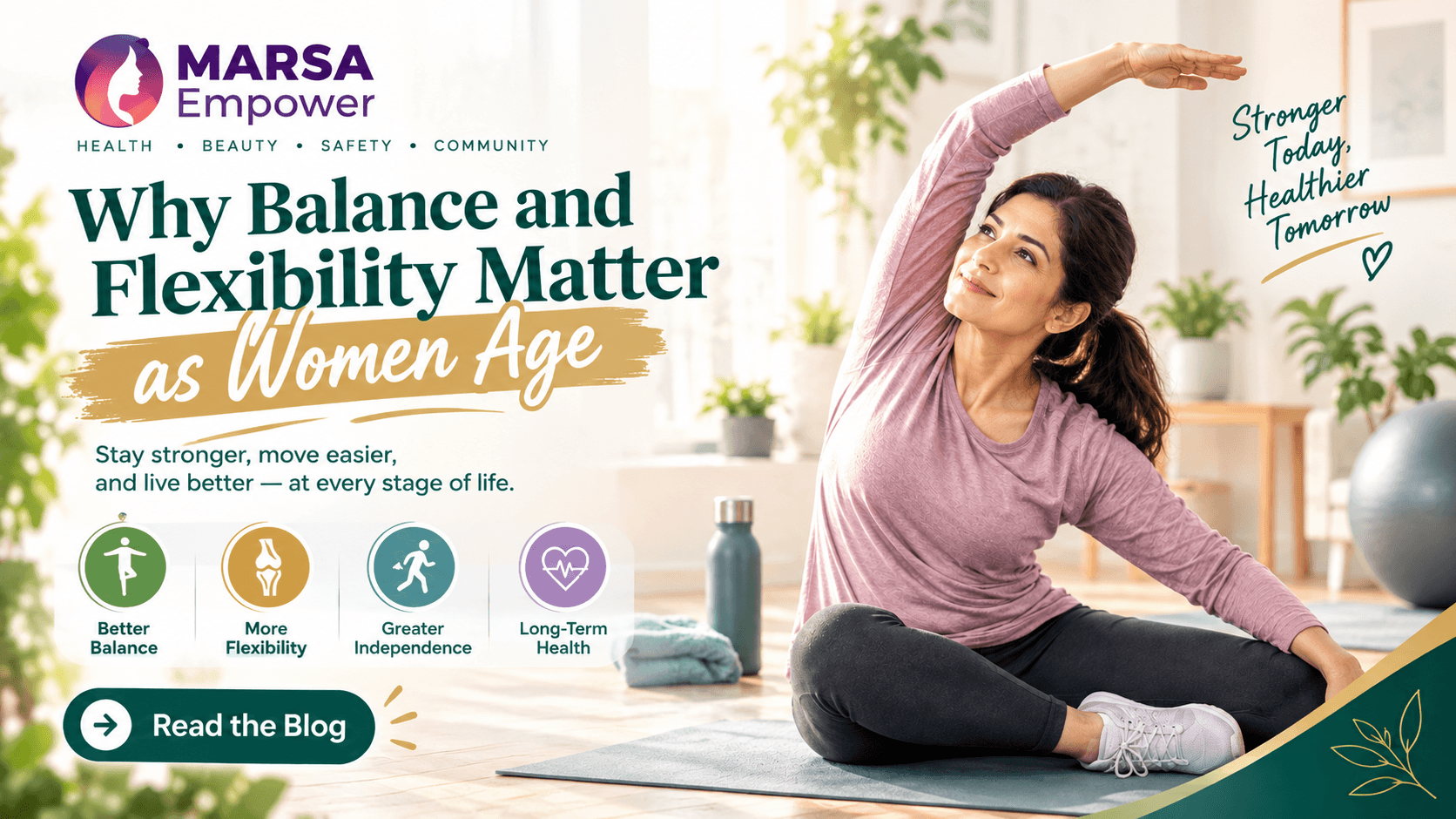
Discover the importance of balance and flexibility for aging women. Learn expert insights and actionable tips to enhance well-being and prevent injuries.
Maryam Mumtaz
Co-Founder & CEO
12 min read•9/20/2026
Marsa Empower · Women's Health & Active Wellness · For Girls & Women Aged 13 and Above · 12 min read
When women think about exercise and physical health, they most commonly think about cardiovascular fitness and weight management. These are genuinely important — but two other dimensions of physical capacity that matter enormously for long-term health, independence, and quality of life are consistently overlooked: balance and flexibility.
Balance is the ability to maintain controlled stability in the body during movement and at rest. Flexibility is the ability to move joints and muscles through their full comfortable range of motion. Together, these qualities are foundational to everything from safely navigating stairs to playing with children, from comfortable sitting through a long work day to recovering from a stumble without falling.
Both decline with age — gradually and often unnoticed — unless they are actively maintained. And women are disproportionately affected by the consequences of their decline: women fall more frequently than men in older age, suffer more osteoporotic fractures from falls, and are more likely to lose the functional independence that balance and flexibility support.
The good news is that both balance and flexibility respond remarkably well to targeted exercise at any age. Unlike cardiovascular fitness or muscle mass — which are harder to restore once significantly lost — balance and flexibility improve relatively quickly with consistent, appropriate training, even in women who have been sedentary for years.
This guide explains what balance and flexibility are, why they matter specifically for women, how they change across different life stages, and what simple, practical exercises can be started safely at any age.
Balance is the integrated ability to maintain the body's centre of mass over its base of support — whether standing still, moving, or recovering from a disturbance. It is governed by a complex system that continuously integrates three types of sensory input:
Visual input from the eyes provides information about the body's position relative to the surrounding environment. Vestibular input from the inner ear detects head position, motion, and acceleration. Proprioceptive input from sensors in muscles, tendons, and joints throughout the body provides moment-to-moment information about the position and movement of every body part.
The brain continuously integrates and weighs these three inputs to calculate where the body is in space and what adjustments the muscles need to make to maintain stability. When any of these systems is impaired — by vision changes, inner ear problems, joint disease, or neurological conditions — balance is compromised.
Balance is not simply "not falling over." It is the dynamic, continuous process of making constant small adjustments that keep the body stable during the physical demands of everyday life.
Flexibility is the ability of a muscle, tendon, or group of muscles to lengthen sufficiently to allow a joint to move through its intended range of motion. It is determined by the properties of the muscle tissue itself (including its resting length, its extensibility, and its resistance to stretch), the joint structure, and the surrounding connective tissues — ligaments, fascia, and tendons.
Flexibility is not a single whole-body quality — a person can be highly flexible in one area (yoga-trained hip opening, for example) while being significantly restricted in another (tight hip flexors from prolonged sitting). Each joint and muscle group has its own flexibility, and these can differ dramatically.
Balance is not something most women think about until they notice they no longer have it — or until a fall makes its loss suddenly and painfully obvious.
Falls are the leading cause of injury in older women. Falls and fall-related injuries — including hip fractures — are the most significant contributor to disability, loss of independence, and premature death in women over 65. Hip fractures from falls carry a one-year mortality rate of approximately 20 to 30 percent in older women and produce significant permanent functional impairment in many who survive.
Women have higher fall risk than men. The combination of lower bone density (particularly after menopause), the higher rates of conditions affecting balance (osteoporosis, joint arthritis, certain medications), and the specific footwear patterns common among women all contribute to a higher fall risk at equivalent ages.
Balance declines silently before falls happen. Most women with significantly reduced balance capacity do not know it until they fall. This is because daily life rarely challenges balance to its limits — the decline happens below the threshold of everyday awareness. Regular balance challenges — as in balance-specific exercises — reveal and correct this decline before its consequences become serious.
Good balance allows physical confidence. Women with well-maintained balance walk on uneven surfaces, use stairs without anxiety, change direction quickly, and navigate the physical world with a confidence and ease that reflects directly in their quality of life.
Flexibility supports the physical quality of everyday life in ways that become most apparent when it is significantly lost.
Joint mobility. Every daily movement — bending, reaching, twisting, turning — requires joints to move through a range of motion. When flexibility is significantly reduced, the range of available movement contracts, making ordinary tasks progressively more effortful, uncomfortable, or simply impossible without modification.
Posture. Tight hip flexors pull the pelvis into an anterior tilt, increasing lumbar lordosis and lower back loading. Tight chest and shoulder muscles allow the upper back to round, producing the forward head posture associated with neck and shoulder pain. Tight hamstrings affect the mechanics of standing, walking, and sitting. Adequate flexibility in these critical areas directly supports better posture and reduces the musculoskeletal pain that poor posture accumulates.
Injury prevention. Muscles and tendons that are habitually tight have a reduced range of motion before they reach maximum extension — meaning that sudden movements that exceed this range produce strains and tears at lower force levels than they would in muscles with adequate flexibility. Flexible muscles can accommodate unexpected demands without injury.
Pain reduction. Many common patterns of chronic pain in women — lower back pain, neck and shoulder tension, hip pain from prolonged sitting — are substantially driven by muscle tightness and reduced joint mobility. Systematic flexibility work directly addresses these pain patterns through their primary mechanism.
Better movement quality across all exercise. Walking, yoga, dancing, swimming, strength training — all forms of physical activity are performed more easily, more effectively, and with lower injury risk by women who have maintained adequate flexibility.
Both balance and flexibility decline with age through several interconnected mechanisms. Understanding these mechanisms helps women understand both what is happening and why the exercises that address them work.
From the mid-thirties onward, muscle mass gradually declines — a process called sarcopenia — unless actively countered by resistance training. This muscle loss affects the leg and core muscles most critical for balance maintenance, reducing the speed and strength of the stabilising muscle responses on which balance depends. It also changes muscle tissue composition in ways that reduce the extensibility (stretchiness) of muscle fibres, contributing to reduced flexibility.
Joints are surrounded by a fibrous capsule lined with a membrane that produces synovial fluid — the lubricating medium that allows smooth joint movement. With age, this fluid reduces in volume and viscosity, and the collagen fibres of the joint capsule become less elastic. The result is greater resistance to movement at the joint — reduced range of motion and increased morning stiffness that takes longer to ease than in younger years.
The single most consistent driver of both balance decline and flexibility loss is reduced physical activity. Women who remain consistently active — walking regularly, doing yoga, dancing, or participating in sports — maintain significantly better balance and flexibility into later decades than equally healthy women who are sedentary. Disuse accelerates the age-related changes described above. Activity, at any age, slows and partially reverses them.
Oestrogen plays a role in maintaining the integrity of connective tissues — tendons, ligaments, and joint capsule — throughout the reproductive years. The significant drop in oestrogen at menopause accelerates the changes in connective tissue elasticity that contribute to stiffness and flexibility loss. Oestrogen also affects proprioception — the joint position sensing that contributes to balance — and its reduction after menopause partly explains the accelerated balance decline that occurs in postmenopausal women compared to premenopausal women of similar age.
Injuries to joints, muscles, or tendons leave scar tissue and adhesions that permanently alter local tissue mobility. Ankle sprains that were inadequately rehabilitated reduce ankle proprioception — one of the most important sources of balance information — often for years afterward. Knee, hip, and back injuries similarly affect local flexibility and the quality of proprioceptive signalling from affected areas.
Vision provides approximately 20 percent of the sensory input for balance — the visual frame of reference for where the body is in space. Age-related vision changes — including reduced contrast sensitivity, changes in depth perception, and reduced ability to see in low light — reduce the quality of this input and contribute to balance decline, particularly in dim or visually complex environments.
Women who maintain good balance and flexibility move more freely, with greater range and ease. They reach overhead without straining. They bend and straighten without discomfort. They turn, twist, and change direction fluidly. This freedom of movement is not a cosmetic quality — it is the foundation of a physically capable, active, independent life.
Balance training directly and measurably reduces fall risk in older women — with research consistently showing 20 to 40 percent reductions in fall rates among women who engage in regular balance and strength training. For women with osteoporosis, for whom a fall may mean a hip fracture, this risk reduction is life-changing.
Getting up from the floor, stepping into a bathtub, carrying groceries on uneven ground, navigating stairs without a handrail, getting in and out of a car — all of these routine activities are performed more easily, safely, and confidently by women with well-maintained balance and flexibility.
Flexibility in the hip flexors, chest, and upper back — combined with adequate muscle strength — directly supports the upright, aligned posture that reduces chronic neck, shoulder, and lower back pain. Women who regularly stretch the muscle groups that tighten with sedentary modern life maintain significantly better postural alignment and experience less chronic musculoskeletal discomfort.
Perhaps the least-discussed but most genuinely meaningful benefit is the increase in physical confidence that comes from knowing the body will do what is asked of it. Women with good balance move through the world with a sense of physical security — navigating environments, terrain, and activities with ease and assurance rather than caution and anxiety.
The capacity to live independently — to move safely through one's own home, to drive, to pursue activities of interest — is profoundly shaped by physical balance and mobility. Women who maintain these qualities into their seventies and eighties retain the independence that significantly determines quality of life in later years.
Balance and flexibility in young women are typically at their lifetime best and rarely receive deliberate attention — because there is no obvious deficit to address. However, the habits established in young adulthood determine how well these qualities are maintained going forward.
Young women who build regular flexibility work (yoga, stretching, dance) and activities that challenge balance (sport, uneven terrain walking, yoga) into their routines establish both the physical capacity and the habit infrastructure that supports these qualities across the decades ahead.
Sedentary young women — particularly those in desk-based work or study for extended hours — accumulate the hip flexor tightness, hamstring shortening, and thoracic stiffness that begin reducing flexibility even in the twenties.
Pregnancy produces specific and significant changes in both balance and flexibility.
The hormone relaxin — produced from the first trimester — loosens ligaments throughout the body, increasing joint laxity in preparation for childbirth. This increases flexibility in some ways but also reduces joint stability, making pregnant women more susceptible to ankle sprains, knee instability, and sacroiliac joint pain than at other times.
The shifting centre of gravity from the growing uterus challenges balance in increasingly significant ways as pregnancy progresses, particularly from the second trimester onward. Pregnant women who maintain regular appropriate physical activity — including pregnancy-appropriate yoga, swimming, and walking — maintain better balance and functional mobility through late pregnancy than those who are sedentary.
After birth, the relaxin-related ligament laxity takes approximately three to six months to fully resolve, meaning postpartum women remain somewhat more susceptible to joint injury during this recovery period.
The hormonal fluctuations and declining oestrogen of perimenopause begin to accelerate both the flexibility loss and balance changes associated with the later postmenopausal years. This is the period when women most benefit from deliberately beginning or increasing their balance and flexibility training — in advance of the more significant changes of postmenopause.
Postmenopause is the life stage at which the balance and flexibility dividends of prior investment are most consequential. Women who have maintained these qualities experience their decline as a gradual reduction rather than a sudden loss, remain physically active and independent for significantly longer, and have dramatically lower fall and fracture risk.
For postmenopausal women who have not previously engaged in targeted balance and flexibility training, it is never too late to begin. Research consistently shows meaningful improvement in balance and flexibility at any age with appropriate training — including in women in their seventies and eighties.
The following exercises progress from the most accessible to more challenging, and can be started by women at any fitness level without equipment. Begin with the easiest variations and progress only when the current level feels stable and comfortable.
Safety first: Perform all balance exercises near a wall, sturdy chair, or other firm support that can be used if needed. Never try to manage a loss of balance unsupported — using a wall is not failure, it is safe and sensible practice.
Stand behind a sturdy chair with both hands lightly resting on the back for support if needed.
Lift one foot slightly off the floor and balance on the other leg. Hold for 10 to 30 seconds. Lower the foot and repeat on the other side.
As confidence builds, progress to holding the chair back with only one hand, then one finger, then no contact (with the chair available immediately if needed). Further progress involves closing the eyes briefly while balanced on one leg — which removes the visual input and significantly challenges the vestibular and proprioceptive systems.
This exercise directly trains the single-leg stability most critical for safe walking, stepping up and down curbs, and recovering from balance disturbances.
Walk in a straight line, placing the heel of each step directly in front of the toes of the previous step — as though walking along a tightrope. Keep the arms out to the sides for additional balance support initially.
Walk ten to fifteen steps forward, then turn carefully and return. A wall nearby provides safety support if needed.
This challenges the dynamic balance needed for walking on uneven or narrow surfaces.
Standing with light support from a chair or wall, slowly lift one leg forward to approximately 45 degrees, then lower it. Repeat to the side, and then behind. Perform 10 repetitions per direction, per leg.
The slow controlled movement challenges both the balance of the standing leg and the hip and core muscles that maintain stability during single-leg stance.
Stand with feet hip-width apart, hands available on a nearby support. Slowly shift body weight to the left leg, lifting the right heel slightly, then shift to the right leg, lifting the left heel slightly. Perform this as a slow, controlled, continuous shift — not a quick rocking. Ten shifts each direction.
This trains the proprioceptive response to weight distribution change that is central to preventing falls during transitions between positions.
The following stretches address the muscle groups that most commonly lose flexibility in women — particularly with sedentary modern lifestyles and aging. Hold each stretch gently for 20 to 30 seconds at the point of comfortable mild tension — never to the point of pain. Breathe slowly throughout.
Before beginning targeted stretches, five minutes of gentle whole-body movement — shoulder rolls, neck circles (slow and small), ankle circles, gentle trunk rotations while standing — warms the tissues and prepares them for more specific work.
The hamstrings — the muscles along the back of the thighs — are among the most commonly tight muscles in women who sit for long hours.
Seated hamstring stretch: Sit on a firm chair. Extend one leg out straight with the heel on the floor. Keeping the back straight, hinge forward from the hips (not rounding the back) until gentle tension is felt along the back of the thigh. Hold 20 to 30 seconds. Switch legs.
Standing hamstring stretch: Stand and place one heel on a low step or footrest with the leg straight. Keeping the back straight, lean forward slightly from the hips until mild hamstring tension is felt. Hold and switch.
Hip flexor stretch: The hip flexors (the muscles at the front of the hip that flex the leg) become chronically shortened with prolonged sitting. Kneel on one knee with the other foot flat on the floor in front (a lunge position). Keeping the trunk upright, press the hips forward until mild tension is felt at the front of the hip on the kneeling leg. Hold 20 to 30 seconds. Switch sides.
Seated hip (piriformis) stretch: Sitting in a chair, place the right ankle over the left knee. Keeping the back straight, lean gently forward until mild tension is felt deep in the right hip and buttock. Hold 20 to 30 seconds. Switch sides.
Cross-body shoulder stretch: Bring one arm across the chest and use the other hand on the upper arm to gently pull it closer to the chest until shoulder tension is felt. Hold 20 to 30 seconds. Switch arms.
Neck side stretch: Sitting or standing tall, gently lower the right ear toward the right shoulder (without raising the shoulder). Hold 15 to 20 seconds. Return and repeat to the left. Keep the movement slow and small — never force the neck into range.
Doorframe chest stretch: Stand in a doorway with arms raised to shoulder height, forearms resting on the door frame. Step one foot forward and gently allow the chest to open toward the doorway until stretch is felt across the chest and front shoulders. Hold 20 to 30 seconds.
Cat-cow movement: On hands and knees, alternate between gently arching the back toward the ceiling (cat — like an angry cat) and dropping the belly toward the floor while lifting the head slightly (cow). Move slowly through 10 repetitions, coordinating with slow breathing. This maintains lumbar mobility and reduces morning stiffness.
Seated trunk rotation: Sitting tall in a chair with feet flat on the floor, place both hands on the right knee and gently rotate the trunk to the right, looking over the right shoulder. Hold 15 to 20 seconds. Return to centre and repeat to the left.
Child's pose: From kneeling, sit the hips back toward the heels and extend the arms forward along the floor, resting the forehead on the floor or a pillow. Hold 30 to 60 seconds. This gently stretches the lumbar spine, hips, and thoracic back.
Balance training: Two to three times per week is sufficient to produce meaningful improvement. Balance exercises can be brief — even five to ten minutes of the exercises above three times per week produces measurable improvement in balance capacity over four to eight weeks with consistent practice.
For women at higher fall risk or those who have already experienced a fall, daily brief balance practice (five minutes each morning) produces faster improvement and may be recommended by a physiotherapist.
Flexibility training: Daily gentle stretching produces the fastest flexibility improvement, but two to four times per week still produces meaningful results. The muscle groups most benefiting from frequent attention are the hip flexors, hamstrings, thoracic spine, and chest — all of which are consistently affected by the sedentary postures of modern life.
Yoga and Pilates classes — whether in-person or through online resources — combine both balance and flexibility work in structured, progressive sessions and are among the most effective formats for consistently addressing both.
Read these before beginning any new balance or flexibility programme.
Always have a stable support — a wall, sturdy chair, or a person — within easy reach when performing any balance exercise. The goal is to challenge balance progressively, not to risk falls.
Never stretch to the point of pain. Comfortable mild tension at the end range of comfortable movement is appropriate. Sharp pain during a stretch means stopping immediately and seeking guidance before proceeding.
Begin with the easiest variations of every exercise and progress gradually. Rushing progression leads to injury and discouragement.
If you have any medical conditions — osteoporosis, recent joint surgery, significant arthritis, a history of falls, neurological conditions, or any condition affecting your balance — discuss which exercises are appropriate for you with a physiotherapist or healthcare provider before starting.
Wear stable, flat footwear or exercise barefoot on a safe non-slip surface. High heels and thick cushioned shoes both reduce proprioceptive feedback during balance training.
Choose a clear, uncluttered space for balance exercises where there are no objects to trip over if balance is briefly lost.
Professional guidance is appropriate before beginning or alongside a balance and flexibility programme in the following circumstances.
You have experienced one or more falls in the past year. You notice significant difficulty with balance — feeling unstable, needing to hold surfaces while walking, or avoiding activities because of balance concerns. You have been diagnosed with osteoporosis — the exercise programme needs to avoid positions that increase vertebral fracture risk. You have significant joint pain, hip or knee replacement history, or a recent injury affecting your lower limbs. You have any neurological condition, inner ear disorder, or vision problem affecting balance. You are pregnant and want guidance on safe balance and flexibility work appropriate to your trimester.
A physiotherapist provides individually assessed, precisely progressed balance and flexibility programmes that are far more targeted and effective than general guidance for women with specific physical limitations or health considerations.
Where Marsa helps — Smart Wellness resources. Marsa's health and wellness content includes guidance on physical activity for women at different life stages, explaining the specific benefits of balance and flexibility training for women navigating perimenopause, postmenopause, pregnancy, and the earlier life stages when preventive habits are most effectively established.
Why this matters for women's long-term health. Balance and flexibility training are among the most consistently neglected but most impactful physical activity priorities for women's long-term independence and quality of life. Marsa's educational resources help women understand why these qualities matter — connecting them to fall risk, fracture prevention, independence, and quality of life in terms that make the commitment to practising them feel meaningful rather than arbitrary.
Health Hub activity and symptom tracking. Women who begin a balance and flexibility practice can use Marsa's health tracking to record their progress — noting improvements in daily activities, reductions in stiffness and discomfort, and any symptoms that warrant attention. Tracking physical wellbeing alongside menstrual cycle data also reveals connections between hormonal phases and physical stiffness or balance fluctuations.
AI health guidance — Digital Doctors. Women who have questions about which balance or flexibility exercises are appropriate for their specific health situation — including pregnancy, postmenopause, osteoporosis, or post-injury recovery — can access Marsa's Digital Doctors for educational guidance and direction toward appropriate professional assessment.
Important note. Marsa Empower is a health education and wellness companion. For women with specific medical conditions, significant balance problems, a history of falls, or post-surgical limitations, a qualified physiotherapist provides the individually assessed, clinically appropriate programme that an educational platform cannot substitute for.
Can women improve their balance as they get older?
Yes, at any age. Research consistently demonstrates that targeted balance training produces meaningful improvements in balance capacity in women in their sixties, seventies, eighties, and beyond. The improvement is faster in younger women but measurable and clinically significant across all age groups. Consistency — regular practice two to three times per week — is the primary determinant of improvement rate, not starting age.
Does stretching actually improve flexibility?
Yes — consistently and measurably. Regular stretching of specific muscle groups increases their extensibility over time, allowing joints to move through greater ranges with less resistance. Improvements are typically detectable within two to four weeks of consistent practice and continue accumulating over months of regular stretching. The key is consistency and the correct technique — stretching to comfortable tension (not pain) and holding the stretch for 20 to 30 seconds.
Can balance exercises help prevent falls?
Yes. Multiple high-quality studies and systematic reviews consistently show that programmes combining balance training with strength training reduce fall rates in older women by 20 to 40 percent. This is one of the most reliably evidence-supported interventions in preventive medicine for older women. The benefit applies even in women who have already experienced falls and have been identified as at high fall risk.
How often should women stretch?
Daily flexibility work produces the fastest improvement, but two to four sessions per week still produces meaningful benefit for most women. The most important muscle groups to prioritise for most women with sedentary lifestyles are the hip flexors, hamstrings, chest, and thoracic spine — which are consistently shortened by prolonged sitting and forward-leaning postures. Yoga or Pilates classes two to three times per week provide well-structured combined flexibility and balance work.
Is flexibility important after menopause?
Particularly important. The decline in oestrogen after menopause accelerates the changes in connective tissue that reduce flexibility and joint mobility. Women who do not actively maintain flexibility through regular stretching may notice significant stiffness increases in the postmenopausal years. Regular stretching, yoga, and movement that takes joints through their available range of motion slow this process and maintain the mobility needed for comfortable, independent daily life.
Can beginners safely start balance exercises?
Yes — the exercises described in this guide are specifically designed to be safe and appropriate for women who have no prior balance training experience. Always start with support available (a wall or chair within reach), begin with the easiest variations, and progress gradually only when the current level feels stable and confident. If you have any health conditions that may affect your stability, discuss appropriate exercises with a healthcare provider or physiotherapist before starting.
Balance and flexibility are not exciting fitness qualities. They do not produce the visible results that strength training does, or the cardiovascular improvement that aerobic exercise does. They are easily neglected because their decline happens silently and slowly, below the threshold of daily awareness, until a fall or the loss of a previously easy movement makes the deficit suddenly obvious.
But their importance to the quality of a woman's life — at every age, and increasingly with each passing decade — is profound. They are the qualities that allow free, confident, independent movement through the world. They are what allows a postmenopausal woman to walk on uneven ground without anxiety, to live in her own home safely, to continue the physical activities she enjoys, to avoid the fall that might change everything.
The investment required to maintain them is modest. Ten minutes of balance work three times a week. Twenty minutes of stretching most days. A yoga or Pilates class when possible. These are not large commitments. The returns on them, measured in falls prevented, pain reduced, independence maintained, and physical confidence sustained over decades, are significant.
Start where you are. Use the exercises in this guide. Progress gradually and consistently. And treat balance and flexibility not as optional extras to add if time permits — but as non-negotiable pillars of your long-term physical health.
Educational Disclaimer
This article is for educational and awareness purposes only. It does not constitute medical or physiotherapy advice. If you have medical conditions affecting your balance or mobility, a history of falls, osteoporosis, or recent injury, please consult a qualified healthcare professional or physiotherapist for personalised assessment and exercise guidance before beginning a new programme.
Marsa Empower | Care. Safety. Growth.
Visit marsaempower.com to access women's wellness education, health tracking tools, and resources supporting physical health and independence at every stage of life.
Medical Disclaimer
This article is for general informational and educational purposes only and is not a substitute for professional medical advice, diagnosis, or treatment. Always seek the advice of a qualified healthcare provider with any questions you may have regarding a medical condition. Never disregard professional medical advice or delay seeking it because of something you have read on MARSA Empower.
Written By
Maryam Mumtaz
Co-Founder & CEO
Co-Founder of MARSA Empower who leads the visual and strategic evolution of the platform. Maryam bridges technical complexity with human-centric design, architecting the team's official roadmap and ensuring MARSA effectively addresses the real-world needs of women. With deep expertise in agentic AI, full-stack development, and UI/UX design, she has delivered 50+ projects for 30+ satisfied clients.
Enjoyed this story?