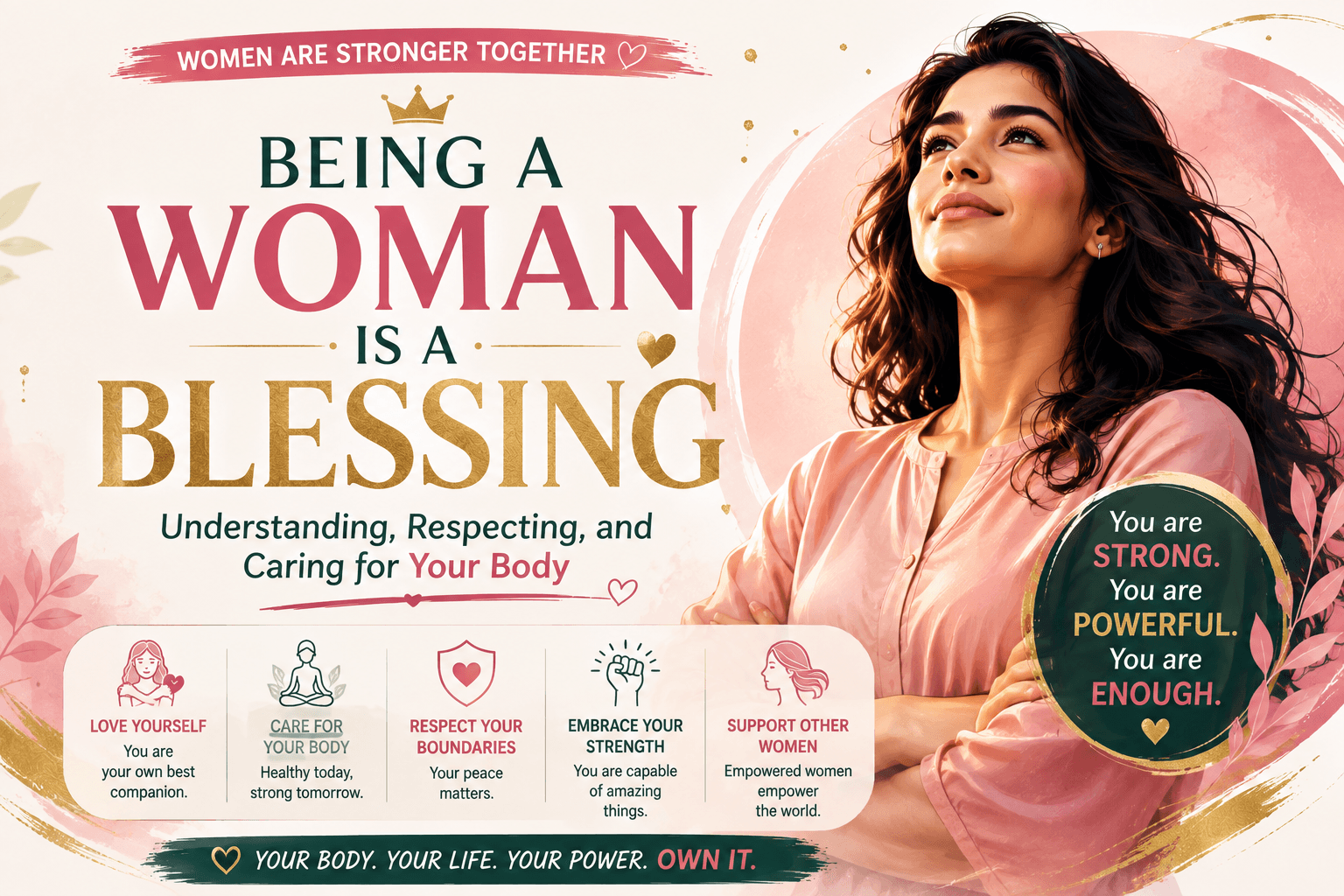
Being a woman is a unique blessing. Learn to understand, respect, and care for your body in profound ways.

Maryam Mumtaz
Co-Founder & CEO
12 min read•8/26/2026
Marsa Empower · Women's Wellness · For Girls & Women of Every Age
Being a woman is more than simply growing up, getting older, or going through different stages of life. It is a journey filled with changes, emotions, responsibilities, challenges, strength, and beautiful moments that make every woman uniquely herself.
For many women, there are moments when they feel frustrated with their bodies. A painful period. A hormonal breakout. Hair loss. Mood changes. Fatigue. Weight changes. The challenges of pregnancy. Menopause.
Sometimes we ask: Why does my body have to go through all of this?
But there is a more powerful question worth asking instead: What would it look like to understand my body, rather than fight it?
For women who believe in Allah, the female body, with all its complexity, its cycles, its capacity for creation, and its resilience, can be seen as one of His beautiful gifts. A gift that deserves to be understood, cared for, and respected.
Not because every physical experience is easy. Not because illness or pain should simply be smiled through. But because the body you live in is yours, and it deserves your knowledge, your attention, and your care.
Many girls grow up in environments where women's bodies are whispered about rather than openly understood. Periods are treated as embarrassing. Hormonal changes are dismissed or minimised. Health concerns are brushed aside with phrases like "all women go through this."
The result is that many women reach adulthood without knowing the most basic facts about their own biology. They do not know what a normal menstrual cycle looks like, so they cannot recognise when something has changed. They do not know what vaginal discharge is, so they worry needlessly every time they see it. They do not know what hormonal acne is, so they blame themselves for their skin. They do not know what a thyroid disorder involves, so years pass before a treatable condition is finally identified.
Lack of knowledge is not modesty. It is a gap that costs women their health.
Your body is not something to be ashamed of. A period is not dirty. Breast changes during puberty are not embarrassing. Hormonal shifts are not weaknesses to hide. Pregnancy does not make a woman less strong. Ageing does not make a woman less valuable.
These are parts of the female experience, and understanding them clearly and honestly is one of the most important things any woman can do for herself.
For many girls, the first period arrives with confusion and sometimes fear, often in a complete absence of the information she actually needed. The menstrual cycle is a natural biological process. It is the body's monthly preparation for the possibility of new life, and the healthy shedding of that preparation when it is not needed.
Periods can be uncomfortable. Cramps, fatigue, mood changes, and headaches are real physiological experiences caused by the prostaglandins the uterus produces during menstruation. They are worth acknowledging rather than dismissing.
But there is an important difference between the discomfort that is part of the natural process and the pain that signals something requiring medical attention. Experiencing a period does not make you weak. Suffering through severe, disabling pain, however, does not have to be your normal.
A girl or woman whose period causes her to miss school, miss work, or spend days unable to function is not experiencing something she simply has to accept. She deserves to understand why it is happening. She deserves access to the care that can help.
Taking care of your menstrual health is not complaining. It is part of respecting the body you have been given.
Hormones are chemical messengers that regulate virtually every function in the female body, including energy, sleep, mood, skin, hair, weight, and reproductive health. They change throughout life across puberty, monthly cycles, pregnancy, postpartum recovery, perimenopause, and menopause. Each stage brings a different hormonal environment, and a different set of experiences that reflect those changes.
Many women have been taught to dismiss their hormonal experiences with phrases like "it is just your hormones." This minimises real symptoms and discourages women from seeking care they genuinely need. The truth is that hormonal health is an important part of overall health, and understanding the connection between hormones and how you feel gives you the information to seek the right kind of support.
Instead of asking "Why am I like this?", you can learn to ask "What is my body telling me right now, and what does it need?" That shift from self-criticism to self-inquiry is one of the most meaningful changes a woman can make in her relationship with her own health.
Women are often extraordinarily strong. They study, work, build careers, care for families, support friends, manage responsibilities, and keep going even when they are tired. But somewhere in the expectation of this strength, many women have learned that their own needs are secondary, that asking for rest is weakness, and that taking time for their own health is selfish when so many other priorities are competing.
None of this is true.
You can be strong and still rest. You can be capable and still ask for help. You can care for others and still prioritise your own wellbeing. You can have difficult days and still be a strong woman.
The most sustainable version of strength is not the one that ignores the body's needs until they become impossible to ignore. It is the one that is honest about those needs, addresses them with care, and recognises that a woman who looks after herself is better equipped to contribute to everything and everyone she values.
Taking care of yourself is not a luxury. It is a responsibility.
Caring for your health does not require obsessing over every symptom, counting every calorie, or following every wellness trend. It means becoming genuinely aware of your body and your health patterns.
Aware of what your normal feels like, so you can notice when something changes. Aware of which symptoms deserve medical attention, so you do not dismiss things that matter. Aware of the basic habits that support your body throughout the different stages of life.
That awareness in practice looks like eating nourishing food consistently and with care for what your body needs. It looks like getting enough sleep, because sleep is not a lifestyle choice but a biological requirement. It looks like moving your body regularly in ways that are both enjoyable and sustainable. It looks like attending appropriate health checkups, because many conditions that affect women are most manageable when identified early. And it looks like taking symptoms seriously rather than dismissing them, and asking questions of doctors and health resources when something does not feel right.
You do not need to become obsessed with your health. You simply need to become aware of it.
One woman has regular periods. Another has PCOS and cycles that are entirely unpredictable. One woman has naturally clear skin. Another struggles with hormonal acne throughout her adult years. One woman carries weight easily. Another finds it genuinely difficult to maintain a healthy weight despite consistent effort. One enters menopause in her late fifties. Another begins the transition in her early forties.
Bodies are different. Health journeys are different. The circumstances, genetics, hormones, and life experiences that shape both are different.
Social media often shows a carefully selected, filtered, and frequently digitally altered version of people's bodies. Measuring your worth against these images is not simply unfair to yourself. It is based on a comparison to something that does not accurately represent reality.
Your body does not have to look like another woman's body to be worthy of respect. Your health journey does not have to follow another woman's path. And your value as a person is not determined by how closely your physical appearance matches an image on a screen.
Comparison does not make you healthier. Understanding and caring for your own body does.
Having PCOS does not make you less of a woman. Having acne does not make you less beautiful. Having painful periods does not make you weak. Experiencing difficulty conceiving does not reduce your worth. Going through menopause does not make you less vibrant or less relevant. Living with a chronic health condition does not change your fundamental value as a person.
A diagnosis is clinical information about one aspect of your physical health. It describes what is happening in your body at this stage of your life. It does not define who you are, what you are capable of, or what your future holds.
Many women whose lives are most meaningful, most impactful, and most full navigate significant health challenges as part of their story. The challenge is part of the story. It is not the whole story. And it is not the end.
The female body communicates consistently. Most women learn to recognise the signals most relevant to their own body through consistent attention over time.
Perhaps you are consistently tired in a way that adequate sleep does not seem to resolve. Perhaps your periods have changed in length, flow, or pain level from what was previously your normal. Perhaps you are losing more hair than usual. Perhaps you are experiencing a pattern of breakouts you have not had before. Perhaps your mood or sleep have shifted in a way that feels significant. Perhaps something just feels different.
These are not always signs that something is seriously wrong. Many changes have benign explanations. But they are signals worth acknowledging, worth tracking, and worth discussing with a doctor rather than silencing.
Awareness of your own body is not hypochondria. It is one of the most practical and powerful forms of health knowledge available to every woman.
A young girl should not have to feel ashamed when her first period arrives. She should already know what it is, why it happens, what is normal, what is not, and who she can talk to. When girls grow up with accurate, clear, non-judgmental knowledge about their bodies, they are more confident. They are better equipped to recognise symptoms that deserve attention. They are less likely to accept suffering as inevitable. And they are more likely to seek help when they need it, without the shame that comes from having been taught that women's bodies are topics too embarrassing to discuss openly.
Health education for girls is not simply academic preparation. It is a form of care, a form of respect, and a foundation that supports their wellbeing for the rest of their lives.
These conversations should begin early and continue throughout life, as each new stage brings new questions that deserve honest, informed answers.
Womanhood is not a single experience. It is a succession of seasons, each with its own character, its own gifts, and its own challenges.
The teenage girl navigating puberty and the confusion of her changing body. The young woman discovering who she is and building her future. The woman managing career, relationships, and responsibilities, often all at once. The mother whose body has carried and nurtured new life. The woman navigating the hormonal shifts of perimenopause with questions she was not prepared to face. The woman who has come through menopause and is building the next chapter of her health and her life. The older woman whose accumulated wisdom and health knowledge are gifts she can share with the women coming after her.
No single stage is more worthy of attention than another. No stage is without its own form of meaning. And no stage is one that a woman should navigate without access to the knowledge and care she genuinely deserves.
You do not have to love every physical experience your body puts you through. You do not have to pretend that pain is not painful. You do not have to perform positivity on difficult days. You do not have to be perfect in your habits, your health choices, or your responses to either.
But you can choose to respect your body. You can choose to learn about your health. You can choose to stop accepting suffering as inevitable when it is actually treatable. You can choose to stop dismissing your symptoms as probably nothing when they deserve investigation. And you can choose to stop measuring your worth against images that do not represent real women living real lives.
For those who hold faith in Allah, you can choose to see the female body, with all its complexity, its capacity, and its resilience, as one of His blessings. A creation worth understanding, worth protecting, and worth caring for with gratitude and intention.
Your health is worth protecting. Your body is worth understanding. And you, exactly as you are, at exactly the stage of life you are in, are worth caring for.
Marsa Empower was built around the belief that every woman deserves access to the health information, tools, and support that help her understand and care for herself, wherever she is and whatever stage of life she is navigating.
Through period and cycle tracking, women can build awareness of their own patterns and notice when something changes. Through health education resources, women can access clear, honest information about the conditions, hormones, symptoms, and health decisions most relevant to their lives. Through Digital Doctors and AI-powered guidance, women can ask the questions they have been hesitant to ask elsewhere and understand their symptoms better. Through Smart Nutrition, Mind and Soul wellness resources, and Beauty and Glow guidance, women can build the daily habits that support their physical and emotional wellbeing. And through the Personal Safety ecosystem, Marsa acknowledges that women's wellbeing extends beyond physical health to the safety and confidence with which she moves through the world.
Marsa does not replace healthcare professionals. But it bridges the gap between the brief moments of formal medical care most women receive and the ongoing health awareness that actually sustains wellbeing across a lifetime.
Understand your body. Care for your health. Respect your journey.
Educational Disclaimer
This article is for educational and awareness purposes only. It does not constitute medical advice. If you have persistent or concerning health symptoms, please consult a qualified healthcare professional for personalised evaluation and guidance.
A Note on Faith and Health
This article reflects a perspective of gratitude and respect for the female body. It does not suggest that illness or pain should simply be accepted without care. Seeking medical attention and building daily wellness habits are entirely consistent with caring for the body with the respect and gratitude it deserves.
Marsa Empower | Care. Safety. Growth.
Visit marsaempower.com to explore women's health resources, track your cycle, and access educational guidance built for every stage of a woman's life.
Medical Disclaimer
This article is for general informational and educational purposes only and is not a substitute for professional medical advice, diagnosis, or treatment. Always seek the advice of a qualified healthcare provider with any questions you may have regarding a medical condition. Never disregard professional medical advice or delay seeking it because of something you have read on MARSA Empower.
Written By
Maryam Mumtaz
Co-Founder & CEO
Co-Founder of MARSA Empower who leads the visual and strategic evolution of the platform. Maryam bridges technical complexity with human-centric design, architecting the team's official roadmap and ensuring MARSA effectively addresses the real-world needs of women. With deep expertise in agentic AI, full-stack development, and UI/UX design, she has delivered 50+ projects for 30+ satisfied clients.
Enjoyed this story?