One App. Every Woman.
One App. Every Woman.
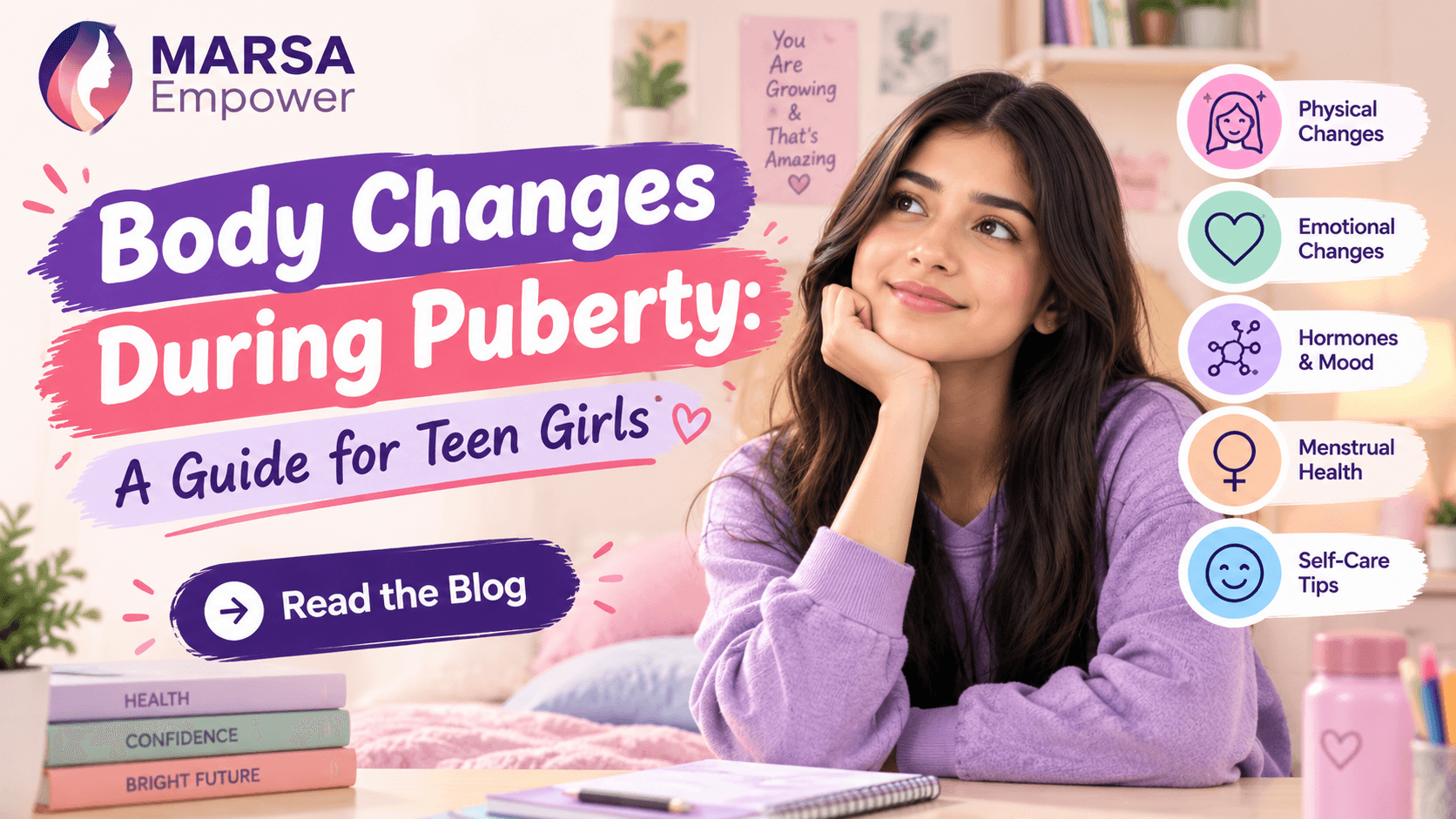
Discover the physical and emotional changes during puberty with expert insights and practical tips tailored for teen girls.
Maryam Mumtaz
Co-Founder & CEO
14 min read•9/14/2026
Marsa Empower · Teen Girls' Health · Growing Up Guide · For Girls Aged 9 and Above · 14 min read
Puberty can feel strange, overwhelming, and sometimes a little frightening — particularly if nobody has explained what is happening to your body before it begins. You might notice changes and wonder if they are normal. You might feel different from your friends who seem to be developing at a different pace. You might have questions that feel too embarrassing to ask out loud.
This guide is written for you.
Everything that happens to a girl's body during puberty has a reason. None of it is strange or wrong. These changes are the body preparing for adulthood — and while they can feel big, confusing, and sometimes uncomfortable, they are a sign that your body is healthy and developing the way it should.
This guide explains every major change that happens during puberty, why it happens, what to expect, and what is normal. It also explains when it is worth speaking to a doctor or trusted adult, because while most changes are normal, there are some patterns that deserve a conversation with someone who can help.
You deserve clear, honest information about your own body. That is exactly what this guide provides.
Puberty is the process through which a child's body develops into an adult body capable of sexual reproduction. It is driven by the release of hormones — chemical messengers produced by glands in the brain and body — that trigger the physical and emotional changes of this period.
For girls, puberty is orchestrated primarily by the hypothalamus and pituitary gland in the brain, which begin producing hormones that signal the ovaries to start producing oestrogen. Oestrogen is the primary female sex hormone, and it drives most of the physical changes described in this guide. The adrenal glands also contribute androgens (male-type hormones present in everyone) that play a role in pubic and underarm hair growth and skin changes.
Puberty is not a single event — it is a gradual process that unfolds over several years, with different changes occurring at different stages.
Puberty in girls typically begins between the ages of 8 and 13, with the average around 10 to 11 years. The first visible sign is usually breast development (breast budding), though vaginal discharge may begin even before this.
There is a wide and entirely normal range in timing. Some girls begin showing signs of puberty at 8 or 9 years. Others do not begin until 12 or 13. Both can be entirely normal. The age of puberty onset is influenced by genetics (your mother's and other female relatives' experiences are often a guide), body weight and nutrition, ethnicity, and other factors.
After the first signs appear, puberty typically takes three to five years to complete. The first period usually occurs about two to three years after breast development begins.
When puberty may warrant medical attention: signs of puberty appearing before age 8 (precocious puberty) or complete absence of any puberty signs by age 13 to 14 (delayed puberty) are both worth discussing with a healthcare professional.
Breast development is usually the first visible sign of puberty in girls and is one of the most significant physical changes of this period.
It typically begins with the development of small, sometimes tender lumps under the nipples — called breast buds. One breast may develop before the other, or one may grow faster than the other for a period of time. This is entirely normal and does not mean anything is wrong.
Breast budding is often accompanied by some tenderness or sensitivity in the nipple area, which is normal and caused by the hormonal changes stimulating breast tissue growth.
Breasts continue to develop gradually over the following years into their final adult shape and size. The size, shape, and appearance of breasts varies enormously between women — all are normal. Breasts may feel lumpy, soft, firmer, or uneven at different stages of puberty and throughout adulthood. Small breasts, larger breasts, slightly asymmetrical breasts — none of these are problems or abnormalities.
The first time a bra may feel useful or comfortable is a personal decision. Some girls find a soft crop top or bralette provides comfort during the early stages of breast development. There is no rule about when to wear one — it is about personal comfort.
A significant growth spurt is one of the most recognisable aspects of puberty. Girls typically experience their fastest height growth relatively early in puberty — often in the year or two around the beginning of breast development and before or around the first period.
After the first period, the rate of height increase slows, and most girls reach approximately their final adult height within one to two years after their first period.
The amount and timing of height growth varies between individuals and is strongly influenced by genetics. It is entirely normal for some girls to grow much taller than their friends during a particular year, then level off, while others grow more gradually throughout puberty.
Alongside height, bone density is being built during this period. This is one reason why adequate calcium, vitamin D, and weight-bearing physical activity during the teenage years are particularly important — the bone density built in this window protects against bone problems in later life.
During puberty, the female body shape changes significantly as it develops toward its adult form.
The hips widen as the pelvis grows — a normal developmental change preparing the body for potential future pregnancy. Body fat redistributes, increasing particularly in the hips, thighs, and buttocks. The waist may become more defined relative to the hips. The overall silhouette changes from the relatively straight lines of childhood to the more curved shape associated with adult female bodies.
These changes are driven by oestrogen and are entirely normal. However, they can feel significant and sometimes uncomfortable — particularly in a culture where very narrow body ideals are frequently presented through media and social media.
It is important to understand that the body is changing to become a healthy adult woman's body — not a problematic body. The natural curves and weight changes of puberty are not excess weight. They are normal development. Girls who try to prevent or resist these normal body changes through restrictive eating are working against their body's healthy developmental process and risk creating health problems from insufficient nutrition during a period of rapid growth.
Hair begins to grow in the pubic area (between the legs) and in the armpits during puberty, driven by androgen hormones produced by the adrenal glands. This hair growth is entirely normal and typically begins within a year or two of breast development starting.
Pubic hair varies between individuals in amount, texture, and distribution — all variations are normal. Underarm hair similarly varies. Whether to remove this hair or leave it is a completely personal decision — there is no hygiene requirement to do so, and no medical reason to.
Hair may also become slightly more noticeable on the legs and other areas of the body during puberty. Some girls also notice a small amount of darker hair on the upper lip or chin — this is common and can be related to the normal androgen activity of puberty.
However, significant or rapidly increasing facial hair (coarse, dark hair on the chin, jaw, or cheeks), particularly if accompanied by irregular periods or other changes, is worth discussing with a healthcare provider as it can sometimes indicate a hormonal condition like PCOS that benefits from proper evaluation.
Acne is one of the most common and most emotionally impactful changes of puberty — and one of the most deserving of clear information.
During puberty, rising androgen levels stimulate the sebaceous glands (oil glands) in the skin to produce more oil than they previously did. This excess oil, combined with dead skin cells, can block pores. Bacteria naturally present on the skin then multiply inside the blocked pore, triggering inflammation and the visible spots, pimples, blackheads, or cysts that constitute acne.
Acne during puberty is not caused by being unclean. It is a hormonal response. Even girls who cleanse consistently and carefully still develop acne because the root cause is hormonal — not a matter of hygiene.
Acne most commonly appears on the face, particularly the forehead, nose, and chin (the T-zone), but can also appear on the back, chest, and shoulders.
For most teenage girls, acne improves after the hormonal surges of early puberty stabilise. However, some girls continue to have significant acne throughout adolescence and into adulthood, particularly if there is a family history of acne or if there is an underlying hormonal condition.
Managing acne during puberty involves a simple, consistent skincare routine rather than excessive or harsh treatment. A gentle cleanser twice daily, a lightweight non-comedogenic moisturiser, and daily sunscreen (to prevent post-acne dark marks from deepening) form the most appropriate basic routine for most teenage girls.
If acne is moderate to severe, causing significant emotional distress, producing deep cysts, or leaving scars, speaking with a doctor or dermatologist about additional treatment is appropriate and worthwhile.
During puberty, sweat glands — particularly the apocrine sweat glands in the armpits and groin — become more active in response to hormonal changes. These glands produce a different type of sweat than the sweat glands that cool the body during exercise. When bacteria on the skin break down apocrine sweat, it produces the distinctive body odour associated with puberty.
This change is entirely normal. It is not caused by being unclean — it is a hormonal change in the type and amount of sweat produced.
Managing body odour is straightforward with regular personal hygiene: washing the underarms and groin area with soap and water during daily bathing, and using a deodorant or antiperspirant in the underarms after washing. Deodorant covers odour; antiperspirant reduces sweat production. Most products designed for teenagers combine both functions.
One of the changes that surprises many girls — because it is rarely discussed in advance — is vaginal discharge. Many girls notice a white, cream, or clear fluid on their underwear and do not know what it is.
Vaginal discharge is completely normal. It is produced by the cervix and vaginal walls as part of the body's natural self-cleaning mechanism — the vagina maintains its health and protective environment partly through this fluid. It typically begins approximately six months to a year before the first period, making it one of the earliest signs that puberty is progressing.
Healthy discharge is white, cream, or clear in colour. It may have a mild smell or no smell at all. It does not cause itching, burning, or discomfort. The amount and texture can vary — sometimes more and sometimes less — and this variation is normal.
Discharge that is yellow, green, or grey, that has a strong unpleasant or fishy smell, or that causes itching or burning is worth mentioning to a doctor or trusted adult, as it may indicate an infection.
The first period (menarche) is one of the most significant puberty milestones and typically occurs about two to three years after breast development begins — usually between ages 11 and 14, though anywhere from 9 to 16 can be normal.
Some signs that the first period may be approaching: vaginal discharge has been present for several months, the breast development is more advanced, growth has slowed compared to the earlier puberty growth spurt.
Getting a period for the first time can feel startling, particularly if no one has prepared you for it. Knowing what it is and what to expect in advance makes it far less frightening.
What the blood looks like. Period blood does not look the same as a cut or wound bleeding. It is typically darker in colour — red, brown, or even almost black — particularly at the beginning or end of the period. This is normal and is because the blood comes from the shedding of the uterine lining rather than a wound.
How much blood. The amount feels like more than it is, because blood mixed with fluid spreads on a pad. Most women lose approximately 30 to 80 ml of blood per period. This is much less than a dangerous blood loss. Heavy flow for the first day or two, lightening over the following days, is a normal pattern.
How long it lasts. Most periods last two to seven days, with the heaviest flow typically on days one and two.
Pain. Some cramping in the lower abdomen is common and normal, caused by the uterine muscle contracting as it sheds the lining. Mild to moderate cramping that responds to a warm water bottle, gentle movement, and over-the-counter pain relief (appropriate for age) is normal. Pain severe enough to prevent attending school or functioning normally is not something to simply accept and is worth discussing with a healthcare provider.
Period products. Sanitary pads are the most accessible and appropriate choice for most girls beginning their first period. Tampons require a little more practice and are suitable once comfortable. Menstrual cups and period underwear are other options that suit some girls better than others. There is no single correct product — choosing what feels most comfortable is what matters.
After the first period, it is very common for cycles to be irregular for the first year or two — sometimes longer. Periods may arrive every few weeks, or there may be gaps of several months between them. The length and heaviness of each period may vary significantly from one cycle to the next.
This irregularity is normal in the first one to two years of menstruation because the hormonal communication system between the brain, pituitary gland, and ovaries takes time to mature and establish its consistent rhythm. Most girls' periods become more regular over the first two to three years after the first period.
However, if periods remain significantly irregular beyond two to three years (consistently arriving more than 35 days apart or fewer than 21 days apart, or arriving fewer than eight times per year), this is worth discussing with a healthcare provider, as it may indicate conditions like PCOS that benefit from proper evaluation.
Physical changes are only one dimension of puberty. The emotional and psychological changes of this period are equally significant.
Mood changes are among the most frequently noticed and least well-explained aspects of puberty. The hormonal fluctuations of the menstrual cycle — and the overall hormonal shifts of puberty — directly affect the brain chemistry systems governing mood. Many girls notice that emotions feel more intense, more unpredictable, and more difficult to regulate than they did in childhood. Feeling happy, then suddenly sad, then irritated, then fine again — often within the same day — is a real experience of early puberty. It does not mean anything is wrong. It reflects the brain adapting to a new hormonal environment.
Increased self-awareness is a normal feature of adolescent development. The teenage brain is processing identity — who you are, how others see you, what matters to you. This self-reflection is healthy and important. However, it can also produce social anxiety, heightened sensitivity to peer judgment, and intense awareness of how you compare to others.
Stress and emotions are often more intense during puberty for neurological reasons — the prefrontal cortex (the brain region responsible for emotional regulation, rational perspective, and impulse control) is still developing throughout the teenage years. This makes emotional experiences more intense and emotional regulation genuinely harder than it will be in adulthood.
Body image is one of the most significant emotional challenges of puberty for many girls. The body is changing in ways that are entirely normal but that may feel dramatic, and the social environment — particularly social media — presents a very narrow range of "acceptable" bodies that does not reflect the real diversity of healthy women. Girls who find themselves comparing their developing body negatively to images online, or who feel significant distress about normal puberty changes, deserve support and honest reassurance that their body is developing normally.
All the physical changes described above are driven by the same fundamental process: the body preparing for reproductive capacity.
The brain signals the pituitary gland to release FSH and LH — hormones that travel to the ovaries and stimulate them to produce oestrogen. Oestrogen drives breast development, changes in body shape, the growth spurt, vaginal changes, and the development of the uterine lining. Androgens (produced by the adrenal glands) drive pubic and underarm hair growth, skin changes, and body odour changes.
The first period occurs when the uterine lining has developed sufficiently to begin cycling — building and shedding in response to the hormonal signals of the monthly cycle.
None of this is something going wrong. It is the body working exactly as it was designed to.
As the body changes during puberty — more active sweat glands, new hair growth, period management — daily hygiene habits become more important.
Daily showering or bathing using mild soap on the body (not inside the vagina — the vagina is self-cleaning) is appropriate. Washing the underarms, groin, and feet thoroughly with mild soap removes sweat and bacteria before odour develops.
Using a deodorant or antiperspirant in the underarms after washing helps manage the new body odour of puberty.
Washing the face twice daily with a gentle cleanser appropriate for your skin type forms the foundation of managing puberty-related skin changes.
Changing underwear daily maintains comfort and hygiene.
Managing periods with appropriate hygiene is simple once you know what to do.
Change sanitary pads every four to six hours (or more frequently if flow is heavy). Change tampons every four to eight hours — never leave a tampon in for longer than eight hours. Wash hands before and after handling period products. Dispose of used pads and tampons in a bin rather than flushing them down the toilet. During the period, washing the external genital area with warm water daily provides adequate hygiene — no special internal washing is necessary or appropriate.
A simple, consistent skincare routine is the most effective approach for managing puberty-related skin changes.
Wash the face gently twice daily with a mild cleanser appropriate for your skin type — gel or foam for oily skin, cream for drier skin. Use a lightweight, non-comedogenic (non-pore-blocking) moisturiser. Apply SPF 30 or higher sunscreen every morning to protect against the darkening of any spots or marks.
If acne is present, salicylic acid (a gentle exfoliant that clears inside pores) or benzoyl peroxide (which reduces acne bacteria) are the most evidence-supported over-the-counter acne-management ingredients. Introduce one product at a time and allow four to six weeks to assess its effect.
Avoid harsh physical scrubs, lemon juice, baking soda, or other home remedies — they can damage the skin barrier and worsen acne.
If acne is moderate to severe, scarring, or significantly affecting confidence, see a dermatologist.
The teenage years are a period of exceptional nutritional demand — the body is growing rapidly, building bone density, establishing menstrual cycles, and developing the hormonal systems that will govern adult health.
Calcium and vitamin D are particularly important during puberty for building the bone density that protects against osteoporosis in later life. Good sources include milk, yogurt, cheese, fortified plant milks, tofu, sardines with bones, and sesame seeds. Sunlight exposure supports vitamin D production.
Iron becomes critical once periods begin, as blood loss removes iron monthly. Good iron sources include red meat, lentils, spinach, chickpeas, and fortified cereals — always consumed alongside vitamin C to improve absorption.
Adequate protein is essential for growth, tissue development, and hormonal production. Eggs, chicken, fish, lentils, dairy, and nuts all contribute.
Adequate calories overall. Puberty is not the time to significantly restrict food intake. The body's energy needs during this period of rapid growth are substantial. Girls who chronically under-eat during puberty risk stunted growth, delayed periods, reduced bone density, impaired immune function, and difficulty with mood regulation.
Hydration. Six to eight glasses of water per day supports skin health, energy, concentration, and kidney function. Reducing sugary drinks in favour of water is one of the most impactful dietary changes available for both skin and overall health.
"Why has one of my breasts grown more than the other?" — Asymmetrical breast development during puberty is very common. The difference usually becomes less noticeable over time as development continues. Some degree of asymmetry between the two breasts is normal throughout life.
"Why do I have discharge in my underwear every day?" — Vaginal discharge is the body's natural cleaning mechanism. It is a sign that the vagina is healthy and working properly. Daily discharge is normal.
"Why do I feel so much more emotional than I used to?" — Hormonal changes during puberty directly affect brain chemistry. Emotions that feel more intense and harder to manage are a normal feature of this period and improve as the brain matures.
"Will my skin always be like this?" — For most girls, acne significantly improves after the intense hormonal activity of early puberty stabilises. Consistent gentle skincare helps manage it in the meantime.
"My period is really irregular — is something wrong?" — Irregular periods in the first one to two years after the first period are very common and usually normal as the hormonal system matures. Persistent irregularity beyond two to three years warrants a healthcare visit.
| Change | Normal or Worth Discussing? |
|---|---|
| One breast developing before the other | Normal |
| Breast tenderness during development | Normal |
| White or clear discharge with no irritation | Normal |
| Irregular periods in first 1 to 2 years | Usually normal |
| Mild period cramps on days 1 to 2 | Normal |
| Mood changes and emotional intensity | Normal |
| Acne across the T-zone | Normal |
| Yellow, green, or grey discharge | Worth seeing a doctor |
| Discharge with strong smell or itching | Worth seeing a doctor |
| Period pain preventing daily activities | Worth seeing a doctor |
| Significant dark facial hair on chin or jaw | Worth seeing a doctor |
| No signs of puberty by age 14 | Worth seeing a doctor |
| Signs of puberty before age 8 | Worth seeing a doctor |
| Periods consistently absent for 3+ months (not pregnant) | Worth seeing a doctor |
| Extreme mood changes significantly affecting daily life | Worth talking to someone |
| Significant distress about body image | Worth talking to someone |
A teenager should see a doctor — or speak to a trusted adult who can help arrange this — for any of the following.
No signs of puberty at all by age 13 to 14. Signs of puberty appearing before age 8 (very early breast development or pubic hair before age 8). Period pain that prevents attending school or normal daily activities. Periods that are still significantly irregular after two to three years of menstruation. Periods that are absent for three months or longer (without pregnancy). Vaginal discharge that is yellow, green, or grey, or that has a strong smell or causes itching. Significant dark hair on the face, chin, or jaw alongside irregular periods. Acne that is severe, causing scars, or causing significant emotional distress. Mood changes or emotional difficulties that are significantly disrupting daily life, school, or relationships. Any change that feels significant and is causing concern — there is no question too small or too embarrassing to raise with a doctor.
How girls experience puberty is significantly shaped by the information, attitude, and emotional environment provided by the adults around them. Parents and guardians can make a profound positive difference through a few consistent approaches.
Prepare girls in advance. The most helpful thing a parent can do is explain what puberty involves before it begins, so that when changes arrive they feel familiar rather than frightening. Knowing in advance that discharge is normal, that periods are coming, and that emotional changes are expected makes each change less alarming when it occurs.
Create an environment where questions are welcome. Girls who know they can ask questions without embarrassment, judgment, or dismissal are far more likely to raise concerns that genuinely deserve attention. A simple "you can always ask me about this" goes further than any amount of formal explanation.
Respond without minimising. "That is normal" is sometimes accurate and reassuring, but it should be paired with genuine curiosity about how the girl is experiencing the change. "That sounds uncomfortable — does it bother you a lot?" invites genuine conversation.
Avoid negative body comments. Comments about weight, shape, or appearance — even well-intentioned ones — during this highly sensitive developmental period can have lasting effects on body image. Focus on health and capability rather than appearance.
Know when to seek help. Significant period pain, very heavy periods, persistent irregular periods, severe acne, significant emotional difficulties, or any symptom that is clearly causing significant distress or disruption deserves professional attention rather than only reassurance.
Puberty can feel isolating when questions feel too embarrassing to ask in person. Marsa Empower provides a private, accessible space where teenage girls and their parents can find clear, reliable health information.
Where Marsa helps — Health Hub cycle tracking. Once periods begin, Marsa's Health Hub allows girls to track their menstrual cycle, symptoms, flow, and mood over time. This builds the personal health awareness that distinguishes normal variation from patterns worth discussing with a healthcare provider. For a teenage girl with irregular early cycles, tracking provides the documented pattern that makes a medical consultation more productive.
Why it matters for teen girls. Many girls have questions about their bodies that feel too personal or embarrassing to raise with a parent or doctor. Marsa provides educational resources that answer these questions honestly and without judgment — what discharge looks like, why periods hurt, what acne is caused by, what is normal and what is not. Having access to clear information reduces the anxiety that comes from not knowing and helps girls recognise when something genuinely deserves attention.
Health education resources. Marsa's educational content explains puberty, menstrual health, skin care, nutrition, and emotional wellbeing in language accessible and appropriate for teenage girls. This includes the honest, non-judgmental tone that teenagers deserve and often do not receive from mainstream sources.
AI health guidance — Digital Doctors. For girls who have questions they feel too embarrassed to ask a parent or doctor, Marsa's Digital Doctors provide a private space to ask health questions and receive clear, educational information. A girl who is worried about whether her discharge is normal, whether her irregular periods are a concern, or whether her period pain is within the expected range can ask these questions and receive honest, informative guidance.
Important note. Marsa Empower is an educational and health awareness companion. It is not a substitute for professional medical evaluation. Any symptom or concern that genuinely warrants a doctor's assessment should be raised with a healthcare professional, and Marsa helps girls and parents recognise when that threshold has been reached.
Is it normal for every girl to develop at a different age?
Yes, entirely. Puberty typically begins between ages 8 and 13, and the range of normal is wide. Some girls begin very early in this range and others very late — both can be completely normal. The age at which close female relatives (particularly the mother) went through puberty is often a useful guide, as timing has a strong genetic component.
Why do breasts grow at different rates?
Asymmetrical breast development during puberty is very common. One breast may begin developing before the other, or grow faster for a period of time. This usually becomes less noticeable as development continues and is not a sign of anything wrong. Some degree of natural asymmetry between breasts is normal throughout adult life.
Is irregular menstruation normal after the first period?
Yes. In the first one to two years after the first period, irregular cycles are very common and usually reflect the hormonal system still maturing. Cycles may arrive at unpredictable intervals, vary in length and heaviness, or occasionally be missed. If irregularity persists significantly beyond two to three years of menstruating, this is worth a healthcare visit.
Why does acne appear during puberty?
Rising androgen hormones during puberty stimulate the skin's oil glands to produce more oil than previously. This excess oil, combined with dead skin cells, blocks pores, allowing bacteria to multiply and triggering the inflammation that produces spots and pimples. Acne during puberty is hormonal rather than hygiene-related — even girls who cleanse carefully still develop it.
Why does body odour change during puberty?
Specific sweat glands — apocrine glands in the underarms and groin — become more active during puberty in response to androgen hormones. When bacteria on the skin break down this sweat, it produces body odour. Daily washing with soap and using a deodorant or antiperspirant manages this effectively.
Is vaginal discharge normal during puberty?
Yes. Vaginal discharge typically begins six months to a year before the first period and is one of the earliest signs of puberty. It is the vagina's natural self-cleaning mechanism. White, cream, or clear discharge with no strong smell or irritation is entirely normal. Yellow, green, or grey discharge, or discharge with a strong smell or itching, is worth discussing with a doctor.
Puberty is one of the most significant transitions in a person's life — and it is a healthy, normal process, even when it feels strange or overwhelming.
Every girl develops at her own pace. The changes described in this guide are signs that the body is healthy and developing as it should. Some changes are comfortable and some are not. Some arrive earlier than expected and others later. Some produce questions that feel too embarrassing to ask.
All of these experiences are valid. All of the questions deserve honest answers. And every girl going through puberty deserves to know that what is happening to her body is remarkable — not frightening, not wrong, not something to be ashamed of.
Understanding your body is not only valuable during puberty. It is the beginning of a lifetime of health awareness that helps you notice what is normal for you, recognise when something has changed, and feel confident seeking help when it is needed.
Educational Disclaimer
This article is for educational and awareness purposes only. It does not constitute medical advice. If you have health concerns about puberty, development, or any symptoms described in this guide, please speak with a trusted adult and consult a qualified healthcare professional.
Marsa Empower | Care. Safety. Growth.
Visit marsaempower.com to explore health resources for teenage girls, track your menstrual cycle, and access educational guidance about growing up and staying healthy.
Medical Disclaimer
This article is for general informational and educational purposes only and is not a substitute for professional medical advice, diagnosis, or treatment. Always seek the advice of a qualified healthcare provider with any questions you may have regarding a medical condition. Never disregard professional medical advice or delay seeking it because of something you have read on MARSA Empower.
Written By
Maryam Mumtaz
Co-Founder & CEO
Co-Founder of MARSA Empower who leads the visual and strategic evolution of the platform. Maryam bridges technical complexity with human-centric design, architecting the team's official roadmap and ensuring MARSA effectively addresses the real-world needs of women. With deep expertise in agentic AI, full-stack development, and UI/UX design, she has delivered 50+ projects for 30+ satisfied clients.
Enjoyed this story?