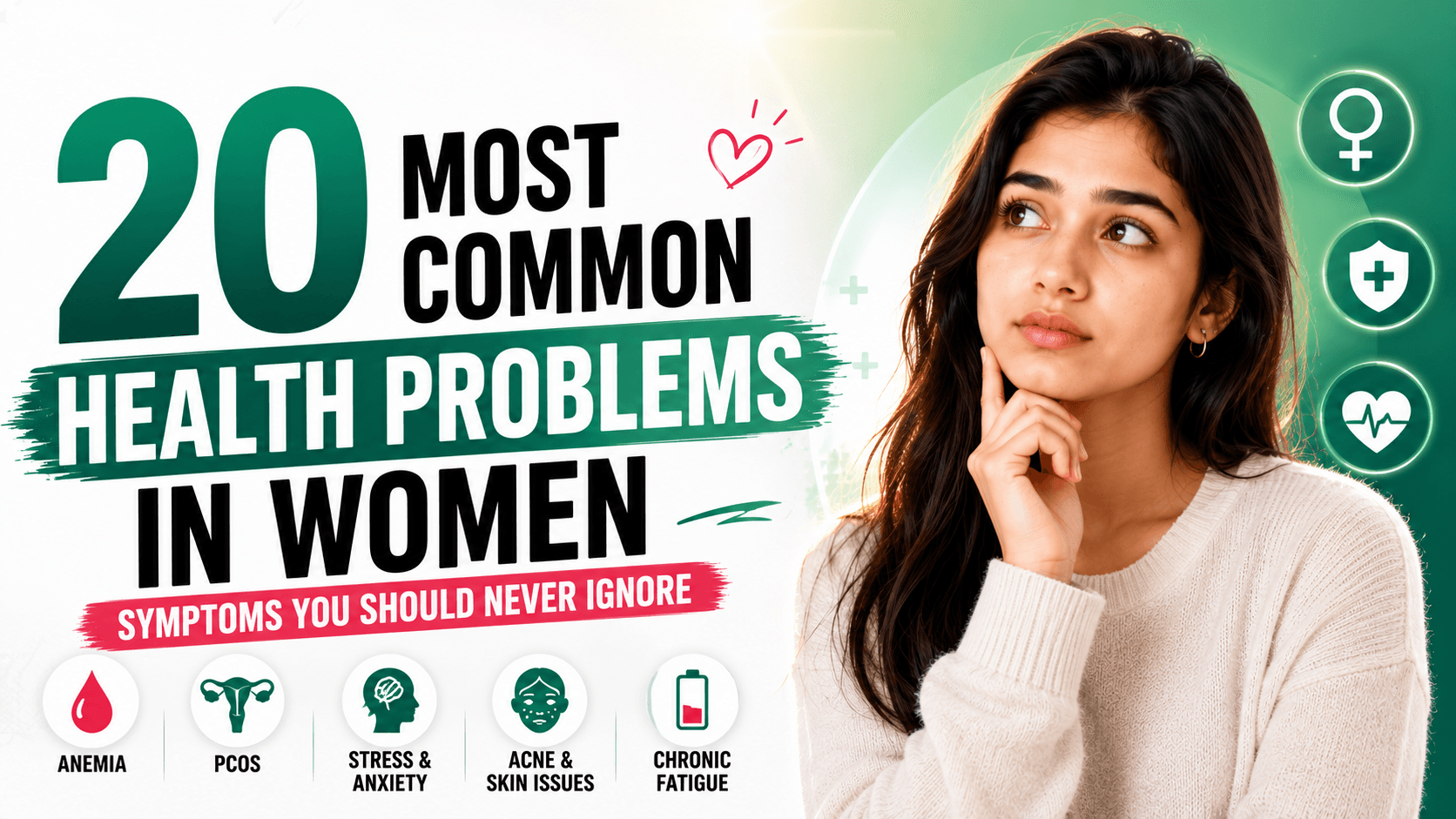
Discover the 20 most common health problems affecting women today. Learn about symptoms that should never be ignored and take steps towards better health.

Maryam Mumtaz
Co-Founder & CEO
14 min read•7/12/2026
🌸 Marsa Empower · Women's Health Awareness · Complete Reference Guide · ~15 min read
"Every symptom on this list deserves attention. Every woman on this list deserves support."
| # | Health Problem | Key Symptoms |
|---|---|---|
| 1 | Iron Deficiency Anaemia | 🩸 Fatigue · Dizziness · Weakness |
| 2 | PCOS | 💊 Irregular periods · Acne · Hair growth |
| 3 | Menstrual Problems | 🩸 Heavy bleeding · Severe cramps · Missed periods |
| 4 | Hormonal Imbalances | 🔄 Mood · Skin · Sleep · Weight |
| 5 | Anxiety & Chronic Stress | 😰 Persistent worry · Physical symptoms |
| 6 | Depression | 😔 Low mood · Withdrawal · Exhaustion |
| 7 | Thyroid Disorders | 🦋 Fatigue · Weight · Hair · Periods |
| 8 | Migraines & Frequent Headaches | 🤕 Throbbing pain · Light sensitivity |
| 9 | Sleep Disorders | 😴 Insomnia · Poor quality sleep |
| 10 | Weight Management Challenges | ⚖️ Metabolic difficulty |
| 11 | Acne | 🧴 Hormonal breakouts |
| 12 | Low Self-Esteem & Body Image | 💔 Confidence · Mental health |
| 13 | Vitamin D Deficiency | 🌞 Fatigue · Bone health · Mood |
| 14 | Nutritional Deficiencies | 🥗 Energy · Cognition · Immunity |
| 15 | Burnout & Mental Exhaustion | 🔥 Chronic depletion |
| 16 | Endometriosis | 🩺 Severe pelvic pain |
| 17 | Breast Health Concerns | 🎗️ Pain · Lumps · Tissue changes |
| 18 | Urinary Tract Infections | 💧 Burning · Urgency · Frequency |
| 19 | Chronic Fatigue | 😴 Persistent tiredness |
| 20 | Osteoporosis | 🦴 Bone density · Fracture risk |
She is always tired.
She has painful periods every month.
Her skin keeps breaking out.
Her mood shifts dramatically without warning.
She is anxious — but cannot explain why.
She tells herself it is just life. That everyone feels this way. That she simply needs to push through harder.
But these are not random inconveniences. They are not character flaws. They are not the price of being a woman.
They are among the most common — and most ignored — health conditions affecting women today. Conditions that have names, causes, and treatments. Conditions that, when identified and managed appropriately, do not have to define a woman's daily experience.
This guide names all twenty. For each one, it explains what it is, what it looks and feels like, and when to seek help — so that no woman has to spend another year telling herself that what her body is experiencing is simply normal, inevitable, or something she has to endure alone.
Iron is essential for producing haemoglobin — the protein that carries oxygen through the blood to every cell and organ in the body. When iron levels fall, oxygen delivery falls with it. Every system in the body receives less of what it needs to function.
Why women are especially vulnerable: Menstruation causes monthly iron loss. Women with heavy periods lose significantly more — often far more than diet alone replaces.
Serum ferritin — not haemoglobin alone. Ferritin measures iron stores and reveals deficiency earlier. Always request it specifically.
💛 Key Insight
"Iron deficiency is the most common and most reversible cause of fatigue in women. A blood test and targeted treatment can produce dramatic improvement — but only if the condition is investigated rather than normalised."
PCOS is one of the most common hormonal conditions in women of reproductive age — a complex interaction of elevated androgens, insulin resistance, and disrupted ovulation that produces a wide range of seemingly unrelated symptoms.
Why it goes undiagnosed: Symptoms closely resemble normal hormonal changes, and cultural silence around reproductive health prevents many women from seeking investigation.
Testosterone · DHEAS · LH · FSH · Fasting insulin · Fasting glucose · Pelvic ultrasound
💛 Key Insight
"PCOS is manageable — but only when it is identified. If you have irregular periods alongside two or more other symptoms on this list, ask your doctor about PCOS screening."
Menstrual problems are among the most commonly normalised women's health issues — and among the most impactful on daily quality of life, mental health, and long-term reproductive health.
What is not normal: Periods so painful they require bed rest. Bleeding so heavy it soaks a pad every hour. Cycles so irregular they cannot be predicted. Missing periods entirely without pregnancy.
PCOS · Endometriosis · Fibroids · Thyroid dysfunction · Iron deficiency · Hormonal imbalance
💛 Key Insight
"Severe period pain and very heavy bleeding are not the price of being a woman. They are medical symptoms with identifiable causes and effective treatments. You do not have to endure them."
Hormones regulate nearly every system in the female body — mood, energy, sleep, skin, weight, reproduction, metabolism, and immune function. When hormonal balance is disrupted, the effects are felt across all of these systems simultaneously.
The dismissal problem: Hormonal symptoms in women are routinely attributed to stress or personality rather than investigated as the medical conditions they are.
TSH · Oestrogen · Progesterone · Testosterone · FSH · LH · Prolactin · Fasting insulin
💛 Key Insight
"Hormonal imbalance is not a vague catch-all. It is a measurable medical state with specific, identifiable causes. A targeted blood panel provides clarity within days."
Anxiety is one of the most common mental health conditions globally — and women are diagnosed with it at roughly twice the rate of men. Chronic stress, while not a clinical diagnosis, produces measurable physical harm when sustained over weeks and months — disrupting hormones, immune function, sleep, digestion, and cardiovascular health.
When anxiety significantly affects daily functioning, relationships, or quality of life — professional support from a counsellor, psychologist, or psychiatrist is appropriate and effective.
💛 Key Insight
"Chronic stress is not just emotionally draining — it is physiologically harmful. It disrupts every hormone in the body and directly worsens most of the other conditions on this list. Managing it is a medical priority, not a lifestyle preference."
Depression is not sadness. It is a clinical condition involving neurobiological changes in the brain — affecting mood, energy, cognition, physical health, and the ability to function. Women experience depression at twice the rate of men — due to hormonal factors, social pressures, trauma history, and the specific life stressors women disproportionately carry.
If you recognise persistent symptoms — please reach out to a mental health professional. Depression is highly treatable. You do not have to carry it alone.
💛 Key Insight
"Depression is not weakness, laziness, or ingratitude. It is a medical condition that responds to treatment — and that deserves the same care and attention as any physical illness."
The thyroid gland governs the metabolic rate of virtually every cell in the body. Both an underactive thyroid (hypothyroidism) and an overactive thyroid (hyperthyroidism) produce wide-ranging symptoms — affecting energy, weight, mood, hair, skin, and the menstrual cycle.
Why it goes undiagnosed: Symptoms develop gradually and are routinely attributed to stress, aging, or lifestyle — particularly in Pakistan, where thyroid screening is not routine.
TSH · Free T3 · Free T4
💛 Key Insight
"Thyroid dysfunction is one of the most treatable conditions in women's health — with the right diagnosis. A single blood test can identify it. If you have unexplained fatigue, hair loss, or weight changes, this test should be among the first requested."
Women experience migraines at approximately three times the rate of men — a difference driven primarily by hormonal fluctuations, particularly the drop in oestrogen before menstruation. Despite this well-established connection, the hormonal basis of women's migraines is rarely explained or explored in clinical settings.
💛 Key Insight
"If your headaches worsen predictably before your period — this is hormonal migraine, and it has specific, effective management strategies. Tracking headache timing alongside your cycle is one of the most useful things you can do before a medical appointment."
Sleep is not optional restoration — it is the period during which the body performs critical hormonal, immune, neurological, and cellular repair. When sleep is consistently disrupted — by insomnia, poor quality sleep, hormonal fluctuations, or undiagnosed sleep disorders — the consequences affect every other system on this list.
Sleep apnoea — which presents differently in women than men — is significantly under-diagnosed in women and produces persistent, severe daytime fatigue. If you consistently wake unrefreshed despite adequate hours, ask about a sleep study.
💛 Key Insight
"Poor sleep is not just tiredness. It is a hormonal disruptor, an immune suppressant, a cognitive impairment, and a cardiovascular risk factor — all simultaneously. Treating it seriously is one of the highest-yield health interventions available."
Weight-related health challenges in women are frequently reduced to a matter of willpower — when in reality they are profoundly influenced by hormonal environment, insulin sensitivity, thyroid function, cortisol levels, sleep quality, and genetic predisposition. Weight that is resistant to lifestyle change is almost always carrying a physiological explanation worth investigating.
Thyroid dysfunction · Insulin resistance · PCOS · Cortisol dysregulation · Depression
💛 Key Insight
"Weight that does not respond to standard healthy living deserves investigation — not more willpower. In most resistant cases, there is an identifiable hormonal or metabolic reason driving the difficulty."
Teenage and adult acne in women is primarily driven by androgens — hormones that stimulate oil gland activity and accelerate skin cell turnover. Despite this well-established hormonal mechanism, acne is consistently framed as a hygiene or skincare problem — leaving women to spend years on ineffective topical treatments while the underlying hormonal cause goes unaddressed.
Persistent acne unresponsive to skincare — particularly when accompanied by irregular periods, excess hair growth, or scalp hair thinning — warrants hormonal evaluation.
💛 Key Insight
"Treating hormonal acne with more face washing and harsher products does not address the cause. Understanding the hormonal driver — and treating it — is the only approach that produces lasting results."
Poor body image and low self-esteem are not superficial concerns — they are mental health issues with measurable consequences for overall wellbeing. For girls aged 13–25, the relentless exposure to edited, filtered, and unrealistic images through social media creates a comparison environment that directly damages confidence, mental health, and healthy relationship with food and exercise.
If body image concerns are affecting eating behaviour, daily functioning, or mental health — please reach out to a counsellor or mental health professional. Early support prevents more serious difficulties from developing.
💛 Key Insight
"Your worth is not a body shape. It is not a number on a scale. It is not a comparison to anyone else. Body image concerns that are significantly affecting your life deserve professional support — not just reassurance."
Vitamin D deficiency is paradoxically common in sunny climates — because sun exposure alone does not guarantee adequate Vitamin D if time outdoors is limited, clothing covers the skin, or diet is low in Vitamin D-rich foods. In Pakistani women, the deficiency rate is estimated to be extremely high — with wide-ranging consequences that are almost never connected to the deficiency without specific blood testing.
25-Hydroxyvitamin D blood test — the only way to confirm deficiency.
💛 Key Insight
"Vitamin D deficiency is both extremely common and extremely correctable. Targeted supplementation under medical guidance produces measurable improvement in energy, mood, immunity, and bone health. It requires a blood test to identify — not guesswork."
Nutritional deficiencies are among the most common and most overlooked drivers of fatigue, poor mental health, hormonal imbalance, and physical symptoms in young women — because they develop gradually, produce symptoms that are easy to attribute to other causes, and are almost never investigated without specific blood testing.
| Nutrient | What It Causes When Deficient | Best Food Sources |
|---|---|---|
| 🩸 Iron | Fatigue · Breathlessness · Hair loss · Brain fog | Red meat · Lentils · Spinach · Fortified grains |
| ☀️ Vitamin D | Fatigue · Low mood · Bone pain · Weak immunity | Sunlight · Eggs · Fatty fish · Fortified milk |
| 💉 Vitamin B12 | Fatigue · Neurological symptoms · Low mood | Meat · Eggs · Dairy · Fortified foods |
| 🥜 Magnesium | Poor sleep · Anxiety · Muscle cramps · Fatigue | Nuts · Seeds · Dark leafy greens · Whole grains |
| 🦪 Zinc | Acne · Hair loss · Immune weakness | Meat · Legumes · Seeds · Nuts |
💛 Key Insight
"Supplementing without testing is guesswork. A targeted blood panel identifies your specific deficiencies — allowing treatment that actually addresses what your body needs rather than what seems popular."
Burnout is a state of chronic depletion — physical, emotional, and cognitive — resulting from sustained demands that exceed the body and mind's capacity to recover. Academic pressure, professional expectations, family obligations, social media, and the invisible labour of managing everything simultaneously are creating burnout in young women at rates that are genuinely unprecedented.
Burnout and depression frequently overlap and coexist. If symptoms are persistent and significantly affecting quality of life, professional evaluation distinguishes between them and guides appropriate support.
💛 Key Insight
"Burnout is not weakness. It is what happens when demand chronically exceeds capacity — for long enough, without adequate recovery. Recovery requires more than a holiday. It requires structural change to the demands and genuine restoration of depleted reserves."
Endometriosis is a condition in which tissue similar to the uterine lining grows outside the uterus — on the ovaries, fallopian tubes, bowel, or elsewhere. It causes severe, often debilitating pain — particularly during menstruation, intercourse, and bowel movements — and is dramatically under-diagnosed, with an average delay of 7–10 years between symptom onset and diagnosis.
If period pain consistently prevents normal daily activity — do not accept "bad periods are normal" as a complete answer. Severe period pain that disrupts life warrants investigation for endometriosis and related conditions.
💛 Key Insight
"The average delay between endometriosis symptom onset and diagnosis is 7–10 years — years of severe, undertreated pain. That delay begins when a woman's pain is normalised rather than investigated. Persistent, severe period pain is a medical symptom that deserves medical evaluation."
Breast health concerns — including cyclical breast pain, new lumps, nipple changes, and tissue changes — are among the most common reasons women seek medical advice. The vast majority of breast changes are benign — but all new changes deserve timely evaluation, because early assessment consistently produces better outcomes.
Monthly breast self-examination — ideally in the week after your period when breast tissue is least tender — builds familiarity with what is normal for you, making changes easier to notice early.
💛 Key Insight
"Most breast lumps are benign. But all new breast changes deserve prompt evaluation — not watching and waiting. Early assessment provides reassurance when things are normal, and early diagnosis when they are not."
The female urethra is shorter than the male urethra — making it significantly easier for bacteria to travel from the outside of the body to the bladder. This anatomical reality means UTIs are dramatically more common in women — with approximately 50% of women experiencing at least one UTI in their lifetime, and many experiencing recurrent infections.
💛 Key Insight
"UTIs are easily treated when caught early — but can become serious kidney infections when ignored or undertreated. Never dismiss UTI symptoms as something to wait out."
Chronic fatigue is distinguished from ordinary tiredness by its persistence, its unresponsiveness to rest, and its impact on daily functioning. It is almost always a symptom of something identifiable — iron deficiency, thyroid dysfunction, vitamin deficiency, hormonal imbalance, sleep disorder, or mental health condition — rather than an inevitable state of being.
Full blood count · Ferritin · TSH · Vitamin D · B12 · Fasting glucose · Fasting insulin · Reproductive hormones
💛 Key Insight
"Chronic fatigue has a cause. Finding it requires investigation — not normalisation. If you have been consistently exhausted for weeks and lifestyle changes have not helped, a blood panel is the essential next step."
Osteoporosis — a condition of reduced bone density that increases fracture risk — is overwhelmingly more common in women than men, particularly after menopause when oestrogen levels fall dramatically. But bone density is built and maintained primarily in childhood, adolescence, and early adulthood — meaning the habits formed in the teenage and young adult years determine the bone health a woman carries for the rest of her life.
Peak bone density is reached between ages 25 and 30. After this point, bone mass can only be maintained — not increased. This makes the years before 30 the most critical window for bone health investment.
💛 Key Insight
"Osteoporosis is not just an older woman's concern. The foundation of bone health is built before age 30 — through calcium, vitamin D, weight-bearing exercise, and adequate oestrogen. The investment made now pays dividends in fracture prevention for decades."
She told herself it was just life.
She normalised the fatigue, the pain, the anxiety, the skin problems, the mood swings. She dismissed her symptoms as the expected price of being a woman — because nobody around her questioned them either.
But none of these twenty conditions are the inevitable price of being a woman.
They are health conditions — with names, causes, mechanisms, and treatments. They are diagnosable, manageable, and in many cases, significantly improvable with the right investigation and support. The first — and often the hardest — step is simply refusing to accept persistent symptoms as normal.
Your body does not produce persistent symptoms without reason. Every fatigue, every painful period, every unexplained mood shift, every skin change, every anxious sleepless night is the body communicating something specific.
Learning to hear that communication — and seeking the support it points toward — is the most important health decision any woman can make.
| # | Condition | Key Symptom | First Action |
|---|---|---|---|
| 🩸 1 | Iron Deficiency Anaemia | Fatigue · Breathlessness | Serum ferritin blood test |
| 💊 2 | PCOS | Irregular periods · Acne · Hair | Hormonal + metabolic panel |
| 🩸 3 | Menstrual Problems | Heavy bleeding · Severe pain | Gynaecological evaluation |
| 🔄 4 | Hormonal Imbalances | Mood · Sleep · Weight · Skin | Full hormonal blood panel |
| 😰 5 | Anxiety & Chronic Stress | Persistent worry · Physical symptoms | Professional mental health support |
| 😔 6 | Depression | Low mood · Withdrawal · Exhaustion | Mental health professional |
| 🦋 7 | Thyroid Disorders | Fatigue · Weight · Hair · Periods | TSH + thyroid hormones |
| 🤕 8 | Migraines & Headaches | Throbbing · Light sensitivity | Cycle tracking + GP evaluation |
| 😴 9 | Sleep Disorders | Unrefreshing sleep · Insomnia | Sleep hygiene + possible sleep study |
| ⚖️ 10 | Weight Challenges | Resistant weight · Abdominal gain | Metabolic + hormonal panel |
| 🧴 11 | Acne | Jawline · Persistent · Cystic | Hormonal evaluation |
| 💔 12 | Body Image & Self-Esteem | Negative self-perception | Counselling support |
| 🌞 13 | Vitamin D Deficiency | Fatigue · Low mood · Bone pain | 25-OH Vitamin D blood test |
| 🥗 14 | Nutritional Deficiencies | Fatigue · Immunity · Cognition | Targeted nutritional blood panel |
| 🔥 15 | Burnout | Complete depletion · Detachment | Reduce demands + professional support |
| 🩺 16 | Endometriosis | Severe period pain · Pelvic pain | Gynaecological evaluation |
| 🎗️ 17 | Breast Health | New lumps · Discharge · Changes | Prompt breast examination |
| 💧 18 | UTIs | Burning · Urgency · Cloudy urine | Urine test + antibiotic treatment |
| 😴 19 | Chronic Fatigue | Persistent · Unresponsive to rest | Comprehensive blood panel |
| 🦴 20 | Osteoporosis | Bone pain · Fracture risk | Calcium · Vitamin D · Exercise |
"Awareness is always the first step toward better health. And you deserve to begin that step with complete, accurate information — not silence, not normalisation, and not the instruction to simply endure."
📌 Educational Disclaimer
This article is for educational and awareness purposes only. It does not constitute medical advice, diagnosis, or treatment. If you recognise persistent symptoms from any condition described above, please consult a qualified healthcare professional for personalised evaluation and guidance.
© Marsa Empower · Women's Health · Complete Health Awareness · Every Symptom Deserves Attention
Medical Disclaimer
This article is for general informational and educational purposes only and is not a substitute for professional medical advice, diagnosis, or treatment. Always seek the advice of a qualified healthcare provider with any questions you may have regarding a medical condition. Never disregard professional medical advice or delay seeking it because of something you have read on MARSA Empower.
Written By
Maryam Mumtaz
Co-Founder & CEO
Co-Founder of MARSA Empower who leads the visual and strategic evolution of the platform. Maryam bridges technical complexity with human-centric design, architecting the team's official roadmap and ensuring MARSA effectively addresses the real-world needs of women. With deep expertise in agentic AI, full-stack development, and UI/UX design, she has delivered 50+ projects for 30+ satisfied clients.
Enjoyed this story?



