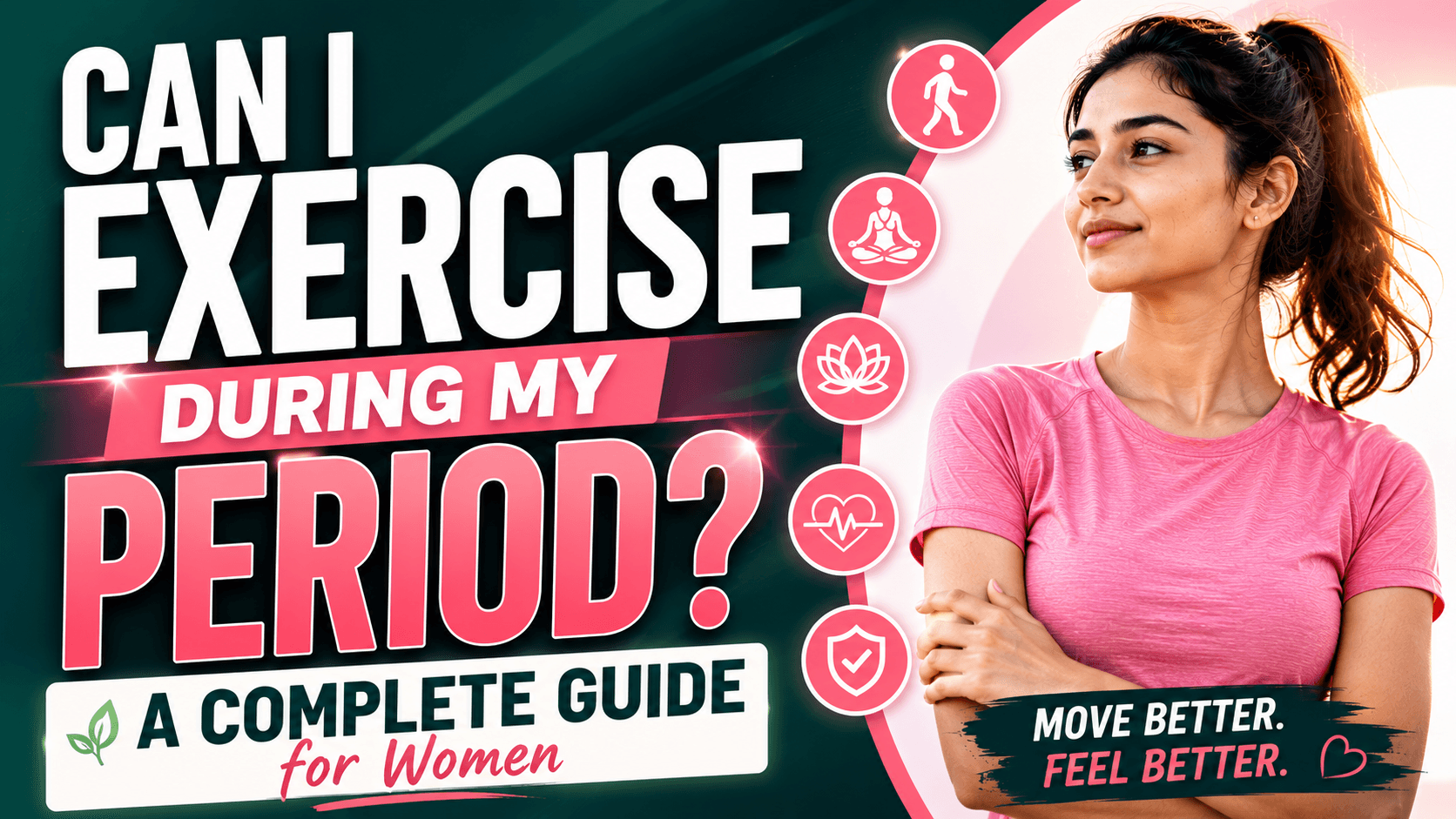
Uncover the truth about exercising during menstruation. Learn how movement can reduce cramps, enhance mood, and boost energy.
Maryam Mumtaz
Co-Founder & CEO
12 min read•7/26/2026
Marsa Empower · Menstrual Health & Fitness · For Girls & Women Aged 13 and Above · 14 min read
"Your period is not a reason to stop moving. For most women, it is actually a reason to move more thoughtfully — and the benefits are real."
Almost every girl and woman has asked this question at some point — usually while lying on the sofa with a hot water bottle, wondering whether she should be doing something, or whether staying still is exactly the right thing to do.
Can I exercise during my period?
The answer is yes — with understanding and with choices that respect how your body is feeling on any given day.
For generations, women were told to rest completely during menstruation. In some cultures and communities, this message still persists — periods are seen as a time of fragility, of being "unwell," of needing to withdraw from physical activity. This has caused many women to feel guilty for exercising during their period, and equally guilty for not exercising.
The reality — supported by decades of research — is more nuanced and more empowering than either extreme. Exercise during your period is not only safe for most women. For many, it is one of the most effective things they can do to feel better. The key is choosing the right kind of movement on the right kind of day — and listening to what your body is telling you.
This guide explains everything you need to know.
Yes. For the vast majority of healthy women and teenage girls, exercising during menstruation is completely safe. There is no medical reason — and no physiological reason — why being in your period should prevent you from being physically active.
This is not a modern opinion. Sports medicine professionals, gynaecologists, and exercise scientists all confirm that menstruation is not a medical condition that requires rest. It is a normal biological process, and the body is entirely capable of physical activity while it is occurring.
Many of the world's top female athletes — Olympic sprinters, professional footballers, long-distance swimmers, elite gymnasts — compete and perform at the highest levels of human physical achievement while menstruating. Their bodies are not an exception. They are simply an illustration of what the female body is capable of throughout the menstrual cycle.
During your period, the uterus contracts to shed its lining. These contractions are caused by chemicals called prostaglandins — the same chemicals that cause menstrual cramping. The body is doing significant hormonal and physical work.
But this work happens internally — in the uterus — and does not impair the cardiovascular system, the muscles, the lungs, or any other system involved in physical exercise. Your heart pumps effectively. Your muscles contract normally. Your lungs breathe as they always do. The biological process of menstruation runs in parallel with — not instead of — your body's physical capabilities.
The only legitimate reason to modify or reduce exercise during menstruation is how you personally feel — not the fact of menstruation itself.
Understanding why exercise helps during your period makes it much easier to motivate yourself to move when you do not particularly feel like it.
When you exercise — even gently — your brain releases a group of chemicals called endorphins. These are the body's natural pain-relieving and mood-elevating compounds. They bind to the same receptors in the brain as opioid pain medications, reducing the perception of pain and producing a sense of wellbeing.
For women with period cramps, this is directly relevant. The endorphins released during even 20 to 30 minutes of gentle walking or yoga measurably reduce the perception of cramping pain — not by eliminating the contractions causing the cramps, but by reducing how intensely the brain registers them.
Exercise increases blood flow throughout the body — including to the pelvic region. Better circulation to the uterine area can help reduce the intensity of cramping, which is partly caused by reduced blood flow to the contracting uterine muscle. A warm-up walk or gentle yoga session literally warms the body up, increases local blood flow, and eases the muscular tension that contributes to cramps.
Exercise has mild anti-inflammatory effects that, with regular practice, can reduce the overall levels of prostaglandins produced during menstruation — meaning that women who exercise consistently throughout the month tend to have less severe cramping than those who are sedentary. This is a longer-term benefit that comes from regular exercise as a habit, not just exercising during the period itself.
The hormonal fluctuations before and during menstruation — particularly the drop in oestrogen and progesterone — can increase emotional sensitivity and reduce mood stability. Exercise reduces cortisol (the stress hormone) and increases serotonin and dopamine, directly counteracting the mood effects of these hormonal shifts.
This is the most immediately felt benefit for many women. Gentle to moderate exercise releases endorphins that act as natural pain relievers, and improves pelvic blood flow that reduces muscle cramping. Many women find that a 20-minute walk on a painful period day produces noticeable cramp reduction within an hour.
A helpful comparison: heat therapy (a hot water bottle on the stomach) is one of the most effective cramp remedies available — it works by increasing blood flow and relaxing uterine muscle. Gentle exercise works through a similar mechanism, just from the inside.
The week before and the first few days of menstruation are when many women experience their lowest mood of the month — driven by falling oestrogen and progesterone, which reduce serotonin and GABA activity in the brain. Exercise directly raises serotonin and dopamine, counteracting these hormonal mood effects.
For women who experience significant premenstrual mood changes or emotional sensitivity during their period, exercise is one of the most powerful and most accessible tools for managing these effects.
The fatigue associated with the first few days of a period is real — it is driven by falling hormones, the physical effort of uterine contraction, and in women with heavy periods, iron loss. It can feel counterintuitive to exercise when you are tired. But gentle movement — a walk, light yoga, some gentle stretching — activates the cardiovascular and metabolic systems in ways that produce energy rather than consume it.
Within 20 to 30 minutes of gentle exercise, most women report feeling more energetic than they did before they started. The key word is gentle — the goal during the first day or two of a heavy period is movement, not intensity.
Bloating is one of the most uncomfortable period symptoms for many women — caused by fluid retention driven by hormonal changes. Gentle movement improves circulation, supports lymphatic drainage, and helps move fluid through the body more effectively — reducing the feeling of abdominal heaviness and bloating.
Yoga, in particular, includes specific poses that gently compress and release the abdominal region, providing relief from both bloating and cramping.
Hormonal shifts during menstruation — particularly the drop in progesterone, which has a natural sedative quality — can disrupt sleep quality. Exercise improves sleep quality and helps regulate the circadian rhythm, supporting deeper and more restorative sleep even during the days when hormonal disruption is most significant.
From a purely practical fitness perspective, avoiding exercise entirely for five to seven days every month means losing approximately one week of training per month — or more than three months per year. For women maintaining an exercise habit, this is a significant interruption that can undermine consistency.
Adapting exercise rather than stopping it entirely — reducing intensity on the heaviest days while continuing lighter activity — maintains both fitness and the habit of regular movement.
Understanding how hormones affect energy throughout the entire menstrual cycle — not just during your period — allows you to exercise more intelligently and more effectively.
Hormones: Oestrogen and progesterone are at their lowest. Energy level: Lower — particularly on days 1 and 2. Best exercise: Gentle walking · Light yoga · Stretching · Gentle swimming
This is the phase most women worry about most — but it is also the shortest. Days 1 and 2 typically have the heaviest flow and the most cramping. Days 3, 4, and 5 usually see significant improvement, and most women can return to near-normal activity as the week progresses.
Hormones: Oestrogen begins rising steadily. Energy level: Rising — often the best energy of the month. Best exercise: Everything — this is your peak exercise window.
As oestrogen rises, energy rises with it. Strength, endurance, motivation, and mood all tend to improve during the follicular phase. This is the time when your body responds best to challenging workouts and when personal fitness records are most likely to be broken. If you have a particularly demanding exercise goal, this is the phase to pursue it.
Hormones: Oestrogen peaks · LH surge triggers egg release. Energy level: Peak — testosterone also rises briefly around ovulation, adding to motivation and drive. Best exercise: High-intensity training · Running · Strength work · Team sports
Many women feel their most physically capable around ovulation. Coordination, strength, and cardiovascular performance tend to peak. This is also a good time to try something new or push your limits.
Hormones: Progesterone rises then falls · Oestrogen also falls toward the end. Energy level: Variable — often good in the early luteal phase, dropping in the late luteal phase as PMS symptoms begin. Best exercise: Moderate intensity in early luteal phase · Yoga, pilates, and lighter activity in the late luteal phase
The early luteal phase (days 15–21) still feels fairly good for most women. The late luteal phase (days 22–28, before the period arrives) is when PMS symptoms — fatigue, bloating, mood changes, breast tenderness, reduced motivation — are most prominent. Lighter, more restorative exercise during this phase — yoga, walking, swimming, stretching — matches the body's needs better than intense training.
These exercises are particularly well-suited to the first few days of menstruation — the days most women find most challenging.
Walking is the single most versatile and most accessible exercise available — and it is particularly beneficial during the first few days of a period. A 20 to 30 minute gentle to brisk walk provides real health benefits without placing excessive demand on the body.
Why it works so well during your period:
Even on the heaviest, most uncomfortable days, a 15-minute gentle walk around the block or garden is more beneficial than lying still — and most women feel noticeably better within 15 minutes of starting.
Yoga is one of the most recommended forms of exercise during menstruation — and for good reason. It combines gentle movement, conscious breathing, and specific poses that provide targeted relief for period symptoms.
Period-friendly yoga poses:
Child's pose (Balasana): Kneel on the floor, sit back on your heels, stretch your arms forward on the floor, and rest your forehead down. This pose gently stretches the lower back, relaxes the hips, and releases tension in the pelvic region that contributes to cramping. Hold for 30 to 60 seconds, breathing deeply.
Cat-Cow (Marjaryasana-Bitilasana): Start on hands and knees. On an inhale, drop the belly toward the floor and lift the head (cow). On an exhale, round the spine toward the ceiling and tuck the chin (cat). Alternate between the two slowly and rhythmically. This movement massages the pelvic organs and relieves lower back pain.
Supine twist (Supta Matsyendrasana): Lie on your back, draw one knee to your chest, and gently guide it across the body to the opposite side while keeping both shoulders on the floor. This gentle spinal twist releases tension in the lower back and improves circulation to the abdominal region.
Legs up the wall (Viparita Karani): Sit sideways against a wall, then swing your legs up so they rest vertically against the wall. This restorative pose reduces leg fatigue, relieves bloating, and promotes circulation back to the core. Incredibly relaxing on heavy days.
Reclining bound angle pose (Supta Baddha Konasana): Lie on your back, bring the soles of your feet together and allow your knees to fall open to the sides. This pose gently opens the hips, releases pelvic tension, and is deeply comfortable during cramping.
Simple stretching routines — even ten to fifteen minutes — reduce muscle tightness throughout the body, improve circulation, and provide genuine pain relief during menstruation.
Focus areas during your period:
Light cycling — on a stationary bike at a comfortable resistance, or outdoors at an easy pace — provides gentle cardiovascular exercise without the impact of running. It is easy to control intensity (pedalling slower on harder days), and the seated position is comfortable during the first days of a period.
Aim for 15 to 30 minutes at a pace where you can breathe comfortably and hold a conversation.
Swimming is one of the most complete and most comfortable forms of exercise available during menstruation — when appropriate period protection is used. Water pressure from the pool typically reduces active menstrual flow during swimming, and the supported, buoyant environment of the water places no impact on joints or the pelvic region.
Use a tampon or menstrual cup for swimming — sanitary pads are not suitable for water. If you are not yet comfortable using internal period products, swimming can be saved for lighter flow days.
Note: Swimming is completely safe and hygienic during menstruation when appropriate protection is used. Water pressure prevents any menstrual flow in the pool. This is a well-established, commonly practised activity for active women.
During the first few days of a period — particularly on heavy or crampy days — reducing the weight and the intensity of strength training while maintaining movement is an ideal approach.
Suitable light strength exercises during your period:
The goal on these days is to keep the body moving and maintain strength without placing excessive physiological demand on a system that is already working hard internally.
These exercises are not necessarily off-limits during your period — many women continue them with no problem. But on days when cramping is severe, bleeding is very heavy, or you feel weak or unwell, it is appropriate to reduce or postpone these activities.
Maximum or near-maximum weight training places significant systemic demands on the body. On days when the body is already managing significant hormonal shifts and heavy bleeding, this level of intensity may feel disproportionately exhausting and may worsen cramping. Reduce weight and increase repetitions, or switch to bodyweight exercises on heavy days.
HIIT involves repeated short bursts of maximum effort exercise — a format that is excellent for fitness building during the follicular and early luteal phases, but may feel genuinely difficult to sustain during the first days of a period. If you love HIIT and feel fine during your period, continue. If you find it depletes you rather than energises you during menstruation, switch to moderate-intensity steady-state exercise for a few days.
Long runs — particularly those lasting more than 45 to 60 minutes — place significant cardiovascular and physical demand on the body. Many women find they can run normally during their period. Others find that performance is reduced on the first two days. Listen to your body: if you can maintain your normal pace comfortably, continue. If you feel unusually fatigued or experience worsening symptoms, reduce distance or switch to walking.
Some yoga traditions advise against inversions — poses where the head is lower than the hips (headstands, shoulder stands, downward-facing dog) — during menstruation, based on the idea that they reverse blood flow. The scientific evidence for or against this is limited. Most women experience no problems with inversions during their period. However, if you feel uncomfortable or dizzy in these positions during your period, simply skip them and substitute other poses.
| Cycle Phase | Days | Exercise Type | Intensity |
|---|---|---|---|
| Menstruation | 1–5 | Walking · Yoga · Stretching · Light cycling | Low to moderate |
| Follicular | 6–13 | All exercise types · Running · Strength training · HIIT | Moderate to high — peak performance window |
| Ovulation | 13–15 | High-intensity activities · Personal records | High — peak strength and endurance |
| Early Luteal | 15–21 | Moderate exercise · Strength training · Classes | Moderate |
| Late Luteal | 22–28 | Yoga · Pilates · Walking · Swimming | Low to moderate — more restorative |
Working with your cycle in this way — rather than trying to maintain the same intensity throughout the month — is called cycle-synced training. It is increasingly recognised by sports scientists and women's health professionals as an approach that reduces injury risk, improves performance, and supports hormonal health by respecting the body's changing capacities across the month.
The right period product during exercise is the one that makes you feel secure, comfortable, and confident enough to focus on your movement rather than your protection.
Best for: Walking, yoga, stretching, light gym work, cycling.
Pads are comfortable and simple to use during low to moderate intensity exercise. For more vigorous activity — running, jumping, intense gym sessions — the pad may shift or feel uncomfortable. Choose winged pads for better security during movement, and change them before exercise if they are near capacity.
Not suitable for: Swimming.
Best for: Running, cycling, swimming, gym sessions, sport, and any activity requiring freedom of movement.
Tampons provide full internal protection that moves with the body without risk of shifting or leaking during vigorous activity. They are suitable for all exercise types including swimming.
Key rules: Change every 4 to 8 hours. Never leave a tampon in for longer than 8 hours. Use the lowest appropriate absorbency for your flow — not the highest, which can cause dryness and discomfort.
Best for: Long exercise sessions · Swimming · Any activity where changing products frequently is inconvenient.
A menstrual cup can be worn safely for up to 12 hours and provides reliable protection through even vigorous exercise. It sits internally, moves with the body, and — once in position correctly — cannot be felt. Excellent for active women once comfortable with insertion and removal.
Note: Menstrual cups have a learning curve for correct insertion. Practice with them at home first before relying on them during exercise.
Best for: Light exercise · Low-flow days · As backup protection alongside other products.
Period underwear is comfortable and feels like regular underwear. Good for low-impact activities like walking, yoga, and stretching. Most period underwear is not designed for high-intensity exercise or very heavy flow, so it works best as the primary option on lighter days or as a backup on heavier ones.
| Exercise | Recommended Product |
|---|---|
| Walking | Pad (winged) · Period underwear |
| Yoga and stretching | Pad · Period underwear · Tampon |
| Running | Tampon · Menstrual cup |
| Swimming | Tampon · Menstrual cup |
| Gym workout | Tampon · Menstrual cup |
| Cycling | Tampon · Menstrual cup · Pad (for light sessions) |
| Team sports | Tampon · Menstrual cup |
Mild to moderate cramping during periods is normal and expected. Gentle exercise can meaningfully reduce it. But severe period pain — pain that significantly prevents normal daily functioning — is not something to manage with exercise alone.
Severe period pain that:
...may indicate an underlying condition such as endometriosis or adenomyosis — conditions where tissue similar to the uterine lining grows outside or within the uterine wall. Both are significantly under-diagnosed — with an average of seven to ten years between symptom onset and diagnosis — because severe period pain is too often normalised.
If your period pain is severe, please see a gynaecologist. Severe period pain is a medical symptom with identifiable causes and effective treatments. Exercise is not a substitute for appropriate medical evaluation and management when pain is at this level.
Absolutely yes. Teen girls can and should participate in physical education classes, school sports, dance, swimming, and any other physical activity during their period — as long as they feel well enough to do so.
The teenage years are one of the most important periods for building bone density, establishing exercise habits, and developing a positive relationship with physical activity. Sitting out of physical activity during periods — potentially five to seven days per month — means missing out on critical opportunities for physical development and habit formation.
Many teenage girls feel embarrassed or self-conscious about exercising during their period, particularly in school settings. This embarrassment — not any physical limitation — is often the primary barrier. Normalising period-friendly exercise and providing appropriate period products and changing facilities in schools is a public health issue as much as a personal one.
Rest is not failure. There are legitimate situations where rest is the most appropriate response to how your body is feeling during your period.
Consider resting from exercise if you experience:
| Situation | Why Rest Is Appropriate |
|---|---|
| Very heavy bleeding soaking through protection within 1 to 2 hours | Significant blood loss causes fatigue and may indicate iron deficiency — rest and medical consultation are appropriate |
| Severe cramping not relieved by medication or heat | Exercising through severe pain is not beneficial — rest, heat therapy, and appropriate pain medication are the priority |
| Dizziness or fainting | These symptoms should always lead to rest and medical evaluation |
| Fever or signs of illness | Exercise is not recommended during illness of any kind |
| Genuine exhaustion that is more than normal period fatigue | Your body is telling you something — rest, hydrate, and nourish yourself |
| Nausea or vomiting | Common accompaniment to severe period pain — rest is appropriate until symptoms ease |
Resting on genuinely difficult days does not undermine your fitness habit. It is appropriate self-regulation — the intelligent adaptation of your routine to meet your body's actual needs on a particular day.
| The Myth | The Truth |
|---|---|
| "You should stay in bed during your period" | There is no medical reason to rest completely during a normal period. Gentle activity is beneficial for most women. |
| "Exercise makes your period heavier" | Exercise does not increase menstrual blood volume. Flow may temporarily seem to increase during vigorous activity due to gravity and movement, but overall blood loss is not changed. |
| "Swimming during your period is unsafe or unhygienic" | Swimming during your period is completely safe and hygienic with appropriate internal protection. Water pressure prevents flow in the pool. |
| "Intense exercise stops your period" | Occasional intense exercise does not stop periods. However, very extreme training combined with insufficient caloric intake can disrupt the hormonal axis and cause periods to stop — this is called exercise-induced amenorrhoea and requires medical attention. |
| "If you have cramps, you should not move" | The opposite is frequently true — gentle movement releases endorphins that reduce cramp perception and improves blood flow that eases muscular cramping. |
| "Period pain means you are not fit enough" | Period pain is caused by prostaglandins — inflammatory chemicals produced by the uterine lining. Fitness level is not the primary determinant of period pain severity. |
| "You cannot perform well when you have your period" | Many elite athletes achieve personal records and win competitions during menstruation. Hormonal levels during the follicular phase of the cycle — the week or two after the period — are actually associated with peak physical performance for many women. |
| Question | Answer |
|---|---|
| Is it safe to exercise during your period? | Yes — for most healthy women and teen girls |
| Does exercise help period pain? | Yes — releases endorphins · Improves blood flow · Reduces cramp intensity |
| What are the best exercises during a period? | Walking · Yoga · Stretching · Light cycling · Swimming · Light strength training |
| What exercises should be reduced on heavy days? | Heavy lifting · HIIT · Long-distance running — reduce intensity, do not necessarily stop |
| Which period products are best for exercise? | Tampons and menstrual cups for vigorous activity and swimming · Pads for light exercise |
| Should teen girls exercise during their period? | Yes — it is healthy, normal, and encouraged |
| When should you rest instead of exercise? | Very heavy bleeding · Severe pain · Dizziness · Fever · Genuine exhaustion |
| Does exercise affect period flow? | No — it does not increase overall blood loss |
| Is swimming safe during a period? | Yes — with tampon or menstrual cup |
| What about severe period pain? | This warrants medical evaluation — exercise alone is not sufficient management |
"Your period is not a barrier to an active life. It is a monthly signal that your body is working. Move with it, not against it — and most days, it will reward you for doing so."
Educational Disclaimer
This article is for educational and awareness purposes only. It does not constitute medical advice, diagnosis, or treatment. If you experience severe period pain, very heavy bleeding, or symptoms that significantly affect your quality of life, please consult a qualified gynaecologist or healthcare professional for personalised evaluation and guidance.
Marsa Empower · Menstrual Health · Fitness & Wellness · Women's Health Education
Medical Disclaimer
This article is for general informational and educational purposes only and is not a substitute for professional medical advice, diagnosis, or treatment. Always seek the advice of a qualified healthcare provider with any questions you may have regarding a medical condition. Never disregard professional medical advice or delay seeking it because of something you have read on MARSA Empower.
Written By
Maryam Mumtaz
Co-Founder & CEO
Co-Founder of MARSA Empower who leads the visual and strategic evolution of the platform. Maryam bridges technical complexity with human-centric design, architecting the team's official roadmap and ensuring MARSA effectively addresses the real-world needs of women. With deep expertise in agentic AI, full-stack development, and UI/UX design, she has delivered 50+ projects for 30+ satisfied clients.
Enjoyed this story?