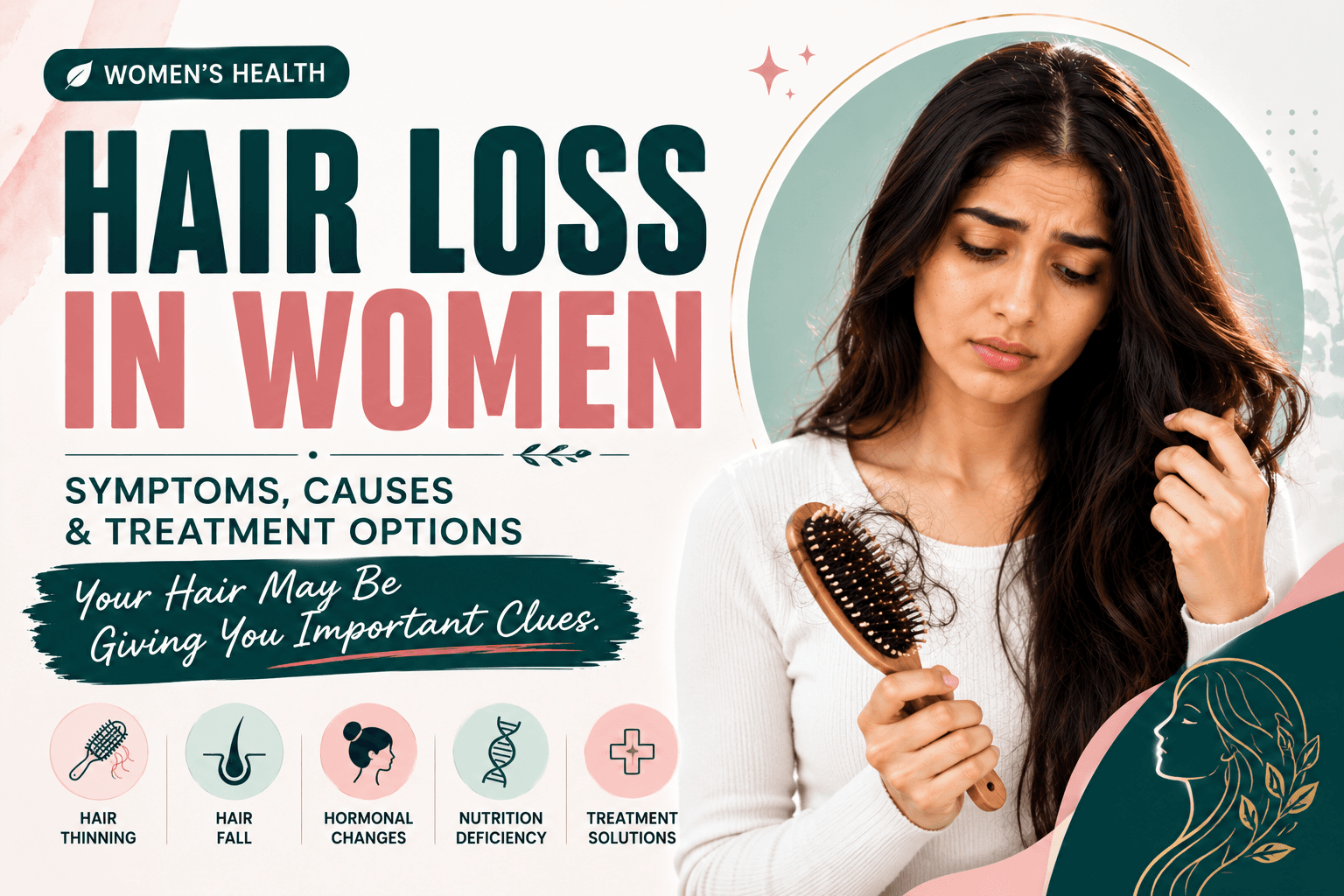
Discover the underlying causes of hair loss in women, learn to identify symptoms, and explore effective treatment options for restoring hair health.

Maryam Mumtaz
Co-Founder & CEO
12 min read•7/18/2026
Marsa Empower · Women's Health · Hair & Hormonal Wellness · For Girls & Women Aged 13–50 · 12 min read
"Your hair is not just about appearance. It is a visible reflection of what is happening inside your body. When it starts to fall, your body is asking you to pay attention."
Losing hair is something almost every woman experiences at some point in her life. It might start with noticing more hair on the pillow in the morning, or finding more strands caught in the brush, or realising that the parting in your hair looks wider than it used to.
Hair loss in women is extremely common — and it can happen at any age, from the teenage years through to menopause and beyond.
The most important thing to understand is this: hair loss is almost never just about the hair. It is almost always a signal — from the blood, from the hormones, from the nutritional status, from the thyroid — that something in the body's internal environment needs attention.
This guide will help you understand what that signal might mean, what is causing it, and what to do about it.
Each hair on your head grows from a tiny structure called a follicle — a small pocket in the scalp that produces the hair shaft. Every follicle goes through a natural cycle:
| Phase | Name | What Happens | Duration |
|---|---|---|---|
| Active growth | Anagen | Hair shaft is produced and grows | 2 to 7 years |
| Transition | Catagen | Follicle shrinks and prepares to rest | 2 to 3 weeks |
| Resting | Telogen | Hair rests before shedding | About 3 months |
| Shedding | Exogen | Old hair falls out, new hair begins | Days to weeks |
At any given time, about 85 to 90 percent of your hair follicles are in the active growth phase. The remaining 10 to 15 percent are resting and preparing to shed. This is why losing some hair every day is completely normal — it is part of the healthy cycle.
Problems begin when too many follicles enter the resting phase at once, when the growth phase becomes shorter than it should be, or when follicles begin to miniaturise and produce thinner, weaker hair.
This is one of the most common questions women have — and one of the most important to answer clearly.
Losing between 50 and 100 hairs per day is considered completely normal. You will see these hairs in your brush, on your pillow, or on the shower floor. This daily shedding is a healthy part of the natural hair cycle and does not indicate a problem.
Hair may also naturally shed more in certain seasons — particularly autumn — and may increase temporarily during and after pregnancy, after significant illness, or during periods of high stress. These temporary increases typically resolve on their own within a few months.
The following patterns are worth investigating:
If any of these apply to you — read on, because understanding the cause is the first and most important step.
Hair loss in women can present in several different ways. Recognising the pattern of your hair loss is helpful — because different patterns often point to different causes.
| Symptom | What It Looks Like | What It May Suggest |
|---|---|---|
| More hair while brushing or washing | Noticeably more strands in the brush, drain, or hands | Telogen effluvium · Iron deficiency · Thyroid |
| Thinning at the top of the head | Crown and central parting area becoming less dense | Androgenic alopecia · PCOS · Hormonal imbalance |
| Wider parting line | Part looks broader than it did a year ago | Androgenic alopecia · Hormonal changes |
| Reduced overall volume | Hair feels thinner in the hand or ponytail is smaller | Any diffuse cause — iron, thyroid, nutrition, stress |
| Hair that feels fine and limp | Individual strands thinner and weaker than before | Miniaturisation from androgen excess |
| Bald patches | Circular or irregular areas of complete hair loss | Alopecia areata — autoimmune · Scalp infection |
| Excessive hair on pillows, clothes | Finding hair on everything throughout the day | Active shedding phase — multiple possible causes |
| Scalp visible under normal lighting | Scalp showing through hair, especially overhead light | Advanced or ongoing hair loss needing investigation |
Iron deficiency is the single most common and most reversible cause of hair loss in women — yet it is frequently missed because standard blood tests do not always detect it in its early stages.
Here is how it works: iron is needed to make haemoglobin — the protein in red blood cells that carries oxygen through the blood. Hair follicles are among the most metabolically active cells in the body and need a constant, rich supply of oxygen to sustain growth. When iron stores fall, the body prioritises oxygen delivery to essential organs and reduces it to non-critical functions — including hair growth. Follicles respond by entering the resting phase early and shedding.
Why women are especially at risk: Every menstrual period involves blood loss — and blood loss means iron loss. Women with heavy periods lose significantly more iron than the average diet replaces, leading to gradual iron depletion over months or years.
The important testing point: A standard blood test measuring haemoglobin alone can miss iron deficiency in its early stages. Serum ferritin — which measures the body's stored iron reserves — is the more sensitive test. Many women with significant hair loss have normal haemoglobin but critically low ferritin. Always request ferritin by name.
The hair follicle contains receptors for oestrogen, progesterone, androgens, and thyroid hormones — making it directly sensitive to hormonal shifts throughout a woman's life.
Several hormonal transitions commonly trigger hair loss:
Puberty: Rising androgen levels during puberty can alter follicle behaviour, contributing to increased oiliness of the scalp and changes in hair texture and density.
Pregnancy: Elevated oestrogen during pregnancy keeps more follicles in the active growth phase, producing the fuller, thicker hair many pregnant women notice. After delivery, oestrogen drops rapidly — and those follicles shift into the resting phase simultaneously. Two to four months later, the shedding can be dramatic. This is called postpartum hair loss and is temporary, typically resolving within 6 to 12 months.
Perimenopause and menopause: As oestrogen declines, androgen levels become relatively dominant. This shift can cause progressive thinning at the crown and parting — the female pattern of androgenic alopecia.
Stopping hormonal contraceptives: Coming off the combined pill can trigger a temporary shedding phase as the body re-establishes its natural hormonal rhythm.
PCOS is one of the most common hormonal conditions in women of reproductive age — and it produces a particularly distressing combination of hair changes.
In PCOS, elevated androgens — particularly dihydrotestosterone (DHT) — cause follicles at the crown and temples to miniaturise progressively. These follicles are genetically sensitive to DHT and respond to androgen excess by producing finer, shorter, weaker hair with each successive growth cycle.
At the same time, the same elevated androgens stimulate coarser, darker hair growth on the face, chin, chest, and stomach — producing the confusing and distressing paradox of scalp hair loss and excess body and facial hair occurring simultaneously.
PCOS-related hair loss is often accompanied by:
If you have scalp hair thinning alongside two or more of these symptoms, PCOS screening is warranted.
Both physical and emotional stress can trigger hair loss through a process called telogen effluvium — a well-understood mechanism in which large numbers of hair follicles are pushed simultaneously into the resting phase as the body responds to a perceived crisis.
The stress does not have to be emotional. Physical triggers include:
Emotional triggers include bereavement, relationship breakdown, prolonged work pressure, or any period of sustained anxiety.
The important thing to understand about stress-related hair loss is the delay. The shedding does not happen during the stressful period — it happens 2 to 3 months afterward, when the follicles that entered the resting phase complete that phase and shed. This delay is why many women cannot connect their hair loss to its cause without guidance.
The good news: telogen effluvium is temporary. Once the triggering stressor is resolved and the body returns to balance, follicles re-enter the growth phase and hair density gradually recovers — usually within 6 to 12 months.
Hair is made of keratin — a structural protein built from amino acids — and every stage of its growth requires a specific set of nutrients. When the diet is consistently deficient in any of these, follicle function is compromised.
| Nutrient | Role in Hair Health | Common Sources |
|---|---|---|
| Protein | Builds the keratin structure of the hair shaft | Eggs · Meat · Lentils · Dairy · Nuts |
| Iron | Carries oxygen to follicles — see Cause 01 | Red meat · Spinach · Lentils · Fortified grains |
| Zinc | Supports follicle cell repair and division | Meat · Seeds · Legumes · Nuts |
| Vitamin D | Activates new follicle cycling | Sunlight · Eggs · Fatty fish · Fortified milk |
| Biotin (B7) | Supports keratin production | Eggs · Nuts · Seeds · Sweet potato |
| Vitamin B12 | Supports red blood cell formation and oxygen delivery | Meat · Eggs · Dairy · Fortified foods |
| Omega-3 fatty acids | Reduces scalp inflammation and supports follicle health | Fatty fish · Walnuts · Flaxseed |
Young women who skip meals, follow very restrictive diets, or eat a limited range of foods are at particular risk of the nutritional deficiencies that impair hair growth — often without realising it, because the consequences are delayed by several months.
The thyroid gland produces hormones that regulate the metabolic rate of virtually every cell in the body — including hair follicle cells. Both an underactive thyroid (hypothyroidism) and an overactive thyroid (hyperthyroidism) can disrupt the hair growth cycle and cause hair loss.
In hypothyroidism: Reduced metabolic activity slows follicle function and shortens the growth phase. The result is diffuse hair thinning across the entire scalp — and often also thinning of the outer third of the eyebrows, which is a relatively specific indicator of thyroid dysfunction. Hair loss from hypothyroidism is also commonly accompanied by fatigue, weight gain, cold sensitivity, constipation, dry skin, and low mood.
In hyperthyroidism: Excess thyroid hormone also disrupts follicle cycling — producing diffuse shedding alongside weight loss, rapid heartbeat, anxiety, and heat intolerance.
Thyroid-related hair loss responds well to treatment once the condition is identified and thyroid function is restored to normal — though recovery takes 6 to 12 months because the hair growth cycle must restart and complete a full phase.
Female pattern hair loss — also called androgenetic alopecia — is the most common form of permanent hair loss in women and is significantly influenced by family history. If female relatives on either side of your family experienced noticeable hair thinning, your own risk is higher.
The pattern in women is typically different from male pattern baldness. Women tend to experience:
Genetic hair loss develops slowly over years rather than suddenly, and it tends to accelerate during hormonal transitions — particularly around perimenopause when oestrogen declines.
Importantly, genetic predisposition does not rule out other contributing causes — iron deficiency, thyroid dysfunction, and nutritional gaps frequently coexist with genetic hair loss and worsen it. All of these should be identified and addressed before concluding that genetics alone is responsible.
Traction alopecia is hair loss caused by sustained mechanical tension on the hair follicle — produced by hairstyles that pull the hair tightly over extended periods of time.
Tight ponytails worn daily, braids pulled close to the scalp, buns that create constant tension at the hairline, and heavy extensions are the most common causes. The pattern of hair loss follows precisely where the tension is greatest — typically along the frontal hairline and at the temples.
In the early stages, traction alopecia is reversible — removing the source of tension allows the follicle to recover. But if sustained over months or years, the chronic inflammation can cause follicle scarring and permanent hair loss in affected areas.
The most important step toward solving hair loss is identifying its cause — because different causes require different treatments. The following blood panel covers the most common causes:
| Test | What It Checks |
|---|---|
| Serum Ferritin | Iron stores — the most sensitive iron marker; request this specifically |
| Full Blood Count (FBC) | Overall blood health and haemoglobin levels |
| TSH + Free Thyroid Hormones | Thyroid function — both hypo and hyperthyroidism |
| Testosterone + DHEAS | Androgen levels — elevated in PCOS and androgenic alopecia |
| 25-Hydroxyvitamin D | Vitamin D status |
| Vitamin B12 + Folate | Nutritional markers affecting energy and hair |
| Fasting Glucose + Fasting Insulin | Metabolic health and insulin resistance |
| Zinc | Nutritional marker directly relevant to follicle repair |
A pelvic ultrasound may also be recommended if PCOS is suspected based on accompanying symptoms.
The right treatment depends entirely on the cause. This is why investigation comes before treatment — not the other way around.
If iron deficiency is confirmed through a ferritin blood test, the treatment is iron supplementation — prescribed and monitored by a doctor — alongside dietary improvements. Iron-rich foods include red meat, lentils, dark leafy greens, and fortified grains. Consuming vitamin C alongside iron-rich meals significantly improves absorption.
Hair regrowth after iron correction typically becomes visible after 3 to 6 months of treatment.
For postpartum hair loss, the primary treatment is time — the shedding is temporary and resolves naturally as hormones stabilise. Supporting recovery with good nutrition and iron intake (particularly important after delivery) speeds the process.
For PCOS-related hair loss, treatment focuses on reducing androgen excess — through dietary changes that improve insulin sensitivity, exercise, and where appropriate, medications such as anti-androgen treatments prescribed by a gynaecologist or endocrinologist.
For perimenopausal hair changes, a discussion with a doctor about hormonal options may be appropriate.
Thyroid dysfunction is treated with medication that restores thyroid hormone levels to normal. Hair typically begins to regrow within 6 to 12 months after thyroid function is normalised. The delay is because the hair growth cycle must restart and complete a full phase before visible changes occur.
Telogen effluvium resolves naturally once the triggering stressor is addressed. Supporting the process includes stress management strategies, adequate nutritional intake, good sleep, and patience. Hair density typically recovers within 6 to 12 months.
Targeted supplementation — guided by blood test results identifying your specific deficiencies — addresses nutritional causes of hair loss. General hair supplements purchased without testing may miss the specific deficiencies actually driving the problem.
For androgenic alopecia — whether driven by PCOS or genetics — medical treatment options include:
| Treatment | How It Works | Availability |
|---|---|---|
| Minoxidil (topical) | Stimulates follicle activity and prolongs the growth phase | Available over the counter in pharmacies |
| Anti-androgen medications | Reduce DHT's effect on follicles | Prescription only — from a dermatologist or endocrinologist |
| Platelet-Rich Plasma (PRP) | Uses the patient's own blood to stimulate follicle growth | Clinic-based procedure |
| Low-Level Laser Therapy | Stimulates follicle activity through light energy | Clinic or at-home device |
These treatments work best when started early — before follicle miniaturisation is too advanced. Consulting a dermatologist gives access to the most appropriate evidence-based options for your specific situation.
While you are addressing the underlying cause of your hair loss, gentle hair care reduces the additional burden placed on already vulnerable follicles.
What you eat has a direct and measurable effect on hair health. These are the most important foods to include regularly:
| Food | Key Nutrients | Why It Helps |
|---|---|---|
| Eggs | Protein · Biotin · Zinc · B12 | One of the most complete hair health foods available |
| Lentils and daal | Iron · Protein · Folate · Zinc | Excellent plant-based source of multiple hair nutrients |
| Spinach and leafy greens | Iron · Vitamin C · Folate | Iron for oxygenation; vitamin C improves iron absorption |
| Nuts and seeds | Zinc · Vitamin E · Omega-3 · Protein | Anti-inflammatory and structurally supportive |
| Chicken and lean meat | Protein · Iron · Zinc · B12 | High-quality protein and easily absorbed iron |
| Fish — especially salmon | Omega-3 · Protein · Vitamin D | Reduces scalp inflammation and supports follicle cycling |
| Sweet potato | Beta-carotene (converts to Vitamin A) · Biotin | Supports sebum production and scalp health |
| Berries | Vitamin C · Antioxidants | Protects follicles from oxidative stress |
| Whole grains | Zinc · B vitamins · Iron | Provides slow-release energy and key minerals |
| Greek yogurt and dairy | Protein · Calcium · B12 | Structural protein and neurological support |
You do not have to wait until hair loss is severe before seeking medical advice. It is appropriate to speak to a doctor if:
A general physician can begin the investigation with a blood panel. A dermatologist specialises in scalp and hair conditions. A gynaecologist or endocrinologist is the right specialist if hormonal causes — PCOS, thyroid disease, adrenal dysfunction — are suspected.
There is no such thing as "too early" to ask about hair loss. Earlier identification means earlier treatment — and significantly better recovery outcomes.
Simple daily habits make a meaningful cumulative difference to hair health over time:
Eat consistently and do not skip meals. Hair follicles are sensitive to nutritional gaps. Regular, balanced meals keep the supply of nutrients to follicles steady.
Stay well hydrated. Every cellular process — including those within the follicle — requires adequate water. Aim for 8 glasses daily, more in heat.
Prioritise sleep. Growth hormone — essential for cell regeneration including follicle repair — is primarily secreted during deep sleep. 7 to 8 hours of consistent sleep is the recommendation.
Manage stress before it accumulates. Chronic stress is a direct hair loss trigger. Building daily habits that reduce cortisol — regular movement, adequate rest, manageable commitments — protects hair health over time.
Get blood tests annually. Iron, thyroid, vitamin D, and B12 are the key markers to check regularly — particularly if periods are heavy or diet is limited.
Handle hair gently every day. The way you treat your hair physically — how you wash, dry, style, and secure it — adds up over months and years. Gentle handling protects already vulnerable follicles from additional mechanical stress.
Do not wait and hope. If shedding has been persistent for more than 3 months without improvement, investigation is the right next step — not more shampoo changes.
| Topic | Key Takeaway |
|---|---|
| What is normal | 50 to 100 hairs per day — more than this, consistently, needs investigation |
| Most common cause | Iron deficiency — check serum ferritin, not just haemoglobin |
| Hormonal causes | Postpartum · PCOS · Perimenopause · Contraceptive changes |
| Stress-related loss | Telogen effluvium — shedding appears 2 to 3 months after the trigger |
| Thyroid | Both hypo and hyperthyroidism cause diffuse hair thinning |
| Nutrition | Protein · Iron · Zinc · Vitamin D · B12 are the key hair nutrients |
| Genetics | Gradual crown and parting thinning — does not exclude other treatable causes |
| Tight hairstyles | Traction alopecia — reversible early, potentially permanent if sustained |
| First step | Blood tests: ferritin · TSH · testosterone · vitamin D · B12 · fasting insulin |
| Treatment timeline | Most causes: 6 to 12 months for visible regrowth after underlying cause is addressed |
| When to seek help | Shedding for more than 3 months · Bald patches · Symptoms alongside hair loss |
"Hair loss is not vanity. It is a health signal — and it deserves the same investigation, care, and attention as any other health concern. Your hair is speaking. Learn to listen."
Educational Disclaimer
This article is for educational and awareness purposes only. It does not constitute medical advice, diagnosis, or treatment. If you are experiencing persistent or significant hair loss, please consult a qualified dermatologist or healthcare professional for personalised evaluation and guidance.
Marsa Empower · Women's Health · Hair & Hormonal Wellness · Dermatology & Endocrinology
Medical Disclaimer
This article is for general informational and educational purposes only and is not a substitute for professional medical advice, diagnosis, or treatment. Always seek the advice of a qualified healthcare provider with any questions you may have regarding a medical condition. Never disregard professional medical advice or delay seeking it because of something you have read on MARSA Empower.
Written By
Maryam Mumtaz
Co-Founder & CEO
Co-Founder of MARSA Empower who leads the visual and strategic evolution of the platform. Maryam bridges technical complexity with human-centric design, architecting the team's official roadmap and ensuring MARSA effectively addresses the real-world needs of women. With deep expertise in agentic AI, full-stack development, and UI/UX design, she has delivered 50+ projects for 30+ satisfied clients.
Enjoyed this story?



