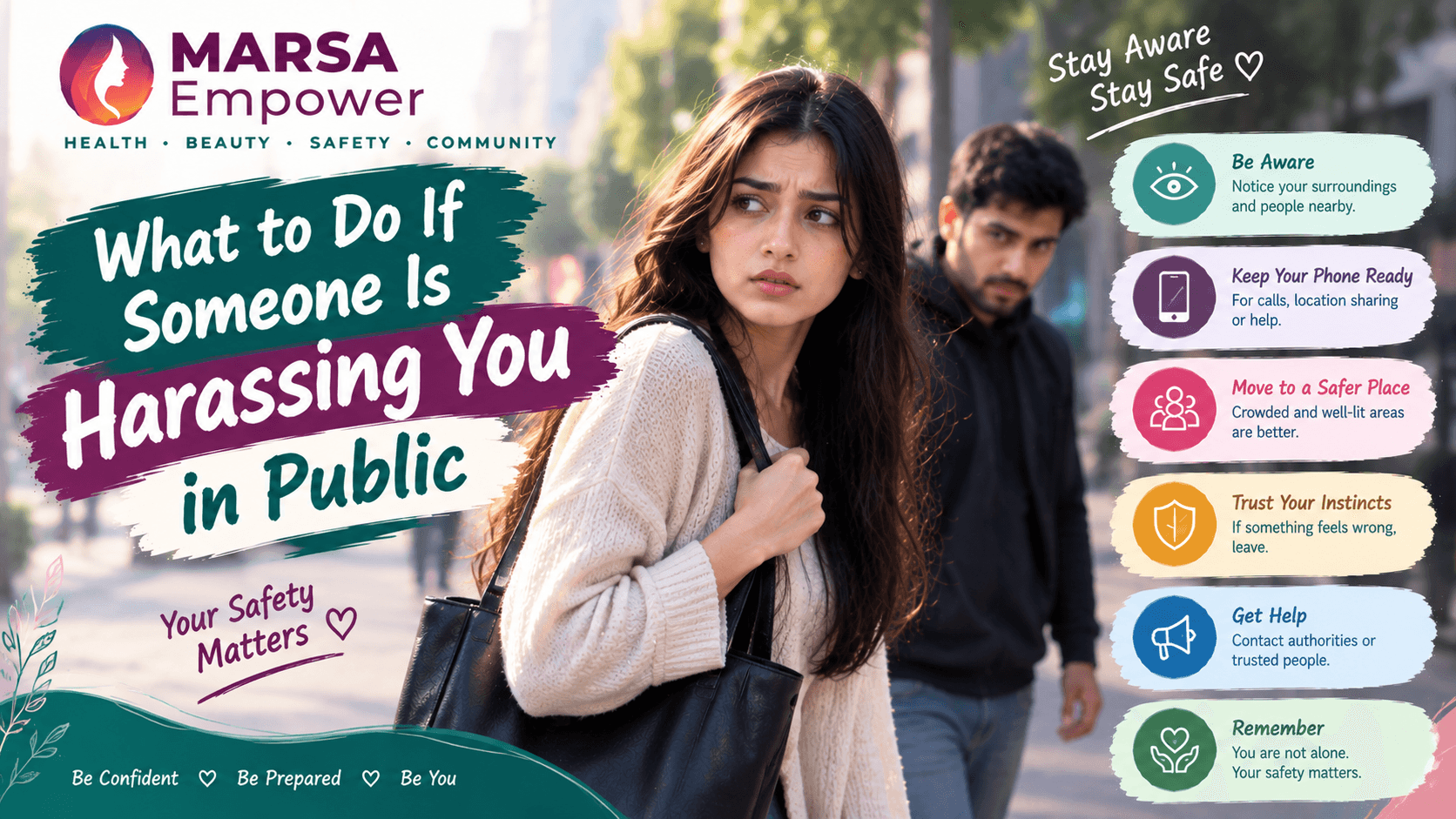
Public harassment can be distressing, but you don't have to face it alone. Discover expert insights and practical tips to handle such situations confidently and safely.

Maryam Mumtaz
Co-Founder & CEO
11 min read•10/10/2026
Marsa Empower · Personal Safety · For Girls & Women Aged 13 and Above · 11 min read
Public harassment can happen anywhere. On a busy street, on a bus, in a market, in a park, outside a school, or in any other shared space. It can come from a stranger, from someone who claims to know you, or from a group of people.
It can look like unwanted comments or sexual remarks. It can be someone following you or repeatedly approaching you after you have made it clear you do not want them to. It can be unwanted physical contact, intimidation, someone blocking your way, or being filmed or photographed without your consent.
Whatever form it takes, the experience can be frightening, confusing, and deeply uncomfortable. And it is never the fault of the person being targeted.
This guide has two purposes. First, to give you practical steps you can take if you are ever in this situation. Second, to show people who witness harassment how they can help safely, without putting themselves or the person being targeted at greater risk.
Public spaces belong to everyone. You deserve to move through them safely.
According to media reports in July 2026, a Japanese travel vlogger was allegedly followed and subjected to harassment by a group of men while filming at the Pakistan Monument in Islamabad. Footage from the incident spread widely online and prompted significant public criticism. Police were reportedly looking into the matter, and the case raised renewed debate about the treatment of visitors and women in public spaces.
What this tells us: Harassment in public spaces is recorded, witnessed, and discussed — and public pressure can result in official response. Bystanders and authorities both play a role in how these situations are handled afterward.
Local media reported that CCTV footage circulated in August 2026 appeared to show a motorcyclist making an obscene gesture toward a woman walking alone in Alfalah Society, Karachi. Residents reportedly shared the footage with police. The case highlighted how community alertness and the availability of recorded evidence can support reporting.
What this tells us: Evidence, when safely preserved and shared with the appropriate authority rather than publicly spread without consent, can support a formal complaint.
A video showing a woman reporting inappropriate behaviour by a man on a train went viral in June 2026. Railway authorities confirmed that a complaint had been registered. The incident prompted discussion about how railway staff and passengers can better respond when harassment occurs in transit spaces.
What this tells us: Harassment on public transport is a specific and common concern. Knowing how to alert staff and what the reporting process looks like makes it easier to act when it matters.
A confrontation on a Cairo bus after a woman accused a fellow passenger of harassment sparked renewed public discussion in February 2026 about the role bystanders play in public transport safety and whether others intervened to help her. The case was reported by multiple Arabic-language news outlets.
What this tells us: Bystander response — or the absence of it — is one of the most significant factors in whether a harassment situation escalates or is interrupted. What other passengers do matters.
Note: All of the above are reported allegations based on news coverage available at the time of writing. Investigations were ongoing or outcomes were not fully confirmed in all cases. Language is used throughout to reflect this: "reportedly," "allegedly," and "according to reports."
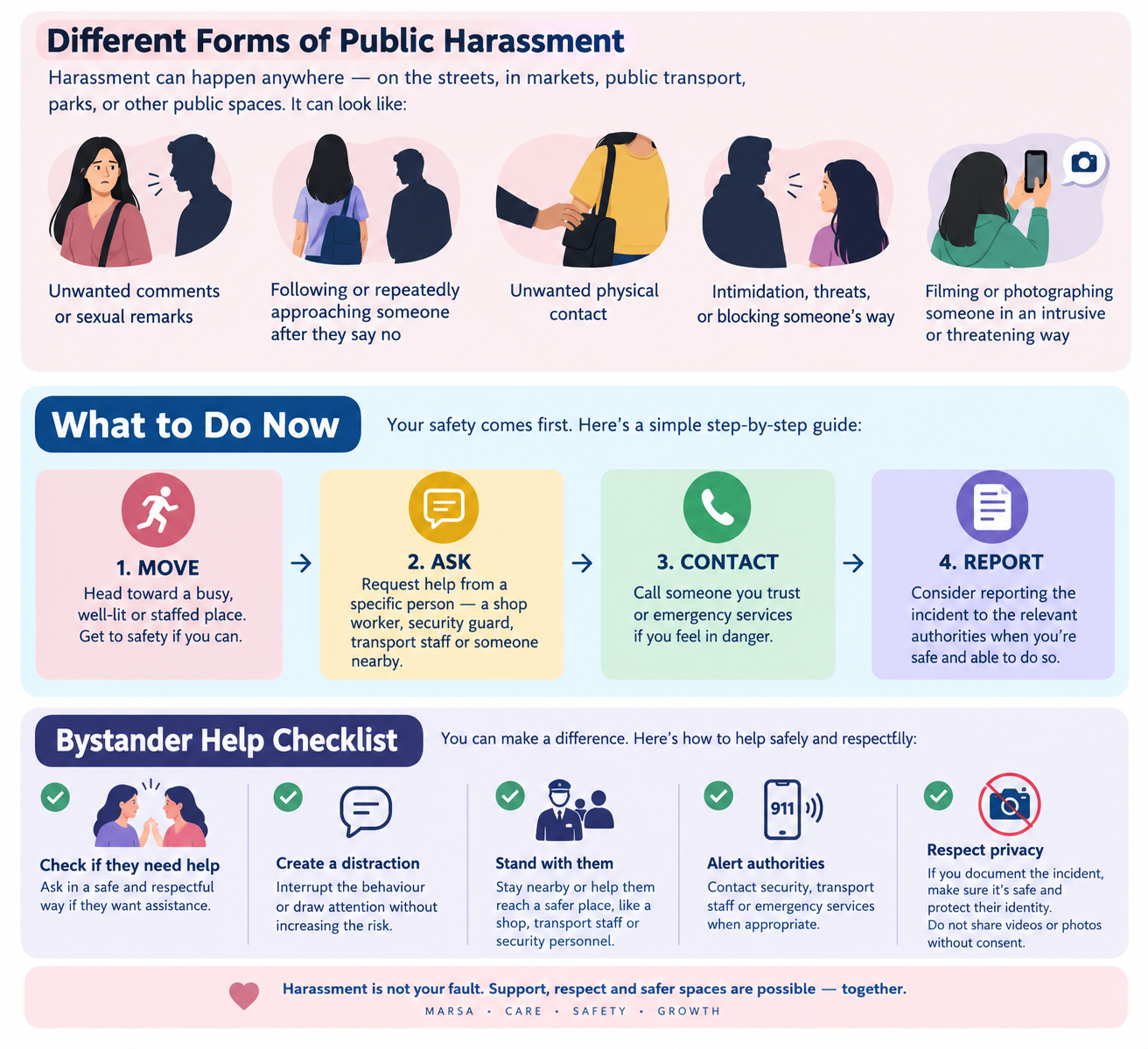
Public harassment takes many forms. The infographic below illustrates the most common types.
Understanding Public Harassment — Infographic
The infographic above shows five common forms of public harassment: unwanted comments or sexual remarks; following or repeatedly approaching someone after they say no; unwanted physical contact; intimidation, threats, or blocking someone's way; and filming or photographing someone in an intrusive or threatening way.
In plain terms:
Unwanted comments or sexual remarks — being called out to, commented on, or subjected to language of a sexual or intimidating nature in a public space.
Following or repeatedly approaching — being trailed by someone, or having someone approach you again and again after you have made clear you do not want the interaction to continue.
Unwanted physical contact — being touched, grabbed, or physically interfered with without your consent.
Intimidation, threats, or blocking your way — someone using their physical presence, words, or actions to threaten or prevent you from moving freely.
Filming or photographing without consent — being recorded in a way that feels threatening, intrusive, or that you have not agreed to.
Context matters. Local laws differ. What constitutes a criminal offence varies by country and jurisdiction. But in all of these forms, the common thread is behaviour directed at you without your consent that makes you feel unsafe, uncomfortable, or violated.
Your safety is the priority. Nothing in this section asks you to put yourself at greater risk in order to respond to harassment.
Move toward a safer location first. Head toward a busy, well-lit, staffed area. A shop, a bank, a transport station, a restaurant, a petrol station — any place with other people and ideally with staff who can assist.
Avoid engaging if a response could increase the danger. You are not required to reply. In many situations, a clear, brief response and then walking away toward other people is the safest available action. In others, any verbal response may escalate the situation.
If it is safe, you can tell the person to stop. A short, direct statement — "Do not speak to me like that" or "Leave me alone" — said calmly and clearly, followed by moving away, can be appropriate when the risk of doing so is low. But this is a judgement call you must make based on your specific situation. Your safety comes first.
Ask a specific person for help. Research on bystander behaviour shows that asking a specific person — rather than appealing to a group — is significantly more effective. "You, in the blue jacket — can you help me?" is more likely to result in assistance than a general appeal. A shop worker, security guard, transport employee, or simply another person nearby can be a resource.
Contact someone you trust, or emergency services. If the situation is serious or continuing, contact a trusted person and tell them where you are. If you are in immediate danger, contact local emergency services.
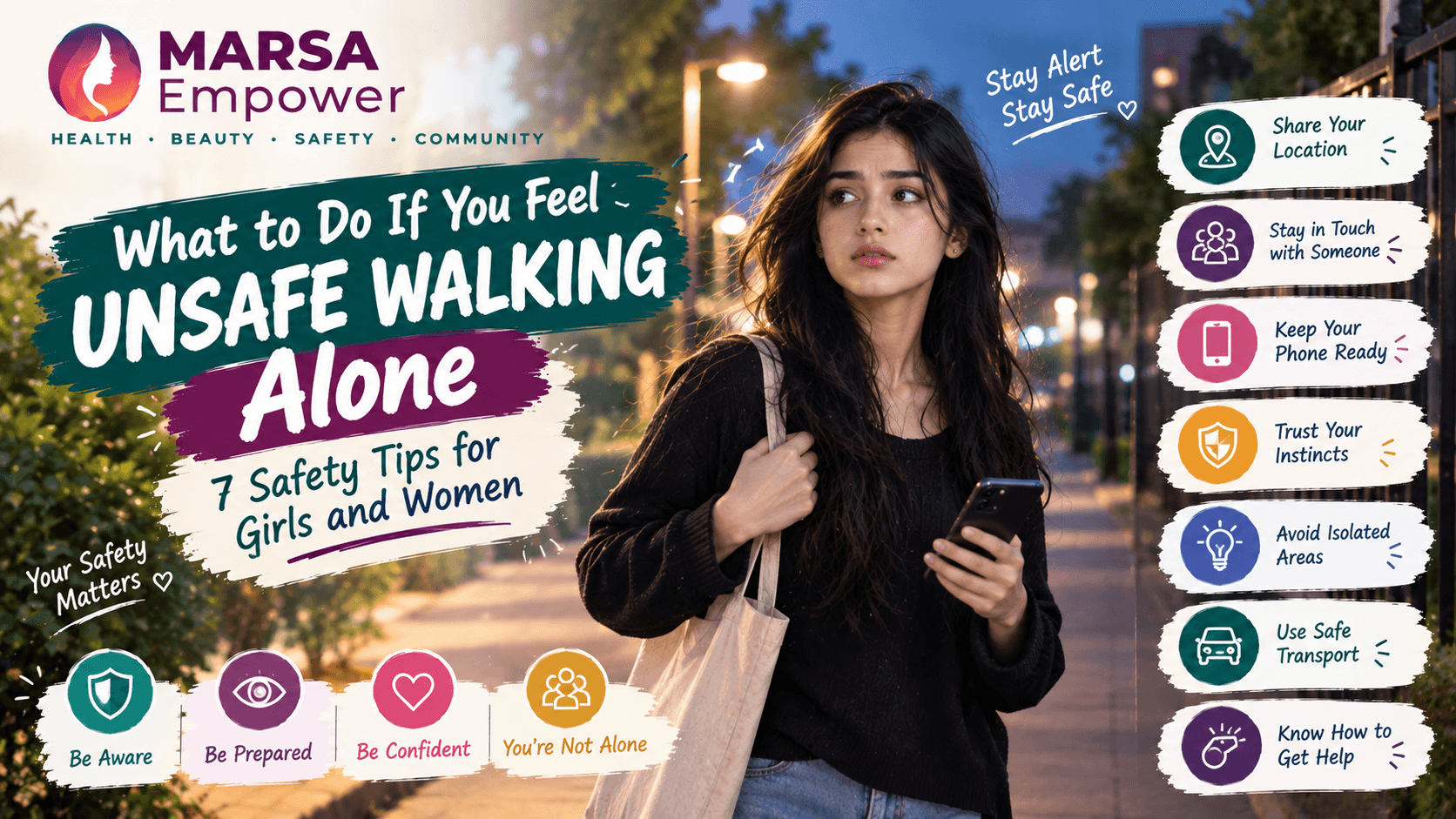
If you believe someone is following you, do not go to an isolated area. Do not go directly home. Leading someone to your home confirms your address.
Change direction toward a more populated place. Enter a shop, a petrol station, a staffed building, or any public location with other people. Stay inside and ask for help if necessary.
Do not confront the person directly if doing so could increase the risk to you. Your goal is to reach safety, not to establish whether you were right about being followed.
If you face an immediate, serious threat, contact local emergency services immediately. In Pakistan: Police 15. In India: 112. In the UK: 999. In the US and Canada: 911.
Public transport creates specific challenges — you may be in a confined space, unable to leave immediately, and unsure who to turn to.
Move closer to the driver, conductor, or transport staff if it is safe to do so. Being physically nearer to a person in authority can provide immediate protection and makes it easier to alert them.
Tell a staff member what is happening. Transport staff have a responsibility to respond to harassment on their vehicles. You are entitled to their assistance.
If no staff member is immediately available, ask a trusted-looking passenger for help — ideally someone who is not alone and who appears to be aware of the situation.
Report the incident to the transport operator after the journey, or to the relevant transport authority. In Pakistan, this can be done through the local transport authority or police. In India, complaints about railway incidents can be made to the Railway Protection Force or through the 139 helpline.
You do not need to confront the person causing harm yourself. Getting yourself to safety and alerting someone with authority to act is sufficient.
If you witness harassment in a public space, you can make a meaningful difference — without putting yourself or the person being targeted at greater risk.
Check whether they want help, if it is safe to ask. Approaching calmly and asking "Are you okay? Do you want me to stay with you?" respects the person's agency and gives them the option to accept help without pressure.
Create a distraction. You do not have to directly challenge the harasser to interrupt the situation. Dropping something, asking for directions from the person being harassed, or simply standing close enough to disrupt the interaction can be effective.
Stand with them. Stay nearby, help them reach a safer place, or simply make it clear through your presence that they are not alone. This alone changes the dynamic of the situation significantly.
Alert authorities. Contact security personnel, transport staff, or emergency services when appropriate. You do not have to resolve the situation personally — alerting someone with authority to intervene is a meaningful act.
Respect privacy. If you document an incident because it is safe to do so, protect the identity of the person being targeted. Do not share footage or photographs of a harassment victim without their explicit consent. Recording a harasser is one thing. Publishing a victim's face or identifying details without permission is another matter entirely.
Never share humiliating footage of the person who was targeted. Do not blame them, and do not pressure them to respond in a particular way.
Do not blame the person being harassed for their clothing, the time of day, where they were, or the fact that they were travelling alone. Harassment is the responsibility of the person causing it.
Do not pressure them to confront the harasser. What response is safest depends on the specific situation, and only the person in it can fully assess that.
Do not spread identifiable videos of the victim without their consent. Viral spread of a victim's experience can cause additional harm.
Do not encourage physical retaliation. A physical response in a public space can escalate a situation and create new risks.
Do not assume that silence means the person was unaffected. Shock, fear, and the instinct to minimise what happened are all common responses. A person who did not react visibly was still affected.
Reporting harassment is a personal decision. No one should be pressured to report before they are ready, or in a way that puts them at additional risk. But knowing the available options makes it easier to decide.
In an immediate emergency, contact Police on 15 or Emergency on 1122.
In Punjab, the Virtual Women Police Station allows women to report harassment and other incidents without attending a police station in person. It can be accessed by calling 15 and pressing 2. A female officer will take the complaint by phone.
In other provinces, harassment can be reported at the nearest police station. If attending in person feels unsafe, a trusted person can accompany you. You can also contact relevant provincial women's protection authorities.
Useful information when making a report: The time and date of the incident. The location. A description of the person involved. Names or contact information of any witnesses. Any safely collected evidence — screenshots, a vehicle number, a physical description. You should never put yourself at risk to collect evidence.
Pakistan NCCIA (for online harassment, threats, or image-based abuse): https://complaint.nccia.gov.pk | Helpline: 1799
Fear of not being believed, of further harassment, of the reporting process itself, or of the impact on family or community is real and valid. You do not have to report immediately, or at all, if doing so would create additional risk for you.
There are other steps that may feel more manageable.
Talk to someone you trust — a friend, family member, or mentor — about what happened. Having one person who knows can provide significant support.
Contact a women's support organisation for confidential guidance about your options before deciding whether to file a formal complaint.
Keep a private, secure record of what happened if the harassment is repeated. Date, time, location, and description. This creates documentation without requiring an immediate formal step.
Seek emotional support. Harassment can affect your confidence, your sense of safety, and your willingness to use public spaces. Speaking to a counsellor, helpline, or support organisation can help.
There is no single correct timeline for deciding what to do next. Your pace is valid.
When something happens in a public space, a simple sequence of steps can help you respond quickly without having to think through every decision from scratch.
1. MOVE Head toward a busy, well-lit, or staffed place. Get to safety if you can. Distance from the person causing harm is the first priority.
2. ASK Request help from a specific person — a shop worker, security guard, transport staff member, or someone nearby. Name them specifically: "You — can you help me?"
3. CONTACT Call someone you trust, or contact emergency services if you feel you are in immediate danger.
4. REPORT When you are safe and ready, consider reporting the incident to the relevant authority. You do not have to do this immediately.
Public spaces — streets, buses, markets, parks, transport stations — are spaces that belong to everyone. Every person has the right to move through them without being harassed, intimidated, or made to feel unsafe.
That right does not depend on what someone is wearing, what time it is, where they are going, or whether they are alone. It is unconditional.
Each of us who witnesses harassment in a public space has a role to play. Not necessarily a dramatic or confrontational one — but a human one. Checking on someone. Standing nearby. Alerting a staff member. Refusing to laugh along. Choosing not to share a victim's footage without their consent.
Together, these choices shape whether public spaces feel safe or hostile. The responsibility for harassment always belongs to the person causing it. But the response to it belongs to all of us.
Harassment is not your fault. Support, respect, and safer spaces are possible — together.
MARSA · Care · Safety · Growth
The person experiencing harassment is never responsible for another person's choice to harass them.
When something happens, your immediate safety matters more than collecting proof, confronting the person, or explaining yourself to anyone. Move toward people and light. Ask for specific help. Contact someone you trust or emergency services when necessary.
Bystanders can make a real difference — without escalating the situation or overriding the choices of the person being targeted.
Reporting options vary by location. Use verified local resources, go at your own pace, and seek support if you need it.
Pakistan Emergency Numbers Police: 15 | Rescue: 115 | Emergency: 1122 | Women's Helpline: 1099 Punjab Virtual Women Police Station: Call 15, press 2
India Emergency Numbers National Emergency: 112 | Women's Helpline: 1091 | Railway Helpline: 139
UK Emergency Emergency Services: 999 | Non-emergency: 101
USA and Canada Emergency Services: 911
Australia Emergency Services: 000
Pakistan — NCCIA (cybercrime and online harassment) https://complaint.nccia.gov.pk | Helpline: 1799
India — National Cyber Crime Reporting Portal https://cybercrime.gov.in | Helpline: 1930
Dastak Foundation Pakistan (women's safety and shelter) https://dastakpk.org
Aurat Foundation Pakistan (women's rights and support) https://af.org.pk
UK — Suzy Lamplugh Trust (personal safety guidance) https://www.suzylamplugh.org
StopStreetHarassment.org (global resources) https://stopstreetharassment.org
Disclaimer
This article is for educational and safety-awareness purposes only. Emergency numbers, reporting procedures, and support resources should be verified locally before relying on them. If you are in immediate danger, contact your local emergency services. Case study details are based on media reports and should not be taken as confirmed legal findings.
Marsa Empower | Care. Safety. Growth. Visit marsaempower.com for women's health, personal safety, and digital awareness resources.
Medical Disclaimer
This article is for general informational and educational purposes only and is not a substitute for professional medical advice, diagnosis, or treatment. Always seek the advice of a qualified healthcare provider with any questions you may have regarding a medical condition. Never disregard professional medical advice or delay seeking it because of something you have read on MARSA Empower.
Written By
Maryam Mumtaz
Co-Founder & CEO
Co-Founder of MARSA Empower who leads the visual and strategic evolution of the platform. Maryam bridges technical complexity with human-centric design, architecting the team's official roadmap and ensuring MARSA effectively addresses the real-world needs of women. With deep expertise in agentic AI, full-stack development, and UI/UX design, she has delivered 50+ projects for 30+ satisfied clients.
Enjoyed this story?