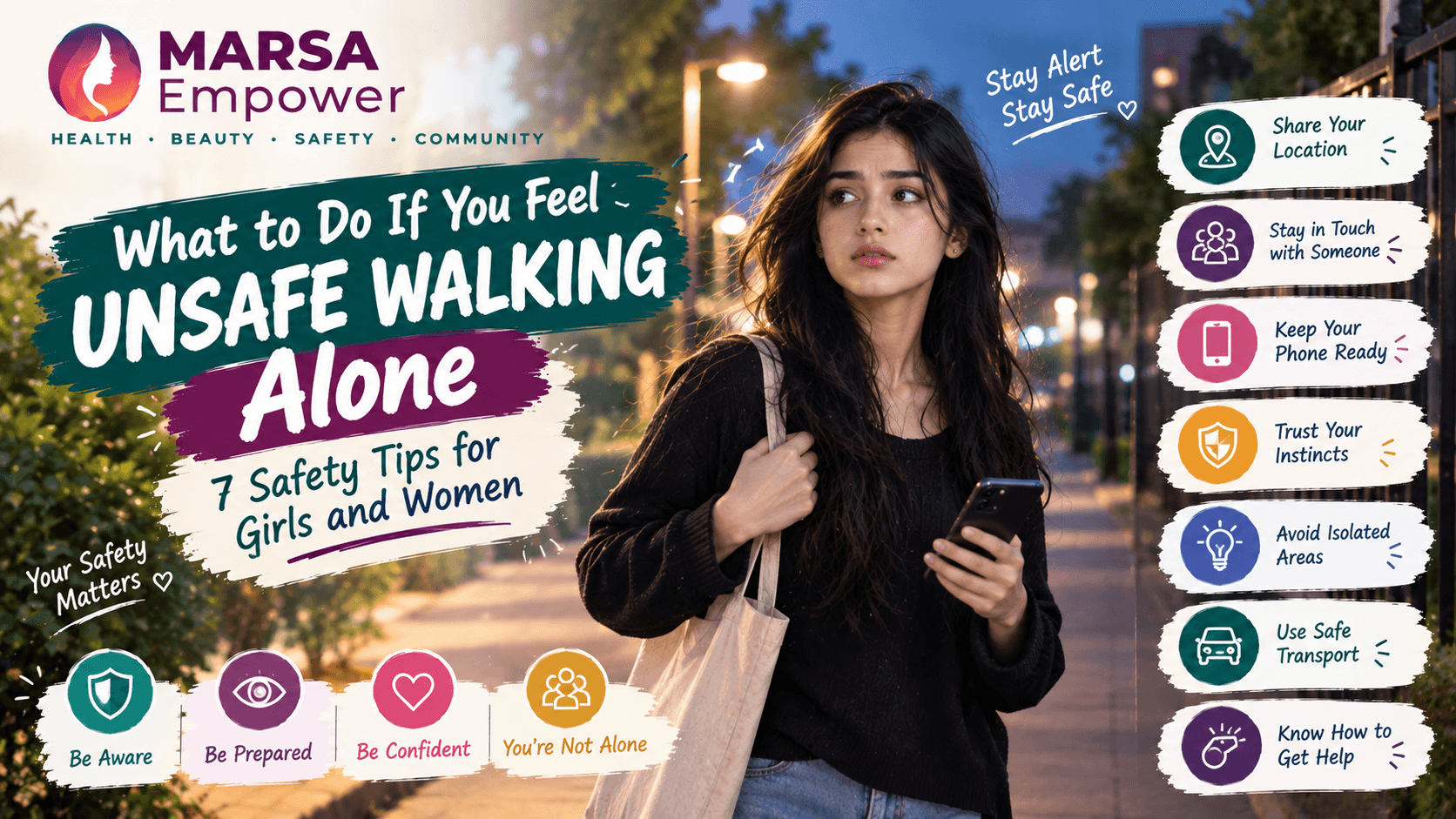
Feeling unsafe walking alone? Learn 7 essential safety tips designed for women to ensure your peace of mind and physical security.

Maryam Mumtaz
Co-Founder & CEO
7 min read•10/9/2026
Marsa Empower · Personal Safety · For Girls & Women Aged 13 and Above · 7 min read
Walking alone is part of everyday life for millions of girls and women — going to school, commuting to work, running errands, visiting friends, or simply moving through the city. The majority of these journeys are completely routine.
But there are moments when something feels wrong. A person seems to be walking too close behind you. A route that seemed fine begins to feel isolated. Someone calls out to you in a way that is uncomfortable. You are not sure if you are being followed.
In those moments, knowing what to do matters. Not because danger is always imminent, but because having a plan allows you to respond with more confidence and less panic.
This guide does not aim to make every walk feel frightening. It aims to give you seven practical tools so that when a situation makes you uncomfortable, you already know your options.
Awareness is the foundation of personal safety. You do not need to be on alert at all times, but when you are walking alone — particularly in an unfamiliar area, at night, or on a quieter route — paying attention to what is around you is the single most important habit you can build.
Notice the people near you. Not with suspicion, but with attention. Is anyone consistently moving at your pace? Is anyone paying unusual attention to you?
Notice the route itself. Is it becoming less busy? Is the lighting getting worse? Are there fewer shops, fewer people, fewer lit buildings?
Keep your phone accessible, but try not to be completely absorbed in it while walking alone. Looking at your screen while walking in an unfamiliar place reduces your awareness of what is happening around you. If you need to check your phone, pause in a lit, busy area rather than walking while reading.
Remove one earphone or keep the volume low enough to hear what is around you when you are in an unfamiliar location at night. Music and podcasts are fine when you know your surroundings well. They become a disadvantage when you need full situational awareness.
The path you choose matters as much as how you walk it.
When you have a choice, prefer busy, well-lit streets over quieter alternatives. A route that takes two extra minutes but keeps you on a main road with other people, passing shops, and visible street lighting is meaningfully safer than an isolated shortcut.
Before you leave, particularly for a route you have not taken before or are taking later in the day than usual, take a moment to identify the route options. Which road has more people? Which has shops or petrol stations you could enter if needed? Which is better lit?
You do not have to memorise every detail. Simply knowing that a shop is three minutes ahead on your route — a place you could enter, slow down, or ask for help — is the kind of practical knowledge that makes a difference if something goes wrong.
If you realise mid-journey that your current route is becoming isolated or uncomfortable, changing your route is always an option. You do not have to continue in a direction that feels wrong simply because it was your original plan.
One of the simplest and most effective safety habits for walking alone requires nothing more than a short message.
Before you leave for a journey that feels slightly longer, later, or less familiar than usual, let someone you trust know where you are going and roughly when you expect to arrive. This does not need to be a formal arrangement. A quick message — "Walking home from [location], should be there by [time]" — is enough.
If your phone allows it, you can share your live location with a trusted person through WhatsApp, Google Maps, or another messaging service. This is a private share between the two of you. It does not mean your location is public.
For longer walks or late-night journeys, you can agree on a simple check-in: "I'll message you when I'm home." If the message does not arrive, the person knows to follow up.
This habit takes almost no time. It means someone who cares about you knows where you are. It is a small step that provides meaningful reassurance.
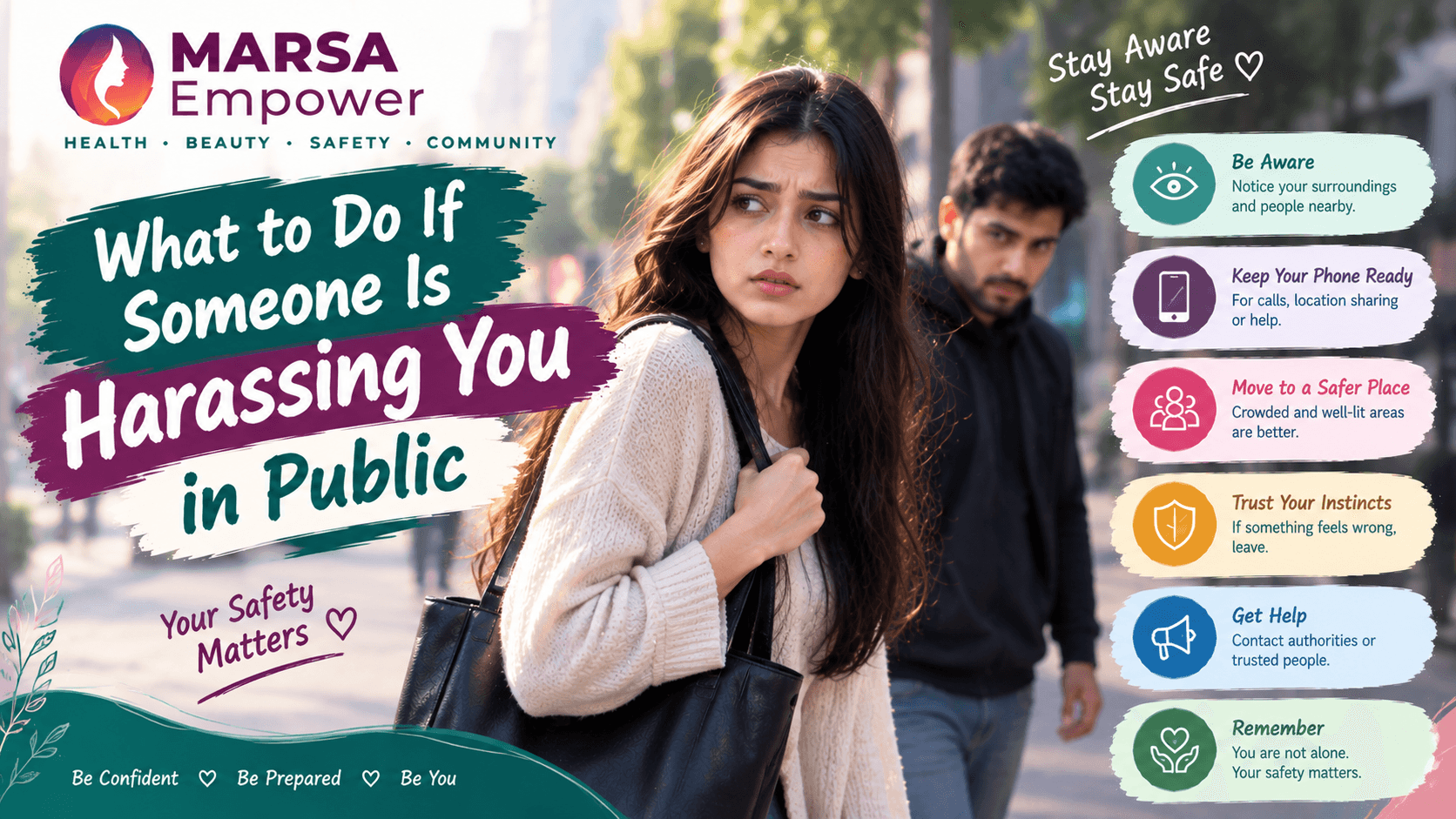
If you notice that a person seems to be consistently behind you, moving at a similar pace and changing direction when you do, trust that observation. You do not need certainty to take a precautionary action.
Do not go directly home. If you are being followed, leading the person to your home confirms your address and creates a risk that extends beyond the immediate situation. This is the most important single point in this section.
Change direction deliberately. Turn onto a busier road or toward a lit building. If the person changes direction too, that is significant information.
Move toward people and light. A busy shop, a petrol station, a restaurant, a bank branch, a pharmacy — any staffed, public place is a destination to move toward. Enter it and stay inside for a few minutes.
Contact someone you trust and tell them what is happening and where you are. Share your live location if possible.
Do not confront the person following you. Turning to challenge someone in an isolated location gives up the advantage of distance. Your goal is to reach safety, not to establish whether your concern was justified.
Contact emergency services if you believe you are in immediate danger or the person continues following you after you have moved toward a populated area.
Unwanted attention — being called out to, followed by comments, having someone approach in a way that feels threatening or intrusive — is an experience many women and girls encounter at some point while walking alone.
You do not have to stop. You do not have to respond. You do not have to explain where you are going, who you are, or why you do not want to engage. Your silence or continued walking is not impolite in this context — it is a reasonable response to an unwanted approach.
Move toward other people or a staffed location. If the person follows you despite your non-response, moving toward a more populated area increases your safety and often discourages the behaviour.
If you decide to respond, a short, firm, clear response — not aggressive, not apologetic — is usually most effective. You are not required to be rude, but you are also not required to be warm. "I'm not interested" said calmly while continuing to walk is sufficient.
Prioritise reaching a safer location over arguing a point or proving something to the person making you uncomfortable. The goal is your safety, not the resolution of an argument.
Your phone is one of your most practical safety tools — but only if it is charged and accessible when you need it.
Before leaving for any journey alone, particularly in the evening or in an unfamiliar area, make sure your phone has sufficient battery. If you are someone who tends to leave the house with a low battery, consider keeping a small portable charger in your bag as a habit.
Keep important contacts accessible. You should not have to search through a long contacts list under stress to find the person you need. Pin or save the contacts you would call in an emergency so they are immediately available.
Know the local emergency number for your area. In Pakistan, the police emergency number is 15. Rescue is 115. Emergency services is 1122. The women's helpline is 1099. In India, the national emergency number is 112. In the UK, it is 999. In the US and Canada, it is 911.
If your phone is unavailable — the battery has died, or it was taken from you — you can ask a member of staff at any shop, petrol station, or public building to call someone or contact emergency services. You do not need your own phone to access help.
Discomfort is not a reason for panic. But it is a reason to act — calmly, promptly, and without waiting until you are certain something is wrong.
The most common reason women and girls stay in uncomfortable situations is not wanting to overreact, seem dramatic, or inconvenience other people. This instinct, while understandable, can delay action that would have been straightforward if taken a few moments earlier.
When something feels wrong, take the simplest available precautionary action immediately. Change direction. Enter a shop. Text a trusted person. Speed up toward a busier area. These are small actions that require no confrontation and no certainty — just a reasonable response to discomfort.
Do not wait to be entirely sure before acting. By the time something has clearly escalated, some of your safest options may be less available.
If someone directly threatens or attempts to harm you, your single priority is reaching safety. Leave toward other people or a lit public place, call emergency services when you are able, and ask for help from anyone nearby. A shop window, a passing car with people in it, a lit doorway — any of these is a resource in an emergency.
Ignoring discomfort to avoid seeming impolite. Politeness is a social value. Your safety is a right. These do not carry equal weight when a situation feels threatening.
Taking an isolated shortcut to save time. Two minutes saved on a dark, empty shortcut is rarely worth the trade-off when a busier alternative exists.
Confronting a threatening person unnecessarily. Confrontation in an isolated space can escalate a situation that distance and movement toward people would have de-escalated naturally.
Sharing your live location publicly on social media or in a group. Share it privately with one specific trusted person, not broadly.
Believing you must handle a frightening situation alone. Asking for help from a shop assistant, a bystander, or emergency services is a practical safety decision, not an overreaction. Help exists, and you are allowed to use it.
Three things worth carrying with you every time you walk alone.
Your safety is more important than your politeness. If a situation is making you uncomfortable, you are allowed to leave it, change your route, or seek help — without explaining yourself to anyone.
Harassment and threatening behaviour are not the victim's fault. Nothing about how you are dressed, where you are going, or what time it is makes unwanted behaviour your responsibility.
You do not have to handle fear alone. Asking for help — from a friend, a shop assistant, or emergency services — is a sensible, proportionate response to a situation that does not feel safe.
Most journeys go exactly as expected. But having a simple plan for the moments when they do not makes a real and practical difference.
Stay aware. Choose routes where other people are present. Tell someone where you are going. Move toward people and light when something feels wrong. Keep your phone charged and your emergency contacts accessible. And if something feels genuinely threatening, ask for help immediately.
You deserve to feel safe wherever you are going.
Pakistan Emergency Numbers Police: 15 | Rescue: 115 | Emergency: 1122 | Women's Helpline: 1099
India Emergency Numbers National Emergency: 112 | Women's Helpline: 1091 | Police: 100
UK Emergency Emergency Services: 999 | Non-emergency police: 101
USA and Canada Emergency Services: 911
Australia Emergency Services: 000
Pakistan — NCCIA (cybercrime and online harassment) https://www.nccia.gov.pk | Helpline: 1799
India — National Cyber Crime Reporting Portal https://cybercrime.gov.in | Helpline: 1930
UK — Suzy Lamplugh Trust (personal safety guidance) https://www.suzylamplugh.org
Pakistan — Dastak Foundation (women's safety and shelter) https://dastakpk.org
Disclaimer
This article is for educational and safety-awareness purposes only. Emergency numbers and resources should be verified locally before relying on them. If you are in immediate danger, contact your local emergency services.
Marsa Empower | Care. Safety. Growth. Visit marsaempower.com for women's health, personal safety, and digital awareness resources.
Medical Disclaimer
This article is for general informational and educational purposes only and is not a substitute for professional medical advice, diagnosis, or treatment. Always seek the advice of a qualified healthcare provider with any questions you may have regarding a medical condition. Never disregard professional medical advice or delay seeking it because of something you have read on MARSA Empower.
Written By
Maryam Mumtaz
Co-Founder & CEO
Co-Founder of MARSA Empower who leads the visual and strategic evolution of the platform. Maryam bridges technical complexity with human-centric design, architecting the team's official roadmap and ensuring MARSA effectively addresses the real-world needs of women. With deep expertise in agentic AI, full-stack development, and UI/UX design, she has delivered 50+ projects for 30+ satisfied clients.
Enjoyed this story?