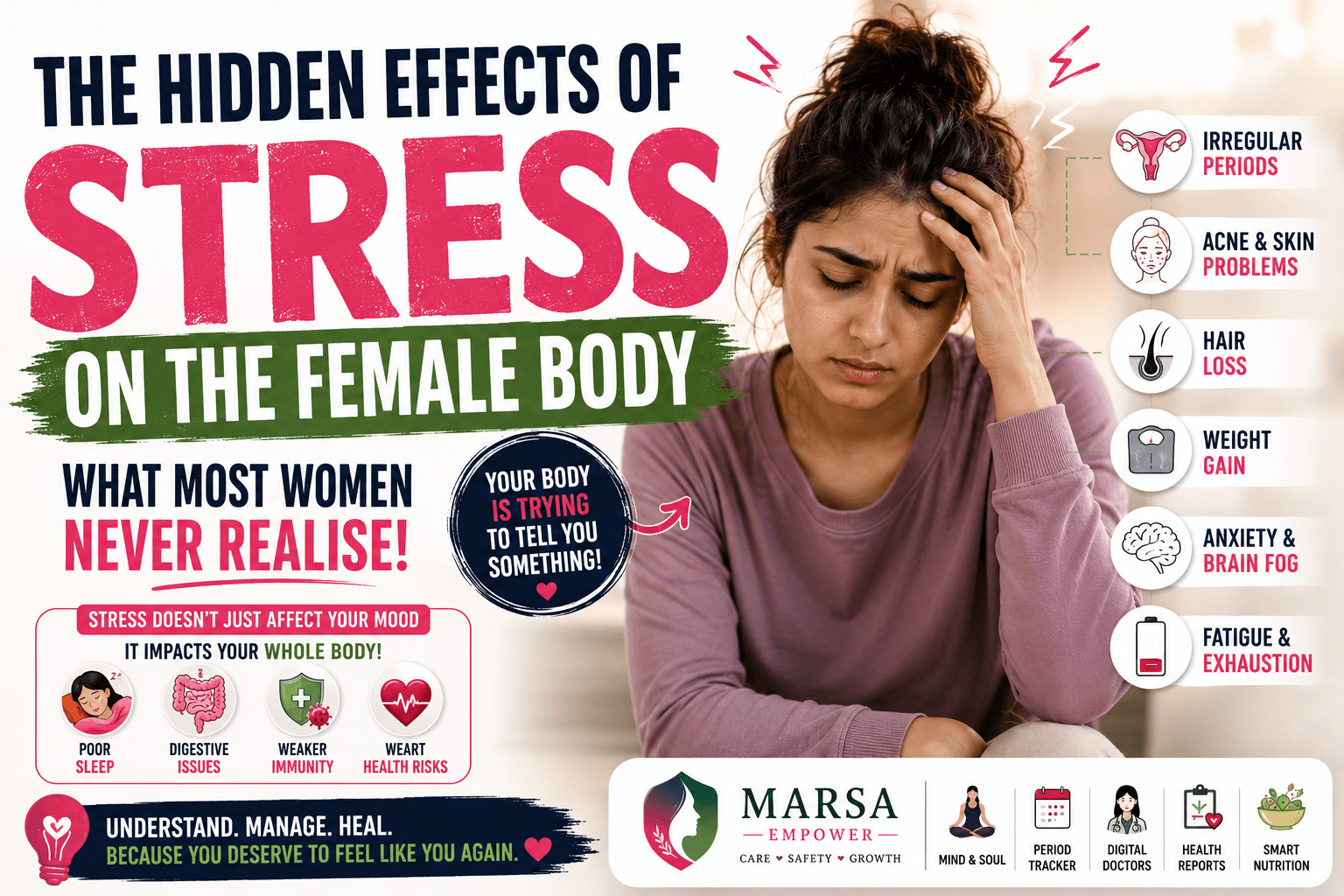
Explore the profound and often hidden effects stress has on women's bodies, from hormonal disruptions to immune weakening.

Maryam Mumtaz
Co-Founder & CEO
12 min read•7/4/2026
"Your stress is not just in your head. It is in your body. And it deserves to be taken seriously."
She thinks she is just tired.
She thinks her skin is just breaking out.
She thinks her periods are just irregular.
She thinks her hair is just thinning.
She does not connect any of it — the fatigue, the acne, the missed cycles, the hair falling in the shower drain. She treats each symptom separately: a new skincare product for the acne, a new shampoo for the hair, a vitamin for the tiredness. She waits for things to settle.
But her body has already connected all of it. And it has been trying to tell her the same thing for months.
Stress.
Not "stress" in the vague, dismissive way it is so often used — as in you are probably just stressed, try to relax. Stress as a measurable, physiological state that is silently reshaping her body from the inside out. Stress as a hormonal disruption with real, identifiable consequences for her skin, her cycle, her hair, her weight, her brain, her heart, and her immune system.
Most women know that stress affects their mood. Far fewer understand what it does to their body. This is the guide that explains it — clearly, completely, and without minimising what chronic stress actually costs a woman's health.
Before exploring what stress does to the female body, it helps to understand the primary mechanism through which it acts: a hormone called cortisol.
Cortisol is produced by the adrenal glands — two small glands that sit on top of the kidneys. It is often called the "stress hormone," but it is more accurately described as the body's emergency response chemical. When you perceive a threat — physical danger, a difficult confrontation, a looming deadline, a frightening piece of news — the brain signals the adrenal glands to release cortisol.
In small, short-term doses, cortisol is useful. It sharpens attention, mobilises energy, suppresses non-urgent functions like digestion and reproduction, and prepares the body to deal with the immediate problem. Once the threat passes, cortisol levels fall and the body returns to its normal resting state.
The human stress response was designed for short, acute threats — a physical danger that resolves in minutes. Modern life does not work this way. The stressors most women face — relentless work pressure, financial worry, relationship difficulties, family demands, social comparison, the invisible mental load of managing everything — are chronic and unrelenting. They do not resolve in minutes. They persist for weeks, months, and years.
When cortisol is chronically elevated, the body cannot return to its resting state. The emergency response that was designed to be temporary becomes the default. And the effects of that sustained emergency state ripple through every system in the body.
Chronic stress is not just an emotional experience. It is a sustained hormonal state that has measurable, physical consequences throughout the female body — consequences that are frequently treated as separate, unrelated symptoms rather than what they actually are: the body's response to ongoing stress.
| # | Hidden Effect | What It Looks Like |
|---|---|---|
| 1 | Disrupted Menstrual Cycle | Delayed, missed, or irregular periods |
| 2 | Triggered or Worsened PCOS | Insulin resistance, androgen excess |
| 3 | Hair Loss | Sudden diffuse shedding 2–3 months later |
| 4 | Damaged Skin Health | Acne, dullness, flares of eczema or rosacea |
| 5 | Destroyed Sleep Quality | Exhausted but unable to sleep deeply |
| 6 | Abdominal Weight Gain | Fat storage around the midsection |
| 7 | Brain Fog & Memory Problems | Difficulty concentrating and remembering |
| 8 | Weakened Immune System | Frequent illness and slow recovery |
| 9 | Digestive Disruption | Bloating, nausea, IBS-like symptoms |
| 10 | Cardiovascular Impact | Elevated blood pressure, increased inflammation |
If you have ever noticed that your period comes late — or does not come at all — during a particularly stressful month, you have experienced this effect firsthand. The connection between stress and menstrual disruption is not psychological. It is hormonal and direct.
The hypothalamus — the small region of the brain that controls hormonal signalling — regulates both the stress response and the reproductive system. When cortisol rises, the hypothalamus prioritises the stress response over reproductive function. It reduces the release of GnRH — gonadotropin-releasing hormone — the signal that starts the entire chain reaction leading to ovulation and a regular period.
Less GnRH means less FSH and LH (the hormones that trigger ovulation), which means less oestrogen and progesterone. The result: delayed periods, missed cycles, irregular flow, and worsened PMS symptoms.
Many women with stress-related cycle disruption are told their periods are "just irregular" without anyone investigating why — or connecting the irregularity to what is happening in their lives. The body does not make this separation. Stress is reproductive health.
A period that consistently arrives late or is missed during high-stress periods is not a coincidence. It is the hypothalamus making a physiological decision: survival first, reproduction second. Your body is not broken. It is responding to the load you are carrying.
PCOS — Polycystic Ovary Syndrome — is the most common hormonal condition in women of reproductive age. Most people know it has genetic components. Far fewer people know that chronic stress is a significant driver of the condition — capable both of worsening existing PCOS and of triggering PCOS-like hormonal patterns in women who were not previously affected.
Chronically elevated cortisol drives insulin resistance — the core metabolic mechanism behind PCOS. Here is the chain: high cortisol → raised blood sugar → elevated insulin → insulin resistance → the ovaries produce excess androgens (male hormones) → disrupted ovulation, irregular periods, acne, excess hair growth.
Every link in that chain is driven or worsened by chronic stress. This means that managing stress is not just good for mental health in women with PCOS — it is a direct intervention in the hormonal mechanism causing their symptoms.
Stress management is not optional lifestyle advice for women with PCOS. It is a core part of managing the condition itself. Reducing chronic cortisol reduces insulin resistance — which reduces the androgen excess at the root of PCOS symptoms.
Stress-related hair loss — medically called telogen effluvium — is one of the most common yet least recognised effects of chronic stress on the female body. What makes it particularly confusing is the delay between the cause and the effect.
Hair follicles cycle through three phases: active growth, transition, and resting. Under significant stress, the body shifts a large proportion of follicles simultaneously into the resting phase — conserving energy for the perceived emergency. Approximately two to three months later, when the resting phase completes, those follicles shed.
This means that a woman who went through an intensely stressful period in January may only notice dramatic hair loss in March or April — long after the stressful event itself. She does not connect the two. She wonders what she has done wrong. She changes her shampoo. She buys supplements.
But the cause was stress, weeks ago, and the solution is not topical.
If you noticed significant hair loss two to three months after a very stressful period — the hair loss is a delayed echo of the stress, not a new problem. Telogen effluvium is typically temporary and reverses once the stress is resolved and nutritional support is in place.
The link between stress and skin is not imaginary or superficial. Cortisol directly affects the skin at a cellular level — and its effects are visible in multiple ways.
Acne: Cortisol increases sebum production in the skin's oil glands. More sebum means more clogged pores, more bacteria, and more inflammatory acne — particularly around the jawline, chin, and cheeks. This is why many women notice consistent breakouts during exam periods, at work deadlines, or through relationship difficulties.
Premature ageing: Cortisol breaks down collagen — the protein that keeps skin firm, plump, and resilient. Chronic cortisol elevation accelerates collagen breakdown, contributing to fine lines, dullness, uneven texture, and skin that looks older than it should.
Inflammatory skin conditions: Chronic stress is a well-documented trigger for flares of eczema, psoriasis, and rosacea — inflammatory skin conditions that are directly worsened by elevated cortisol suppressing immune regulation.
Stress-related skin problems will not respond to skincare products alone — because the cause is hormonal and internal. Addressing the stress load is the most powerful skincare intervention available.
One of the most exhausting and frustrating experiences of chronic stress is the tired-but-wired paradox — the state of being physically exhausted while simultaneously being unable to fall asleep, stay asleep, or sleep deeply enough to feel rested.
Cortisol and melatonin — the hormone that initiates sleep — are directly antagonistic. Melatonin rises in the evening as cortisol falls, signalling to the body that it is time to sleep. When cortisol is chronically elevated and fails to fall in the evening, melatonin cannot rise properly. The result is a racing mind, physical tension, and wakefulness precisely during the hours when the body should be in its deepest recovery.
Poor sleep then worsens every other stress effect — because sleep is when the body repairs cortisol dysregulation, restores hormonal balance, consolidates memory, and resets the immune system. Without it, the entire cycle accelerates.
Addressing sleep is not separate from addressing stress — it is central to it. Improving sleep quality breaks the cortisol-fatigue cycle at one of its most accessible points.
Weight gain during stressful periods is not simply a matter of stress-eating or emotional comfort. It is a hormonal reality with a specific, well-understood mechanism.
Cortisol increases appetite directly — particularly cravings for high-sugar, high-fat foods that the body interprets as quick energy for the perceived emergency. It also directly signals the body to store fat, particularly in the abdominal region — because visceral fat (abdominal fat) provides quickly accessible energy reserves for stress response.
Additionally, chronically elevated cortisol worsens insulin resistance — which promotes fat storage and makes losing weight significantly harder regardless of dietary effort. Many women who experience abdominal weight gain during high-stress periods and find it resistant to diet and exercise are observing the direct metabolic effects of cortisol on fat storage — not a failure of discipline.
Abdominal weight gain during stressful periods is a hormonal response, not a failure of willpower. Addressing the cortisol load — through stress management, sleep, and movement — is far more effective than simply trying to eat less.
Many women living with chronic stress describe a frustrating experience of mental cloudiness — difficulty concentrating, forgetting things they would not normally forget, struggling to think clearly, losing the mental sharpness that used to feel effortless. This experience is called brain fog, and it has a direct neurological basis in chronic stress.
The hippocampus — the brain region most critical for memory consolidation and learning — is directly damaged by prolonged cortisol exposure. Research using brain imaging has shown measurable structural changes in the hippocampus of people living with chronic stress — reduced volume, reduced connectivity, reduced function.
Cortisol also impairs the prefrontal cortex — the region responsible for decision-making, planning, and emotional regulation. This is why under chronic stress, decisions feel harder, emotional reactions feel more intense, and tasks that were previously straightforward feel overwhelming.
Brain fog is not laziness, distraction, or a personality trait. In women living with chronic stress, it is a measurable neurological consequence of sustained cortisol exposure. It responds to stress reduction, sleep restoration, and nutritional support.
You may have noticed that you tend to get ill during or just after particularly stressful periods — a cold at the end of exam season, a throat infection after weeks of overwork. This is not coincidence. Chronic cortisol elevation has a well-documented suppressive effect on immune function.
In short bursts, cortisol actually enhances certain immune functions. But when elevated chronically, it suppresses the immune cells responsible for fighting infection and detecting abnormal cells, while simultaneously promoting systemic inflammation — a low-grade inflammatory state throughout the body that is associated with increased risk of multiple chronic diseases over time.
Women under chronic stress heal more slowly, fall ill more frequently, and experience more pronounced symptoms when they do get sick — not because they are inherently unhealthy, but because their immune system has been running on reduced capacity.
Frequent illness during or after stressful periods is a direct immune consequence of chronic cortisol — not bad luck. Protecting immune function means treating stress management as a health priority, not a lifestyle preference.
The gut and the brain are connected through a sophisticated network called the gut-brain axis — a bidirectional communication pathway through which the brain influences digestion and the gut influences mood, cognition, and stress response. When stress activates the cortisol system, the gut feels it immediately.
Bloating, nausea, cramping, and irregular bowel habits that worsen during stressful periods are not just "anxiety symptoms." They are physiological responses to a disrupted gut-brain axis.
Digestive symptoms that reliably worsen during stressful periods are a physical health signal, not an emotional overreaction. The gut is one of the most sensitive organs to the effects of chronic stress — and one of the most reliable indicators of stress load.
The connection between stress and heart disease is well-established in medical research — but it is dramatically under-discussed in the context of women's health specifically. Women have historically been considered lower cardiovascular risk than men, and stress-related heart risk in women has received inadequate attention as a result.
Chronic cortisol elevation produces a cluster of cardiovascular risk factors:
Chronic stress is a cardiovascular risk factor in women — as significant as poor diet and physical inactivity. Heart health is not separate from stress health. They are the same conversation.
The most important shift is this: stop treating stress as purely emotional and start treating it as the physical health concern it is. That reframe changes everything — because physical health concerns deserve real, practical interventions, not simply being told to "try to relax."
Write down the physical symptoms you are experiencing. Irregular periods. Skin breakouts. Hair in the shower drain. Waking at 3am. Weight around your abdomen. Then ask honestly: what is my stress load right now? The connection between your stress and your symptoms is almost certainly real.
Sleep is the single most powerful cortisol-regulating tool available. A consistent sleep schedule — same bedtime and wake time even on weekends — resets the circadian rhythm that governs cortisol release. Create a wind-down routine: no screens for 30 to 60 minutes before bed, a cool and dark room, and something that genuinely quiets your nervous system — reading, prayer, gentle stretching, or simply lying still in the dark.
Physical movement is one of the most effective cortisol-lowering interventions available. Even 20 to 30 minutes of moderate walking measurably reduces cortisol levels, improves insulin sensitivity, supports sleep quality, and elevates mood. You do not need intense exercise — in fact, very intense training during periods of chronic stress can raise cortisol further. The goal is consistent, gentle, enjoyable movement.
Overcommitment is one of the primary drivers of chronic stress in women. Saying yes to everything — every request, every obligation, every expectation — is not a virtue. It is an accumulating cortisol load. Identifying what you can reduce, delegate, or decline, and doing so without guilt, is a physiological intervention as much as an emotional one.
Skipping meals and eating irregularly worsens blood sugar instability and cortisol dysregulation simultaneously. Eating regular, balanced meals built around whole foods — vegetables, protein, healthy fats, whole grains — provides the nutritional substrate for cortisol regulation and hormonal recovery.
Your menstrual cycle is one of the most sensitive indicators of your stress load. A period that consistently arrives late during high-stress months, or a cycle that becomes irregular during difficult life periods, is biological feedback about what your body is managing. Track it. The pattern reveals the truth.
There are points at which stress exceeds what self-management alone can address. If you are experiencing persistent anxiety, depression, burnout, or physical symptoms that are affecting your ability to function, professional support — from a therapist, counsellor, psychiatrist, or physician — is not weakness. It is the appropriate response to a health concern that has exceeded its threshold.
Women are extraordinarily good at carrying. At managing. At continuing to function under loads that would break most systems. Society often rewards this capacity rather than questioning it — treating the woman who pushes through exhaustion, irregular periods, hair loss, and brain fog as strong, rather than as someone whose body is sending urgent distress signals.
The hidden effects of stress on the female body are not minor inconveniences. They are measurable changes to the menstrual cycle, the skin, the hair, the brain, the immune system, the gut, and the heart. They accumulate quietly, over months and years, into health consequences that are far harder to reverse than they were to prevent.
You do not have to carry this much to be worthy or capable or strong.
Taking your stress seriously — as a physical health concern, not just an emotional one — is not self-indulgence. It is one of the most important things you can do for your long-term health.
Your body has been connecting the dots for a long time.
It is time to listen.
"Stress is the most underestimated health threat facing women today. It lives not just in the mind — but in the cycle, the skin, the hair, the gut, the brain, and the heart. Taking it seriously is not optional. It is essential."
This article is for educational and awareness purposes only. It does not constitute medical advice, diagnosis, or treatment. If you are experiencing persistent physical or emotional symptoms related to stress, please consult a qualified healthcare professional for personalised evaluation and support.
MARSA Empower is an AI-powered women's empowerment platform offering private, multilingual tools for health, beauty, and safety. From 11 specialized AI health doctors and a personalized Beauty & Glow advisor to a built-in safety system with SOS alerts, MARSA helps women take charge of their wellbeing — accessibly and securely.
Medical Disclaimer
This article is for general informational and educational purposes only and is not a substitute for professional medical advice, diagnosis, or treatment. Always seek the advice of a qualified healthcare provider with any questions you may have regarding a medical condition. Never disregard professional medical advice or delay seeking it because of something you have read on MARSA Empower.
Written By
Maryam Mumtaz
Co-Founder & CEO
Co-Founder of MARSA Empower who leads the visual and strategic evolution of the platform. Maryam bridges technical complexity with human-centric design, architecting the team's official roadmap and ensuring MARSA effectively addresses the real-world needs of women. With deep expertise in agentic AI, full-stack development, and UI/UX design, she has delivered 50+ projects for 30+ satisfied clients.
Enjoyed this story?



