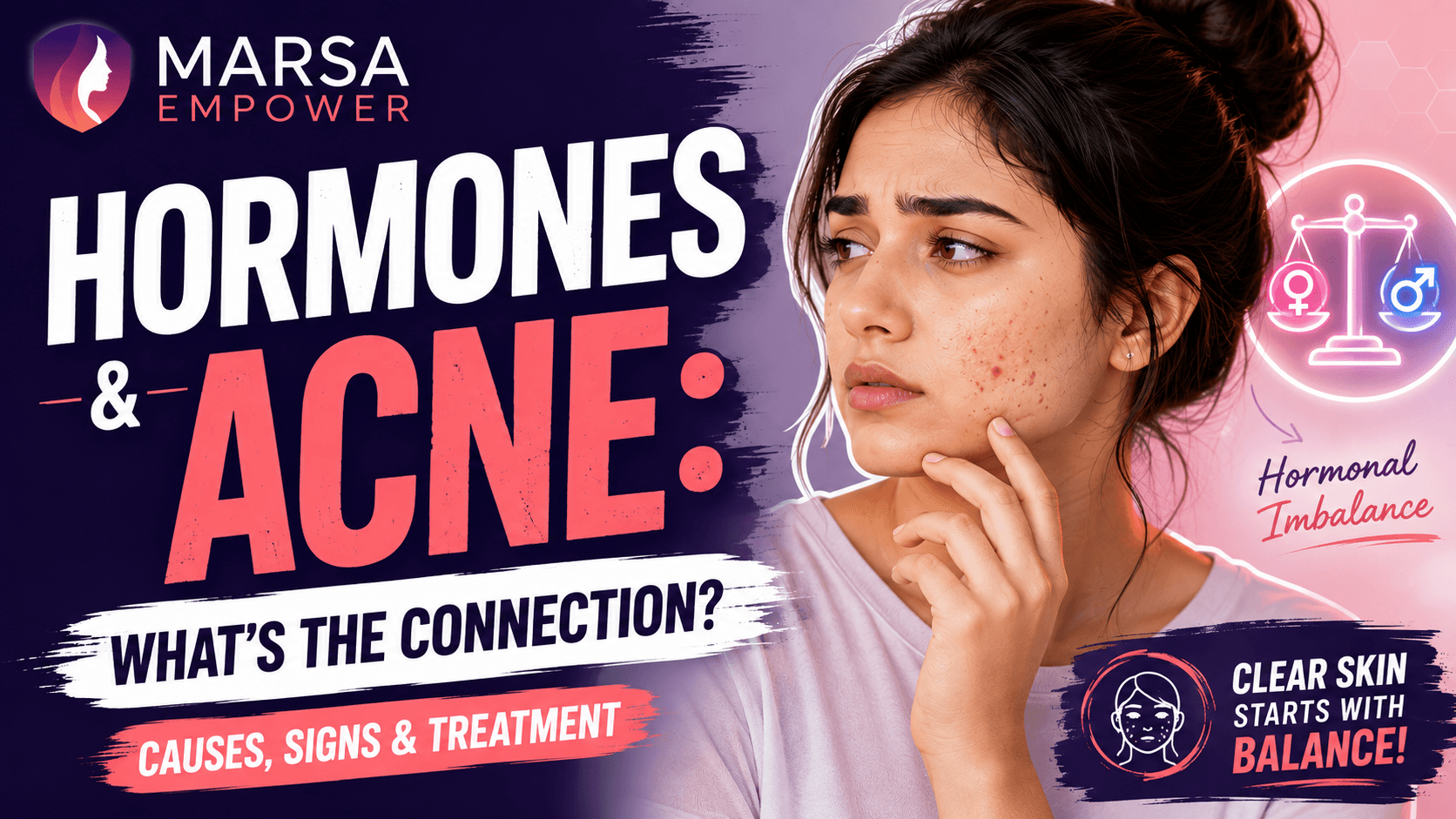
Discover how hormonal changes can lead to acne and learn about signs, causes, and effective treatment options in our expert-guided article.

Maryam Mumtaz
Co-Founder & CEO
12 min read•8/18/2026
Marsa Empower · Skin Health & Hormonal Wellness · For Girls & Women Aged 13 and Above · 12 min read
"Hormonal acne is not caused by poor hygiene or the wrong cleanser. It is caused by hormones — and understanding that distinction is the starting point of actually managing it."
You wash your face twice a day. You use a good cleanser. You avoid touching your face. You change your pillowcase regularly. And yet — every month, around the same time, your chin and jawline break out in deep, sometimes painful spots that no skincare product seems to prevent.
This is hormonal acne. And it is frustrating precisely because it does not respond to the same strategies that manage surface-level or hygiene-related breakouts. No matter how diligently you cleanse, hormonal acne returns — because its cause is not on the surface of your skin. It is inside your body.
Understanding what hormones are, how they drive acne, and what specifically addresses them is what makes the difference between managing hormonal acne and simply hoping it will resolve on its own.
Hormones are chemical messengers produced by glands throughout the body — the ovaries, adrenal glands, pituitary gland, thyroid, and others. They travel through the bloodstream and deliver instructions to cells and organs throughout the body, governing processes ranging from growth and metabolism to mood, sleep, reproduction, and — relevant here — the behaviour of the skin's oil glands.
The skin is directly responsive to hormonal signals. The sebaceous glands (oil glands) embedded throughout the skin contain receptors for several hormones — meaning they can literally receive and respond to hormonal messages. When certain hormones rise, these glands produce more oil. When others rise, inflammation in the skin increases. When hormonal levels shift — as they do consistently throughout the menstrual cycle, during puberty, during pregnancy, and with conditions like PCOS — the skin reflects these shifts visibly.
This is why acne has a hormonal dimension that no topical skincare product can fully address. The trigger is arriving from inside the body.
The pathway from hormonal change to pimple follows a specific sequence:
Androgens are a group of hormones that includes testosterone. They are present in all women — but in varying amounts. During puberty, before periods, and in conditions like PCOS, androgen levels rise significantly. Androgens directly stimulate the sebaceous glands to produce more sebum (oil) than the skin needs.
The excess oil produced by androgen stimulation mixes with dead skin cells inside the hair follicle. This mixture forms a plug — blocking the follicle and creating the conditions inside it for the next step.
A bacteria called Cutibacterium acnes naturally lives on the skin in small amounts. Inside a blocked, oil-rich follicle, it has the conditions it needs to multiply. As it does, it produces byproducts that trigger the immune system.
The immune system responds to the bacterial activity inside the blocked follicle with inflammation — sending immune cells to the site, producing redness, swelling, and sometimes pus. The result is the visible pimple, cyst, or nodule.
Beyond androgens, the other key reproductive hormones — oestrogen and progesterone — also influence skin behaviour:
Oestrogen generally supports skin health — it stimulates collagen production, maintains skin moisture, and reduces sebum production. This is why skin often looks better in the first half of the menstrual cycle when oestrogen is rising.
Progesterone in the second half of the cycle (after ovulation) increases skin sensitivity and stimulates sebum production — which is why many women break out in the week before their period, when progesterone is high and then falls sharply.
The most universal hormonal acne experience. Puberty triggers a dramatic rise in androgen production — in both girls and boys — which directly stimulates the sebaceous glands to become more active than they have ever been before. This explains why acne is so nearly universal during the teenage years.
For teenage girls, the onset of menstruation adds another layer — the monthly hormonal fluctuations of the menstrual cycle begin producing their own pattern of skin changes.
The premenstrual week — when progesterone peaks and then falls, and oestrogen is also declining — is the phase most commonly associated with breakouts. Oil production increases under progesterone's influence. Skin barrier function is slightly impaired. Inflammation in the skin increases. The result is the predictable premenstrual breakout that many women recognise as cyclical.
During the period itself, acne may begin to improve for some women as hormone levels reach their lowest point — though for others, the first few days of the period remain a difficult skin period.
Starting, stopping, or changing hormonal contraceptives — the pill, patch, ring, hormonal IUD, or implant — can trigger significant skin changes. Some combined oral contraceptive pills (those containing oestrogen and a progestogen with low androgenic activity) actually improve acne by reducing androgens. Others — particularly progestogen-only contraceptives — can worsen acne in some women by having a mild androgen-like effect on the skin.
Pregnancy produces dramatic hormonal shifts. Many women experience the worst acne of their lives in the first trimester, when progesterone surges and androgens rise. Some women experience improvement in later pregnancy. Managing acne safely during pregnancy requires medical guidance, as many common acne treatments are not safe for use during pregnancy.
PCOS — Polycystic Ovary Syndrome — is one of the most common causes of persistent hormonal acne beyond the teenage years. The elevated androgens characteristic of PCOS drive persistent, often cystic acne that is concentrated along the jawline, chin, and lower cheeks — and that frequently does not respond adequately to topical skincare or standard acne treatments. PCOS-related acne requires addressing the hormonal root cause, not just the skin symptoms.
Hormonal acne has a distinctive presentation that differs from other types of acne in several recognisable ways:
Hormonal acne concentrates in the lower third of the face — the chin, jawline, and lower cheeks. This is because the oil glands in this area have the highest density of androgen receptors — making them most sensitive to androgen stimulation.
Contrast this with the classic teenage "T-zone" acne (forehead, nose, and central cheeks) which is more often driven by general oil production rather than androgen-specific stimulation.
Hormonal acne tends to be deeper and more inflammatory than surface-level blackheads or whiteheads. The spots are often:
For women with menstrual cycles, hormonal acne has a consistent timing pattern — appearing or worsening in the week before or during the period, and improving in the week or two afterward. This cyclical nature is one of the most reliable indicators that acne is primarily hormonal.
Topical skincare — even good skincare — produces limited improvement because it cannot address the hormonal signal driving excess oil production. A woman with hormonal acne who uses a well-designed skincare routine may see some improvement, but the breakouts return reliably because the underlying hormonal driver continues.
| Feature | Hormonal Acne | Surface or Pore-Based Acne |
|---|---|---|
| Primary location | Chin · Jawline · Lower cheeks | Forehead · Nose · T-zone |
| Type of spots | Deep · Cystic · Painful nodules | Blackheads · Whiteheads · Surface papules |
| Timing | Cyclical — worse before period | Not reliably cycle-linked |
| Response to skincare | Limited — returns reliably | Often responds to consistent topical care |
| Associated factors | Menstrual cycle · Contraceptive changes · PCOS · Pregnancy | Excess oil production · Product use · Hygiene |
| Treatment | Requires hormonal management + skincare | Responds primarily to topical treatment |
Puberty is characterised by a dramatic surge in androgen production — which is precisely why acne is so nearly universal during the teenage years. Almost every teenage girl will experience some degree of acne during puberty, and this is completely normal.
The androgens rising at puberty are doing something important — they are driving the physical development of the adult body. The acne they produce is a side effect of this necessary process, not a sign that something is wrong.
Gentle skincare — consistently applied. A gentle gel or foam cleanser appropriate for oily or acne-prone skin, applied twice daily. A lightweight, non-comedogenic moisturiser. Daily sunscreen to prevent the dark marks that acne leaves behind from darkening further.
Salicylic acid and benzoyl peroxide are the most evidence-supported over-the-counter ingredients for teenage acne. Salicylic acid dissolves the dead-skin-cell and oil mixture inside pores. Benzoyl peroxide kills the bacteria driving inflammation. Both require consistent use for four to eight weeks before meaningful improvement is visible.
Harsh scrubbing: Scrubbing the face harder or more frequently does not remove hormonal acne — it strips the skin, damages the skin barrier, and stimulates more oil production in compensation. Gentle is consistently better than harsh.
Very frequent washing: Washing more than twice a day strips natural oils and worsens rather than improves oiliness and acne over time.
Random online skincare trends: Home remedies including toothpaste, lemon juice, and baking soda can cause significant skin damage without meaningfully improving acne. Stick to established, evidence-based ingredients.
Acne during the teenage years has a disproportionate emotional impact — because adolescence is already a period of heightened self-consciousness, social comparison, and identity formation. Acne that is dismissed as "just normal teen skin" by adults who have forgotten what it feels like can cause significant distress.
Teenage girls dealing with significant acne — acne that is painful, that covers large areas, or that is causing emotional distress — deserve appropriate skincare guidance and, where needed, dermatological support. No girl should simply be told to wait it out.
Many women are surprised to discover that acne does not automatically resolve after the teenage years. Adult hormonal acne — acne that develops or persists in the twenties, thirties, and beyond — is extremely common, and it is driven by the same hormonal mechanisms as teenage acne, just through different triggers.
Continuing hormonal cycles: Every month, the premenstrual hormonal shift produces the conditions for breakouts — regardless of age. A 32-year-old woman has the same hormonal cycle as a 17-year-old, and the same premenstrual androgen and progesterone changes affect her skin in the same way.
Changing contraceptive methods: Starting, stopping, or switching contraceptives often triggers significant skin changes. Many women whose acne was managed by the combined pill experience a significant flare when they stop it — as the pill's androgen-suppressing effect is removed.
Stress: Chronic stress elevates cortisol and androgens — directly driving more sebum production and more acne. The stress loads of adult professional and family life are a consistent and often underrecognised acne driver.
PCOS: Adult women who develop significant acne — particularly concentrated along the jawline, and particularly accompanied by other symptoms like irregular periods, excess hair, or weight changes — may have previously undiagnosed PCOS. This is one of the most important and most treatable causes of adult hormonal acne.
Adult women with acne are sometimes dismissed — told that acne is a teenage problem and that they must be doing something wrong with their skincare. This dismissal is both inaccurate and unhelpful. Adult hormonal acne is a recognised clinical condition with identifiable causes and effective treatments. Adult women with significant acne deserve investigation and appropriate management — not judgment.
PCOS is one of the most common and most significant hormonal drivers of persistent acne in women beyond the teenage years.
In PCOS, insulin resistance drives the ovaries to produce excess androgens. These elevated androgens reach the skin and stimulate the sebaceous glands — producing the excess oil that drives persistent cystic acne, particularly along the jawline and chin.
PCOS-related acne is distinctive because:
Because PCOS acne is driven by elevated androgens from insulin resistance, the most effective management addresses the hormonal root cause:
Dietary changes that reduce insulin resistance: A low-glycaemic diet — reducing refined carbohydrates and sugar — directly lowers insulin levels, which reduces ovarian androgen production, which reduces sebum production. This dietary approach produces more sustained skin improvement in PCOS than any topical treatment alone.
Regular exercise: Improves insulin sensitivity, reducing the hormonal driver of acne.
Medical hormonal management: Combined oral contraceptive pills (those with anti-androgenic activity), anti-androgen medications like spironolactone, or metformin for insulin resistance are the primary medical options for PCOS-related acne. These require prescription and medical oversight.
Topical treatment alongside hormonal management: While topical skincare alone is insufficient for PCOS acne, it remains a useful complementary approach — reducing surface bacteria and oil while the hormonal management addresses the root cause.
Managing hormonal acne requires a two-pronged approach: addressing the hormonal driver (through lifestyle changes and, where needed, medical treatment) and managing the skin's response (through appropriate skincare).
Reduce insulin resistance: For women with PCOS or significant premenstrual acne, a low-glycaemic diet is the most impactful dietary change — reducing refined carbohydrates and sugar reduces the androgen production that drives oil production and acne.
Manage stress: Cortisol drives androgen production. Consistently high stress levels worsen hormonal acne. Regular exercise, adequate sleep, and active stress management are not just general wellness advice — they directly reduce the hormonal driver of acne.
Support regular sleep: Sleep deprivation elevates cortisol and androgens. Seven to nine hours of consistent, quality sleep is part of hormonal acne management.
Consider hormonal medical treatment: For women with significant hormonal acne that does not respond adequately to lifestyle changes and topical treatment, medical hormonal management — through contraceptives with anti-androgenic activity, spironolactone, or PCOS-specific treatment — is both appropriate and effective. These require assessment and prescription by a healthcare professional.
Good skincare does not cure hormonal acne — but it manages its visibility, prevents secondary bacterial infection, reduces inflammation, and minimises the dark marks that acne leaves behind.
Step 01 — Cleanse: A gentle gel or foam cleanser appropriate for oily or acne-prone skin. Massage with fingertips for 30 to 60 seconds. Rinse with lukewarm water. Pat dry — never rub.
Step 02 — Treatment (if using a morning treatment): Niacinamide serum — this ingredient reduces redness, controls oil production, minimises pores, and is very well-tolerated. Apply after cleansing, before moisturiser.
Step 03 — Moisturise: A lightweight, oil-free, non-comedogenic moisturiser. Do not skip this step even on oily skin — dehydrated skin produces more oil as compensation.
Step 04 — Sunscreen: SPF 30 or higher, non-comedogenic. Essential for preventing the dark marks that acne spots leave behind from darkening further with sun exposure. This step is non-negotiable.
Step 01 — Remove makeup: Micellar water or cleansing oil, followed by the cleanser. Never sleep in makeup.
Step 02 — Cleanse: Same gentle cleanser as the morning.
Step 03 — Active treatment: This is where acne-fighting ingredients are most effective:
Step 04 — Moisturise.
When lifestyle changes and over-the-counter skincare do not adequately manage hormonal acne, several effective medical treatments are available — all requiring assessment and prescription by a healthcare provider.
| Treatment | How It Works | Best For |
|---|---|---|
| Combined oral contraceptive pill (specific formulations) | Reduces androgen levels by increasing SHBG (a protein that binds androgens) and suppressing ovarian androgen production | Women with cyclical acne · PCOS-related acne · Adult hormonal acne |
| Spironolactone | Anti-androgen medication — blocks androgen receptors in the skin and reduces sebum production | Persistent adult hormonal acne · PCOS acne · Not suitable during pregnancy |
| Topical retinoids (tretinoin — prescription strength) | More potent than over-the-counter retinol — significantly improves all acne types through accelerated cell turnover | Moderate to severe acne · Post-acne marks |
| Oral antibiotics | Reduces inflammatory acne bacteria systemically | Moderate to severe inflamed acne — usually short-term use |
| Isotretinoin (Roaccutane) | Most powerful acne treatment available — reduces oil gland size significantly | Severe cystic acne unresponsive to other treatments · Requires strict medical monitoring |
| Metformin | Improves insulin sensitivity — reduces the insulin-driven androgen production at the core of PCOS acne | PCOS-related acne with significant insulin resistance |
Reduce high-glycaemic foods: This is the single most evidence-supported dietary change for acne. Sugary drinks, white bread, white rice, packaged biscuits, and sweets cause rapid blood sugar spikes → insulin spikes → androgen spikes → more oil production. Reducing these consistently produces measurable skin improvement over several weeks.
Omega-3 fatty acids: Fatty fish, walnuts, chia seeds, and flaxseeds reduce the skin inflammation that drives acne severity. Women with PCOS in particular benefit from regular omega-3 intake.
Zinc-rich foods: Pumpkin seeds, meat, chickpeas, and lentils. Zinc regulates oil gland activity and has direct mild anti-bacterial properties.
Green tea: Contains antioxidants that reduce sebum production and inflammation when consumed regularly.
Vegetables and fruit: Vitamins A, C, and E from colourful vegetables and fruits support skin health, reduce inflammation, and support the skin barrier.
Treating it only as a skincare problem: Hormonal acne has a driver that no cleanser or serum can address. Skincare manages the symptoms — it cannot resolve the hormonal cause.
Over-cleansing: Washing the face more than twice daily strips the skin's natural protective oils, triggers more oil production, and worsens the skin barrier that normally provides partial protection against acne.
Using too many active ingredients at once: Layering multiple actives simultaneously overwhelms the skin, causes irritation and inflammation, and makes it impossible to know which products are helping. Introduce one new product at a time, four to six weeks apart.
Picking and squeezing: The most consistent cause of acne scarring and persistent dark marks. A spot left alone resolves faster and with less aftermath than one that has been squeezed.
Expecting results within a week: Most skincare interventions — and most medical treatments — require four to eight weeks of consistent use before meaningful improvement is visible. Abandoning a treatment after two weeks because it "is not working" prevents anything from ever working.
Assuming it is caused by poor hygiene: Hormonal acne is not a hygiene problem. The most diligent skincare routine in the world cannot suppress the oil production driven by elevated androgens. Understanding this removes the self-blame that often accompanies persistent acne — and redirects focus toward what will actually help.
A consistent gentle skincare routine manages mild hormonal acne for many women. But professional evaluation is appropriate — and important — in several situations.
The most significant consequence of unmanaged severe acne is scarring — both the physical atrophic scars (pits) and the dark post-inflammatory marks that can last months to years. Early, appropriate treatment prevents this permanent damage. Waiting until acne is very severe before seeking help allows preventable scarring to accumulate.
For women and girls navigating hormonal acne — often without clear information about why it is happening or what will actually help — Marsa Empower provides accessible, reliable educational support.
Marsa's Beauty & Glow resources provide skin type analysis, personalised skincare routine guidance, ingredient education, and product guidance — helping women build skincare approaches appropriate for their specific skin type and acne presentation rather than following generic advice.
Marsa's health education resources explain the connection between PCOS, menstrual cycles, insulin resistance, and skin health — helping women understand whether their acne has a hormonal dimension worth investigating and what the most appropriate next steps are.
Marsa's Health Hub cycle tracking allows women to record their skin condition alongside their menstrual cycle phase — revealing whether breakouts consistently correlate with specific cycle phases. Documented pattern data is genuinely useful for both self-understanding and for communicating with a healthcare provider.
Marsa's Digital Doctors provide educational information about hormonal conditions, acne causes, and skincare approaches — helping women arrive at dermatologist or gynaecologist appointments better informed, with specific questions and documented symptom patterns.
Important: Marsa's resources are educational and informational — they do not diagnose hormonal disorders, prescribe treatment, or replace medical evaluation. Significant, persistent, or scarring acne warrants assessment by a qualified dermatologist or — if a hormonal condition is suspected — a gynaecologist or endocrinologist.
Why do I always break out before my period?
In the week before a period, progesterone rises and then falls sharply, oestrogen also declines, and androgens are relatively dominant. These hormonal shifts increase sebum production and skin sensitivity — producing the predictable premenstrual breakout most women experience. This is normal hormonally but can be managed through targeted skincare during this cycle phase and, for severe cyclical acne, through hormonal medical management.
Is hormonal acne the same as teenage acne?
Both are hormonally driven — by the same mechanism of androgen stimulation of sebaceous glands. The difference is the source of the androgens: in teenage acne, it is the rise of puberty. In adult hormonal acne, it is the monthly cycle, PCOS, contraceptive changes, or stress. The treatment principles are similar, but adult women with persistent hormonal acne may benefit more specifically from hormonal medical management.
Can a particular diet clear hormonal acne?
No single food or diet "cures" hormonal acne. But consistently reducing high-glycaemic foods — refined carbohydrates, sugary drinks, processed snacks — reduces insulin spikes that drive androgen production and sebum production. This dietary approach produces measurable skin improvement in most women with insulin-driven hormonal acne, including PCOS-related acne. It is not a cure, but it is a meaningful contributor to clearer skin.
Will the pill help my hormonal acne?
Combined oral contraceptive pills that contain oestrogen and a low-androgenic or anti-androgenic progestogen can significantly improve hormonal acne — by reducing ovarian androgen production and increasing SHBG (a protein that binds and inactivates androgens). Not all pills have this effect — some formulations with highly androgenic progestogens can worsen acne. A dermatologist or gynaecologist can advise on appropriate formulations.
Can hormonal acne cause permanent scarring?
Yes — particularly cystic and nodular acne, which involves deep inflammation in the skin. Squeezing or picking these spots significantly worsens the scarring risk. Early, appropriate treatment — particularly of severe hormonal acne — is the most effective prevention. Once scarring has occurred, it requires specific dermatological treatment (laser, chemical peels, microneedling) and is significantly harder to address than the original acne.
| Feature | Hormonal Acne |
|---|---|
| Primary cause | Androgens stimulating sebaceous glands → excess oil → blocked pores → inflammation |
| Primary location | Chin · Jawline · Lower cheeks |
| Timing | Cyclical — worse before period · Or persistent with PCOS |
| Spot type | Deep · Cystic · Painful · Slow to resolve |
| Response to skincare alone | Limited — returns reliably without hormonal management |
| Lifestyle interventions | Low-glycaemic diet · Regular exercise · Adequate sleep · Stress management |
| Skincare approach | Gentle cleanser · Salicylic acid or benzoyl peroxide · Non-comedogenic moisturiser · Daily SPF |
| Medical options | Combined pill (anti-androgenic) · Spironolactone · Retinoids · Metformin (for PCOS) |
| PCOS connection | Elevated androgens from insulin resistance drive persistent cystic jawline acne |
| When to see a doctor | Moderate to severe · Scarring · Not improving after 2–3 months · Accompanied by hormonal symptoms |
| Most important truth | Hormonal acne is not caused by poor hygiene — it requires both skincare and hormonal management |
"Hormonal acne is not a reflection of how well you take care of your skin. It is a reflection of what your hormones are doing inside your body. Understanding that — and addressing both the hormonal driver and the skin response — is how you actually manage it."
Educational Disclaimer
This article is for educational and awareness purposes only. It does not constitute medical advice, diagnosis, or treatment. If you have persistent, severe, or worsening acne, or acne accompanied by other hormonal symptoms, please consult a qualified dermatologist or healthcare professional for personalised evaluation and treatment guidance.
Marsa Empower · Skin Health · Hormonal Wellness · Acne Awareness and Education
Medical Disclaimer
This article is for general informational and educational purposes only and is not a substitute for professional medical advice, diagnosis, or treatment. Always seek the advice of a qualified healthcare provider with any questions you may have regarding a medical condition. Never disregard professional medical advice or delay seeking it because of something you have read on MARSA Empower.
Written By
Maryam Mumtaz
Co-Founder & CEO
Co-Founder of MARSA Empower who leads the visual and strategic evolution of the platform. Maryam bridges technical complexity with human-centric design, architecting the team's official roadmap and ensuring MARSA effectively addresses the real-world needs of women. With deep expertise in agentic AI, full-stack development, and UI/UX design, she has delivered 50+ projects for 30+ satisfied clients.
Enjoyed this story?