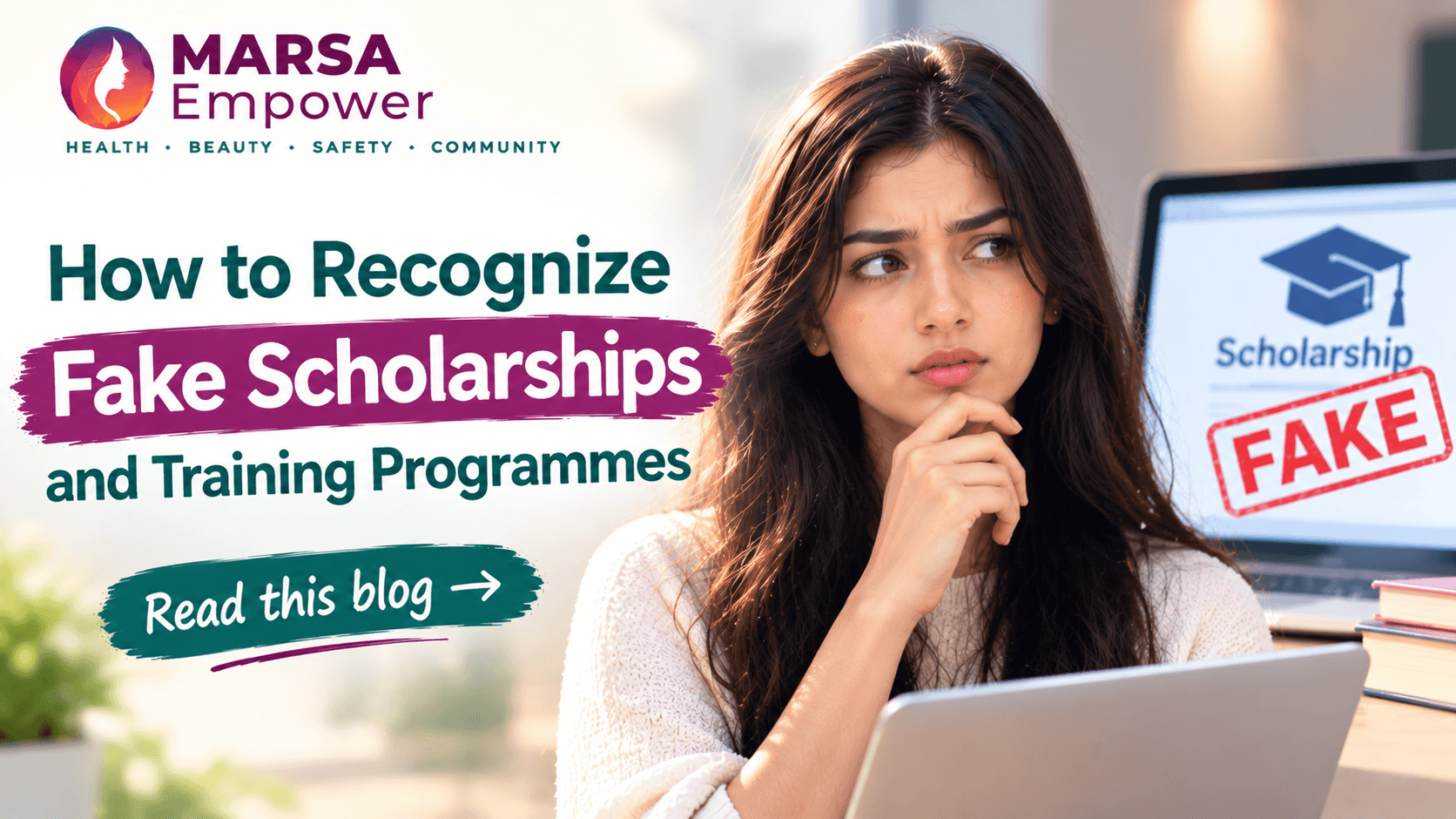
Fake scholarships and fraudulent training programmes target students every year. This guide explains the warning signs, how to verify any opportunity, what to do if you have already paid, and where to report education fraud in Pakistan and other countries

Maryam Mumtaz
Co-Founder & CEO
14 min read•10/13/2026
Marsa Empower · Student Safety & Digital Awareness · For Students, Families, and Educators · 14 min read
Every year, millions of students search for scholarships, free courses, international study opportunities, and training programmes that can help them build a better future. This ambition is genuine, meaningful, and deserving of respect.
Unfortunately, it is also something that scammers deliberately target.
Fake scholarship advertisements, fraudulent training programmes, and dishonest education consultants appear on social media, WhatsApp groups, emails, and even printed flyers. They are designed to look legitimate. They use the names of real universities, real government bodies, and real scholarship schemes to create the impression of authenticity. They promise life-changing outcomes — a Harvard admission, an HEC scholarship, a guaranteed visa — and then disappear with the applicant's money, documents, or both.
In 2026 alone, cases reported in Pakistan have involved families losing hundreds of thousands, and in some cases millions, of rupees to people who presented themselves as legitimate education consultants.
This guide is for students, teenage girls, young women, families, and educators. It explains what fake scholarships and training programmes look like, how to verify any educational opportunity before paying or sharing personal information, and what to do if something has already gone wrong.
Learning to verify an opportunity is a practical skill. It protects money, personal information, and the future plans that students have worked hard to build.
Education fraud takes several forms. Understanding the most common types makes it easier to recognise them.
These are announcements — on social media, in messaging apps, via email, or through printed materials — that claim to offer scholarships from well-known universities, government agencies, or international organisations. The announcements often use official-looking logos, reference real programme names, and require applicants to pay a processing fee, registration fee, or deposit to secure the scholarship.
Genuine scholarships from legitimate institutions do not typically require applicants to pay fees in order to apply or to receive their award.
These are paid courses that claim to offer professional certificates, diplomas, or qualifications from recognised institutions. The certificates they issue are either entirely fabricated or issued by unrecognised bodies that have no standing with employers or educational institutions.
Some fraudulent education businesses create websites, offices, and marketing materials that claim their programmes are accredited by national bodies, international organisations, or well-known universities. These claims are false. A course certificate from an unaccredited institution may be worthless — and in some contexts, using such a certificate in a job application could cause serious problems.
These advertise paid or prestigious internships with well-known companies or government bodies. They typically require an application fee, a security deposit, or the payment of a "placement fee" before the internship begins. The internship either does not exist or offers nothing of the value promised.
No genuine education consultant can guarantee admission to a specific university, secure a scholarship on a student's behalf, or guarantee a visa. These are outcomes determined by universities, scholarship committees, and immigration authorities — not by consultants. Consultants who promise guaranteed outcomes in exchange for substantial upfront fees are a significant source of education fraud.
A single warning sign does not automatically prove that an opportunity is fraudulent. But several warning signs appearing together deserve careful investigation before you pay anything or share personal information.
| Warning Sign | What It Looks Like |
|---|---|
| Guaranteed admission or scholarship | "You are already selected." "Scholarship guaranteed." No genuine institution guarantees outcomes before proper assessment. |
| Advance payment required | Paying a fee before receiving a scholarship or starting a free course is a major warning sign. |
| Pressure to pay immediately | "Offer expires tonight." "Only three slots left." Urgency is used to prevent you from checking. |
| Suspicious email addresses | Using Gmail, Yahoo, or Hotmail addresses instead of an official institution domain. |
| Fake or unverifiable documents | Award letters, admission offers, or visa documents that cannot be verified with the issuing institution. |
| Requests for passwords, OTPs, or PINs | No legitimate scholarship programme ever asks for your banking PIN, OTP, or social media password. |
| Vague eligibility or missing contact details | Legitimate programmes publish clear eligibility criteria and verifiable contact information. |
| Promises of guaranteed jobs or earnings | "Complete this course and earn Rs. 50,000 per month guaranteed." This is not how education or employment works. |
| Unverifiable institution | You cannot find the institution independently on any government or accreditation body list. |
| Too good to be true | Full funding for a foreign university with minimal requirements and no competitive selection process. |
A polished website, a professional-looking logo, a large number of social media followers, and testimonials from apparent past students do not independently prove that an opportunity is legitimate. These can all be created or purchased. Independent verification — described in the next section — is the only reliable check.
Use the following checklist for any scholarship, course, internship, or training programme before you pay, apply, or share personal documents.
Step 1 — Find the opportunity on the official provider's website Do not rely only on the advertisement or the link sent to you. Search for the university, government body, or organisation independently. Go to their official website and look for the scholarship or programme in their own announcements or scholarship pages.
Step 2 — Check the institution's identity and recognition For a university: verify it through the country's higher education authority. For Pakistan: check the Higher Education Commission (HEC) directory at https://www.hec.gov.pk For international universities: check the relevant national accreditation body of the country where the institution is based.
Step 3 — Confirm eligibility, deadlines, benefits, and application procedures Every legitimate programme publishes this information. If the advertisement does not match what is on the official website, treat this as a serious warning sign.
Step 4 — Contact the institution using independently verified contact details Do not use the phone number or email address provided in the advertisement. Find the institution's contact details independently — from their official website — and contact them directly to confirm the offer.
Step 5 — Verify any payment requests directly with the provider If a fee is requested, confirm with the institution's official office — not with the person who sent you the advertisement — whether this fee is legitimate and what it is for.
Step 6 — Check whether the advertised course or certificate is genuinely free Some platforms advertise "free" courses but require payment for the certificate. Confirm what is genuinely free before committing time and energy.
Step 7 — Research the organisation beyond its own materials Search the name of the organisation, consultant, or programme alongside words like "complaint," "fraud," or "scam." Check whether any official authority, news source, or student forum has raised concerns about it.
Step 8 — Ask a trusted adult, teacher, or qualified adviser to review the offer A second set of eyes from someone with experience — a teacher, a university career adviser, or a family member who has navigated this process before — can identify problems that are easy to miss when you are excited about an opportunity.
Understanding the process that education fraudsters typically follow makes it easier to recognise the pattern before it reaches the point of financial loss.
Stage 1 — The attractive advertisement A social media post, a WhatsApp forward, an email, or a flyer announces an exceptional opportunity: a fully funded scholarship to a prestigious university, a free professional certificate course with guaranteed job placement, or a limited-time internship. The language is enthusiastic and the opportunity seems exceptional.
Stage 2 — Creating urgency and trust The fraudster creates a sense of urgency — "applications close in 48 hours," "only five slots remaining" — to prevent the applicant from taking time to verify the offer. Fake testimonials, fabricated screenshots of successful past applicants, and professional-looking documents are used to create the impression of legitimacy.
Stage 3 — The payment or information request Once the applicant expresses interest, they are asked to pay a processing fee, registration fee, security deposit, or visa application fee. In some cases, the first payment is modest — making it feel lower-risk — with larger payments requested later. Alternatively, the applicant is asked to share copies of identity documents, academic transcripts, or banking information.
Stage 4 — Further demands or disappearance After the first payment, the fraudster may ask for additional payments — for insurance, for visa processing, for a background check. They may produce convincing fake documents to maintain the deception. Eventually, they stop responding, the "scholarship" never materialises, and the money is gone.
According to ARY News, reporting on 11 October 2026, police arrested a suspect accused of defrauding Laiba Ijaz — a gold medallist student at the International Islamic University Islamabad — of Rs. 9.3 million (approximately $33,000). <cite index="9-1">According to the First Information Report, two suspects allegedly looted Rs. 9.3 million from Laiba Ijaz by promising to secure her a US visa and scholarship, using fake scholarship documents and university admission offer letters to deceive the student and her family.</cite>
<cite index="8-1">Laiba's maternal uncle told ARY News that the family had approached a consultancy in Islamabad's Blue Area, where a man identified as Noman offered to arrange a scholarship. After submitting the required documents, the family was told the scholarship had been approved. However, when the family contacted Harvard University to verify the documents, they discovered they were fake.</cite>
What students can learn from this case: Fake scholarship documents can appear very convincing. Always verify directly with the named institution — not with the consultant — using independently sourced contact details. Harvard University, like all major universities, publishes official contact information and allows prospective students to verify their application status directly.
Source: ARY News, 11 October 2026 https://arynews.tv/police-arrest-suspect-in-scholarship-fraud-case-involving-student-laiba
<cite index="11-1">The Federal Investigation Agency (FIA), Anti-Human Trafficking Circle Islamabad arrested an alleged education fraudster accused of swindling students out of US $10,000 each by offering fake Higher Education Commission (HEC) scholarships and admissions to a United States university. During the investigation, it was revealed that the suspect allegedly collected US $10,000 from each victim and provided forged documents purportedly issued by the Higher Education Commission (HEC) Pakistan. The documents were later verified by HEC and declared fake. A case was registered against the accused under sections 420, 468 and 109 of the Pakistan Penal Code.</cite>
What students can learn from this case: The HEC publishes official scholarship announcements at hec.gov.pk. Any scholarship claiming to be from HEC can be verified directly through HEC's official website or by calling their helpline. Forged government documents are a serious criminal offence — and a serious warning sign that the offer is fraudulent.
Source: Associated Press of Pakistan (APP), July 2026 https://www.app.com.pk/?p=1252457
<cite index="12-1">Bangladesh's Prime Minister's Education Assistance Trust issued an official warning in July 2026 that a fraud ring was attempting to obtain scholarship OTPs and passwords by falsely identifying themselves as the Scheme Director of its Integrated Scholarship Programme. The Trust urged all concerned officials and school heads to remain vigilant and not provide any OTP or password in response to suspicious phone calls. The notice stated clearly that no officer or employee of the Prime Minister's Education Assistance Trust ever contacts officials to request an OTP or password.</cite>
What students and families can learn from this case: Government scholarship schemes will never ask you to share your OTP, password, or PIN over the phone or by message. If someone calls claiming to be from a scholarship programme and asks for this information, do not provide it. Hang up and call the official programme number directly.
Source: Bangladesh Sangbad Sangstha (BSS), 16 July 2026 https://www.bssnews.net/news/406374
If you have already paid money in response to what you now believe may be a fraudulent scholarship or training programme, do not panic. There are practical steps you can take.
Stop sending additional money immediately. A common tactic is to continue requesting small payments after an initial one — for processing, insurance, visa costs, or other reasons. Do not pay again.
Save everything. Keep all messages, receipts, screenshots, advertisements, documents, and the details of any accounts, phone numbers, or email addresses involved. Do not delete anything — this evidence is needed for reporting.
Contact your bank or payment provider promptly. If you made a payment through a bank transfer, mobile wallet, or payment service, contact them as soon as possible and explain that you believe you have been defrauded. The sooner you contact them, the greater the chance of any available remedy.
Verify directly with the institution named in the offer. Contact the actual university, scholarship body, or government agency whose name was used — using contact details you find yourself on their official website, not the details provided by the person who offered the scholarship — and confirm whether the offer was genuine.
Report the suspected fraud to the appropriate authority. Reporting channels are listed in the next section.
Seek support from a trusted adult, teacher, or family member. You do not need to handle this alone. Sharing what happened with someone you trust makes it easier to take the next steps.
No one should feel ashamed for having trusted a well-constructed deception. These fraudsters invest considerable effort in making their offers appear legitimate. The responsibility lies with the person who committed the fraud, not with the student who was deceived.
Federal Investigation Agency (FIA) — Cybercrime Wing For cases involving online fraud, fake websites, forged documents, and digital deception. Website: https://fia.gov.pk Cybercrime reporting portal: https://www.fia.gov.pk/en/complaint
National Cyber Crime Investigation Agency (NCCIA) For cybercrime complaints including online scholarship fraud and identity theft. Complaint portal: https://complaint.nccia.gov.pk Helpline: 1799
Higher Education Commission (HEC) — For cases using HEC's name If a fraudster has used HEC's name or forged HEC documents, HEC can verify the claim and be informed. Website: https://www.hec.gov.pk Helpline: 051-90402000
Local police A First Information Report (FIR) can be filed at any local police station for fraud cases.
India — National Cyber Crime Reporting Portal https://cybercrime.gov.in | Helpline: 1930
UK — Action Fraud (National Fraud and Cybercrime Reporting Centre) https://www.actionfraud.police.uk
USA — Federal Trade Commission (FTC) https://reportfraud.ftc.gov
Australia — Scamwatch (Australian Competition and Consumer Commission) https://www.scamwatch.gov.au
If you are in a country not listed here, contact your national cybercrime authority, consumer protection agency, or local police.
Reporting fraud does not guarantee a financial refund, but it creates an official record, may protect other students, and can support an investigation.
Students — particularly younger students and those applying for educational opportunities for the first time — benefit enormously from the support of informed adults around them.
Encourage verification before any payment is made. The most important habit families and teachers can build is a simple one: no payment, no document submission, and no sharing of personal information before the opportunity has been independently verified. This single habit can prevent most scholarship scams from succeeding.
Create a safe space to discuss suspicious offers. Students who are afraid of seeming naive or embarrassing their families may not raise doubts about an offer even when something feels wrong. Teachers and parents who discuss this topic openly — without blame — make it easier for students to ask before paying.
Do not shame students who have already been deceived. If a student or family member has already paid money in response to a fake scholarship, the response should be calm and supportive. The focus should be on the practical steps: saving evidence, reporting, and protecting against further loss — not on assigning blame.
Know the genuine scholarship sources. Familiarise yourself with the official scholarship portals and government scholarship programmes relevant to your country. When a new opportunity arrives, checking it against these official sources takes only a few minutes and provides a meaningful safeguard.
Verify education consultants independently. If a family is using an education consultant to help apply for scholarships or admissions abroad, verify that the consultant is registered with the relevant professional body, check for any complaints or reports against them, and never allow a consultant to manage scholarship funds on the student's behalf.
| Organisation | Purpose | URL |
|---|---|---|
| Higher Education Commission (HEC) | Verify Pakistani universities and scholarships | https://www.hec.gov.pk |
| HEC Scholarships Portal | Official HEC scholarship listings | https://www.hec.gov.pk/english/scholarshipsgrants |
| FIA Cybercrime Wing | Report online fraud and education scams | https://www.fia.gov.pk/en/complaint |
| NCCIA Complaint Portal | Cybercrime reporting including scholarship fraud | https://complaint.nccia.gov.pk |
| DigiSkills.pk | Free, verified skills training for Pakistani students | https://www.digiskills.pk |
| Organisation | Purpose | URL |
|---|---|---|
| Scholars4Dev | Database of verified international scholarships | https://www.scholars4dev.com |
| Chevening Scholarships (UK) | UK government scholarships, official listings | https://www.chevening.org |
| Fulbright Program (USA) | US government exchange scholarships | https://foreign.fulbrightonline.org |
| DAAD (Germany) | German academic exchange scholarships | https://www.daad.de/en |
| Commonwealth Scholarships (UK) | Commonwealth government scholarship programme | https://cscuk.fcdo.gov.uk |
| IELTS / British Council (Verified English tests) | Verify test centres and results | https://www.britishcouncil.org |
| Platform | What It Offers | URL |
|---|---|---|
| Coursera (audit option) | University-level courses, many free to audit | https://www.coursera.org |
| edX | Free courses from global universities | https://www.edx.org |
| Khan Academy | Free academic learning, all ages | https://www.khanacademy.org |
| Google Applied Digital Skills | Free digital skills courses | https://applieddigitalskills.withgoogle.com |
| freeCodeCamp | Free coding education | https://www.freecodecamp.org |
| Country | Authority | URL |
|---|---|---|
| Pakistan | NCCIA / FIA | https://complaint.nccia.gov.pk |
| India | National Cyber Crime Reporting Portal | https://cybercrime.gov.in |
| UK | Action Fraud | https://www.actionfraud.police.uk |
| USA | FTC | https://reportfraud.ftc.gov |
| Australia | Scamwatch | https://www.scamwatch.gov.au |
MARSA Empower is a platform built for girls and women — supporting health, personal safety, digital awareness, and growth at every stage of life.
Education is one of the most powerful tools a young woman can access. When fraudsters target students' ambitions, they are not simply taking money — they are stealing time, confidence, and opportunity from people who have worked hard and deserve genuine support.
Knowing how to verify an opportunity, ask the right questions, and report a suspicious offer is a form of protection. It is part of the same awareness and confidence that MARSA supports in every area of a woman's life.
If you are a student, a parent, or a teacher who has found this guide useful, sharing it with someone you know costs nothing and may prevent a very real loss.
Care. Safety. Growth. marsaempower.com
You deserve genuine educational opportunities. You deserve to pursue your ambitions without being exploited.
Every student who searches for a scholarship, applies for a course, or asks an education consultant for help is doing something brave and forward-looking. That ambition should be protected — not targeted.
Before you pay anything, take one extra step: verify the opportunity independently through the official source. It takes minutes, and it can save everything.
If something has already gone wrong, it is not your fault. Take the practical steps in this guide, report the fraud to the appropriate authority, and seek support from people you trust.
The right opportunity will not ask you to pay before you have verified it. The right opportunity will not pressure you to decide tonight. The right opportunity will exist on the official website of the institution offering it.
Verify before you pay. Every time.
ARY News — Police arrest suspect in scholarship fraud case involving student Laiba (11 October 2026) https://arynews.tv/police-arrest-suspect-in-scholarship-fraud-case-involving-student-laiba
ARY News — Laiba's uncle reveals how family lost millions in US scholarship scam (10 October 2026) https://arynews.tv/laibas-uncle-reveals-how-family-lost-millions-in-us-scholarship-scam
Associated Press of Pakistan (APP) — FIA arrests education fraudster for fake HEC scholarships, US admissions scam (July 2026) https://www.app.com.pk/?p=1252457
Bangladesh Sangbad Sangstha (BSS) — PM's Education Assistance Trust warns against scholarship OTP and password scam (16 July 2026) https://www.bssnews.net/news/406374
Higher Education Commission Pakistan — Official scholarship listings https://www.hec.gov.pk/english/scholarshipsgrants
FIA Pakistan — Cybercrime complaint portal https://www.fia.gov.pk/en/complaint
NCCIA Pakistan — Cybercrime reporting https://complaint.nccia.gov.pk
India — National Cyber Crime Reporting Portal https://cybercrime.gov.in
USA — FTC Fraud Reporting https://reportfraud.ftc.gov
UK — Action Fraud https://www.actionfraud.police.uk
Australia — Scamwatch https://www.scamwatch.gov.au
Caption: "10 Warning Signs of a Fake Scholarship or Training Programme" Content: A compact, well-designed infographic listing the ten warning signs from the table in this article, using icons for each sign. Suggested placement: After the "Warning Signs to Watch For" section.
Caption: "Use this checklist before paying or sharing personal information for any scholarship or training programme." Content: A clean, printable checklist based on the 8-step verification process in this article, with a checkbox beside each step. Suggested placement: After the "How to Verify" section, designed as a standalone shareable graphic.
Caption: "How to check whether a scholarship is real — and what to do if it isn't." Content: A simple flowchart:
Suggested placement: After the "How These Scams Work" section.
Disclaimer
This article is for educational and safety-awareness purposes only. It does not constitute legal advice. Reporting channels, official URLs, and helpline numbers should be verified before use. The news cases cited are based on reports published by named media organisations and are accurately described as allegations or confirmed findings as appropriate.
Marsa Empower | Care. Safety. Growth. Visit marsaempower.com for women's health, personal safety, digital awareness, and growth resources.
Medical Disclaimer
This article is for general informational and educational purposes only and is not a substitute for professional medical advice, diagnosis, or treatment. Always seek the advice of a qualified healthcare provider with any questions you may have regarding a medical condition. Never disregard professional medical advice or delay seeking it because of something you have read on MARSA Empower.
Written By
Maryam Mumtaz
Co-Founder & CEO
Co-Founder of MARSA Empower who leads the visual and strategic evolution of the platform. Maryam bridges technical complexity with human-centric design, architecting the team's official roadmap and ensuring MARSA effectively addresses the real-world needs of women. With deep expertise in agentic AI, full-stack development, and UI/UX design, she has delivered 50+ projects for 30+ satisfied clients.
Enjoyed this story?