Discovering a hidden camera in a changing room is unsettling. Learn essential steps to protect your privacy and take action effectively.

Maryam Mumtaz
Co-Founder & CEO
8 min read•10/11/2026
Marsa Empower · Personal Safety & Privacy · For All Ages · 8 min read
Changing rooms, public washrooms, and other private spaces are places where people reasonably expect to have complete privacy. Hidden cameras placed in these spaces without consent are a serious violation of that privacy — and in most countries, a criminal offence.
Reports of hidden cameras found in changing rooms, gym facilities, public toilets, and shared washrooms have emerged from many countries. This is not a problem confined to any one place. It is a concern that applies to shopping malls, schools, gyms, swimming pools, hotels, and many other locations.
This guide is written for children, teenagers, and adults. Its goal is practical: to help you stay aware, to explain clearly what to do if something seems wrong, and to reassure you that you do not need to investigate a suspicious object yourself. Leaving the space, telling a responsible person, and reporting the concern to the appropriate authority is the right response.
You do not need to panic. You do not need to become an expert in detecting surveillance equipment. You simply need to know what to do if something does not feel right.
Any space where you expect complete privacy and where changing, undressing, or using a toilet takes place deserves your basic awareness.
Clothing store and shopping mall changing rooms are among the most commonly reported locations. These spaces are often small, enclosed, and used by many different people throughout the day.
Public washrooms and toilet cubicles in shopping centres, restaurants, transport hubs, parks, and other public facilities.
Changing areas at gyms, swimming pools, and sports facilities — including both individual cubicles and shared changing rooms.
School, college, and other shared changing facilities — spaces used by younger people deserve particular care and regular inspection by responsible adults.
You do not need to conduct a detailed technical search every time you enter a changing room. But a natural, brief look around before you begin changing is a reasonable habit.
Choose a facility that appears properly maintained. Well-maintained facilities in reputable establishments are not a guarantee of safety, but they are a starting point. Broken fittings, poor lighting, and obvious lack of upkeep can indicate that a space is not being properly monitored by the business.
Look around naturally as you enter. Notice whether there are any objects that seem out of place — a small device, an unfamiliar item, or an unusual opening that does not serve an obvious purpose.
Pay attention to fittings that appear altered or inconsistently positioned. A hook placed at an unusual angle, a small hole in a wall that seems unnecessary, or a fixture that seems to have been modified without clear reason are worth noticing.
If anything concerns you, use a different facility and inform staff. You do not have to use a space that makes you uncomfortable. Reporting your concern to the facility staff is the most appropriate next step.
Understand that a room can look ordinary and still not be guaranteed free of hidden cameras. Awareness is a useful habit. It is not a guarantee. The responsibility for illegal surveillance lies entirely with the person placing it.
No. You do not need to stop using changing rooms entirely because of this concern.
The majority of changing rooms in reputable stores and facilities are safe and regularly inspected. Living in constant fear of every changing room is not a reasonable or healthy response to a risk that, while real, is not universal.
Choose reputable stores and properly maintained facilities when you have a choice. Use the designated changing areas with enclosed, private cubicles rather than open shared areas when the option exists.
If a changing room seems suspicious, do not use it. Use another cubicle if available, or choose a different store. This is always a valid and reasonable choice.
If you prefer not to try on clothes in a store, check the store's return and exchange policy. Many stores allow returns or exchanges of unworn, tagged items. Trying on at home and returning what does not fit is a practical alternative.
Never make children or teenagers feel responsible for preventing another person's wrongdoing. If a child is worried about a changing room, take their concern seriously and support them. The responsibility for illegal recording lies entirely with the person who carried it out — not the person who was in the space.
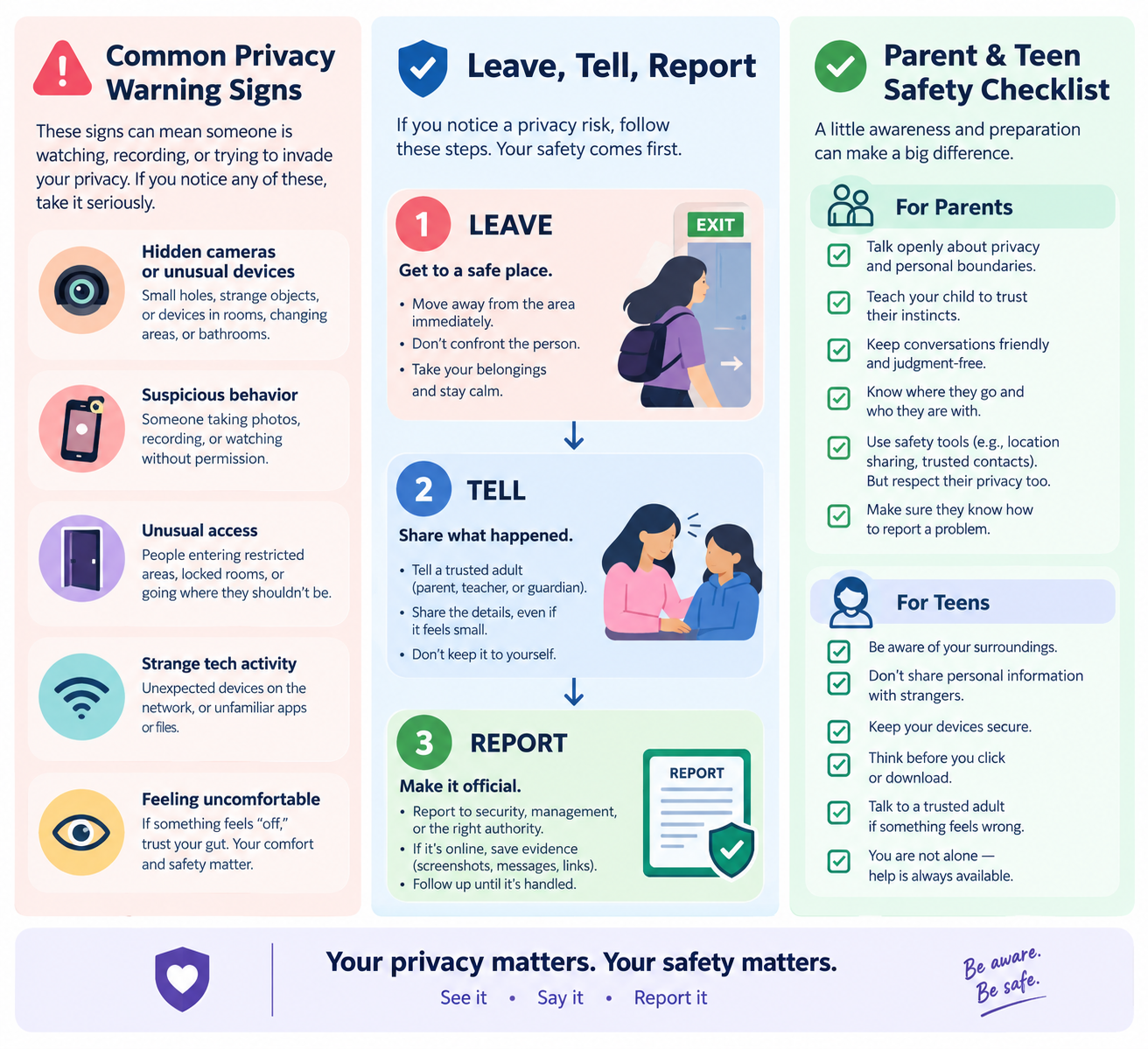
The following are things that may warrant your attention. They do not prove that a camera is present, and ordinary objects, mirrors, and small holes do not automatically indicate surveillance. These are simply things that may seem inconsistent or out of place.
An unfamiliar electronic device or object placed where it seems unnecessary. A small device on a shelf, tucked into a fitting, or positioned in a way that seems deliberate rather than functional.
An unusual opening or unexplained modification in a wall, fitting, hook surround, mirror frame, or other fixture. A small hole that does not appear to serve any structural or ventilation purpose.
An object that appears to have been deliberately positioned toward a private area. A hook, a device, or a fixture angled in a way that serves no obvious purpose other than directing a lens toward where a person would undress.
If you see any of these, the correct response is to leave the space and report the concern — not to investigate the object yourself.
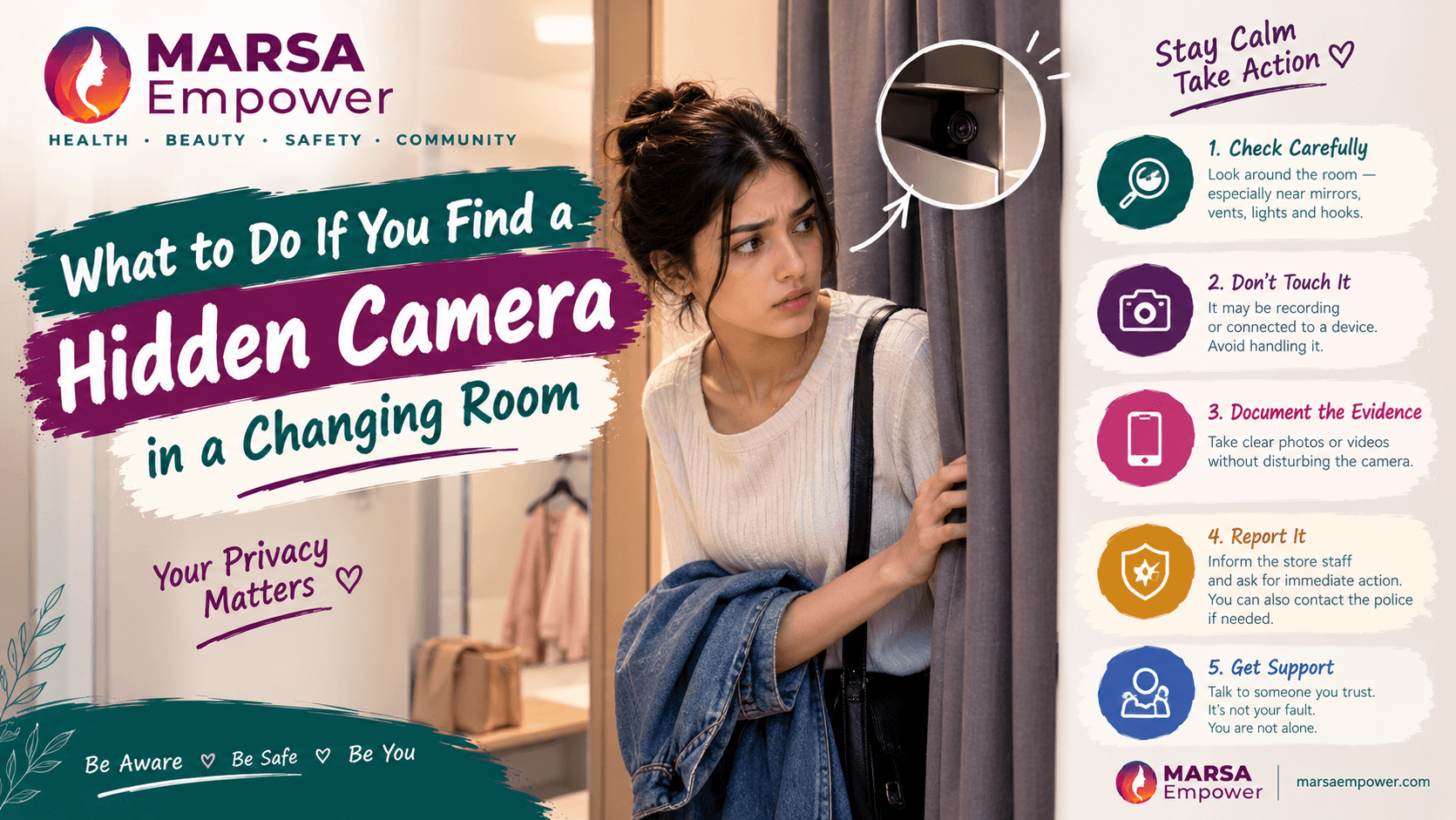
If something seems wrong in a private space — leave, don't touch, tell a responsible person, and report.
Stop changing or using the facility immediately. You do not need to finish what you were doing. Your privacy and safety take priority.
Leave calmly and move to a safe, public area. You do not need to draw attention to yourself or confront anyone. Simply leave.
Tell the shop manager, facility supervisor, security staff, or another responsible adult. Do this as soon as you are out of the space. Give them the specific location — which cubicle, which room — and describe what you observed.
If you believe a camera has been deliberately placed to record people in a private space, report it to the appropriate authorities. This is a matter for the police or relevant law-enforcement agency. The business or facility management may also be required to report it to authorities.
Do not touch, dismantle, or attempt to remove the suspected device. Touching the object could compromise evidence that authorities may need. Leave it in place and leave the reporting to the appropriate people.
If you find what appears to be a hidden recording device in a private space:
Leave the private area immediately. Do not stay to investigate further.
Tell a trusted adult if you are under 18. A parent, guardian, teacher, or other responsible adult should be informed immediately. You should not have to handle this situation alone.
Notify the facility management and contact the police or relevant local authority. Both should be informed. The management has a responsibility to respond, and the police have authority to investigate.
If it is safe to do so, note the location, time, and a brief description of what you observed before leaving, so you can report it accurately. Do not physically touch or move the device.
Do not photograph yourself or anyone else in a state of undress to document the incident. This is unnecessary and could create additional harm.
Do not post the suspected device or identifying details publicly online before considering the privacy and legal implications. Share the concern with the appropriate authorities — not on social media.
First and most importantly: you are not to blame. Being in a changing room that contained a hidden camera is not your fault. The responsibility lies entirely with the person who placed it there.
Tell a trusted adult or person who can support you. You should not carry this alone. A parent, guardian, counsellor, or friend can provide both emotional support and help you decide on next steps.
Report the incident to the facility management and appropriate authorities. This creates a record, may protect others who use the same facility, and allows an investigation to take place.
If someone threatens to share recordings of you, this is a separate offence — a form of image-based abuse. Preserve the threatening messages and account details without forwarding any intimate content. Report the threat to the cybercrime authority in your country. Do not pay or provide more images. Guidance on this situation is available in Marsa's dedicated guide on private photo threats.
Seek support. The experience of finding out you may have been recorded without your knowledge can cause significant distress. Speaking to a counsellor, helpline, or trusted adult is a valid and important step.
Children and teenagers deserve clear, age-appropriate guidance about privacy in shared spaces.
Private areas deserve privacy and respect. Explain to children that certain spaces — changing rooms, washrooms, bedrooms — are places where their body is private and should not be seen or recorded by others.
It is okay to leave if something feels wrong. Teach children that they are allowed to leave a changing room or washroom without finishing what they were doing if they feel uncomfortable. They will not be in trouble for this.
Children can tell a trusted adult about an uncomfortable situation without fear of punishment. Make this clear directly and repeatedly. A child who feels safe enough to speak up is far better protected than one who stays silent out of fear of getting in trouble.
Never blame a child for being recorded or for not noticing a suspicious object. Hidden cameras are designed to be concealed. An adult professional might not spot one. A child should never be made to feel that they should have detected it or prevented it.
Adults should respond calmly, protect the child's privacy, and report serious concerns. If a child reports something suspicious or distressing, take it seriously, keep it private, and contact the appropriate authorities rather than escalating publicly.
The responsibility for providing safe private spaces rests significantly with the businesses and facilities that operate them.
Regular inspection of changing rooms and washrooms should be a standard part of facility management — not an occasional reaction to a complaint.
Private areas must remain free from inappropriate surveillance. Staff should be trained to understand what this means and to respond seriously when concerns are raised.
Clear staff training on how to respond to privacy complaints ensures that a customer or visitor who reports a concern is heard and helped rather than dismissed.
A clear, visible process for reporting concerns should be available to customers. People should know who to tell and how.
Protecting customers' identities if an incident is reported is essential. The business should not share footage, allegations, or identifying details publicly. Incidents should be handled through proper authority channels.
Contact local police if you believe a device has been placed to record people in a private space. This is a criminal matter in most countries, and the police are the appropriate first authority to contact.
Report the incident to your local police station. If intimate recordings have been shared or threatened online, Pakistan's National Cyber Crime Investigation Agency (NCCIA) provides a complaint process.
NCCIA complaint portal: https://complaint.nccia.gov.pk NCCIA website: https://www.nccia.gov.pk Helpline: 1799 Police emergency: 15
Report to your local police or state police. The national cybercrime portal handles cases where recordings have been shared or threatened online.
National Cyber Crime Reporting Portal: https://cybercrime.gov.in Helpline: 1930 Police emergency: 100 or 112
The National Human Rights Commission of India has previously taken suo motu cognizance of hidden camera incidents in washrooms and college facilities, demonstrating that these cases are taken seriously at a national level.
Contact local police (999 for emergencies, 101 for non-emergencies). Report online image-based abuse to the Revenge Porn Helpline: https://revengepornhelpline.org.uk
Contact local police (911). Report cybercrime or image-based threats to the FBI's Internet Crime Complaint Center: https://www.ic3.gov
Contact local police (000). Report image-based abuse to the eSafety Commissioner: https://www.esafety.gov.au/report/image-based-abuse
If a child may have been recorded, involve a trusted adult and the appropriate child-protection or law-enforcement authorities promptly. Do not delay.
Everyone deserves genuine privacy in a changing room, washroom, or any other space where they expect to be unobserved.
Staying aware is a useful habit. Looking around naturally before using a private facility is reasonable. But you are not responsible for detecting every hidden device, and you are not to blame if someone has placed one without your knowledge.
The responsibility for illegal and abusive surveillance lies entirely with the person who carries it out. Your role is simply to leave, report, and seek support when needed.
You do not have to investigate. You do not have to confront anyone. You do not have to handle it alone.
Leave. Tell someone. Report it.
Be aware, but do not live in fear. Most changing rooms are safe. Most facilities are not under covert surveillance. A basic habit of looking around naturally before using a private space is sensible — but it does not need to be a source of constant anxiety.
If something seems wrong, trust that feeling. Leave the space. Tell a responsible person. Report it to the appropriate authority. Do not touch or move what you found. Do not try to investigate it yourself.
If you are a parent or guardian, teach children that they can always leave a space that feels wrong and tell a trusted adult. No child should ever feel responsible for what another person chose to do.
Privacy is a right. Illegal surveillance is a crime. The responsibility belongs to the person who chose to violate your privacy — never to you.
National Human Rights Commission of India — Hidden Camera Incidents https://nhrc.nic.in/media/press-release/nhrc-takes-suo-motu-cognizance-the-reported-incidents-hidden-cameras-found-in-the-washrooms-a-girls-college-in-krishna-district-andhra-pradesh-in-a-popular-eatery-in-bengaluru-karnataka
Pakistan — NCCIA Complaint Portal https://complaint.nccia.gov.pk
Government of India — National Cyber Crime Reporting Portal https://cybercrime.gov.in
University of California Santa Barbara — Crime Prevention and Safety Resources https://www.police.ucsb.edu/resources/crime-prevention-safety
Australia — eSafety Commissioner (Image-Based Abuse) https://www.esafety.gov.au/report/image-based-abuse
UK — Revenge Porn Helpline https://revengepornhelpline.org.uk
USA — FBI Internet Crime Complaint Center (IC3) https://www.ic3.gov
Disclaimer
This article is for educational and safety-awareness purposes only. It does not constitute legal advice. Emergency numbers and reporting procedures should be verified locally before relying on them. If you are in immediate danger, contact your local emergency services.
Marsa Empower | Care. Safety. Growth. Visit marsaempower.com for women's health, personal safety, and digital awareness resources.
Medical Disclaimer
This article is for general informational and educational purposes only and is not a substitute for professional medical advice, diagnosis, or treatment. Always seek the advice of a qualified healthcare provider with any questions you may have regarding a medical condition. Never disregard professional medical advice or delay seeking it because of something you have read on MARSA Empower.
Written By
Maryam Mumtaz
Co-Founder & CEO
Co-Founder of MARSA Empower who leads the visual and strategic evolution of the platform. Maryam bridges technical complexity with human-centric design, architecting the team's official roadmap and ensuring MARSA effectively addresses the real-world needs of women. With deep expertise in agentic AI, full-stack development, and UI/UX design, she has delivered 50+ projects for 30+ satisfied clients.
Enjoyed this story?