One App. Every Woman.
One App. Every Woman.
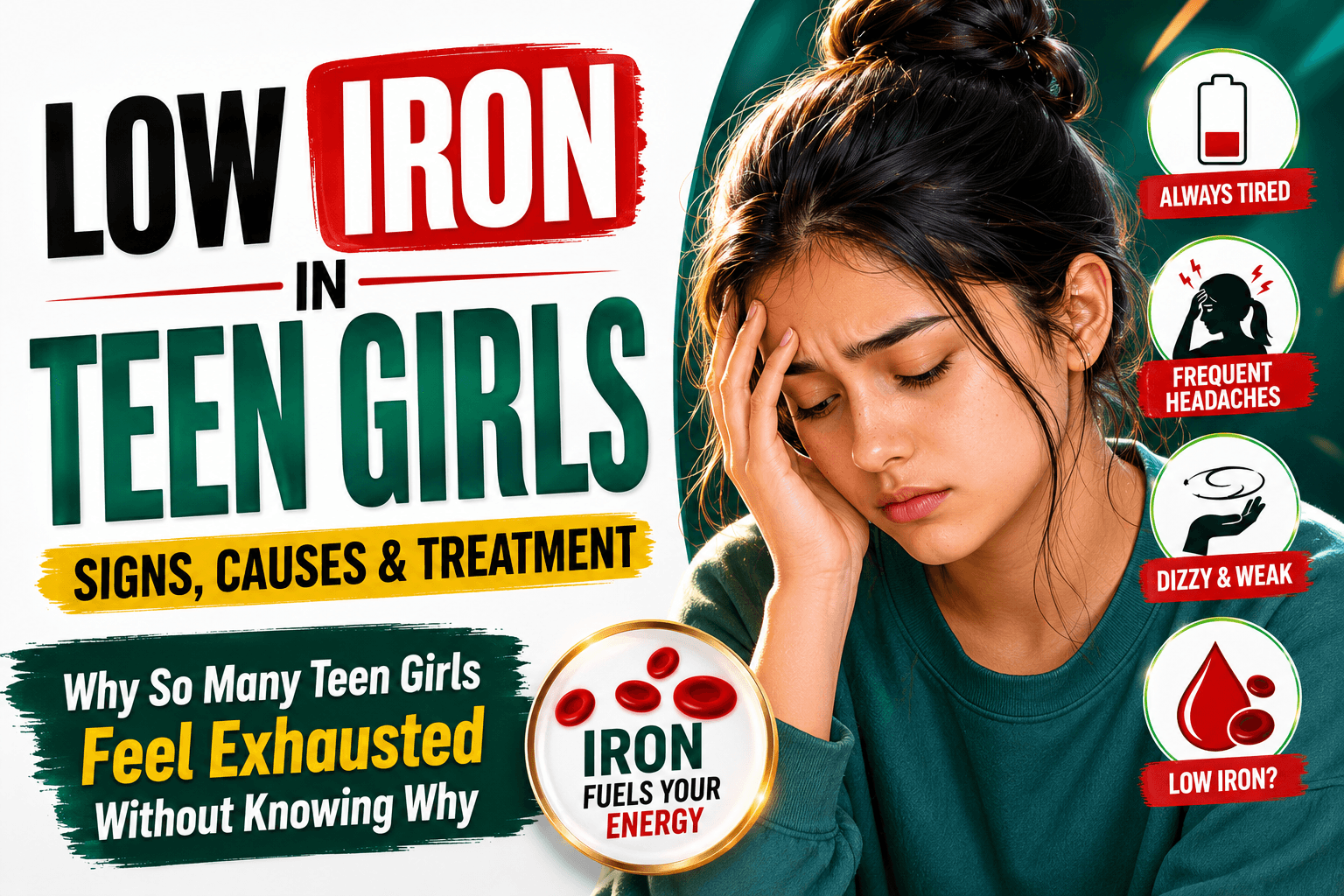
Discover the signs, causes, and treatments of low iron in teenage girls. Learn how proper nutrition and healthcare can prevent iron deficiency and promote well-being.

Maryam Mumtaz
Co-Founder & CEO
18 min read•7/30/2026
Marsa Empower · Teen Health & Nutritional Wellness · For Girls & Women Aged 13 and Above · 13 min read
"Persistent tiredness is not simply the price of being a busy teenager. In many cases, it is a nutritional signal — and low iron is one of the most common and most correctable causes."
She sleeps eight hours and still wakes up exhausted. She gets breathless climbing a single flight of stairs. She feels dizzy when she stands up too quickly. Her hands and feet are always cold. Her concentration dips in the afternoon no matter how much sleep she got or how much coffee she drinks.
She tells herself it is just a busy schedule. Exam stress. Growing up.
But for many teenage girls, this kind of persistent, unrelenting fatigue has a very specific cause — one that can be identified with a simple blood test and corrected with a targeted nutritional plan.
Low iron is one of the most common nutritional problems affecting teenage girls worldwide — and one of the most frequently missed. Because its symptoms develop gradually and are easy to attribute to other causes (stress, poor sleep, being a busy teenager), many girls live with iron deficiency for months or even years without knowing it.
This guide explains everything you need to know — what iron does in your body, why teenage girls are particularly vulnerable, what the symptoms look like, how it is diagnosed, and precisely what to do to correct it.
Iron is a mineral — one of the essential nutrients the body cannot produce on its own and must obtain through food. It is needed in relatively small amounts, but those small amounts are critical to several biological processes that affect how you feel every day.
The most important function of iron is enabling the production of haemoglobin — the protein that gives red blood cells their red colour and carries out their primary function: transporting oxygen from the lungs to every cell, tissue, and organ in the body.
Here is how it works: every time you breathe in, your lungs draw oxygen from the air into the bloodstream. Red blood cells — tiny disc-shaped cells that circulate continuously through the cardiovascular system — pick up this oxygen and carry it to the muscles, brain, heart, liver, and every other part of the body. Haemoglobin is the specific protein inside these red blood cells that binds to oxygen and holds onto it during transport.
Iron is the mineral at the centre of haemoglobin's structure. Without sufficient iron, the body cannot produce enough functional haemoglobin. Without sufficient haemoglobin, red blood cells cannot carry enough oxygen. And without sufficient oxygen delivery:
This is why iron deficiency produces such wide-ranging symptoms — because oxygen delivery to every cell is compromised.
Beyond oxygen transport, iron is involved in:
These two terms are related but different — and understanding the distinction matters.
Iron deficiency means the body's iron stores are depleted. There is not enough iron available to fully support all of the body's iron-dependent processes. Iron deficiency can produce symptoms — fatigue, reduced concentration, increased hair shedding — even before blood haemoglobin levels fall to the level classified as anaemia.
This is why many girls feel unwell and have measurably low iron stores, but their standard blood test result comes back "normal" — because haemoglobin is being measured rather than ferritin (the marker of iron stores), and haemoglobin can remain within the normal range in early iron deficiency.
Anaemia is the more advanced stage — when iron stores have been depleted to the point where haemoglobin levels fall below the normal range. At this stage, red blood cell production is significantly impaired, oxygen transport throughout the body is meaningfully reduced, and symptoms are more pronounced.
Iron deficiency anaemia is the most common form of anaemia globally and the most common nutritional deficiency among women and teenage girls worldwide.
The progression from adequate iron → iron deficiency → iron deficiency anaemia is gradual — which is why many girls are surprised to receive an anaemia diagnosis after months of symptoms they had normalised as "just being tired."
Iron deficiency is significantly more common in teenage girls than in teenage boys or in women after menopause. Several factors specific to the female adolescent body create a vulnerability that is important to understand.
Every menstrual period involves blood loss — and blood carries iron. A typical period involves a blood loss of approximately 30 to 80 ml over three to seven days, which translates to an iron loss of approximately 15 to 35 mg.
This monthly loss is manageable for most women when dietary iron intake is adequate. But it becomes a problem when:
Puberty requires the production of a significantly larger blood volume than the body maintained in childhood. A growing teenage girl needs to expand her total blood supply — and expanding blood volume requires more iron to produce more red blood cells. This increased demand occurs simultaneously with monthly iron losses beginning at menarche, creating a period of particularly high iron need.
Many teenage girls do not eat enough iron-rich foods to meet their elevated daily needs:
| Age Group | Recommended Daily Iron |
|---|---|
| Girls 9–13 years | 8 mg per day |
| Girls 14–18 years | 15 mg per day |
| Women 19–50 years | 18 mg per day |
| Women 51+ years | 8 mg per day |
The jump from 8 mg to 15 mg per day at age 14 — when menstruation typically begins — illustrates just how significantly iron needs increase with the onset of periods. For girls with heavy periods, the requirement is even higher.
Iron deficiency produces a distinctive cluster of symptoms that, when recognised together, point clearly to the diagnosis. However, because these symptoms are relatively non-specific and develop gradually, they are often attributed to other causes and missed for months.
| Symptom | How Common | Notes |
|---|---|---|
| Persistent fatigue and low energy | Very common | The most universal symptom — tiredness that does not improve with adequate sleep |
| Weakness | Very common | Muscles fatigue more quickly — tasks that were previously easy feel effortful |
| Pale skin | Common | Particularly noticeable in the inner lower eyelids, which become noticeably lighter than their normal pink-red colour |
| Shortness of breath during activity | Common | Breathlessness climbing stairs or during exercise that would not normally cause it |
| Dizziness or lightheadedness | Common | Particularly when standing up quickly from a sitting or lying position |
| Frequent headaches | Common | Caused by reduced oxygen delivery to the brain |
| Cold hands and feet | Common | Poor circulation resulting from reduced haemoglobin |
| Difficulty concentrating | Common | Brain fog · Reduced attention · Poor memory and focus |
| Fast or irregular heartbeat | Moderate | The heart compensates for low oxygen content per blood cell by beating faster |
| Brittle, ridged, or spoon-shaped nails | Moderate | Koilonychia — spoon-shaped nails are a specific indicator of iron deficiency |
| Increased hair shedding | Moderate | Hair follicles are deprived of adequate oxygen and enter the resting phase prematurely |
| Restless legs | Less common | An uncomfortable urge to move the legs, particularly at night |
| Pica | Less common | A craving to eat non-food substances — ice, clay, chalk. A specific and unusual symptom of severe iron deficiency |
The most important symptom of iron deficiency is the simplest: tiredness that does not improve with sleep. When a teenage girl reports feeling persistently exhausted despite sleeping adequately, and when this has been the case for weeks rather than days, iron deficiency should always be among the first considerations investigated — not normalised.
Understanding why these specific symptoms occur helps you recognise them more accurately and take them more seriously.
Why fatigue? Every cell in the body produces energy through a process that requires oxygen — delivered by haemoglobin in red blood cells. When haemoglobin levels fall, cells receive less oxygen, produce less energy, and fatigue accumulates throughout every system in the body.
Why pale skin? The colour of the skin, particularly in areas where blood vessels are close to the surface — the inner lower eyelids, the lips, the nail beds — reflects the colour of the blood itself. Iron-deficient blood, with less functional haemoglobin, is lighter in colour than healthy oxygenated blood. This produces the pallor characteristic of anaemia.
Why breathlessness? When each red blood cell carries less oxygen (because haemoglobin is reduced), more blood must circulate faster to deliver the same amount of oxygen to working muscles. The respiratory system compensates by breathing harder and faster — producing the sensation of breathlessness even during mild exertion.
Why fast heartbeat? The cardiovascular system similarly compensates by pumping blood faster — increasing heart rate to move more blood through the body more quickly, trying to offset the reduced oxygen content per cell.
Why cold hands and feet? When oxygen supply is limited, the body prioritises delivering what is available to the most essential organs — the brain and heart. Peripheral circulation to the hands and feet is reduced, producing persistent coldness.
Why difficulty concentrating? The brain consumes approximately 20% of the body's total oxygen supply. When oxygen delivery is reduced, cognitive function is among the earliest affected — producing the brain fog, reduced concentration, and memory difficulties that iron-deficient girls often describe.
As described above, this is the most common cause of iron deficiency in teenage girls and young women. Girls with heavy periods — soaking a full pad more frequently than every two hours, passing large clots, or bleeding for more than seven days — are losing significantly more iron each month than the average dietary intake replaces.
Many girls do not recognise that their periods are heavy because they have no comparative reference. If a period has always been heavy, it can feel normal — until the cumulative iron loss produces enough symptoms to signal a problem.
Any teenage girl with persistent iron deficiency symptoms should be asked about her menstrual pattern — and any girl with heavy periods should be proactively screened for iron deficiency.
The body cannot produce iron — it must come entirely from food. When dietary iron intake consistently falls below the daily requirement (15 mg per day for teenage girls), iron stores gradually deplete.
This can happen through:
Not all iron consumed from food is absorbed equally. The body absorbs only a fraction of dietary iron — approximately 15% to 35% from animal sources and approximately 2% to 20% from plant sources, depending on what else is consumed at the same meal.
Several factors reduce iron absorption:
The body's total blood volume expands significantly during puberty, requiring more red blood cells and more iron to produce them. This increased demand coincides with the onset of monthly iron losses — creating a period of particularly high iron need that many teenage girls' diets do not adequately meet.
Calorie-restricted diets, skipped meals, and eating disorders all reduce total food intake — and with it, total iron intake. Iron deficiency is one of the most consistent nutritional consequences of restrictive eating in teenage girls, and it compounds the fatigue and cognitive difficulties that disordered eating already produces.
Iron deficiency is diagnosed through blood tests. A physical examination and symptom review are important first steps, but blood tests provide the objective confirmation needed to determine whether iron is actually the cause of the symptoms.
Complete Blood Count (CBC / Full Blood Count): Measures haemoglobin, haematocrit (the proportion of blood volume that is red blood cells), and the size and appearance of red blood cells. In iron deficiency anaemia, haemoglobin is below normal, and red blood cells are smaller and paler than normal (microcytic, hypochromic anaemia).
Serum Ferritin: Measures the body's stored iron reserves. This is the most sensitive marker for iron deficiency — it falls before haemoglobin does, identifying iron depletion at an earlier stage.
Serum Iron: Measures the amount of iron circulating in the blood.
Transferrin Saturation: Measures what percentage of the body's iron transport protein (transferrin) is actually loaded with iron. Falls in iron deficiency.
A doctor investigating possible iron deficiency will typically ask:
Serum ferritin is the single most sensitive and most clinically important blood test for iron deficiency — and the one most frequently overlooked in standard blood panels.
Haemoglobin — the marker included in a standard Complete Blood Count — only falls below the normal range once iron deficiency has progressed to a relatively advanced stage. In the earlier stages of iron deficiency, haemoglobin may be within the normal range while the body's iron stores (measured by ferritin) are already critically low and producing symptoms.
This means that a girl can be genuinely iron deficient — experiencing fatigue, hair shedding, poor concentration, and reduced exercise tolerance — while her standard blood test result shows a "normal" haemoglobin level. Her doctor may tell her her blood test is normal. But if ferritin has not been tested, the most sensitive marker of her iron status has been missed.
Always ask specifically for serum ferritin to be included in the blood panel when investigating symptoms of iron deficiency. It is a simple addition to the blood test — but it is frequently omitted from standard panels unless specifically requested.
| Ferritin Level | Interpretation |
|---|---|
| Below 12 ng/mL | Iron deficiency — iron stores depleted |
| 12 to 30 ng/mL | Low-normal — many women experience symptoms at this range |
| 30 to 100 ng/mL | Normal |
| Above 100 ng/mL | Good iron stores |
Some clinical guidelines now suggest that ferritin levels below 30 ng/mL may warrant treatment in women experiencing symptoms — even though technically within the "normal" range — because symptoms of iron deficiency can precede a measurably low ferritin.
Treatment depends on the severity of the deficiency and its underlying cause. A healthcare professional will guide the appropriate treatment plan.
Regardless of the severity of iron deficiency, improving dietary iron intake is the essential foundation of treatment. Diet provides iron in a natural, well-absorbed form alongside other nutrients that support overall health — and it is what prevents recurrence after supplementation is complete.
Full guidance on iron-rich foods, absorption-enhancing foods, and absorption-reducing foods is provided in the sections below.
When dietary improvement alone is insufficient — particularly in moderate to severe iron deficiency, or when haemoglobin is meaningfully below normal — iron supplements are prescribed. Iron supplements restore iron stores more rapidly than diet alone.
Important: Do not start iron supplements without medical guidance. Determining the appropriate dose requires knowing the severity of the deficiency (from blood tests), and taking excessive iron causes significant digestive side effects (nausea, constipation, stomach pain) and, in serious overdose, organ damage.
Types of iron supplements:
How to take iron supplements for maximum absorption:
How long to take supplements:
If heavy menstrual periods are the driver of iron deficiency, treating the period heaviness itself — not just supplementing the iron lost — is an essential part of management. A gynaecologist can assess and treat heavy periods through hormonal management, non-hormonal medications (tranexamic acid, NSAIDs), or investigation for underlying causes such as PCOS, fibroids, or thyroid dysfunction.
Building a consistently iron-rich diet is the most sustainable solution to iron deficiency — and the strategy that prevents recurrence after any supplementation.
Iron from animal sources is called haem iron — it is bound in a form that the body absorbs readily, regardless of what else is consumed at the same meal. Absorption rates are typically 15% to 35%.
| Food | Iron Content Per Serving | Notes |
|---|---|---|
| Beef (lean, cooked) | 2.5–3.5 mg per 85g | Excellent daily source |
| Chicken liver | 11 mg per 85g | Very high — consume once weekly maximum |
| Chicken (dark meat) | 1.1 mg per 85g | Good everyday source |
| Fish (tuna, sardines) | 1–2 mg per 85g | Sardines eaten with bones also provide calcium |
| Eggs | 1 mg per egg | Convenient, versatile source |
| Lamb | 2.5 mg per 85g | Good everyday red meat source |
Iron from plant sources is called non-haem iron — it is less readily absorbed by the body (2% to 20% absorption), and absorption is significantly affected by what else is consumed at the same meal. However, plant sources can contribute meaningfully to iron intake when consumed regularly and combined with vitamin C.
| Food | Iron Content Per Serving | Notes |
|---|---|---|
| Lentils (cooked) | 3.3 mg per 100g | Excellent everyday source — add to soups and daal |
| Chickpeas (cooked) | 2.9 mg per 100g | Versatile — works in curries, salads, and snacks |
| Kidney beans (cooked) | 2.6 mg per 100g | Good in stews and curries |
| Tofu (firm) | 3.4 mg per 100g | Excellent source for vegetarians |
| Spinach (cooked) | 3.6 mg per 100g | Note: raw spinach has lower absorption than cooked |
| Pumpkin seeds | 2.5 mg per 30g | Easy to add to meals and snacks |
| Sesame seeds / tahini | 4 mg per 30g | Add to dressings and sauces |
| Fortified breakfast cereal | 2–18 mg per serving | Check the label — iron content varies widely |
| Fortified oats | 2 mg per 40g serving | Good breakfast option |
| Dark chocolate (70%+) | 3.4 mg per 30g | Useful small addition |
| Dried apricots | 1.4 mg per 30g | Easy snack addition |
| Whole wheat bread | 0.9 mg per slice | Consistent daily contribution |
The most important strategy for improving iron absorption from plant sources is combining them with vitamin C at the same meal. Vitamin C converts non-haem iron from plant foods into a form the body can absorb more readily — increasing absorption by up to three to four times.
| Vitamin C Food | Easy Ways to Combine With Iron-Rich Foods |
|---|---|
| Oranges or orange juice | Drink a glass of orange juice with fortified cereal or lentil dishes |
| Lemon juice | Squeeze over spinach, daal, or chickpea dishes |
| Tomatoes | Add to lentil soups, bean curries, or meat dishes |
| Bell peppers (capsicum) | Add raw to salads alongside iron-rich foods |
| Broccoli | Serve alongside meat or lentil-based dishes |
| Strawberries | Eat alongside iron-fortified cereal |
| Kiwi fruit | Excellent with a meal containing plant-based iron |
| Amla (Indian gooseberry) | One of the richest vitamin C sources — extremely useful for increasing iron absorption |
Certain substances consumed at the same time as iron-rich foods can significantly reduce how much iron the body absorbs. These do not need to be permanently removed from the diet — they simply should not be consumed at the same time as iron-rich meals or supplements.
Tea and coffee: The tannins in both black and green tea, and the chlorogenic acid in coffee, bind to non-haem iron in the digestive tract and significantly reduce absorption. Studies show that drinking tea with a meal reduces iron absorption by 60% to 70%.
Recommendation: Wait at least one hour after an iron-rich meal before drinking tea or coffee.
Calcium (dairy and calcium supplements): Calcium competes with iron for the same absorption pathway in the intestine. Consuming large amounts of dairy or calcium supplements at the same time as iron-rich foods or iron supplements reduces iron absorption significantly.
Recommendation: Separate calcium supplements from iron supplements by at least two hours. Consuming some dairy at a meal is fine — the concern is primarily with high-dose calcium supplements taken simultaneously with iron.
Phytates (in whole grains, legumes, and nuts in their raw form): Phytates bind to iron and reduce its absorption. However, cooking, soaking, and sprouting significantly reduces phytate content. Eating a varied diet — not relying exclusively on raw plant foods for iron — largely manages this.
Recommendation: Soak lentils and beans before cooking. Eat cooked rather than raw legumes when relying on them for iron.
This is a practical example of how to build iron into daily eating — with vitamin C combinations to maximise absorption.
| Meal | Iron-Rich Content | Vitamin C to Boost Absorption |
|---|---|---|
| Breakfast | Iron-fortified oatmeal or cereal | Strawberries or orange juice alongside |
| Mid-morning snack | Small handful of pumpkin seeds | A small orange or kiwi fruit |
| Lunch | Lentil soup or chickpea salad | Lemon juice in the soup · Tomatoes in the salad · Bell pepper |
| Afternoon snack | Boiled egg | Tomato slices |
| Dinner | Chicken, beef, or fish with cooked spinach | Tomato-based curry or sauce alongside · Lemon squeezed over greens |
| Drinks | Water throughout the day | Fresh lemon water |
| Avoid with meals | Tea and coffee | Separate by at least 1 hour from iron-rich meals |
Prevention is significantly easier than correction — and the habits that prevent iron deficiency are the same healthy eating habits that support overall wellbeing.
Include at least one iron-rich food at most meals. This does not require a dramatic dietary overhaul — simply making iron-conscious choices within your regular eating pattern. Add lentils to soups. Eat eggs at breakfast. Choose whole grain bread over white. Snack on pumpkin seeds.
Make it a habit: lemon on lentil dishes, tomatoes with meat, fresh fruit alongside fortified cereal. These combinations are easy, flavourful, and significantly increase the iron your body actually absorbs from what you eat.
This single change can significantly improve iron absorption for girls who drink tea or coffee regularly — which in Pakistan, where chai is a dietary staple, is almost everyone. Enjoy chai — but wait an hour after an iron-rich meal before drinking it.
Skipping meals reduces total food intake and therefore total iron intake. Regular, consistent eating is the simplest nutritional strategy for maintaining adequate iron levels.
If your periods are consistently heavy, speak to a doctor about both the iron implications and the period heaviness itself. Heavy periods are not something to simply accept — they are a medical symptom that can often be managed effectively, protecting both quality of life and iron stores.
If you have risk factors for iron deficiency — heavy periods, vegetarian or vegan diet, history of iron deficiency — an annual blood panel including serum ferritin is a simple and valuable monitoring habit.
A doctor will take a detailed history, examine you, and order blood tests — including (ideally) a complete blood count and serum ferritin. Based on the results, they will recommend the appropriate combination of dietary changes, supplementation, and any further investigation into the cause (such as investigation of heavy periods or assessment for digestive absorption problems).
Do not self-prescribe iron supplements. While the impulse to supplement when you feel tired is understandable, the appropriate dose and duration of iron supplementation requires knowledge of your actual iron levels. Excessive iron causes its own health problems — and without a blood test, there is no way to know whether the dose you are taking is appropriate, insufficient, or excessive.
| Topic | Key Takeaway |
|---|---|
| What iron does | Produces haemoglobin · Carries oxygen to every cell · Powers energy production |
| Why teen girls are at risk | Monthly iron loss through periods + rapid growth + often insufficient diet |
| The most common symptom | Persistent fatigue that does not improve with sleep |
| Other key symptoms | Pale skin · Dizziness · Breathlessness · Headaches · Cold hands · Hair shedding · Poor concentration |
| Most important test | Serum ferritin — always request this specifically |
| Primary cause | Heavy periods + insufficient dietary iron |
| Best animal iron sources | Beef · Chicken · Fish · Eggs |
| Best plant iron sources | Lentils · Chickpeas · Tofu · Spinach · Pumpkin seeds |
| Most important absorption hack | Pair iron-rich foods with vitamin C — lemon, oranges, tomatoes, bell peppers |
| What reduces absorption | Tea and coffee with meals — separate by at least 1 hour |
| Treatment | Dietary improvement + iron supplements when prescribed by a doctor |
| Prevention | Iron-rich diet daily + vitamin C pairing + annual ferritin check if at risk |
| When to see a doctor | Persistent fatigue · Dizziness · Heavy periods · Pale skin · Breathlessness |
"Tiredness that does not go away with sleep is not just a personality trait. It is often a nutritional signal — and iron deficiency is one of the most common and most correctable causes among teenage girls. A simple blood test can provide the answer. You deserve to feel well."
Educational Disclaimer
This article is for educational and awareness purposes only. It does not constitute medical advice, diagnosis, or treatment. If you are experiencing symptoms of iron deficiency, please consult a qualified healthcare professional for personalised blood testing, diagnosis, and treatment guidance. Do not begin iron supplementation without medical advice.
Marsa Empower · Teen Health · Nutritional Wellness · Iron & Menstrual Health Education
Medical Disclaimer
This article is for general informational and educational purposes only and is not a substitute for professional medical advice, diagnosis, or treatment. Always seek the advice of a qualified healthcare provider with any questions you may have regarding a medical condition. Never disregard professional medical advice or delay seeking it because of something you have read on MARSA Empower.
Written By
Maryam Mumtaz
Co-Founder & CEO
Co-Founder of MARSA Empower who leads the visual and strategic evolution of the platform. Maryam bridges technical complexity with human-centric design, architecting the team's official roadmap and ensuring MARSA effectively addresses the real-world needs of women. With deep expertise in agentic AI, full-stack development, and UI/UX design, she has delivered 50+ projects for 30+ satisfied clients.
Enjoyed this story?