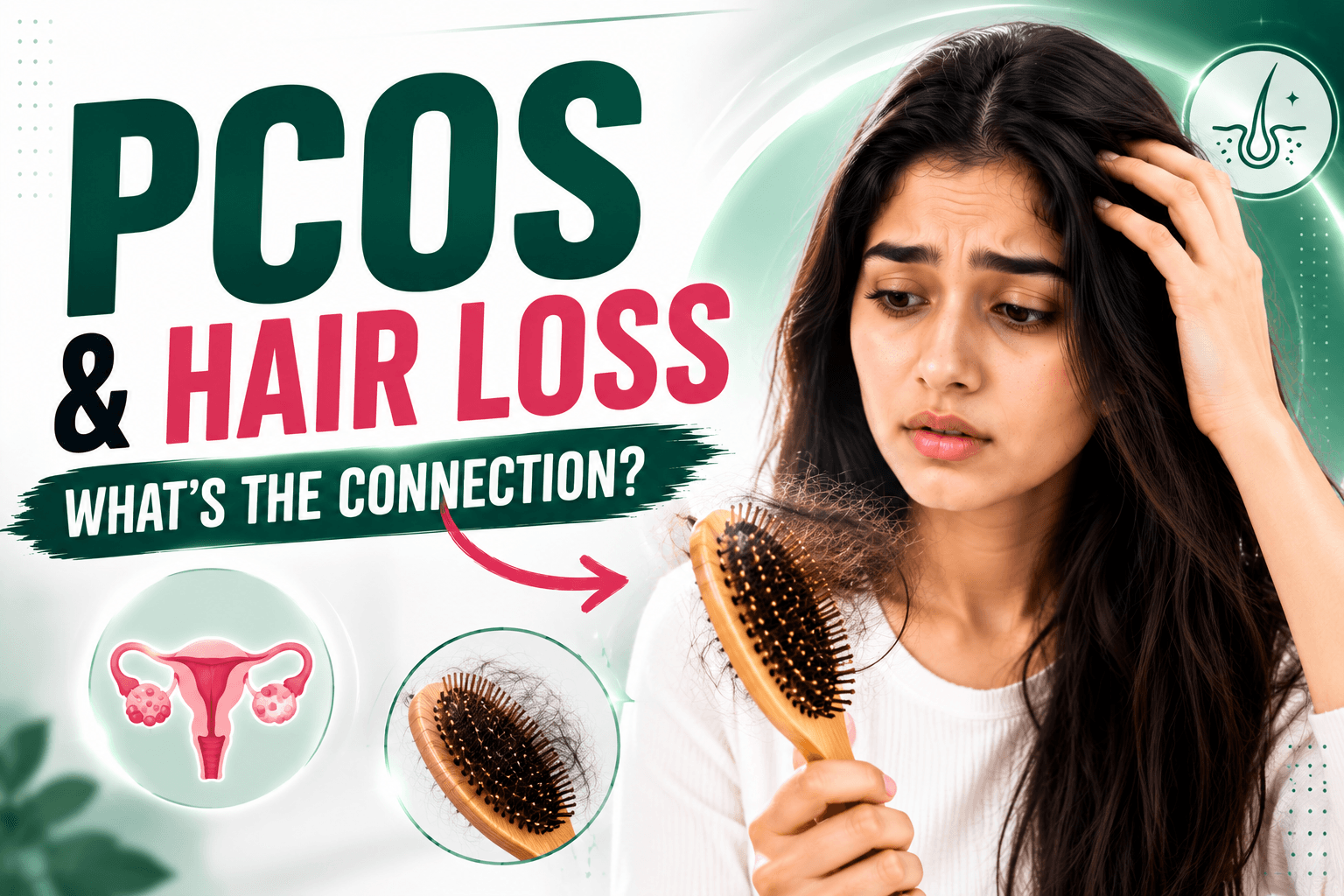
Discover how PCOS affects hair growth and loss. Understand the symptoms, potential treatments, and lifestyle changes to support hair health.

Maryam Mumtaz
Co-Founder & CEO
12 min read•7/14/2026
Marsa Empower · Women's Hormonal Health · Dermatology & Endocrinology · 11 min read
"Hair thinning in PCOS is not a cosmetic inconvenience. It is a clinical signal — one that points directly toward the hormonal disruption driving the condition itself."
Many women with Polycystic Ovary Syndrome are aware of the more widely discussed symptoms — irregular periods, persistent acne, difficulty managing weight. Far fewer are told that PCOS can also contribute to hair thinning and hair loss. And so, when it happens — when the part line gradually widens, when the brush collects more than it used to, when the hair feels less dense than it once did — the connection is rarely made.
The hair loss is treated as a separate, unrelated concern. New shampoos are tried. Supplements are purchased. The underlying hormonal driver — the elevated androgens central to PCOS — continues unaddressed.
Understanding the relationship between PCOS and hair loss does more than explain a distressing symptom. It directs attention toward the hormonal environment generating that symptom, which is precisely where meaningful intervention is possible.
This guide explains that relationship fully.
Polycystic Ovary Syndrome is one of the most common hormonal conditions affecting women of reproductive age — estimated to affect approximately 1 in 10 women globally, with rates potentially higher in South Asian populations including Pakistan.
Despite the name, PCOS is not primarily a condition of the ovaries. It is a hormonal and metabolic condition involving three interconnected disruptions:
Elevated androgens. Androgens are hormones present in all women, but in smaller amounts than in men. In PCOS, the ovaries produce androgens — including testosterone and its derivative, dihydrotestosterone (DHT) — in greater quantities than normal. This androgen excess is responsible for many of the most visible PCOS symptoms, including acne, hirsutism, and scalp hair thinning.
Disrupted ovulation. Irregular or absent ovulation produces irregular or absent periods — the symptom most commonly associated with PCOS in clinical and public awareness. Without regular ovulation, the normal monthly hormonal cycle is disrupted, and the corpus luteum — which produces progesterone — does not form reliably.
Insulin resistance. The majority of women with PCOS have some degree of insulin resistance — a state in which cells respond less efficiently to insulin, requiring the pancreas to produce more. Elevated insulin levels directly signal the ovaries to produce more androgens, creating the central self-reinforcing cycle of PCOS: more insulin drives more androgens, which worsen the hormonal environment further.
Because PCOS affects multiple systems simultaneously, its symptom profile is broad and variable:
| System Affected | Common Symptoms |
|---|---|
| Reproductive | Irregular periods · Absent periods · Difficulty conceiving |
| Skin | Persistent cystic acne — particularly jawline and chin |
| Hair | Scalp hair thinning · Excess facial and body hair |
| Metabolic | Unexplained weight gain · Abdominal fat · Fatigue |
| Psychological | Anxiety · Depression · Low self-esteem |
Not every woman with PCOS experiences all of these symptoms, and the severity varies significantly between individuals. This variability is one reason PCOS is frequently under-diagnosed — a woman with mild cycle irregularity and no acne may not recognise herself in the typical description of the condition.
To understand why PCOS causes hair thinning, it is necessary to understand how androgens interact with the hair follicle.
The primary driver of PCOS-related scalp hair loss is dihydrotestosterone — commonly abbreviated as DHT. DHT is a potent androgen produced when testosterone is converted by an enzyme called 5-alpha reductase. In women with PCOS, elevated testosterone levels lead to elevated DHT levels, which then act on hair follicles.
Not all hair follicles respond to DHT equally. Follicles at the temples and crown of the scalp contain a higher concentration of androgen receptors and are genetically more sensitive to DHT. When DHT binds to these receptors, it shortens the anagen (growth) phase of the hair cycle and causes the follicle to miniaturise progressively — producing finer, shorter, weaker hair with each successive growth cycle, until eventually the follicle may become dormant.
This process — androgenic alopecia — is the same mechanism that causes male-pattern baldness in men. In women, it typically presents differently: rather than a receding hairline, women tend to experience diffuse thinning at the crown and widening of the central parting, with the frontal hairline generally preserved.
Insulin resistance — present in the majority of women with PCOS — amplifies androgen-driven hair loss through an indirect mechanism. Elevated insulin levels stimulate the ovaries to produce more androgens, which increases the DHT available to act on follicles. Managing insulin resistance through diet, exercise, and where appropriate, medication, therefore reduces the hormonal load on the hair follicle — which is why lifestyle interventions are genuinely relevant to hair health in PCOS, not merely general wellness advice.
In a woman without androgen excess, each follicle cycles through extended periods of active growth (anagen), lasting two to seven years, before entering a brief resting phase and shedding. In PCOS, elevated DHT progressively shortens the anagen phase — so each hair grows for a shorter period, reaches a shorter maximum length, and the follicle produces progressively thinner hair with each cycle.
The result is gradual, diffuse hair thinning rather than sudden, patchy hair loss — a pattern that develops slowly enough to be dismissed as normal variation until the cumulative change becomes visible.
One of the most confusing — and emotionally distressing — aspects of PCOS-related hair changes is that many women experience scalp hair thinning and excess facial or body hair growth at the same time. This seems contradictory, but it follows directly from the same underlying hormonal mechanism.
The response of any given hair follicle to elevated DHT depends on the genetic sensitivity of that specific follicle — which is determined by the density of androgen receptors it contains.
Follicles at the scalp crown and temples are genetically sensitive to DHT — they miniaturise in response to androgen excess. Follicles on the face (particularly the chin, jaw, and upper lip), chest, stomach, and back are stimulated by DHT rather than suppressed by it — they grow coarser, darker, more visible hair under androgen stimulation.
This is why the same hormonal state — elevated androgens — simultaneously causes hair loss where most women want to retain their hair and hair growth where most women do not want it. Understanding this paradox removes the confusion and directs the solution toward its source: reducing androgen excess rather than treating the scalp and face as separate, unrelated problems.
PCOS-related hair loss develops gradually and is often noticed indirectly — through changes in hair behaviour and appearance rather than obvious shedding events. The following are the most characteristic signs:
The most common initial presentation is a general reduction in hair density at the top of the scalp — hair that feels less full, lies flatter, or shows the scalp more readily in certain lighting. This change develops slowly over months and is often dismissed as a normal consequence of aging or styling until it becomes more pronounced.
A central parting that appears gradually wider than it used to is one of the most specific visual indicators of androgenic alopecia in women. The parting widens because the hair follicles on either side of it — at the crown — are among the most androgen-sensitive and are therefore among the first to miniaturise.
Women often describe hair that feels thinner in the hand, that does not style or hold the way it previously did, or that requires less elastic to secure in a ponytail than it once did. This reduction in volume reflects the progressive miniaturisation of individual hairs — producing finer, shorter strands — rather than a reduction in the total number of follicles.
Because the anagen phase is shortened, more hairs reach the end of their growth cycle simultaneously and enter the telogen (resting) phase. When those resting hairs shed during washing or brushing, the volume of hair lost in each session increases noticeably. This is distinct from telogen effluvium, where shedding is typically more dramatic and often clearly linked to a triggering event.
In more advanced cases — particularly when PCOS has been unmanaged over several years — the scalp becomes visible through the hair at the crown and temples in a way that was not previously the case, even under normal overhead lighting.
Hair loss alone does not confirm PCOS — many other conditions produce hair thinning, and PCOS must be distinguished from them through proper investigation. However, when scalp hair thinning occurs alongside several of the following symptoms, PCOS becomes a clinically significant possibility that warrants evaluation:
Irregular menstrual cycles. Cycles consistently shorter than 21 days, longer than 35 days, or occurring fewer than 8 times per year suggest disrupted ovulation — a core feature of PCOS.
Persistent acne. Particularly cystic acne along the jawline and chin that is unresponsive to standard skincare — driven by the same androgen excess producing scalp hair loss.
Excess facial or body hair. Noticeable, coarse hair growth on the chin, jaw, upper lip, chest, stomach, or back — hirsutism — in patterns beyond typical genetic background.
Unexplained weight gain. Particularly abdominal weight gain that is resistant to lifestyle changes — driven by insulin resistance.
Persistent fatigue and low energy. Linked to insulin resistance and the metabolic disruption central to PCOS.
Darkening of skin around the neck, underarms, or groin. Acanthosis nigricans — a sign of insulin resistance, appearing as velvety, hyperpigmented skin in skin folds.
Mood changes. Anxiety and depression are significantly more prevalent in women with PCOS — both as a consequence of hormonal disruption and as a response to the burden of chronic, often unexplained symptoms.
This is the question most women with PCOS-related hair loss want answered. The honest answer is: it depends — on how early the hair loss is addressed, on the degree of follicle miniaturisation that has already occurred, and on how effectively the underlying hormonal environment is managed.
If PCOS-related hair loss is identified and addressed relatively early — before follicles have fully miniaturised or become dormant — significant improvement in hair density is achievable. The follicles are still functional; they simply require the hormonal environment to shift in their favour.
The most effective approaches address the root hormonal cause rather than the hair surface:
Reducing androgen excess through medical treatment — anti-androgen medications, where appropriate, prescribed by a gynaecologist or endocrinologist — reduces DHT's effect on follicles and can allow miniaturised follicles to produce progressively thicker hair over twelve to eighteen months.
Improving insulin sensitivity through dietary changes, regular physical activity, and where clinically indicated, medications such as metformin, reduces the insulin-driven androgen production that sustains the hair loss cycle.
Addressing concurrent nutritional deficiencies — particularly iron, vitamin D, zinc, and B12 — that may be compounding the hormonal hair loss with nutritional hair loss simultaneously.
Hair recovery is a slow process — because hair grows approximately one centimetre per month, and the anagen phase must restart and progress before visible thickening occurs. Changes that begin in response to treatment are typically not visible for six to twelve months. This timeline requires patience and consistency, but it is achievable.
In cases where follicles have been dormant for many years, full recovery may not be possible. This is the most important reason why early recognition and early intervention produce significantly better outcomes than delayed diagnosis.
Several persistent misconceptions about PCOS and hair loss delay diagnosis, misdirect treatment, and cause unnecessary distress. The following are the most important to address:
Myth: "If I am losing hair, I must have PCOS."
Hair loss has many causes — iron deficiency, thyroid dysfunction, chronic stress, nutritional deficiency, medications, genetic alopecia — and PCOS is one of several possible explanations. Hair loss alone, without accompanying hormonal symptoms, is more likely to reflect one of the other causes. Investigation is the only way to establish the correct diagnosis.
Myth: "Hair thinning only affects older women."
PCOS-related hair thinning can and does begin in the teenage years and early twenties. It is not a condition of aging — it is a condition of androgen excess, which is present from the onset of PCOS regardless of age.
Myth: "PCOS hair loss always looks the same."
The severity, pattern, and rate of progression vary considerably between women depending on the degree of androgen excess, the genetic sensitivity of individual follicles, and the presence or absence of concurrent nutritional deficiencies.
Myth: "Hair loss from PCOS is permanent and irreversible."
When addressed early with appropriate hormonal management, nutritional support, and lifestyle intervention, significant improvement in hair density is achievable in the majority of women. The key variable is how early the intervention begins.
Myth: "Treating the scalp will resolve PCOS hair loss."
Topical treatments can support the scalp environment, but they do not address the androgen excess driving follicle miniaturisation. Meaningful recovery requires managing the underlying hormonal condition — not applying products to the surface.
When a woman presents with hair loss and suspected PCOS, a comprehensive evaluation should include both hormonal investigation and assessment of the conditions most likely to coexist with or mimic PCOS-related hair loss.
| Investigation | Purpose |
|---|---|
| Serum Ferritin | Rules out iron deficiency — the most common concurrent cause of hair loss in women |
| Full Blood Count | Assesses overall blood health and haemoglobin |
| TSH and Free Thyroid Hormones | Rules out thyroid dysfunction — frequently coexists with or mimics PCOS |
| Total and Free Testosterone | Assesses androgen excess |
| DHEAS | Adrenal androgen — elevated in some women with androgen excess |
| LH and FSH | Reproductive hormonal balance — LH:FSH ratio elevated in many PCOS cases |
| Fasting Glucose and Fasting Insulin | Assesses insulin resistance |
| 25-Hydroxyvitamin D | Commonly deficient in PCOS — worsens metabolic and hormonal picture |
| Prolactin | Elevated prolactin can cause cycle irregularity and should be excluded |
| Zinc and B12 | Nutritional markers relevant to hair follicle function |
A pelvic ultrasound assesses ovarian morphology — the presence of multiple small follicles characteristic of PCOS — and uterine health. It forms part of the diagnostic criteria for PCOS but is not sufficient alone; blood tests and clinical history are equally essential components of diagnosis.
A thorough clinical history — including menstrual pattern, symptom onset and duration, medication history, family history of hair loss or PCOS, and dietary habits — provides context that laboratory results alone cannot supply.
Medical treatment addresses the hormonal root cause. Lifestyle practices create the internal environment in which treatment is most effective and in which follicles have the best opportunity to recover.
A low-glycaemic diet — one that minimises rapid blood sugar spikes from refined carbohydrates and added sugars — directly reduces insulin levels and, through that pathway, reduces androgen stimulation of hair follicles. Building meals around vegetables, legumes, whole grains, quality protein, and healthy fats supports insulin sensitivity in measurable, clinically relevant ways.
Ensuring adequate intake of the nutrients most directly relevant to hair growth — protein, iron, zinc, vitamin D, and B vitamins — addresses any concurrent nutritional contribution to hair loss. A targeted nutritional blood panel identifies which specific deficiencies require attention rather than requiring guesswork.
Regular moderate exercise improves insulin sensitivity — one of the most direct lifestyle interventions for the metabolic component of PCOS. Even 30 minutes of brisk walking daily produces measurable improvements in insulin response over weeks to months. Resistance training adds additional metabolic benefit.
Chronic stress elevates cortisol, which worsens insulin resistance and drives androgen production — compounding the hormonal picture in PCOS and directly adding a stress-driven hair loss mechanism (telogen effluvium) to the androgen-driven one. Stress management is therefore not peripheral to PCOS hair health — it is part of the treatment picture.
Adequate, consistent sleep regulates cortisol rhythms, supports insulin sensitivity, and provides the hormonal environment in which growth hormone — essential for cellular repair including follicle function — is properly secreted. Seven to eight hours of consistent sleep is the recommendation; irregular sleep schedules undermine the hormonal benefits even when total hours are adequate.
While gentle hair care does not address the hormonal cause of PCOS hair loss, it reduces the mechanical stress added to already vulnerable follicles. Minimising heat styling, avoiding tight hairstyles worn daily, using a wide-toothed comb rather than a bristle brush on wet hair, and reducing the frequency of chemical treatments all reduce the additional burden placed on follicles that are already operating under hormonal pressure.
The following situations warrant prompt consultation with a gynaecologist or endocrinologist, rather than continued self-management:
Early evaluation produces better outcomes. The follicle changes driven by androgen excess are progressive — meaning the earlier they are identified and the underlying hormonal state is addressed, the more recoverable the hair loss is.
| Key Point | The Detail |
|---|---|
| The mechanism | Elevated DHT from PCOS causes follicles at the crown and temples to miniaturise progressively |
| The pattern | Gradual diffuse thinning — widening part line, reduced volume, increased shedding |
| The paradox | Same androgens cause scalp loss and facial/body hair gain simultaneously |
| The coexisting causes | Iron deficiency, thyroid dysfunction, and nutritional deficiency frequently coexist — all must be investigated |
| Recovery | Possible when addressed early — requires hormonal management, not topical products |
| The timeline | 12–18 months for visible improvement after hormonal environment improves |
| First step | Comprehensive blood panel + clinical evaluation by gynaecologist or endocrinologist |
"PCOS-related hair loss is not the hair's problem. It is the hormonal environment the hair is responding to. Address the environment — and the hair follows."
Educational Disclaimer
This article is for educational and awareness purposes only. It does not constitute medical advice, diagnosis, or treatment. If you are experiencing hair loss or suspect PCOS, please consult a qualified healthcare professional for personalised evaluation and guidance.
Marsa Empower · Women's Hormonal Health · PCOS Awareness · Dermatology & Endocrinology
Medical Disclaimer
This article is for general informational and educational purposes only and is not a substitute for professional medical advice, diagnosis, or treatment. Always seek the advice of a qualified healthcare provider with any questions you may have regarding a medical condition. Never disregard professional medical advice or delay seeking it because of something you have read on MARSA Empower.
Written By
Maryam Mumtaz
Co-Founder & CEO
Co-Founder of MARSA Empower who leads the visual and strategic evolution of the platform. Maryam bridges technical complexity with human-centric design, architecting the team's official roadmap and ensuring MARSA effectively addresses the real-world needs of women. With deep expertise in agentic AI, full-stack development, and UI/UX design, she has delivered 50+ projects for 30+ satisfied clients.
Enjoyed this story?



