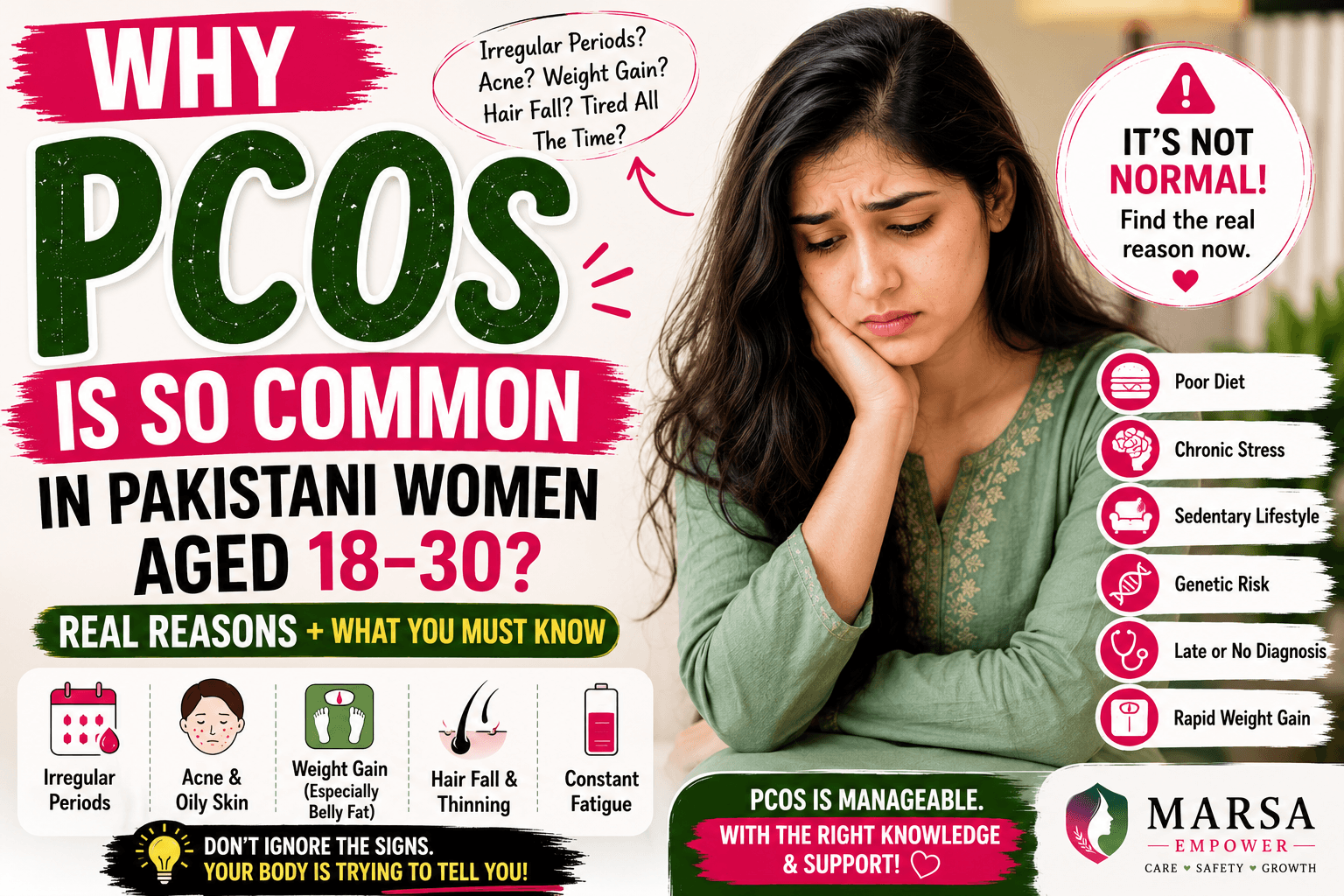
PCOS is increasingly common among Pakistani women aged 18–30. Discover the reasons behind its prevalence and effective ways to manage symptoms.

Maryam Mumtaz
Co-Founder & CEO
12 min read•7/3/2026
"PCOS is manageable. But only when it is identified, understood, and addressed."
Her periods are all over the place. Some months they come early. Some months they come late. Some months they barely come at all.
Her skin keeps breaking out — not just occasionally, but constantly. Around her chin, her jawline, her cheeks. She has tried every face wash. Nothing works for long.
Her weight keeps changing, even when she has not changed what she eats. She feels tired most of the time — a kind of tired that sleep does not fix.
When she finally mentions it to someone, she is told: "It is normal. It will settle. Just relax."
So she waits. And she tries to relax. And it does not settle.
Because nobody told her she might have PCOS.
PCOS stands for Polycystic Ovary Syndrome. It sounds complicated, but here is what it actually means in plain language:
Your body produces hormones — chemical messengers that tell different parts of your body what to do. In a healthy hormonal system, everything works in balance. But in PCOS, that balance is disrupted. Specifically:
Despite the name, PCOS does not always mean you have cysts on your ovaries. The "cysts" are actually small, undeveloped follicles — tiny sacs that were supposed to release an egg but did not, because ovulation did not happen that month. They are not dangerous in themselves, but they indicate that the hormonal system is not working as it should.
PCOS is one of the most common hormonal conditions in women of reproductive age worldwide — affecting approximately 1 in 10 women globally. But in Pakistan, and across South Asia more broadly, the rates are thought to be even higher — with some studies suggesting closer to 1 in 5 women may be affected.
Among Pakistani women aged 18 to 30 specifically, PCOS is especially prevalent. And yet — it remains one of the most under-diagnosed, least discussed, and most misunderstood health conditions in the country.
Many Pakistani women visit multiple doctors over several years before receiving a PCOS diagnosis. By the time they are finally told what is wrong, the condition has often been affecting their health, their confidence, and their daily life for years.
This is not about blame. It is about understanding the specific factors in Pakistani society, diet, and lifestyle that make PCOS particularly common — and particularly under-recognised — among young women today.
In the last twenty years, the typical diet in Pakistani cities has shifted dramatically. Home-cooked daal and sabzi has been increasingly replaced by — or supplemented with — fast food, packaged snacks, white bread, sugary drinks, biscuits, and processed meals.
Refined carbohydrates and sugar cause rapid spikes in blood sugar. To manage those spikes, the body produces insulin. When this happens repeatedly throughout the day, day after day, the body gradually becomes insulin resistant — meaning the cells stop responding to insulin properly, and the body has to produce more and more of it to do the same job.
High insulin levels directly trigger the ovaries to produce more androgens (male hormones). More androgens means more acne, more unwanted hair growth, more disrupted ovulation — and more PCOS.
The shift toward ultra-processed, high-sugar diets in Pakistani urban life is one of the biggest drivers of the PCOS epidemic among young women today.
Think about the pressures facing a Pakistani woman aged 18 to 30. Academic performance. Marriage pressure — either being pressured into it too early, or being asked constantly why it has not happened yet. Family expectations. Career competition. Social comparison. Financial stress. All of this creates chronic stress — not the occasional stressful day, but a sustained, ongoing state of pressure that never fully resolves.
When you are stressed, your body produces a hormone called cortisol. In small amounts, cortisol is useful — it sharpens focus and mobilises energy. But when cortisol is chronically high, it directly disrupts the hormonal system that regulates ovulation and reproduction. It worsens insulin resistance. It elevates androgen levels. It disrupts sleep — which further worsens hormonal balance.
Chronic stress does not just affect your mood. It affects your hormones at a biological level — and for young Pakistani women living with sustained social and family pressure, this is a significant PCOS risk factor.
The unique social pressures facing Pakistani women in their late teens and twenties — academic, marital, familial — create a chronic stress environment that directly disrupts the hormonal balance PCOS depends on.
Smartphones, streaming platforms, online study, desk jobs, and increased time indoors have made sedentary lifestyles the default for many young Pakistani women. This is not a criticism — it is a description of how modern life has changed.
Physical movement is one of the most powerful tools for improving insulin sensitivity — meaning it helps the body use insulin more effectively, which lowers insulin levels, which reduces the androgen excess that drives PCOS symptoms.
Even 30 minutes of walking per day produces measurable improvements in insulin sensitivity over time. It also reduces cortisol, improves sleep quality, supports a healthy weight, and directly benefits mood. None of these things require a gym membership or intense exercise — simply moving more throughout the day makes a real difference.
Regular physical movement is not just good for fitness. For women with PCOS or at risk of it, it is one of the most evidence-based hormonal interventions available — and one of the most accessible.
PCOS has a strong genetic component. If your mother, sister, aunt, or close female relative has PCOS — your own risk is significantly higher than average. This familial pattern is particularly pronounced in South Asian populations, including Pakistani families.
If PCOS runs in your family — even if it was never formally diagnosed, even if it was just described as "irregular periods" or "hormonal issues" — you should be aware that your own risk is elevated. This does not mean you will definitely develop PCOS. But it means paying attention to the warning signs earlier, tracking your cycle consistently, and seeking investigation sooner rather than later if symptoms appear.
Genetic predisposition is not destiny. But it is important information. Knowing your family history allows you to take preventive action early — before symptoms become established and difficult to manage.
In Pakistan, talking about periods, hormones, and reproductive health is still, for many women, surrounded by silence, embarrassment, or taboo. Young women are often not taught to recognise when their periods are irregular or what that might mean. Symptoms are normalised rather than investigated. Visiting a gynaecologist before marriage carries social stigma in some communities.
The result is that women with PCOS suffer for years — with acne, irregular cycles, weight struggles, fatigue, and mood changes — without anyone connecting these symptoms to a single, treatable underlying condition.
PCOS that is unmanaged over years does not simply stay the same. Untreated PCOS is associated with increased long-term risk of:
Early diagnosis does not just relieve current symptoms — it protects long-term health.
The cultural silence around reproductive health in Pakistan is one of the biggest obstacles to PCOS diagnosis. Breaking that silence — talking openly, seeking answers, demanding investigation — is an act of genuine self-care.
Puberty brings significant hormonal changes — and in the context of the dietary and lifestyle factors above, it also frequently brings rapid weight gain in young Pakistani women. This weight gain — particularly fat stored around the abdomen — directly worsens insulin resistance, which worsens androgen levels, which worsens PCOS.
It becomes a cycle: PCOS drives weight gain, weight gain worsens PCOS. And because the weight feels resistant to conventional dieting — because insulin resistance makes it so — many women conclude something is deeply wrong with them, without understanding the hormonal mechanism driving the difficulty.
Weight gain in PCOS is not a failure of willpower. It is a metabolic consequence of insulin resistance. Addressing the insulin resistance — through diet, movement, sleep, and where necessary, medication — is far more effective than simply trying to eat less.
PCOS presents differently in different women — not every woman will have every symptom. But if you recognise several of the following, it is worth discussing with a doctor:
| Symptom | What It Looks Like |
|---|---|
| Irregular periods | Cycles shorter than 21 or longer than 35 days, missed periods, unpredictable timing |
| Persistent acne | Deep, cystic breakouts around the jawline, chin, and cheeks that do not respond to skincare |
| Unexplained weight gain | Particularly around the abdomen, without obvious change in diet |
| Excess facial or body hair | Hirsutism — noticeable hair growth on the face, chest, stomach, or back |
| Scalp hair thinning | Particularly at the temples and crown |
| Persistent fatigue | Low energy that does not improve with rest |
| Mood changes | Anxiety, depression, irritability — particularly around the menstrual cycle |
| Skin darkening | Around the neck, underarms, or groin — a sign of insulin resistance |
| Difficulty conceiving | When trying for pregnancy without success |
You do not need to have all of these symptoms to have PCOS. Many women have only two or three. If you have irregular periods alongside any two other symptoms on this list — get tested.
PCOS is diagnosed using a combination of three criteria — and you only need two of the three to receive a diagnosis:
Managing PCOS does not require perfection. It requires consistency in a few key areas:
Even if you feel generally well, an annual blood test checking insulin, testosterone, thyroid function, and vitamin D gives you a clear, current picture of your hormonal health — and catches changes before they become problems.
Living with PCOS — particularly before diagnosis — takes a quiet but real toll on mental health. The unexplained acne, the unpredictable weight changes, the hair loss, the exhaustion, the irregular periods, the fertility concerns — each one is difficult alone. Together, they can create persistent anxiety, low self-esteem, and depression.
Research consistently shows that women with PCOS have significantly higher rates of anxiety and depression than women without it — not as a coincidence, but because the same hormonal imbalances that drive the physical symptoms also directly affect brain chemistry and mood regulation.
If you are struggling emotionally alongside physical PCOS symptoms — that is not weakness, and it is not separate from your PCOS. It is part of the same condition. And it deserves the same care and attention.
Managing PCOS means managing the whole picture — physical symptoms, metabolic health, and emotional wellbeing. You deserve support for all of it.
If you are reading this and recognising yourself in these symptoms — please know: you did not cause this. PCOS is not a consequence of laziness, weakness, or not trying hard enough. It is a complex hormonal condition shaped by genetics, environment, lifestyle, and factors largely outside your control.
What is within your control is what you do next. Getting informed. Getting tested. Getting support. Making the small, consistent changes that shift the hormonal environment in your favour. Refusing to normalise symptoms that deserve investigation.
PCOS is manageable. Thousands of Pakistani women are living well with it — with regular cycles, clear skin, stable weight, and good energy — because they found out what was happening in their bodies and took action.
You can too.
"PCOS does not define you. But understanding it empowers you — to feel better, live better, and take care of yourself the way you have always deserved."
This article is for educational and awareness purposes only. It does not constitute medical advice, diagnosis, or treatment. If you recognise symptoms of PCOS, please consult a qualified healthcare professional — including a gynaecologist or endocrinologist — for personalised evaluation and guidance.
MARSA Empower is an AI-powered women's empowerment platform offering private, multilingual tools for health, beauty, and safety. From 11 specialized AI health doctors and a personalized Beauty & Glow advisor to a built-in safety system with SOS alerts, MARSA helps women take charge of their wellbeing — accessibly and securely.
Medical Disclaimer
This article is for general informational and educational purposes only and is not a substitute for professional medical advice, diagnosis, or treatment. Always seek the advice of a qualified healthcare provider with any questions you may have regarding a medical condition. Never disregard professional medical advice or delay seeking it because of something you have read on MARSA Empower.
Written By
Maryam Mumtaz
Co-Founder & CEO
Co-Founder of MARSA Empower who leads the visual and strategic evolution of the platform. Maryam bridges technical complexity with human-centric design, architecting the team's official roadmap and ensuring MARSA effectively addresses the real-world needs of women. With deep expertise in agentic AI, full-stack development, and UI/UX design, she has delivered 50+ projects for 30+ satisfied clients.
Enjoyed this story?



