Explore the distinctions between PCOS and normal hormonal changes. Learn why recognizing the differences matters for effective health management.

Maryam Mumtaz
Co-Founder & CEO
15 min read•7/11/2026
🌸 Marsa Empower · Women's Hormonal Health · For Girls & Women Aged 13–30 · ~10 min read
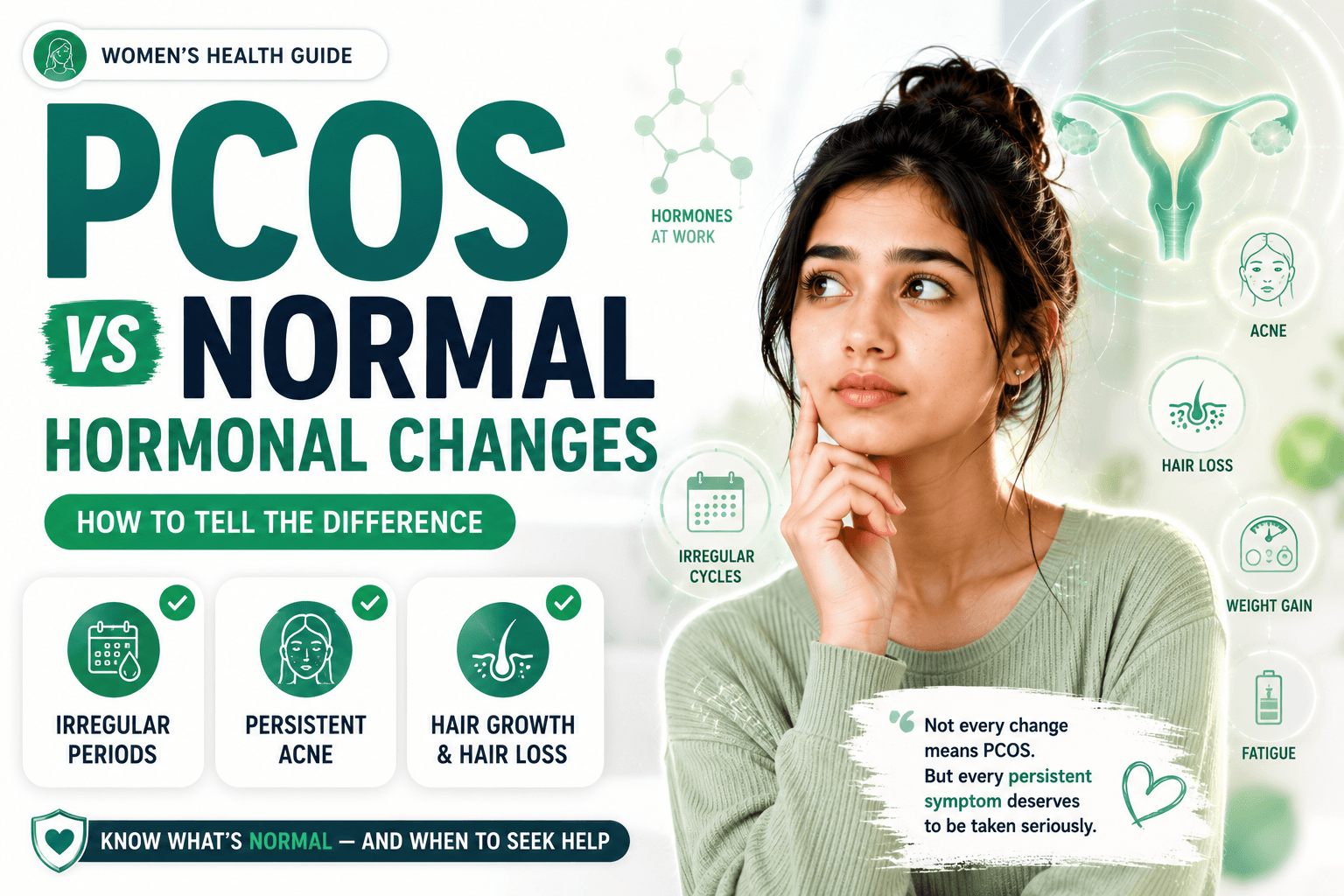
"Not every hormonal change means PCOS. But every persistent symptom deserves to be taken seriously."
| # | Section | Theme |
|---|---|---|
| 1 | Introduction — It Had a Name Nobody Told Her | 🌱 The Problem |
| 2 | What Are Normal Hormonal Changes? | ✅ Normal |
| 3 | What Is PCOS — And What Makes It Different? | 💡 Understanding |
| 4 | The Key Differences — Side by Side | 📊 Comparison |
| 5 | Periods — Normal vs PCOS | 🩸 Cycles |
| 6 | Acne — Normal vs PCOS | 🧴 Skin |
| 7 | Hair Loss — Normal vs PCOS | 💇 Scalp |
| 8 | Hair Growth — Normal vs PCOS | 🌱 Hirsutism |
| 9 | Weight — Normal vs PCOS | ⚖️ Metabolism |
| 10 | Energy & Blood Sugar — Normal vs PCOS | ⚡ Insulin |
| 11 | Can Teenagers Have PCOS? | 🌸 Age |
| 12 | Common PCOS Myths Corrected | ❌ Myths |
| 13 | When to Seek Medical Evaluation | ⚠️ Action |
She had irregular periods for two years. She was told it was normal — just puberty settling.
She had persistent acne she could not manage. She was told to wash her face more carefully.
She noticed hair growing where it never had before. Nobody connected any of it.
But it was all connected.
And it had a name she was never told.
PCOS — Polycystic Ovary Syndrome — is one of the most common hormonal conditions affecting women of reproductive age globally, estimated to affect 1 in 10 women worldwide and possibly more in South Asia. Yet it remains one of the most under-diagnosed conditions in women's health — largely because its symptoms closely resemble the normal hormonal changes every girl experiences during puberty and throughout her reproductive years.
This similarity is what makes PCOS so easy to miss — and so important to understand.
Knowing the difference between normal hormonal fluctuation and PCOS could save years of undiagnosed suffering, prevent long-term health complications, and give a girl the explanation she has been searching for without knowing where to look.
This guide draws that line clearly.
Hormones naturally fluctuate throughout life — particularly during puberty, throughout the menstrual cycle, and across different seasons and phases of a woman's life. These fluctuations produce real, noticeable physical and emotional effects that are entirely expected.
Understanding what is normal is the essential first step — because without this baseline, it is impossible to recognise when something has moved beyond normal into something that needs attention.
| Symptom | What Is Normal |
|---|---|
| 🧴 Acne | Occasional breakouts — particularly in the week before a period — that come and go |
| 😊 Mood changes | Mild mood swings that are predictable, cycle-linked, and resolve after menstruation |
| ⚖️ Weight fluctuations | Minor changes — typically 1–3 kg — linked to water retention and hormonal cycling |
| 🩸 Cycle variation | Slight variation in timing — especially in the first 2–3 years after menstruation begins |
| 🌸 Breast tenderness | Cyclical tenderness — typically in the second half of the cycle — that resolves with the period |
| ⚡ Appetite and energy shifts | Predictable changes in hunger, energy, and food preferences across the month |
💛 Key Insight
"Normal hormonal changes are the body working exactly as it should — cycling through a predictable monthly pattern of hormonal rise and fall. The symptoms are real, but they are temporary, manageable, and tied to a recognisable pattern. When symptoms stop being temporary and start being persistent — that is when the question of PCOS becomes relevant."
PCOS — Polycystic Ovary Syndrome — is a hormonal and metabolic condition that affects how the ovaries function. Despite the name, it does not necessarily involve cysts. The "cysts" referred to are actually small, undeveloped follicles — tiny fluid-filled sacs that contain immature eggs — which accumulate in the ovaries when ovulation does not occur regularly.
At its core, PCOS involves three interconnected disruptions:
| PCOS Core Feature | What It Means |
|---|---|
| 🔄 Irregular or absent ovulation | Eggs are not released regularly — causing unpredictable or absent periods |
| 📈 Elevated androgens | Higher than normal levels of testosterone and similar hormones — causing acne, hair changes, and cycle disruption |
| 🍬 Insulin resistance | Cells respond poorly to insulin — causing elevated insulin, which signals the ovaries to produce more androgens |
These three features create a self-reinforcing cycle: insulin resistance drives androgen excess, which disrupts ovulation, which alters hormonal patterns, which worsens insulin resistance. This is why PCOS produces such a wide range of seemingly unrelated symptoms — acne, irregular periods, hair changes, weight challenges, fatigue — that are all downstream effects of the same underlying hormonal disruption.
The key difference between PCOS and normal hormonal changes is not the type of symptom — it is the pattern of the symptom.
| Normal Hormonal Change | PCOS Pattern |
|---|---|
| Temporary | Persistent — lasting months or years |
| Manageable | Difficult to control or unresponsive to standard care |
| Cyclical and predictable | Irregular, unpredictable, or continuous |
| Mild to moderate | Moderate to severe |
| One or two symptoms | Multiple symptoms occurring simultaneously |
💛 Key Insight
"The question is never just 'do I have this symptom?' — it is 'has this symptom been persistent, progressive, and present alongside other symptoms?' A single irregular period during a stressful month is not PCOS. Consistently irregular or absent periods for six months alongside acne, excess hair growth, and fatigue — that pattern deserves investigation."
| Symptom | 🟢 Normal Hormonal Change | 🔴 PCOS Pattern |
|---|---|---|
| 🩸 Periods | Occasional mild irregularity · Settles within 2–3 years of menarche | Consistently absent · Extremely infrequent · Highly irregular long-term |
| 🧴 Acne | Occasional pre-period breakouts · Responsive to skincare | Persistent · Severe · Unresponsive to consistent skincare |
| 💇 Scalp Hair | Temporary shedding after stress or illness | Progressive thinning at temples and crown over time |
| 🌱 Body/Facial Hair | Light body hair consistent with genetic background | Noticeable growth on face · chin · chest · stomach · back (hirsutism) |
| ⚖️ Weight | Minor fluctuations with hormonal cycle | Persistent difficulty managing weight despite healthy habits |
| ⚡ Energy | Predictable energy dips around menstruation | Significant instability linked to insulin resistance |
| 🧠 Mood | Cycle-linked mood changes that resolve post-period | Persistent anxiety or depression not tied to cycle alone |
| 🩺 Blood Sugar | Normal glucose regulation | Insulin resistance — fasting glucose or insulin may be elevated |
The menstrual cycle is the most sensitive barometer of hormonal health — and the most important symptom to understand when distinguishing normal hormonal fluctuation from PCOS.
It is normal for cycles to be irregular in the first 1–2 years after menarche — because the hormonal axis is still maturing. But if cycles remain consistently irregular or absent beyond the first 2 years, or if they were regular and then become persistently irregular, evaluation is warranted.
💛 Key Insight
"Early puberty irregularity is normal and expected. Persistent irregularity beyond the first 2 years of menstruation — or irregularity that arrives alongside other symptoms — is the pattern that warrants investigation."
In PCOS, elevated androgens continuously stimulate oil gland activity — meaning the hormonal driver of breakouts is present every day, not just premenstrually. This is why PCOS-related acne is persistent rather than cyclical, and why it does not respond to standard skincare in the way normal hormonal acne does.
💛 Key Insight
"Acne that has been present for years, that does not respond to skincare, that is consistently cystic and concentrated along the lower face — is not a skincare problem. It is a hormonal signal, and it deserves a hormonal investigation."
💛 Key Insight
"The hallmark of PCOS-related hair loss is the pattern — crown and temple thinning that worsens progressively. This is distinct from the diffuse, temporary shedding of telogen effluvium, and distinct from the eyebrow and diffuse thinning of thyroid dysfunction. Investigating the cause determines the correct treatment."
Unwanted facial and body hair is one of the most emotionally distressing PCOS symptoms — and one of the most silently managed. Many women spend years removing unwanted hair without knowing it is a medical symptom pointing to a diagnosable and treatable condition. The shame around discussing it keeps it hidden — and keeps the diagnosis delayed.
💛 Key Insight
"Hirsutism is not a cosmetic inconvenience. It is a clinical sign of elevated androgens — and one of the most important indicators a doctor needs to know about. If you are managing unwanted facial or body hair and have other symptoms on this list, please tell your doctor. It matters more than you may realise."
In PCOS, insulin resistance means the body produces more insulin than it should to manage blood sugar. High insulin signals the ovaries to produce more androgens, promotes fat storage (particularly abdominal), and makes it significantly harder for the body to use stored fat for energy. This is a metabolic challenge — not a willpower failure.
💛 Key Insight
"Difficulty managing weight in PCOS is not a personal failure. It is a metabolic consequence of insulin resistance — a condition that makes the body's energy regulation system work against standard weight management efforts. Addressing the insulin resistance is far more effective than simply trying harder to diet."
Insulin resistance means glucose cannot enter cells efficiently. The cells are starved of energy even when blood sugar is technically present — causing persistent fatigue, strong carbohydrate cravings, and post-meal energy crashes. This is a metabolic reality, not a lifestyle choice.
💛 Key Insight
"Consistent post-meal energy crashes, relentless carbohydrate cravings, and fatigue that sleep does not fix — especially alongside other symptoms on this list — are worth investigating for insulin resistance. A fasting glucose and fasting insulin test can reveal this quickly."
Yes. PCOS can and does develop during the teenage years. In fact, many women who are eventually diagnosed with PCOS in their twenties or thirties had symptoms that began — unrecognised — during adolescence.
The challenge is that many PCOS symptoms genuinely overlap with normal puberty:
| Symptom | Normal Puberty | Could Also Be PCOS |
|---|---|---|
| 🩸 Irregular periods | Common in first 1–2 years | Persistent beyond 2 years |
| 🧴 Acne | Very common | Severe · persistent · unresponsive |
| ⚖️ Weight changes | Normal during development | Progressive · abdominal · resistant |
| 😊 Mood changes | Normal adolescent emotional development | Persistent · disproportionate |
When PCOS goes undiagnosed and unmanaged during the teenage years, the condition does not simply wait quietly. Untreated PCOS during adolescence is associated with:
Early identification — even if formal diagnosis requires waiting until cycles are more established — allows early lifestyle intervention that measurably changes long-term outcomes.
💛 Key Insight
"A teenage girl with persistent irregular periods, ongoing severe acne, and noticeable excess hair growth does not need to be told 'wait and see — it is probably just puberty.' She needs to be evaluated — because early action produces dramatically better long-term outcomes than delayed diagnosis."
| ❌ The Myth | ✅ The Truth |
|---|---|
| "Every girl with irregular periods has PCOS" | Irregular periods have many causes — stress, thyroid dysfunction, nutritional deficiency, extreme exercise. PCOS is one of several possible explanations, not the only one |
| "PCOS only affects older women" | PCOS regularly begins in the teenage years and is common among women in their early twenties |
| "PCOS is only about periods" | PCOS affects metabolism, insulin regulation, skin, hair, mental health, cardiovascular health, and fertility — it is a whole-body hormonal and metabolic condition |
| "You must have cysts to have PCOS" | The name is misleading — the "cysts" are small undeveloped follicles, and not all women with PCOS have them on ultrasound |
| "PCOS means you cannot get pregnant" | PCOS affects fertility but does not make pregnancy impossible. Many women with PCOS conceive naturally or with appropriate medical support |
| "Losing weight cures PCOS" | Weight management supports PCOS management significantly — but PCOS is not caused by weight alone, and lean women also develop PCOS |
| "PCOS goes away after menopause" | The reproductive symptoms resolve, but the metabolic components — insulin resistance, cardiovascular risk — continue and require management throughout life |
Seek evaluation from a gynaecologist or endocrinologist if you experience any of the following:
| Signal | What It Warrants |
|---|---|
| 🩸 Periods consistently absent or fewer than 8 per year | Hormonal evaluation — PCOS screening |
| 🌱 Noticeable facial or body hair in androgen-sensitive areas | Androgen testing — testosterone, DHEAS |
| 🧴 Severe acne unresponsive to consistent skincare | Hormonal panel — androgens, insulin |
| 💇 Progressive scalp hair thinning | Full hormonal and nutritional evaluation |
| ⚖️ Persistent weight difficulty despite healthy habits | Fasting glucose, insulin, hormonal panel |
| ⚡ Significant post-meal energy crashes and cravings | Fasting glucose and insulin testing |
| 🌸 Multiple symptoms from this list occurring simultaneously | Comprehensive PCOS evaluation |
| Test | What It Checks |
|---|---|
| 🩸 Full Blood Count + Ferritin | Rules out anaemia as a cause of fatigue |
| 🦋 TSH + Free Thyroid Hormones | Rules out thyroid dysfunction |
| 🌸 LH, FSH, Oestrogen, Progesterone | Assesses reproductive hormonal balance |
| ⚡ Testosterone + DHEAS | Measures androgen levels |
| 🍬 Fasting Glucose + Fasting Insulin | Assesses insulin resistance |
| ☀️ Vitamin D + B12 | Nutritional markers often disrupted in PCOS |
| 🔬 Pelvic Ultrasound | Assesses ovarian appearance and uterine health |
The difference between normal hormonal changes and PCOS is not always dramatic. It is often subtle — a matter of persistence, of pattern, of multiple symptoms occurring together rather than one symptom in isolation.
This subtlety is precisely what makes PCOS so easy to miss — and why so many women spend years receiving partial answers, inadequate reassurance, and the quiet instruction to simply endure what their body is experiencing.
You deserve more than that.
You deserve to know the difference between what is normal and what is not. You deserve to have your persistent symptoms investigated rather than normalised. You deserve an accurate diagnosis — and with it, access to management strategies that actually address what is happening in your body rather than treating each symptom as an unrelated problem.
Not every hormonal change means PCOS.
But every persistent symptom deserves to be taken seriously.
"She was not dramatic. Her skin was not dirty. Her body was not broken. She had PCOS — a real, identifiable, manageable condition — and she deserved to know that from the beginning."
📌 Educational Disclaimer
This article is for educational and awareness purposes only. It does not constitute medical advice, diagnosis, or treatment. If you recognise a pattern of persistent symptoms described in this article, please consult a qualified gynaecologist or endocrinologist for personalised evaluation. Early assessment leads to significantly better outcomes.
© Marsa Empower · Women's Hormonal Health · PCOS Awareness · Education & Empowerment
Medical Disclaimer
This article is for general informational and educational purposes only and is not a substitute for professional medical advice, diagnosis, or treatment. Always seek the advice of a qualified healthcare provider with any questions you may have regarding a medical condition. Never disregard professional medical advice or delay seeking it because of something you have read on MARSA Empower.
Written By
Maryam Mumtaz
Co-Founder & CEO
Co-Founder of MARSA Empower who leads the visual and strategic evolution of the platform. Maryam bridges technical complexity with human-centric design, architecting the team's official roadmap and ensuring MARSA effectively addresses the real-world needs of women. With deep expertise in agentic AI, full-stack development, and UI/UX design, she has delivered 50+ projects for 30+ satisfied clients.
Enjoyed this story?