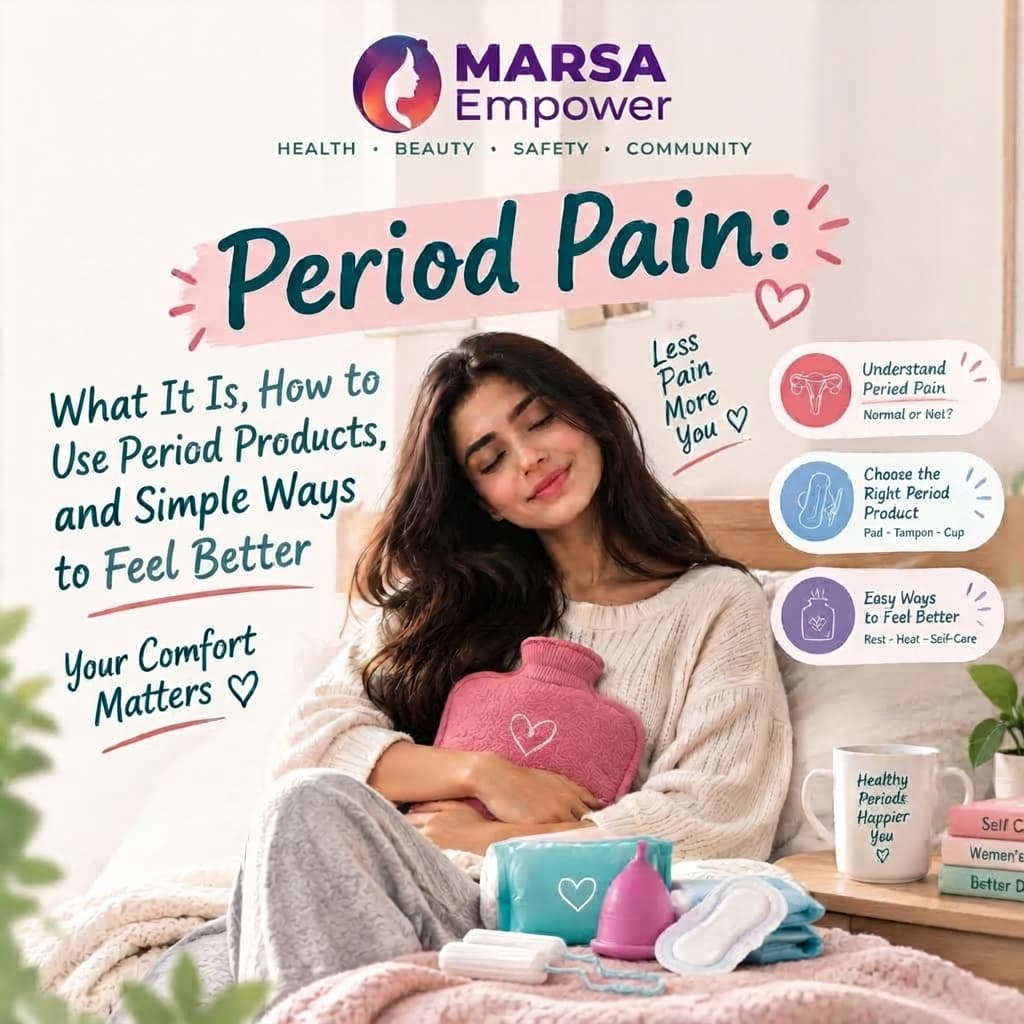
Getting your first period can be confusing. Learn about period pain, how to use period products in Pakistan, and easy ways to feel better.

Maryam Mumtaz
Co-Founder & CEO
11 min read•7/15/2026
Marsa Empower · First Period Guide · For Girls & Women of All Ages · 10 min read
"Getting your period is one of the most natural things your body will ever do. Once you understand it — it stops being scary and starts making complete sense."
Every month, your body prepares itself for the possibility of pregnancy. To do this, the uterus — the organ inside your lower abdomen — builds up a soft lining. When pregnancy does not happen, the body sheds that lining. That shedding is what we call a period.
The blood and tissue leave the body through the vagina over the course of a few days. This is completely natural, completely normal, and happens to girls and women all over the world every single month.
A period is not a sign that something is wrong. It is a sign that your body is working exactly the way it was designed to.
Most periods last between 3 and 7 days. Some girls have shorter periods of 2 to 3 days. Some have slightly longer ones. Both are normal as long as the pattern is consistent for you.
A typical menstrual cycle is 21 to 35 days — counted from the first day of one period to the first day of the next. For most girls, this means a period roughly once a month. In the first year or two after starting, cycles can be irregular — sometimes coming early, sometimes late. This is normal while the body is still finding its rhythm.
Most girls get their first period between the ages of 9 and 16. The average age is around 12 or 13 — but there is no single "right" age. Some girls start earlier. Some start later. Both are completely normal.
Your first period will usually arrive about 2 years after your breasts begin to develop and often around the same time as pubic hair and underarm hair appear. These are the body's natural signals that menstruation is approaching.
A helpful tip: It is a good idea to carry a sanitary pad in your school bag once you notice these signs — so you are prepared whenever your first period arrives, wherever you are.
Every girl's experience is different. Some periods are barely noticeable. Others come with cramping, tiredness, and mood changes that can feel overwhelming — especially in the beginning.
The flow of blood varies throughout the period. The first day or two is often the heaviest. By day 3 or 4, the flow typically lightens, and by day 5 to 7, it usually stops entirely. The colour of the blood can range from bright red to dark brown — all of which is normal at different points during your period.
Most girls experience at least some of these symptoms in the days before or during their period:
| Symptom | Where You Feel It | Why It Happens |
|---|---|---|
| Cramps | Lower stomach or back | The uterus contracting to shed its lining |
| Back pain | Lower back | Cramping muscles radiating downward |
| Tiredness | All over the body | Hormonal shifts and blood loss |
| Mood changes | Emotionally | Oestrogen and progesterone falling before the period |
| Headaches | Head and temples | Hormonal fluctuations affecting blood vessels |
| Bloating | Stomach area | Fluid retention from hormonal changes |
| Breast tenderness | Chest | Progesterone changes in the days before the period |
| Nausea | Stomach | Prostaglandins — the chemicals that cause cramping |
Not every girl experiences all of these. Some girls have very mild symptoms. If your symptoms are severe enough to stop you from going to school or doing everyday activities, it is worth speaking to a doctor.
There are several period products available in Pakistan. Understanding each one helps you choose what works best for your body, your lifestyle, and your comfort level.
Best for: Beginners · All flow levels · Everyday use
Sanitary pads are the most widely used period product in Pakistan — and the most beginner-friendly. They are worn inside the underwear and absorb menstrual blood as it leaves the body. No insertion is required, making them the most comfortable starting point for most girls.
Popular brands available in Pakistan:
| Brand | What to Know |
|---|---|
| Always | Widely available · Multiple thickness options · Good for medium to heavy flow |
| Butterfly | Very common in Pakistan · Affordable · Available at most pharmacies and stores |
| Trust | Budget-friendly option · Widely stocked in local shops |
| Sincere | Available in many supermarkets and medical stores |
Types of pads:
Best for: Very light flow · Spotting · The last day of your period · Discharge between periods
Panty liners are thinner and smaller than regular pads. They are not designed for heavy flow but are perfect for the beginning or end of your period when the flow is very light, or for the spotting some girls notice between periods.
They work exactly the same way as a pad — peel off the backing and stick inside your underwear.
Best for: Swimming · Physical activity · Girls who prefer internal protection
Tampons are inserted inside the vagina to absorb blood internally. They are less commonly used by younger girls in Pakistan and can feel unfamiliar at first, but they are entirely safe and widely used around the world.
Key points about tampons:
Best for: Environmental sustainability · Long-term cost saving · Older teens and adults comfortable with insertion
A menstrual cup is a small, flexible silicone cup that is inserted into the vagina to collect — rather than absorb — menstrual blood. It can be worn for up to 12 hours, is reusable for years, and produces no waste.
Menstrual cups have a steeper learning curve than pads or tampons but are increasingly popular among women who want a more sustainable, cost-effective option. They are available through online stores in Pakistan.
| If You Are... | Try... |
|---|---|
| Getting your period for the first time | Regular sanitary pad with wings |
| Experiencing heavy flow | Maxi or overnight pad |
| Going swimming or playing sport | Tampon |
| On the last day of your period | Panty liner |
| Looking for an eco-friendly option | Menstrual cup |
Using a sanitary pad correctly is simple. Follow these steps:
Step 1 — Wash your hands Always wash your hands before and after handling period products.
Step 2 — Take the pad out of its wrapper Open the individual wrapper carefully. The pad has two sides — the soft cotton side that touches your skin, and the adhesive (sticky) side that attaches to your underwear.
Step 3 — Peel off the backing paper On the sticky side, there will be a paper strip covering the adhesive. Peel it away completely. If the pad has wings, there will be separate paper strips on the wings too — remove those as well.
Step 4 — Place the pad in your underwear Press the sticky side firmly onto the inside of your underwear, in the centre, lining up with where it needs to sit. If there are wings, fold them around the outside edges of the underwear and press them down so the pad stays in place.
Step 5 — Check it is secure The pad should lie flat and feel comfortable. If it feels bunched or uncomfortable, reposition it.
Step 6 — Change the pad regularly Change your pad every 4 to 6 hours — or sooner if it feels full. On heavy flow days, you may need to change it every 2 to 3 hours. Never leave a pad on all day without changing it, as this can cause irritation and odour.
Step 7 — Dispose of used pads properly Wrap the used pad in its wrapper or in toilet paper and place it in a bin. Never flush pads down the toilet — they can block drains and plumbing.
Panty liners work exactly like pads — peel, stick, change. The only difference is that they are thinner and smaller. Change a panty liner every 4 to 6 hours or when it feels damp.
Period pain — known medically as dysmenorrhea — is one of the most common symptoms of menstruation. Understanding why it happens helps you manage it better.
During your period, the uterus contracts — squeezes — to help push the lining out. These contractions are caused by chemicals called prostaglandins. The higher the prostaglandin levels, the stronger the contractions — and the more pain is produced.
The pain is most often felt as cramping in the lower abdomen — sometimes radiating into the lower back and upper thighs. It typically starts just before the period begins and is worst in the first 1 to 2 days, when flow is heaviest and prostaglandin levels are highest. By day 3 or 4, pain usually decreases significantly.
Primary dysmenorrhea is pain caused by the normal contractions of the uterus — not by any underlying condition. This is what most girls experience, and it often improves with age and after childbirth.
Secondary dysmenorrhea is period pain caused by an underlying condition such as endometriosis or fibroids. This type tends to be more severe, may worsen over time, and requires medical evaluation and management.
Most period pain can be managed effectively at home with the following approaches:
Applying warmth to the lower abdomen is one of the most effective — and most immediate — ways to relieve period cramps. Heat relaxes the uterine muscles, reduces the intensity of contractions, and improves blood flow to the area.
How to use it: Fill a hot water bottle with warm (not boiling) water and place it on your lower stomach. A warm, damp cloth works too. Apply for 15 to 20 minutes at a time, and repeat as needed. You can use heat therapy while resting, reading, or watching something — it does not require any preparation.
Studies have shown that heat therapy can be as effective as pain medication for mild to moderate period cramps.
Over-the-counter pain medications can be very effective for period pain, particularly when taken at the first sign of cramping rather than waiting until the pain is severe.
Ibuprofen (available as Brufen in Pakistan) works particularly well for period pain because it reduces prostaglandin production — meaning it addresses the chemical cause of cramping directly, not just the sensation of pain. Take it with food.
Paracetamol (Panadol) is a milder option that reduces pain but does not address prostaglandins directly. It works best for mild cramps.
Always follow the dosage instructions on the packaging. If you are not sure which medication is right for you, ask a pharmacist.
It can feel counterintuitive to move when you are in pain, but gentle physical activity releases endorphins — the body's natural pain-relieving chemicals. Even a short, slow walk can measurably reduce the intensity of cramping.
Good options during your period:
Avoid very intense exercise on the first day if your pain is severe — but do not feel you need to be completely still.
Your body is doing significant work during your period — hormonal shifts, uterine contractions, and blood loss all require energy. Giving yourself permission to rest, particularly in the first 1 to 2 days, supports your body's recovery.
A warm bed, a hot water bottle, and adequate sleep are not indulgences during your period. They are appropriate, evidence-based self-care.
Drinking enough water helps reduce bloating, supports blood circulation, and reduces the intensity of cramps. Warm drinks — warm water with lemon, herbal teas, or warm milk — are particularly soothing for some girls during their period.
Avoid very cold drinks during your period if you find they worsen cramping — some girls notice this sensitivity.
Massaging the lower abdomen in small, gentle circular motions can help relax uterine muscles and improve blood flow. Using a few drops of a warm oil (coconut oil works well) can make this more comfortable and effective.
What you eat during your period can make a meaningful difference to how you feel. These are the most important nutritional guidelines:
| Food | Why It Helps |
|---|---|
| Dark leafy greens (spinach, methi) | High in iron — replaces iron lost through menstrual blood |
| Lentils and beans (daal) | Good plant-based iron source |
| Bananas | Potassium helps reduce bloating and cramping |
| Ginger tea | Natural anti-inflammatory — reduces prostaglandin activity |
| Warm milk | Calcium helps reduce muscle cramping |
| Nuts and seeds | Magnesium supports muscle relaxation |
| Water and herbal teas | Reduces bloating and supports blood flow |
| Eggs and meat | Protein and iron for energy and blood replenishment |
| Food | Why to Limit It |
|---|---|
| Salty snacks and processed food | Increases water retention and worsens bloating |
| Sugary drinks and sweets | Causes blood sugar spikes followed by energy crashes |
| Caffeine (too much) | Can increase anxiety, worsen cramps, and disrupt sleep |
| Very cold foods and drinks | May worsen cramping in some girls |
| Fried and heavy foods | Can worsen nausea and digestive discomfort |
You do not need to follow a strict diet during your period — eating balanced, regular meals and staying hydrated is the most important thing.
Most period pain and symptoms are normal and manageable at home. However, there are situations where seeing a doctor is important — and these should never be dismissed or delayed.
See a doctor if:
These symptoms can sometimes indicate conditions such as endometriosis, PCOS, fibroids, or iron deficiency anaemia — all of which are treatable when identified early.
There is no such thing as "too dramatic" when it comes to your period. If something about your period does not feel right, it is always appropriate to ask a healthcare professional about it.
Every girl benefits from having a small period kit ready — whether in a school bag, handbag, or bathroom cabinet. Here is what to include:
| Item | Purpose |
|---|---|
| 2 to 3 sanitary pads (regular and overnight) | Day and night protection |
| 1 to 2 panty liners | Light flow and discharge days |
| Small zip-lock bag or pouch | To keep products private and clean |
| Paracetamol or ibuprofen | For cramps when they start |
| A small hot water bottle (at home) | Heat therapy for cramping |
| Period tracking app or calendar | To track your cycle and predict your next period |
Tracking your period is one of the most useful habits you can build from the very beginning. Recording when your period starts, how long it lasts, how heavy the flow is, and what symptoms you experience gives you:
You can track your period in a notebook, on a calendar, or by using a period tracking app.
Getting your first period — or learning to understand the one you already have — can feel confusing, uncomfortable, and sometimes embarrassing. That is understandable. It is a big change, and many girls are not given the information they need to feel prepared and confident.
But here is what is true: your period is one of the most natural things your body will ever do. Every woman who has ever lived has experienced it. Every girl going through it alongside you is navigating the same questions, the same uncertainty, and the same cramping on cold mornings.
You are not alone in this. And the more you understand about your period — what it is, what to expect, and how to take care of yourself during it — the less power it has to catch you off guard.
"Your period is not something that happens to you. It is something your body does for you — a monthly sign of health, hormonal function, and the remarkable capacity of the female body to care for itself."
Educational Disclaimer
This article is for educational purposes only and does not constitute medical advice. If you have concerns about your period or menstrual health, please speak with a qualified healthcare professional.
Marsa Empower · Period Health · First Period Guide · Women's Health Education
Medical Disclaimer
This article is for general informational and educational purposes only and is not a substitute for professional medical advice, diagnosis, or treatment. Always seek the advice of a qualified healthcare provider with any questions you may have regarding a medical condition. Never disregard professional medical advice or delay seeking it because of something you have read on MARSA Empower.
Written By
Maryam Mumtaz
Co-Founder & CEO
Co-Founder of MARSA Empower who leads the visual and strategic evolution of the platform. Maryam bridges technical complexity with human-centric design, architecting the team's official roadmap and ensuring MARSA effectively addresses the real-world needs of women. With deep expertise in agentic AI, full-stack development, and UI/UX design, she has delivered 50+ projects for 30+ satisfied clients.
Enjoyed this story?



