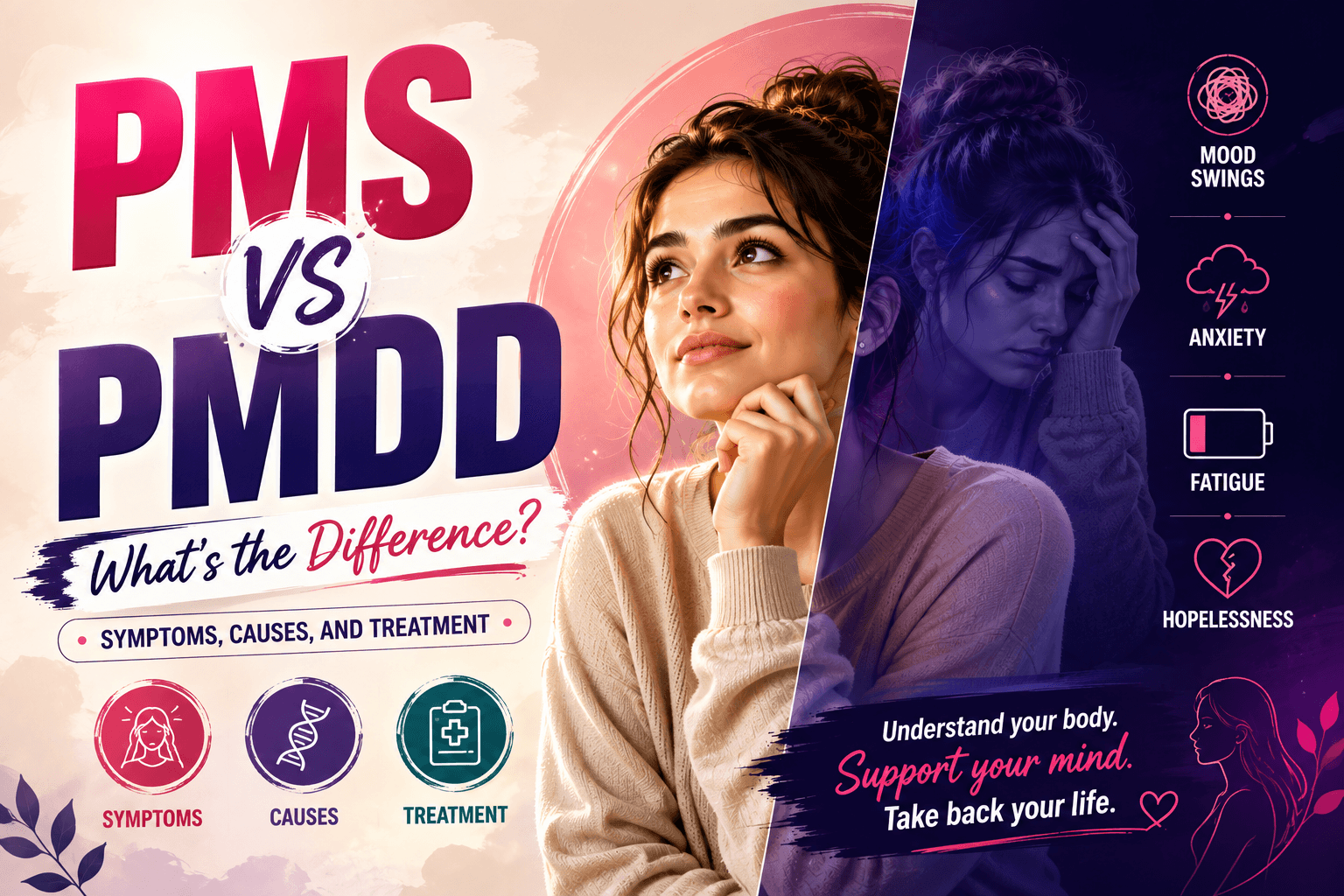
Explore the critical differences between PMS and PMDD, their symptoms, causes, and treatment options to better manage your health.

Maryam Mumtaz
Co-Founder & CEO
12 min read•8/28/2026
Marsa Empower · Menstrual Health & Women's Wellness · For Girls & Women Aged 13 and Above · 12 min read
Most women experience some degree of physical or emotional changes in the days before their period. Mild bloating. Tiredness. A lower threshold for irritation. Breast tenderness. These experiences are so common that many women consider them a normal, unavoidable part of their menstrual cycle.
For some women, however, the changes before a period go far beyond mild discomfort. Mood changes become severe. Sadness or anxiety become overwhelming. Anger or emotional reactivity feel entirely disproportionate and impossible to manage. Work becomes difficult. Relationships become strained. And every month, in the days leading up to the period, life becomes significantly harder than it should be.
Understanding the difference between PMS and PMDD, recognising which pattern fits your experience, and knowing when symptoms cross the line from common to clinically significant is the starting point of getting appropriate support. That is what this guide explains.
PMS stands for Premenstrual Syndrome. It is a cluster of physical and emotional symptoms that occur in the luteal phase of the menstrual cycle, typically in the one to two weeks before a period begins. Symptoms generally improve shortly after the period starts, as hormone levels shift.
PMS is extremely common. Estimates suggest that between 75 and 90 percent of women who menstruate experience at least some premenstrual symptoms during their reproductive years. For most of these women, symptoms are mild to moderate, manageable, and do not significantly prevent them from carrying out their daily activities.
The symptoms of PMS are real and physiological. They are not imagined, exaggerated, or a sign of emotional weakness. They reflect the hormonal changes of the luteal phase, which affect multiple body systems including the digestive system, the nervous system, and the brain's mood-regulating pathways.
PMDD stands for Premenstrual Dysphoric Disorder. It is a distinct medical condition that shares some features with PMS but differs significantly in the severity and impact of its symptoms, particularly the emotional and psychological ones.
PMDD involves severe premenstrual symptoms that are intense enough to significantly impair a woman's ability to function in her daily life, her work or studies, her relationships, and her overall wellbeing. These symptoms follow a predictable pattern tied to the menstrual cycle, and they typically resolve within a few days after the period begins.
PMDD is significantly less common than PMS, affecting approximately 3 to 8 percent of women of reproductive age. It is recognised as a clinical condition in major medical diagnostic frameworks and has evidence-based treatment options.
The most important thing to understand about PMDD is that it is not simply "really bad PMS." It is a distinct condition that deserves recognition, proper diagnosis, and appropriate medical management.
The most important difference between PMS and PMDD is not the type of symptoms but their severity and their impact on daily functioning.
Both conditions involve premenstrual symptoms tied to the menstrual cycle. Both typically improve after the period begins. Both involve physical and emotional components.
What distinguishes PMDD from PMS is that in PMDD, the symptoms, particularly the mood-related symptoms, are severe enough to meaningfully disrupt the person's life. A woman with PMDD does not simply feel irritable or emotional. She may find that her relationships are damaged, her work suffers, her ability to manage everyday responsibilities is impaired, and the days before her period feel genuinely unbearable.
This distinction matters because it determines the appropriate response. PMS symptoms are often managed effectively through lifestyle approaches. PMDD typically requires professional medical assessment and treatment.
PMS can cause both physical and emotional symptoms in the one to two weeks before a period.
Bloating: Fluid retention in the days before a period can cause visible abdominal bloating and a feeling of fullness or heaviness in the abdomen. This is one of the most universally reported premenstrual physical symptoms.
Breast tenderness: The breasts may feel swollen, sore, or tender to touch, driven by progesterone's effects on breast tissue in the luteal phase.
Cramps: Some women experience mild cramping before the period begins, as early uterine activity in preparation for menstruation starts.
Headaches: Hormonal headaches are common in the premenstrual phase, driven by the fluctuating oestrogen levels of the late luteal period.
Fatigue: Progesterone has a mildly sedating effect that increases in the luteal phase, and the hormonal shifts of late luteal can impair sleep quality, producing increased tiredness.
Food cravings: Cravings, particularly for sweet or carbohydrate-rich foods, are common premenstrually. Serotonin levels fall as oestrogen declines, and carbohydrate intake temporarily raises serotonin, making the cravings a neurochemically driven response.
Mood changes: Mild irritability, lower emotional resilience, or feeling more easily upset than usual in the premenstrual days is extremely common. This reflects oestrogen's influence on serotonin activity, which reduces as oestrogen falls before the period.
Feeling emotional: Being more tearful or sensitive than usual is a recognised and very common PMS experience.
Difficulty concentrating: Some women find it harder to sustain focus or feel mentally foggier in the premenstrual days.
For most women with PMS, these symptoms are noticeable but manageable. They do not prevent normal daily activities even though they cause discomfort.
PMDD shares some symptoms with PMS but the emotional and psychological symptoms are the defining feature of PMDD and are significantly more severe.
Severe irritability or anger: Not mild impatience but intense, disproportionate anger that may be directed at family members, colleagues, or partners. Many women with PMDD describe feeling unlike themselves during these episodes, aware that their reactions are excessive but unable to modulate them.
Significant mood swings: Rapid, unpredictable shifts in emotional state that are difficult to manage or explain.
Intense sadness: A depth of sadness that goes well beyond mild emotional sensitivity. Some women describe feeling genuinely hopeless or as though things will never improve during premenstrual episodes.
Anxiety or tension: Significant anxiety, worry, or a feeling of being on edge that is disproportionate to circumstances. Some women describe a physical sense of tension or dread in the premenstrual days.
Feeling overwhelmed: The ordinary demands of daily life, things that feel manageable during the rest of the month, feel impossible to cope with in the premenstrual phase.
Reduced interest in normal activities: Activities or relationships that are normally enjoyable feel flat or meaningless premenstrually. This is sometimes described as a temporary, cyclical low mood that mirrors the features of depression.
Feeling hopeless: A sense that things will not improve, which resolves after the period begins. This pattern, hopelessness that is clearly cyclical and tied to the menstrual cycle, is one of the most significant PMDD features.
Difficulty concentrating: More significant than the mild cognitive effects of PMS. Sustained attention, memory, and cognitive performance are noticeably impaired.
Changes in sleep: Either difficulty falling or staying asleep, or sleeping much more than usual during the premenstrual phase.
Changes in appetite: Significant changes in hunger, food intake, or food cravings beyond the milder cravings of PMS.
Physical symptoms similar to PMS: Bloating, breast tenderness, headaches, and cramps may also occur alongside the emotional symptoms.
The defining criterion that separates PMDD from PMS is that these symptoms cause significant impairment in daily life, including work, relationships, social activities, or everyday functioning.
| Feature | PMS | PMDD |
|---|---|---|
| How common it is | Very common (75 to 90% of women) | Less common (3 to 8% of women) |
| Type of symptoms | Physical and emotional | Physical and emotional, with severe mood and psychological symptoms |
| Severity | Mild to moderate | Moderate to severe |
| Impact on daily life | Usually manageable | Can significantly disrupt work, relationships, and daily activities |
| Mood symptoms | Mild irritability, feeling emotional | Severe irritability, intense sadness, anxiety, feeling hopeless |
| When symptoms occur | Luteal phase, 1 to 2 weeks before period | Luteal phase, typically 1 to 2 weeks before period |
| When symptoms resolve | Shortly after period begins | Within a few days of period beginning |
| Treatment needed | Lifestyle approaches often helpful | Professional assessment and treatment usually needed |
| Clinical diagnosis | Not always formally diagnosed | A recognised medical condition with specific diagnostic criteria |
Both PMS and PMDD symptoms occur during the luteal phase of the menstrual cycle, which begins after ovulation and continues until the period begins. In a 28-day cycle, this is roughly from day 15 onward, with symptoms typically most intense in the five to seven days immediately before the period.
In PMDD specifically, the most severe symptoms usually occur in the week before menstruation, though some women begin experiencing symptoms closer to ovulation, meaning symptoms may be present for ten to fourteen days before the period.
The key diagnostic feature of both conditions is that symptoms reliably resolve within a few days of the period beginning and are absent or minimal in the first half of the cycle. This cyclical pattern, clear presence in the luteal phase and clear absence in the follicular phase, is what distinguishes PMS and PMDD from other mood disorders that do not follow this pattern.
For women with PMS, the impact on daily life is real but generally manageable. She may feel more tired, more irritable, or more emotionally reactive for several days, but she can still attend school or work, manage her relationships, and carry out her normal responsibilities, even if they feel harder than usual.
For women with PMDD, the impact can be much more significant. In the premenstrual phase, she may:
Find that her relationships are repeatedly strained by mood episodes she cannot fully control. Miss work, school, or important events because the psychological symptoms make functioning too difficult. Feel that the days before her period are so consistently distressing that she dreads their approach each month. Make significant decisions or have significant conflicts during the premenstrual phase that she later regrets or would not have acted on at another point in her cycle. Experience a pattern of months where a significant portion of her time is spent managing severe symptoms.
This level of cyclical impairment is not something a woman should simply accept or be told to manage with lifestyle changes alone. PMDD is a clinical condition that responds to appropriate medical treatment, and women with PMDD deserve access to that treatment.
The exact mechanisms underlying both PMS and PMDD are not completely understood, but research points to several contributing factors.
Both conditions are tied to the hormonal changes of the luteal phase, particularly the rise and fall of progesterone and oestrogen after ovulation. However, women with PMDD do not necessarily have abnormal hormone levels compared to women without PMDD.
The current evidence suggests that PMDD involves an increased sensitivity of the brain to the normal hormonal changes of the menstrual cycle, particularly to progesterone and its metabolites, which interact with GABA receptors in the brain. GABA is the brain's primary inhibitory neurotransmitter, producing calm and reduced anxiety. In women with PMDD, the brain appears to respond abnormally to progesterone-related compounds that would normally support calm, producing anxiety and mood disruption instead.
Serotonin, the neurotransmitter most closely associated with mood stability, is influenced by oestrogen. As oestrogen falls in the late luteal phase, serotonin activity decreases. In women with PMS and PMDD, this serotonin-oestrogen interaction appears to produce more significant mood effects than in women without these conditions.
Research shows a significant genetic component to both PMS and PMDD. Women with a family history of either condition are significantly more likely to experience it themselves.
A history of trauma, anxiety disorders, or depression increases the risk of PMDD. Significant psychosocial stress can worsen the severity of both conditions, though it does not cause them.
Neither PMS nor PMDD can be diagnosed from a single difficult month or from a description of symptoms without documented tracking. Diagnosis requires establishing that symptoms occur consistently in a cyclical pattern tied to the menstrual cycle and that they resolve after the period begins.
A healthcare professional making a diagnosis will typically:
Review a prospective symptom diary recorded across at least two menstrual cycles. This is the most important diagnostic step, and it requires the woman to track symptoms daily at the time they occur rather than recalling them retrospectively.
Assess whether symptoms occur in the luteal phase and resolve within a few days of the period beginning, and whether the follicular phase is free of significant symptoms.
Assess the severity and impact of symptoms on daily functioning, which is particularly important for distinguishing PMDD from PMS.
Rule out other conditions that can cause similar symptoms, including depression, anxiety disorders, thyroid dysfunction, and other hormonal conditions that do not follow the cyclical menstrual pattern.
This is why attempting to self-diagnose based on a single cycle or on social media content is not appropriate. A healthcare professional provides the clinical context, the questioning, and the rule-out process that distinguishes these conditions from other diagnoses that require different treatment.
Consistent, prospective symptom tracking is the single most useful thing a woman can do before seeking help for premenstrual symptoms. It provides objective, documented evidence of the cyclical pattern that is essential for diagnosis, and it ensures that the healthcare provider has accurate information rather than a general retrospective description.
The first day of your period, so that the cycle phase of each day's entry is known. The specific symptoms present that day, both physical and emotional. The severity of each symptom on a simple scale, such as 1 for mild, 2 for moderate, and 3 for severe. Whether the symptoms affect your daily functioning, including school, work, relationships, or activities. Any relevant factors, including sleep quality, significant stressors, or medications.
Track for at least two full cycles before the healthcare appointment. Marsa Empower's Health Hub cycle and symptom tracking can be used to record this information consistently.
The key pattern to identify is whether symptoms are clearly present and worse in the luteal phase (roughly the two weeks before the period), clearly better or absent in the follicular phase (roughly the two weeks after the period begins), and consistently repeating across multiple cycles.
For women with PMS whose symptoms are mild to moderate, several lifestyle approaches can produce meaningful improvement.
Regular physical activity is one of the most evidence-supported interventions for PMS. Exercise reduces cortisol, increases serotonin and endorphin activity, improves sleep, and directly reduces the severity of both physical and mood symptoms. Consistent moderate exercise throughout the month, not only during the symptomatic phase, produces the greatest benefit.
Adequate sleep is essential for premenstrual symptom management. Sleep deprivation worsens every emotional and cognitive symptom of PMS by reducing prefrontal cortex function and increasing cortisol. Consistent, quality sleep throughout the cycle, and particularly in the premenstrual phase, is a direct intervention on symptom severity.
Dietary adjustments that reduce high-glycaemic foods and sugar, limit excess caffeine and alcohol, reduce salt intake (which worsens bloating), and ensure adequate intake of magnesium, calcium, and vitamin B6 can reduce the severity of both physical and mood PMS symptoms.
Stress management through breathwork, meditation, journaling, or whatever is both effective and sustainable for the individual reduces cortisol throughout the cycle and improves the luteal phase experience.
Over-the-counter pain relief such as ibuprofen is appropriate for the physical symptoms of PMS including cramps, headaches, and breast tenderness when medically suitable for the individual.
PMDD requires professional assessment and typically a more specific treatment approach than PMS alone.
Antidepressants (SSRIs and SNRIs): The most consistently evidence-supported pharmaceutical treatment for PMDD. SSRIs (selective serotonin reuptake inhibitors) and SNRIs are effective for PMDD at lower doses than typically used for depression, and they work more quickly, sometimes within the first treated cycle. They can be taken continuously throughout the month or only during the luteal phase, depending on the clinical assessment. Options should be discussed with and prescribed by a healthcare provider.
Hormonal treatments: Because PMDD is driven by sensitivity to luteal phase hormonal changes, treatments that suppress or modulate the hormonal cycle can reduce symptoms. Combined oral contraceptives (specific formulations), GnRH analogues that temporarily suppress ovulation, and other hormonal approaches can be effective for some women with PMDD. These require careful medical assessment, as different formulations have different effects and individual suitability varies.
Cognitive Behavioural Therapy (CBT): Psychological therapy, particularly CBT, is effective for managing the thought patterns and coping strategies around PMDD. It does not change the underlying hormonal sensitivity but can significantly reduce the distress and impairment PMDD produces, and it provides strategies for managing the most difficult premenstrual days.
Combined approaches: Many women with PMDD benefit most from a combination of medication and psychological support, alongside the lifestyle approaches that support overall hormonal health.
Treatment for PMDD should be individualised to the specific person's symptoms, preferences, medical history, and circumstances. Social media advice about "hormone balancing" supplements or elimination diets is not a substitute for this individualised clinical process.
Regardless of whether symptoms are closer to PMS or PMDD on the severity spectrum, several lifestyle habits consistently reduce symptom severity across the menstrual cycle.
Exercise consistently throughout the month. The benefits of exercise for premenstrual symptoms come from sustained, regular activity throughout the cycle, not only during the symptomatic phase.
Prioritise sleep quality and consistency. Consistent sleep and wake times, adequate sleep duration (seven to nine hours for adults), and pre-sleep habits that support quality sleep all reduce premenstrual symptom severity.
Reduce caffeine and alcohol, particularly in the premenstrual phase. Both worsen anxiety, disrupt sleep, and in the case of alcohol, impair the hormone clearance processes that affect premenstrual hormonal levels.
Eat a balanced diet with adequate magnesium, calcium, and B vitamins. Magnesium reduces cramping, mood irritability, and sleep disruption. Calcium reduces the overall severity of PMS symptoms in several studies. B6 supports serotonin synthesis.
Reduce salt in the premenstrual phase. Salt worsens fluid retention and bloating.
Manage stress actively. Elevated cortisol worsens both the physical and emotional symptoms of PMS and PMDD through its effects on serotonin activity and hormonal balance.
Track symptoms consistently. Awareness of where in the cycle you are and the patterns of your symptoms allows you to anticipate difficult days, plan accordingly, communicate more clearly with those around you about your experience, and have accurate information for healthcare consultations.
Talk to a healthcare professional if your premenstrual symptoms meet any of the following criteria.
They are severe enough to significantly disrupt your work, studies, or ability to carry out daily activities. They damage your relationships in ways you regret after the premenstrual phase passes. They cause significant anxiety, intense sadness, or feelings of hopelessness that are clearly tied to the menstrual cycle. They feel impossible to manage despite consistent lifestyle approaches. They have been present for multiple cycles and show no sign of improving on their own. You are uncertain whether what you are experiencing is within the range of normal.
You do not need to wait until symptoms become a crisis before seeking help. Earlier assessment and earlier intervention consistently produce better outcomes.
If you experience thoughts of suicide, self-harm, or feeling that you cannot stay safe during the premenstrual phase, this is an emergency. Please seek immediate help from local emergency services, a trusted person, or an emergency healthcare facility. PMDD can cause severe depression in the premenstrual phase that constitutes a genuine mental health crisis requiring urgent support. You do not have to manage this alone.
Marsa Empower supports women in tracking, understanding, and seeking appropriate help for premenstrual symptoms.
Cycle and symptom tracking in the Health Hub allows women to record their symptoms daily alongside their cycle phase, building the documented pattern that is both personally valuable and clinically essential for diagnosis. Consistent tracking over two to three cycles reveals whether symptoms follow the premenstrual pattern characteristic of PMS or PMDD and provides specific, detailed information to share with a healthcare provider.
Health education resources explain PMS, PMDD, hormonal health, and the range of treatment options in clear, accessible language, helping women understand what they are experiencing and what appropriate support looks like.
AI health guidance through Digital Doctors provides informational support on menstrual health and mood-related premenstrual symptoms, helping women identify whether their experiences warrant professional assessment and what that assessment might involve.
Mind and Soul wellness resources provide guided meditation, stress management tools, and mood support that can complement medical treatment for both PMS and PMDD.
Important: Marsa's AI guidance is educational and informational. It does not diagnose PMS or PMDD, does not prescribe treatment, and does not replace clinical assessment by a qualified healthcare professional. If you believe you may have PMDD, please seek evaluation from a doctor or gynaecologist who can provide the personalised assessment and treatment that this condition requires.
Is PMDD worse than PMS?
PMDD is significantly more severe than typical PMS and involves symptoms that can meaningfully disrupt daily life in ways that PMS typically does not. PMDD is a distinct clinical condition rather than an extreme version of PMS.
Can teenagers have PMDD?
Yes. PMDD can occur in adolescent girls after menstruation begins. Severe, recurring premenstrual mood symptoms that interfere with school, friendships, or daily life in a teenage girl should be taken seriously and discussed with a healthcare professional rather than attributed to normal teenage hormonal changes.
Does PMDD happen every month?
Symptoms generally follow a recurring pattern each cycle, though the severity may vary somewhat from month to month. The consistent premenstrual timing and resolution after the period begins is what defines both conditions.
Can PMS turn into PMDD?
PMS and PMDD are distinct conditions rather than different stages of the same condition. Some women who have experienced PMS later develop PMDD, but this is not an inevitable progression. A healthcare professional can assess whether symptoms have changed in a clinically significant way.
Can PMDD be treated?
Yes. Several effective treatments are available for PMDD, including SSRIs and SNRIs, hormonal treatments, and cognitive behavioural therapy. Treatment should be individualised through clinical assessment rather than self-prescribed based on online recommendations.
How do I know if I have PMS or PMDD?
The most important step is tracking your symptoms consistently across at least two menstrual cycles, noting severity and the impact on daily functioning. A healthcare professional can then use this information alongside clinical assessment to determine whether your pattern is consistent with PMS, PMDD, or another condition.
Does diet affect PMS and PMDD?
Diet can influence the severity of premenstrual symptoms. Reducing high-glycaemic foods, caffeine, alcohol, and excess salt, while ensuring adequate magnesium, calcium, and B vitamins, is associated with reduced PMS symptom severity. These dietary approaches are a useful complement to other management strategies, particularly for PMS. For PMDD, lifestyle changes alone are typically insufficient and medical treatment is also needed.
| Question | PMS | PMDD |
|---|---|---|
| How common? | Very common | 3 to 8% of women |
| Main symptoms | Physical discomfort and mild mood changes | Severe mood symptoms alongside physical symptoms |
| Impact on daily life | Manageable | Significant impairment |
| When do symptoms appear? | Luteal phase, before the period | Luteal phase, before the period |
| When do symptoms resolve? | Shortly after period begins | Within a few days of period beginning |
| Primary treatment | Lifestyle changes | Professional assessment and medical treatment |
| Diagnosis approach | Symptom tracking across multiple cycles | Symptom tracking plus clinical assessment |
| When to seek help | When lifestyle approaches are insufficient | Always warrants professional assessment |
Mental Health Emergency Notice
If you experience thoughts of suicide or self-harm, please seek immediate help from local emergency services, a trusted person, or an emergency healthcare facility. You do not have to manage this alone.
Educational Disclaimer
This article is for educational and awareness purposes only. It does not constitute medical advice, diagnosis, or treatment. If you have significant premenstrual symptoms that affect your daily life, please consult a qualified healthcare professional for personalised evaluation and guidance.
Marsa Empower · Menstrual Health · Women's Wellness · Care. Safety. Growth.
Medical Disclaimer
This article is for general informational and educational purposes only and is not a substitute for professional medical advice, diagnosis, or treatment. Always seek the advice of a qualified healthcare provider with any questions you may have regarding a medical condition. Never disregard professional medical advice or delay seeking it because of something you have read on MARSA Empower.
Written By
Maryam Mumtaz
Co-Founder & CEO
Co-Founder of MARSA Empower who leads the visual and strategic evolution of the platform. Maryam bridges technical complexity with human-centric design, architecting the team's official roadmap and ensuring MARSA effectively addresses the real-world needs of women. With deep expertise in agentic AI, full-stack development, and UI/UX design, she has delivered 50+ projects for 30+ satisfied clients.
Enjoyed this story?



