
One App. Every Woman.
One App. Every Woman.
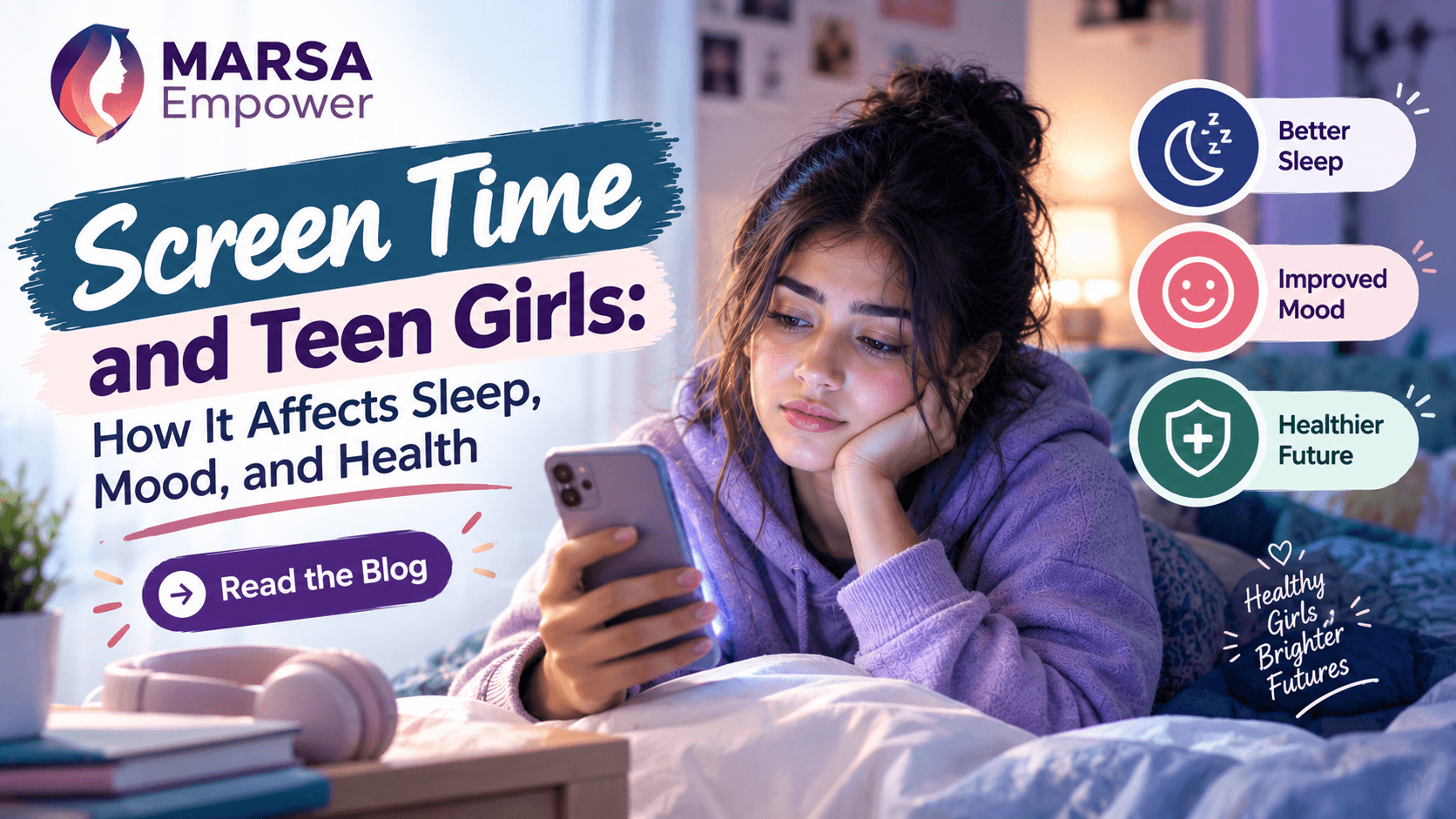
Understand how screen time affects teen girls' sleep, mood, and health. Learn expert insights and practical tips to promote healthier digital habits.

Maryam Mumtaz
Co-Founder & CEO
13 min read•9/18/2026
Marsa Empower · Teen Girls' Health · Digital Wellness · For Girls Aged 10 and Above · 13 min read
For teenage girls today, screens are everywhere. The phone is the first thing looked at in the morning and the last thing looked at before sleep. Classes involve laptops. Friendships happen partly through messaging apps. Entertainment is on screens. Study notes are shared through screens. Homework references screens.
This is the reality of modern teenage life, and this guide is not about pretending otherwise or arguing that screens are simply bad. Technology provides genuine benefits — connection, information, creativity, entertainment, and access to resources that earlier generations did not have.
But there is a specific, well-documented set of ways in which the particular patterns of screen use most common among teenage girls — scrolling through social media late at night, having notifications arrive through the night, comparing themselves to curated images of others, spending less time in physical activity and outdoor environments because screens compete for that time — can affect sleep, mood, mental health, physical health, and academic performance in ways that deserve honest attention.
Understanding these effects is not about guilt or prohibition. It is about making informed choices. A teenager who understands why looking at her phone until midnight consistently worsens her sleep, mood, and skin is in a better position to make different choices than one who simply hears "put your phone away" without understanding why.
Screen time refers to the time spent looking at any screen — smartphones, tablets, laptops, televisions, gaming consoles, and e-readers. It includes a very wide range of activities: social media scrolling, video watching, gaming, messaging friends, studying and researching, creative work like photography or writing, and video calls.
These different types of screen time are not equivalent in their effects. A teenager who spends two hours video calling a friend she misses is having a meaningfully different experience from one who spends two hours scrolling social media comparing herself to influencer content. A teenager who uses a screen for an hour of focused study is using it differently from one spending an hour watching highly stimulating, rapidly changing short videos before trying to sleep.
When this guide discusses screen time effects, it is primarily concerned with the patterns most consistently associated with harm — particularly passive social media scrolling, late-night screen use, and the fragmentation of attention through constant notifications. Creative, educational, and socially connected screen use is a different matter.
Several aspects of teenage girls' biology, psychology, and social context make the effects of heavy screen use particularly significant for this group.
The developing teenage brain is in a state of significant neurological change, with the reward systems — which are directly stimulated by social media's design — maturing before the prefrontal regulatory systems that provide judgement and impulse control. This means teenage girls are particularly susceptible to the compulsive pull of social media, notifications, and the variable reinforcement schedule of likes and comments.
Sleep needs are highest in adolescence — teenage girls need eight to ten hours of sleep per night — and the teenage circadian clock is naturally shifted toward later sleep onset and waking. When screen use before bed further delays sleep onset and the phone causes nighttime waking, the sleep debt accumulated significantly affects mood, health, and academic performance.
Social context is central to teenage development. Social belonging, peer acceptance, and social comparison are genuinely important developmental concerns during adolescence — and social media platforms are built to leverage precisely these concerns through curated images, follower counts, likes, and peer validation mechanisms. The social pressure this creates is real and more intense for teenage girls than for other groups.
Body image concerns are most prevalent among teenage girls, and social media's persistent presentation of narrow, filtered, often surgically altered body ideals directly feeds these concerns during the developmental period when they are most sensitive and most consequential.
Sleep is where the relationship between screen use and health is most direct, most well-documented, and most immediately reversible.
The hour or two before sleep is the period when the brain transitions from alert wakefulness toward the sleep state. This transition is governed by the rise of melatonin — the hormone that signals the body's sleep-wake system that night has arrived. Melatonin rise is triggered by the decrease in light intensity and brightness as evening progresses.
Phone screens emit bright, blue-spectrum light at close range. This light signal directly suppresses melatonin secretion — the body interprets it as daylight and delays the sleep-onset transition. The result is that a teenage girl who looks at her phone until midnight will have her sleep onset delayed — potentially by 30 to 90 minutes — compared to if she had put the phone away 60 to 90 minutes earlier.
Over a school week, this delay compounds: if she needs to wake at 6:30 am for school, consistently falling asleep 60 to 90 minutes later than she otherwise would produces a cumulative sleep debt that builds through the week.
Blue light (the short-wavelength spectrum of visible light) is the wavelength most effective at suppressing melatonin via the photosensitive retinal cells that signal the brain's circadian clock. Modern phone and tablet screens produce blue light efficiently — particularly at the high brightness levels typically used in the evening when ambient room light is lower.
The "night mode" or "warm colour" settings available on most modern phones reduce blue light emission, which provides some benefit. However, they do not eliminate the alerting effect of screen use before bed — the stimulating content, social engagement, and cognitive activation of late-night scrolling also delays sleep independently of the light itself.
Social media platforms are designed by engineers whose professional focus is maximising the time users spend on the platform. The infinite scroll design means there is never a natural stopping point. The variable reinforcement of new likes, comments, and unexpected content stimulates the same reward pathways as other habit-forming activities. And emotionally activating content — whether funny, dramatic, or anxiety-provoking — activates the brain in ways incompatible with the calm, quietening needed for sleep onset.
A teenager who starts scrolling at 10:30 pm with the intention of stopping in ten minutes is working against platform design specifically optimised to prevent exactly that. Understanding this — that the difficulty of stopping is partly engineered, not purely a personal failure of willpower — is genuinely useful.
Notifications that arrive through the night — messages, likes, alerts — can cause brief awakenings that disrupt sleep architecture even when the phone is placed face down. The sound or vibration of a notification activates the brain's alerting response enough to interrupt deep sleep stages, even if the sleeper does not fully wake.
Multiple sleep interruptions through the night reduce the proportion of restorative deep sleep and REM sleep — the stages most important for memory consolidation, emotional processing, and physical recovery. The cumulative effect is measurably reduced sleep quality even when total sleep duration appears adequate.
The most effective solution is placing the phone outside the bedroom (or at minimum, on aeroplane mode with all notifications silenced) before sleep. This removes both the notification-driven awakening risk and the temptation to reach for the phone during normal light-sleep awakenings in the early morning hours.
Sleep is not a lifestyle preference for teenagers. It is a biological requirement during one of the most metabolically and neurologically demanding periods of development. The consequences of consistent sleep insufficiency during the teenage years are measurable and significant.
Mood and emotional regulation. Sleep deprivation impairs the prefrontal cortex's ability to modulate emotional reactivity. Teenage girls who are sleep-deprived are measurably more emotionally reactive, more irritable, more prone to tearfulness, and less able to manage social stress — and these effects directly worsen the anxiety and mood difficulties already elevated in this demographic.
Academic performance. Memory consolidation — the process by which learning is transferred from working memory to long-term storage — occurs primarily during sleep. Sleep deprivation impairs this process, reducing the effective learning from study time regardless of how many hours were spent studying. Concentration, working memory, and creative problem-solving all fall measurably with insufficient sleep.
Immune function. The immune system's most active repair and regulation occurs during sleep. Consistently sleep-deprived teenagers have measurably impaired immune function, increased susceptibility to illness, and slower recovery.
Hormonal health. Sleep is one of the primary regulators of hormonal balance — including reproductive hormones, cortisol, insulin, and growth hormone. Chronic sleep deprivation in teenage girls disrupts the hormonal axis that governs the menstrual cycle, contributing to irregular periods and worsened PMS and period symptoms.
Skin health. Skin repair and regeneration peak during sleep. Growth hormone — which drives cellular repair — is secreted primarily in the first hours of deep sleep. Teenage girls with consistently poor sleep commonly notice worsened acne, dullness, and reduced skin healing as a direct consequence.
The modern smartphone environment is one of the most information-dense, decision-rich, and emotionally activating environments humans have ever inhabited. The constant stream of social updates, world events, opinion, entertainment, comparison, and interaction keeps the nervous system in a sustained state of low-level activation — preventing the downregulation and recovery that the nervous system needs during the day, and particularly before sleep.
For teenage girls — whose nervous systems are still developing the regulatory capacity to manage this input — sustained screen overstimulation through the day is associated with increased baseline anxiety, increased emotional reactivity, and difficulty accessing the calm needed for both sleep and focused study.
Social media is a curated highlights reel. Every person presents an edited version of their life — the most attractive photos, the most exciting moments, the most positive presentations of their social lives, bodies, achievements, and relationships. Nobody posts their ordinary days, their insecurities, or their difficult moments in the same proportion they post their best ones.
When a teenage girl spends significant time scrolling through this curated content, she is implicitly comparing her ordinary internal experience (her real feelings, doubts, and ordinary moments) to other people's external highlights. This comparison is inherently unfair and inherently skewed — but it does not feel unfair in the moment. It feels like an accurate picture of how other people's lives are going.
Research consistently shows that heavier social media use is associated with increased social comparison, decreased life satisfaction, increased envy, and increased depressive symptoms — with teenage girls showing the strongest and most consistent effect of any demographic.
Several features of social media use produce specific anxiety in teenage girls.
The visibility of social exclusion — seeing events, gatherings, and activities you were not invited to — creates social anxiety that would not have been possible before digital documentation of social life became ubiquitous.
The quantification of social standing through follower counts, likes, and comments creates an explicit, visible metric of peer acceptance that was previously implicit. A post that receives few likes can feel like direct evidence of social rejection.
The expectation of constant availability — the pressure to respond to messages quickly, to be reachable and engaged at all times — prevents the genuine social disengagement and recovery time that supports mental health.
Teenage girls who use social media heavily and who have poor sleep as a result of evening screen use frequently experience mood that is more volatile, more negative on baseline, more prone to irritability, and more difficult to regulate than their less screen-heavy peers. This mood effect is the product of both sleep deprivation and the direct psychological effects of heavy social media use.
The important point is that these mood effects are not character flaws or signs that something is fundamentally wrong. They are predictable, understandable consequences of specific environmental conditions — and they can be meaningfully improved by addressing those conditions.
Time is finite. Time spent on screens cannot simultaneously be spent in physical activity, outdoors, or in face-to-face social interaction. Research consistently shows that heavier screen use among teenagers is associated with lower physical activity levels.
This matters significantly for teenage girls because physical activity during adolescence supports cardiovascular health, bone density building, hormonal health, mood, sleep quality, and immune function — all at a period when these foundations are being set for the years ahead.
Prolonged screen use produces a pattern of symptoms known as digital eye strain or computer vision syndrome — including eye fatigue, dryness, blurred vision, and headaches from sustained visual focus at close range. The eye muscles that maintain focus at close distance become fatigued with extended use without breaks.
The 20-20-20 rule is a practical evidence-based recommendation: every 20 minutes of screen use, look at something approximately 20 feet (6 metres) away for at least 20 seconds. This brief focus-shift relaxes the eye muscles and significantly reduces digital eye strain accumulation.
Looking down at a phone — the posture adopted for most phone scrolling — places substantial compressive force on the cervical spine. The head weighs approximately five kilograms in a neutral, upright position. When the neck is tilted forward at 30 degrees for phone viewing, the effective compressive load on the cervical spine increases to approximately 18 kilograms. At 60 degrees of forward tilt, the load approaches 27 kilograms.
Sustained in this position for hours daily over months and years — the typical phone use pattern of many teenage girls — this load produces the muscular fatigue, stiffness, and chronic neck and upper back discomfort that is increasingly common in teenagers.
Raising the phone to eye level, alternating between sitting and standing while using screens, and taking regular movement breaks significantly reduces this accumulation.
Headaches from screen use occur through several mechanisms: eye muscle fatigue, sustained poor neck posture loading the cervical spine and its associated muscles, dehydration (screens often displace water drinking), and disrupted sleep (which lowers the headache threshold). Teenage girls who notice frequent afternoon or evening headaches are often experiencing the compounded effect of several of these factors simultaneously.
Screen use during meals and snacks is associated with distracted eating — eating without attention to fullness signals, continuing to eat past satiety because attention is focused on the screen rather than the meal, or under-eating because screen absorption delays the recognition of hunger. Both patterns disrupt the intuitive eating cues that support healthy food relationship and appropriate intake.
Research on the "mere presence" effect of smartphones on cognitive performance shows that a phone that is visible — even face down on a desk, even silenced — measurably reduces available working memory and concentration capacity compared to study conditions with the phone in another room.
The explanation is that the presence of the phone captures a portion of attention through anticipatory awareness — part of the brain's processing capacity is allocated to monitoring for potential notifications or resisting the impulse to check. This allocated capacity is not available for the study task.
Removing the phone from the study space — not merely silencing it or placing it face down, but putting it in another room — produces measurably better concentration and information retention compared to any other phone management strategy during study.
Teenagers frequently believe they are effective multitaskers — studying while having social media open in another tab, texting while reviewing notes, watching video while reading. Research on multitasking is clear: what feels like multitasking is actually rapid task-switching, and each switch carries a cognitive cost — both the time of the switch and the "warm-up" time needed to re-engage with the primary task after returning from the distraction.
A teenage girl who checks her phone briefly every few minutes during study is not studying with occasional brief interruptions. She is repeatedly abandoning and re-entering the focused cognitive state that learning requires, accumulating switching costs that significantly reduce the productivity of the study time.
The average teenager's phone receives dozens of notifications per day — messages, social media alerts, app updates, news, and various prompts. Each notification activates a brief orienting response in the brain — a shift of attention toward the source of the alert — that interrupts whatever was being done before it arrived.
Turning off non-essential notifications — and specifically silencing all notifications during study time and sleep — dramatically reduces this fragmentation without requiring the phone to be abandoned entirely.
Social media's effect on teenage girls' body image is one of the most extensively studied and most consistently documented harms of heavy social media use.
The combination of curated, filtered, often surgically altered or digitally modified images of women and girls — presented continuously and in enormous volume — creates a comparison environment that previous generations of teenagers did not inhabit. Research consistently shows that heavier social media use is associated with increased body dissatisfaction, higher rates of disordered eating, and more frequent appearance-related anxiety in teenage girls.
This effect is not about weak character or excessive vanity. It is about the sheer volume of exposure and the psychological reality that comparison is automatic and social — the brain is designed to register how one compares to others, and it does so even when the conscious mind knows that social media images are curated and unrealistic.
A teenage girl who feels worse about her body after scrolling Instagram is not being foolish or superficial. She is experiencing the predictable psychological effect of repeated exposure to a carefully selected, heavily filtered, narrowly representative sample of human appearance — presented in a way that makes it feel like a representative picture of how other people look.
Reducing exposure — unfollowing or muting accounts that consistently produce negative comparison feelings, being deliberate about which accounts and content to engage with, and spending more time in face-to-face social settings where bodies are not performatively displayed — all reduce this effect.
The honest answer is that there is no universally applicable specific number of hours per day that is "safe" and beyond which all harm begins. What matters more than total time is the pattern of use.
Screen time before bed is more harmful than equivalent screen time earlier in the day. Passive social media scrolling that produces social comparison and negative emotion is more harmful than the same time spent on a video call with a close friend. Screen time that consistently displaces physical activity, outdoor time, sleep, and face-to-face connection is more harmful than screen time that supplements these activities.
The most useful question for a teenage girl to ask about her screen use is not "how many hours is this?" but "how do I feel after spending time this way?" If screen use consistently leaves her feeling more anxious, more dissatisfied with her own life, more tired, or worse about herself — that is meaningful information about whether this particular pattern of use is serving her wellbeing.
Place the phone outside the bedroom — or switch it to aeroplane mode with all notifications silenced — at least 60 minutes before the planned sleep time. This single habit, implemented consistently, typically produces noticeable improvement in sleep quality within one to two weeks. Use this pre-sleep time for a calming wind-down activity: reading, gentle stretching, journaling, prayer or meditation, or a relaxing conversation.
Keep notifications active only for genuine priority contacts and communications. Turn off all social media notifications, promotional notifications, and non-urgent app alerts. Notifications should require that something has happened that genuinely needs attention — not simply that an algorithm has found something it thinks might engage you.
The 20-20-20 rule for eye health. Standing and moving for two to three minutes every 30 to 60 minutes of screen use. Looking at something in the distance and taking several slow breaths between study sessions. These brief interruptions are not disruptions to productivity — they are the recovery moments that allow sustained performance.
Time spent outdoors — walking, sitting in a garden, playing sport, simply being outside — provides natural light exposure (which supports the circadian clock and vitamin D production), physical movement, relief from screen-generated overstimulation, and the mood-lifting effect of natural environments documented in research across multiple cultures and populations.
Even 20 to 30 minutes of outdoor time daily produces measurable mood and cognitive benefits. This does not require formal exercise — simply being outside without a screen counts.
Regular physical activity directly counters many of the physical and psychological effects of heavy screen use: it reduces cortisol, increases serotonin and dopamine, improves sleep quality, maintains physical fitness that screens displace, and provides a natural screen break built around the body's movement needs.
Meals without screens are an opportunity for present-moment awareness of food — what it tastes like, when you are satisfied — and for genuine in-person social interaction with family members. Both are worth protecting.
Phone in another room during study sessions. Website blockers for social media during study hours. Specific, defined screen-free study times that become a consistent part of the weekly routine. These structures remove the constant low-level decision-making about whether to check the phone that consumes cognitive resources during study.
The following simple evening structure supports better sleep, mood, and recovery without requiring the phone to be abandoned entirely — only used more deliberately.
By 8:30 pm: finish main use of social media for the evening. Evening tasks — homework, preparation for the next day, family time — without social media tabs open. By 9:30 pm: phone on aeroplane mode or outside the bedroom. A calming wind-down activity: reading, gentle stretching, journaling. By 10:00 to 10:30 pm: consistent sleep time for an eight to ten hour night.
This routine does not require willpower or discipline on its own. It requires setting it up in advance — placing the charger in a room other than the bedroom, setting the aeroplane mode timer, having a physical book available — so that the decision is made in advance rather than in the moment when the phone's pull is strongest.
The following patterns suggest that screen use may be significantly affecting a teenage girl's health and wellbeing in ways worth addressing.
Consistently taking more than 30 minutes to fall asleep after going to bed. Regularly feeling tired during the day despite having been in bed for adequate hours. Feeling anxious or significantly worse about herself after using social media. Feeling unable to go significant stretches of time (a few hours during the day) without checking the phone, and feeling uncomfortable when this is not possible. Finding that the phone is the primary source of entertainment, connection, and stimulation — with other activities (physical activity, reading, creative hobbies, in-person socialising) increasingly displaced. Mood that is consistently better on days with less screen use and worse on heavy-screen days.
Seeking support from a trusted adult — a parent, guardian, school counsellor, or healthcare professional — is appropriate when any of the following are true.
Anxiety about social media, social status, appearance, or peer relationships is significantly affecting daily life, school performance, or sleep. Mood is consistently low, hopeless, or significantly worse than it was previously, and screen use patterns may be a contributing factor. There is significant distress about body image that feels connected to social media exposure. Sleep is significantly disrupted despite attempting to change screen habits, and the sleep deprivation is affecting daily functioning. Online interactions are causing significant distress — including bullying, harassment, or interactions that feel unsafe.
Create household norms around screens that apply to everyone, not only teenagers. Adults who put their phones away during meals, have screen-free mornings, and protect sleep with device-free bedrooms model the habits they hope to see.
Frame screen time conversations around wellbeing rather than rules. "How do you feel after you spend a lot of time on Instagram?" invites genuine reflection. "You're spending too much time on your phone" invites defensiveness.
Make it easy to follow healthy habits. Charging stations in common areas rather than bedrooms. A household norm of phones away during dinner. These structural choices reduce the constant friction of willpower-based habit management.
Talk about social media honestly. Discuss the curated, filtered, often commercially motivated nature of social media content — that what is seen is not representative reality. Teenagers who understand how social media works are more resilient to its comparison effects than those who have not had this conversation.
Recognise when professional support is needed. Significant, persistent anxiety, depression, body image distress, or disordered eating that may be connected to social media use deserves professional evaluation — not only parental management of screen time.
Where Marsa helps — Health Hub sleep and symptom tracking. Marsa's Health Hub allows teenage girls to track their sleep quality, mood, energy, and other health patterns over time. This documentation makes it easier to notice whether mood and energy are consistently better on lower-screen-use days, and whether sleep quality correlates with evening screen patterns — turning vague feelings into documented patterns that support better self-awareness and more productive conversations with parents or healthcare providers.
Why it matters. Many teenage girls do not recognise the connection between their evening screen habits and how they feel the next day — the effects of one night's poor sleep on mood, concentration, and emotional regulation are not always obvious in isolation. Tracking these patterns over time makes the connection visible.
Health education resources. Marsa's educational content explains the specific biological mechanisms through which screen use affects sleep — the melatonin suppression of blue light, the circadian disruption of late-night screen use, the sleep architecture effects of nighttime notifications — in accessible language that helps teenage girls understand the "why" behind the recommendations, not just the rules.
Menstrual health tracking and hormonal connections. For teenage girls who experience worsened period symptoms, more irregular cycles, or more intense PMS during periods of heavy screen use and poor sleep, Marsa's cycle tracking alongside sleep and mood data reveals these connections over time.
Mind and Soul wellness resources. Marsa's guided relaxation, breathing exercises, and mindfulness tools provide screen-free alternatives for the evening wind-down period — accessible, private, and specifically designed to support the calm before sleep that screens displace.
AI health guidance — Digital Doctors. Teenage girls who have questions about sleep, mood, anxiety, body image, or digital wellness habits can access Marsa's Digital Doctors for private, educational guidance — without the embarrassment that these conversations might feel in person.
Important note. Marsa Empower is a health education and wellness companion. For significant anxiety, depression, eating disorders, online harassment, or other serious mental health concerns, professional evaluation and support from a qualified healthcare professional, school counsellor, or mental health practitioner is the appropriate response.
Does using a phone before bed affect sleep?
Yes, significantly. Phone screens emit blue light that suppresses melatonin — the hormone that signals the sleep-wake system to initiate sleep. This delays sleep onset. The stimulating content of social media and messaging also maintains brain alertness incompatible with sleep onset. Putting the phone away 60 to 90 minutes before intended sleep time consistently improves both how quickly sleep comes and the quality of sleep that follows.
Can too much screen time affect mood?
Yes. Heavy social media use is consistently associated with increased social comparison, decreased life satisfaction, increased depressive symptoms, and higher anxiety in teenage girls. Sleep deprivation from late-night screen use independently worsens mood, emotional reactivity, and capacity to manage stress. Both effects compound each other — poor sleep worsens mood, and worsened mood may increase screen use as a coping mechanism.
Can screen time cause headaches?
Yes. Prolonged screen use produces digital eye strain, eye muscle fatigue, and headaches from sustained close-focus visual effort. Poor neck posture during screen use accumulates compressive load on the cervical spine that produces neck and headache pain. Sleep deprivation from evening screen use also lowers the headache threshold. Taking regular eye breaks (20-20-20 rule), improving screen posture, and protecting adequate sleep all reduce screen-related headache frequency.
Can social media affect body image?
Yes. Research consistently shows that heavier social media use is associated with increased body dissatisfaction, more appearance-related anxiety, and increased risk of disordered eating in teenage girls. The curated, filtered, often digitally altered presentation of bodies on social media creates an unrealistic comparison standard that the brain engages with automatically, regardless of conscious awareness that the images are edited.
How can I reduce screen time without giving up my phone?
Focus on the specific patterns causing harm rather than total elimination. Put the phone outside the bedroom at night. Turn off non-essential notifications. Use the phone away from the desk during study. Have meals without the phone present. Set specific times to check social media rather than responding to every notification as it arrives. Keep physically active and spend time outdoors. These changes reduce the harmful patterns without requiring the phone to be abandoned.
Should teenagers completely avoid screens before bed?
Completely is a high standard. The most important change is avoiding social media, stimulating video content, and bright-screen scrolling in the 60 to 90 minutes before sleep. Lower-stimulation screen use — reading a calm long-form article, using a dim, warm-mode screen for a gentle wind-down activity — is less harmful than high-stimulation social scrolling. The phone outside the bedroom is the single most impactful structural change for protecting sleep.
Screens are not the enemy. But the specific patterns of screen use most common among teenage girls — scrolling social media until late at night, sleeping with the phone on the bedside table, spending hours in social comparison, allowing notifications to fragment attention throughout the study day — have measurable, real effects on sleep, mood, mental health, physical health, and academic performance.
Understanding these effects is not about rules or prohibition. It is about being informed enough to make choices that serve your own wellbeing rather than the goals of platform algorithms designed to maximise your time on screen.
The changes that make the biggest difference are also among the simplest: phone outside the bedroom at night, notifications off during study and sleep, time outdoors and physically active every day, and occasional honest reflection about whether specific patterns of screen use are making your life better or worse.
Your sleep, your mood, your skin, your concentration, and your relationship with your own body all benefit when you use screens deliberately rather than compulsively. That deliberateness is worth practising — not because screens are bad, but because your health and wellbeing matter more than any feed.
Educational Disclaimer
This article is for educational and awareness purposes only. It does not constitute medical or mental health advice. If you are experiencing significant anxiety, depression, sleep problems, body image distress, or other health concerns, please speak with a trusted adult and consult a qualified healthcare professional or mental health practitioner for personalised support and guidance.
Marsa Empower | Care. Safety. Growth.
Visit marsaempower.com to track your sleep, mood, and health patterns, access educational resources, and explore wellness tools designed for teenage girls and women at every stage of life.
Medical Disclaimer
This article is for general informational and educational purposes only and is not a substitute for professional medical advice, diagnosis, or treatment. Always seek the advice of a qualified healthcare provider with any questions you may have regarding a medical condition. Never disregard professional medical advice or delay seeking it because of something you have read on MARSA Empower.
Written By
Maryam Mumtaz
Co-Founder & CEO
Co-Founder of MARSA Empower who leads the visual and strategic evolution of the platform. Maryam bridges technical complexity with human-centric design, architecting the team's official roadmap and ensuring MARSA effectively addresses the real-world needs of women. With deep expertise in agentic AI, full-stack development, and UI/UX design, she has delivered 50+ projects for 30+ satisfied clients.
Enjoyed this story?