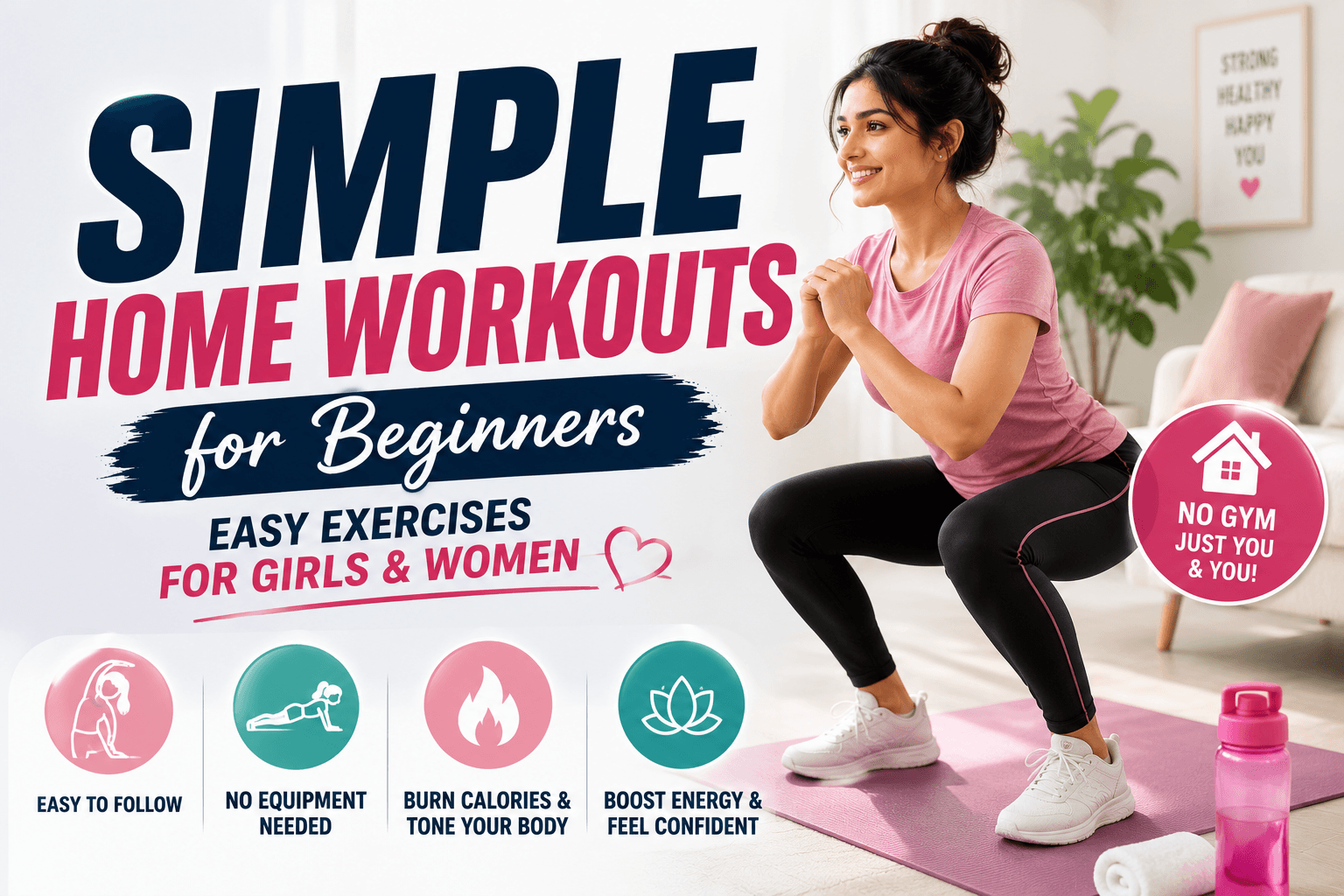
Explore beginner-friendly home workouts tailored for girls and women, focusing on strength, flexibility, and overall well-being.

Maryam Mumtaz
Co-Founder & CEO
14 min read•8/9/2026
Marsa Empower · Health & Fitness · Beginner Wellness · For Girls & Women Aged 13 and Above · 14 min read
"You do not need a gym membership, expensive equipment, or a perfect body to start moving. You need a small space, comfortable clothes, and the decision to begin."
Starting an exercise routine for the first time — or returning to one after a long break — can feel daunting. There is often a sense that exercise requires more than you currently have: more fitness, more motivation, more equipment, more time, more knowledge.
None of that is true.
The exercises in this guide require no gym, no equipment, and no prior experience. They can all be done in a small room, a hallway, a garden, or anywhere with a flat surface and enough space to stand with your arms extended. They take 15 minutes. They are designed for complete beginners — teenage girls, women in their twenties and thirties, women who have never exercised consistently, and women returning to exercise after an extended break.
More importantly: they work. These are not gentle warm-ups or token movements. These are foundational exercises that build real strength, real cardiovascular fitness, and real flexibility — the same movements that form the base of most professional training programmes, adapted for someone who is starting from scratch.
Start here. Be consistent. Let the habit build.
Before beginning, it is worth understanding what exercise actually does in the body — because understanding the benefits makes it significantly easier to stay motivated when the initial enthusiasm wears off and consistency becomes the challenge.
This seems counterintuitive — using energy through exercise should make you more tired. But the opposite is consistently true. Regular exercise improves cardiovascular efficiency: the heart and lungs deliver oxygen to cells more effectively, cells convert food to energy more efficiently, and the overall result is higher energy throughout the day. Women who exercise regularly consistently report better energy than during periods of inactivity.
Muscles adapt to the demands placed on them. When the body is asked to squat, push, and lift regularly, the muscle fibres grow stronger in response. This strength is not just aesthetic — it makes every physical task of daily life easier, reduces joint strain and injury risk, and — critically for women — supports bone density, which peaks in the early twenties and then gradually declines.
Exercise is one of the most evidence-supported mood-improving interventions available. It releases endorphins (natural mood-elevating chemicals), increases serotonin and dopamine activity, reduces cortisol (the stress hormone), and activates the prefrontal cortex — the brain region governing emotional regulation. The effect is measurable, reliable, and begins within a single session.
Regular physical activity improves both the ease of falling asleep and the depth of sleep once achieved. Exercise reduces cortisol in the evening (supporting sleep onset), improves the depth of slow-wave sleep (the most restorative stage), and regulates the circadian rhythm that governs sleep-wake cycles.
The heart is a muscle. Like all muscles, it becomes stronger and more efficient when regularly challenged. Regular moderate exercise — even walking — lowers resting heart rate, reduces blood pressure, improves cholesterol profiles, and significantly reduces cardiovascular disease risk.
A body that moves regularly maintains its range of motion. Regular stretching and movement through a full range keeps joints mobile, muscles flexible, and posture aligned — reducing the stiffness, back pain, and postural problems that accumulate from sedentary daily life.
Exercise directly improves insulin sensitivity — reducing the hormonal imbalances that drive PCOS, weight management difficulties, and cycle irregularities. It reduces cortisol and supports the hormonal balance governing reproductive health. For women managing hormonal conditions, consistent moderate exercise is a clinical tool, not just general wellness advice.
Start easier than you think you need to. The most common beginner mistake is starting too intensely — doing too many repetitions, too many sets, or too many days in week one. This leads to excessive soreness, discouragement, and stopping within two weeks.
A first session that feels almost too easy is a first session you will come back to. That is the goal.
A warm-up gradually raises the heart rate, increases blood flow to the muscles, raises muscle temperature (improving flexibility and reducing injury risk), and prepares the joints for the movement demands ahead.
Skipping the warm-up increases injury risk and reduces exercise performance. It takes five minutes. Do it every time.
March in place — 1 minute Stand tall and march on the spot, lifting your knees to hip height and swinging your arms naturally. Start slowly and gradually increase the pace.
Arm circles — 30 seconds forward, 30 seconds backward Stand with feet shoulder-width apart. Extend both arms to the sides. Draw small circles with your hands, gradually increasing to large circles. Reverse direction.
Shoulder rolls — 30 seconds Roll both shoulders forward in large slow circles, then reverse.
Hip circles — 30 seconds each direction Stand with feet shoulder-width apart and hands on hips. Rotate the hips in large, slow circles — like using a hula hoop. Reverse direction.
Leg swings — 30 seconds each leg Stand near a wall for balance. Swing one leg forward and backward in a controlled arc. Repeat on the other side.
Gentle knee bends — 30 seconds Stand with feet shoulder-width apart. Slowly bend both knees to a comfortable angle — not a full squat — and straighten. Repeat at an easy pace.
After five minutes of this warm-up, your heart rate should have risen slightly, your muscles should feel warmer, and your joints should feel more mobile. You are ready to begin.
Each exercise below includes complete step-by-step instructions, common mistakes to avoid, and modifications for making it easier or harder. Read through all instructions before beginning.
What it targets: Cardiovascular system · Legs · Overall warm-up and endurance
Why it is useful: Walking in place is the simplest cardiovascular exercise available. It requires no space, no equipment, and no skill. It is an excellent starting exercise for complete beginners and a useful active rest between more demanding exercises.
Tempo: Start at a comfortable walking pace. Gradually increase speed until you are stepping briskly.
Duration: 1 to 2 minutes as a standalone exercise. Also used as active recovery between exercises.
To make it harder: Increase the height of the knee lift and the speed of the steps. Add high knees — lifting each knee toward chest height — for a more intense version.
Common mistake: Looking down at your feet. Keep your head up and eyes forward.
What it targets: Quadriceps (front of thighs) · Hamstrings (back of thighs) · Glutes (bottom) · Core stabilisers
Why it is useful: The squat is one of the most functional movements the human body performs — it mimics sitting down and standing up, which happens dozens of times per day. Building squat strength reduces knee and lower back strain in daily life, builds leg and glute strength, and supports bone density.
Repetitions: 8 to 10 for beginners · Build to 15 to 20 as strength improves
Sets: 2 sets · Rest 60 seconds between sets
To make it easier: Do not lower as far — a shallow squat is still a squat. Hold onto a chair or wall for balance support until confidence improves.
To make it harder: Slow down the lowering phase — take 3 to 4 seconds to lower, pause at the bottom, then push up.
Common mistakes:
What it targets: Chest (pectorals) · Shoulders (deltoids) · Back of upper arms (triceps) · Core
Why it is useful: Push-ups build upper body pushing strength — important for carrying, lifting, and all daily tasks involving the arms. Wall push-ups are the most accessible version — providing the same muscle-building stimulus as floor push-ups but at a gentler angle, making them suitable for complete beginners with no upper body strength base.
Repetitions: 8 to 10 for beginners · Build to 15 to 20
Sets: 2 sets · Rest 60 seconds between sets
To make it harder: Move your feet further from the wall — increasing the angle and therefore the resistance. Progress eventually to a counter or table-height surface, then the floor.
To make it easier: Move closer to the wall — a more upright position reduces the resistance.
Common mistakes:
What it targets: Glutes · Hamstrings · Lower back · Core
Why it is useful: The glute bridge strengthens the muscles of the posterior chain — the back of the body — which are chronically underused in people who sit for most of the day. Strong glutes reduce lower back pain, improve posture, and support healthy knee function.
Repetitions: 10 to 12 for beginners · Build to 15 to 20
Sets: 2 sets · Rest 60 seconds between sets
To make it harder: Hold the top position for five seconds rather than two. Progress to single-leg glute bridges — one foot flat on the floor, the other extended straight.
Common mistakes:
What it targets: Core stabilisers (particularly erector spinae and transverse abdominis) · Glutes · Shoulder stabilisers · Balance
Why it is useful: The bird dog is one of the safest and most effective core exercises available. Unlike crunches, which compress the spine, the bird dog trains the deep muscles that stabilise the spine — reducing lower back pain and improving posture without spinal compression.
Repetitions: 8 repetitions per side (16 total) for beginners
Sets: 2 sets · Rest 60 seconds between sets
To make it easier: Begin by extending only the arm (without the leg) until comfortable. Add the leg once you can maintain hip stability with the arm alone.
Common mistakes:
What it targets: Quadriceps · Glutes · Hamstrings · Balance and coordination
Why it is useful: The step-up is a functional, single-leg exercise that builds leg strength, improves balance, and mimics the everyday movement of climbing stairs. It is lower impact than lunges, making it suitable for those with knee sensitivities.
What you need: A stable step, the bottom stair of a staircase, or a sturdy low platform approximately 15 to 25 cm high
Repetitions: 8 to 10 per leg (alternating, so 16 to 20 total) for beginners
Sets: 2 sets · Rest 60 seconds between sets
To make it easier: Use a lower step — even a thick book or a folded mat provides some elevation. Hold a wall or railing for balance support.
To make it harder: Use a higher step. Pause for three seconds at the top of each step.
Common mistakes:
What it targets: Hip flexors · Core · Balance · Light cardiovascular activity
Why it is useful: Standing knee raises improve hip flexor strength, core stability, and balance — while also providing a gentle cardiovascular stimulus when performed at a moderate pace.
Repetitions: 10 per leg (20 total) for beginners
Sets: 2 sets
To make it harder: Perform more quickly for a cardiovascular challenge. Add a pause of three seconds at the top of each lift.
To make it easier: Reduce the height of the knee raise — even lifting the knee to 45 degrees provides benefit.
Common mistakes:
What it targets: Quadriceps · Glutes · Hamstrings · Balance · Hip flexibility
Why it is useful: The lunge trains each leg independently — building strength, balance, and coordination. It improves hip flexibility and challenges balance in a way that bilateral (two-legged) exercises like squats do not.
Repetitions: 8 per leg (16 total) for beginners · Build to 12 per leg
Sets: 2 sets · Rest 60 seconds between sets
To make it easier: Shorten the step length and reduce how far you lower — a shallow lunge still builds strength. Hold a wall for balance support.
To make it harder: Slow down the lowering phase — take three seconds to lower. Hold at the bottom for two seconds.
Common mistakes:
What it targets: Calves (gastrocnemius and soleus) · Ankle stability
Why it is useful: Calf raises strengthen the lower leg muscles and improve ankle stability — reducing the risk of ankle sprains and supporting all standing and walking activities. They are one of the easiest exercises to incorporate anywhere.
Repetitions: 12 to 15 for beginners · Build to 20 to 25
Sets: 2 sets
To make it harder: Perform on one foot at a time. Slow the lowering phase to three to four seconds.
Common mistakes:
What it targets: Flexibility · Muscle recovery · Tension relief · Relaxation
Why it is useful: Stretching after exercise while muscles are warm improves flexibility, reduces post-exercise soreness, supports recovery, and provides a mental transition out of the exercise session. It should be the final component of every workout.
Standing quadriceps stretch — 30 seconds each leg Stand on one leg. Bend the other knee and hold the ankle behind you, pulling the heel toward your glutes. Keep your knees together and stand tall. Hold 30 seconds each side.
Standing hamstring stretch — 30 seconds each leg Stand with feet together. Step one foot forward slightly and flex the toes upward. Hinge gently forward from the hips — keeping the back straight — until you feel a stretch in the back of the extended leg. Hold 30 seconds each side.
Hip flexor stretch — 30 seconds each side Kneel on one knee with the other foot forward in a lunge position. Gently press the hips forward until you feel a stretch in the front of the kneeling hip. Keep the upper body upright. Hold 30 seconds each side.
Chest stretch — 30 seconds Clasp both hands behind your back. Straighten your arms and gently lift them while opening your chest. Hold 30 seconds. Breathe deeply.
Neck stretch — 30 seconds each side Slowly tilt your head to the right, bringing your right ear toward your right shoulder. Hold 30 seconds. Repeat on the left.
Lower back — Child's pose — 30 to 60 seconds Kneel on the floor, sit back on your heels, and stretch both arms forward on the floor. Rest your forehead on the mat or floor. Breathe slowly and deeply.
Use this routine as your starting programme. Do it three times per week, with at least one rest day between sessions.
| Component | Exercise | Duration or Reps |
|---|---|---|
| Warm-up | Walking in place + arm circles + hip circles | 5 minutes |
| Exercise 1 | Bodyweight squats | 10 reps × 2 sets (60 sec rest) |
| Exercise 2 | Wall push-ups | 8 reps × 2 sets (60 sec rest) |
| Exercise 3 | Glute bridges | 10 reps × 2 sets (60 sec rest) |
| Exercise 4 | Standing knee raises | 10 per leg × 1 set |
| Exercise 5 | Calf raises | 12 reps × 1 set |
| Cool-down | Full-body stretching routine | 5 minutes |
| Total time | Approximately 15 to 20 minutes |
After two to three weeks with this routine, add bird dogs, lunges, and step-ups to increase the workout to 25 to 30 minutes. Increase repetitions by two to three per exercise as the movements become easier.
Week 1 to 2: Three days per week · At least one rest day between sessions (e.g. Monday, Wednesday, Friday)
Week 3 to 4: Three to four days per week as the body adapts
Month 2 onward: Four to five days per week if desired — though three consistent days per week indefinitely produces excellent health benefits
Rest days are not lazy days. They are when the body adapts to the training stimulus — repairing the micro-damage in muscle fibres caused by exercise and rebuilding them stronger. Without adequate rest, this adaptation cannot occur. Beginners who exercise every day from week one typically experience excessive soreness, fatigue, and often give up within two to three weeks.
Three days per week is enough to produce real, meaningful fitness improvements. Consistency over months is far more valuable than intensity over weeks.
These are signals from the body to rest — not signals of weakness.
Exercise for teenage girls is about something different from what it is often presented as. It is not primarily about weight loss, changing body shape, or achieving a particular appearance. It is about building a relationship with physical movement that supports health, confidence, and wellbeing — for decades to come.
Enjoyment: The most important factor in long-term exercise consistency is finding movement you enjoy — or at least do not actively dislike. Dancing counts. Walking with a friend counts. Playing a sport counts. The exercises in this guide count. None of these is more or less valid than any other.
Bone density building: The teenage years are the most critical window for building bone density — which peaks in the early twenties. Weight-bearing exercise (walking, squats, lunges, step-ups) directly stimulates bone formation. Building bone during this window protects against osteoporosis decades later.
Strength and capability: Building physical strength in the teenage years — through bodyweight exercises and regular movement — builds confidence in what the body can do, rather than focusing only on how it looks.
Coordination and flexibility: The teenage body is still developing coordination and spatial awareness. Exercises involving balance (bird dogs, lunges, standing knee raises) support neurological development alongside physical development.
Mood and mental health: Exercise is one of the most reliable mood-improving tools available to teenage girls — who face some of the highest rates of anxiety and depression of any demographic. Regular movement reduces cortisol, increases serotonin, and provides a genuine mental health benefit that no social media algorithm can replicate.
For women in their twenties, thirties, and beyond, the relevant exercise considerations shift from development to maintenance and protection.
Muscle mass begins to gradually decline from the late twenties without consistent resistance exercise. The bodyweight exercises in this guide — squats, lunges, glute bridges, push-ups — build and maintain the muscle mass that supports metabolic rate, bone density, joint health, and daily physical function.
Regular moderate aerobic activity — walking at pace, cycling, swimming, dancing — protects heart health, reduces blood pressure, and significantly reduces the risk of cardiovascular disease, which becomes a leading health concern for women after menopause.
Many women in their twenties and thirties spend significant time sitting — at desks, in cars, in front of screens. Sitting shortens the hip flexors and weakens the glutes and upper back muscles that support upright posture. The exercises in this guide — particularly bird dogs, glute bridges, and hip flexor stretches — directly address the postural consequences of a sedentary work life.
As discussed throughout Marsa Empower's health resources, regular moderate exercise is one of the most powerful interventions for hormonal health — improving insulin sensitivity (relevant for PCOS), reducing cortisol, and supporting the hormonal balance governing the menstrual cycle. Exercise is not simply an aesthetic tool for women in this life stage. It is a clinical health tool.
The compounding demands of career, relationships, and for many women, early parenthood, create significant stress loads in the twenties and thirties. Exercise is consistently among the most reliable cortisol-reducing, mood-supporting, and resilience-building tools available.
The most common reason people stop exercising within the first month is excessive soreness and fatigue from starting too intensely. Starting with three days per week, moderate duration, and manageable intensity — and increasing gradually — is the approach most likely to become a sustainable habit.
The warm-up takes five minutes. Skipping it increases injury risk and reduces the quality of the exercise session. This is the most consistently skipped component of beginner workouts — and one of the most important.
Performing exercises incorrectly — particularly squats and lunges — can cause knee and lower back strain. The full technique descriptions above cover the most common form errors. Read them carefully before beginning, and prioritise good form over higher repetitions or faster speed.
Social media exercise content features people who have been training for years, have experienced coaches, and often look very different from their starting point. Comparing your first week of exercise to someone's third year is not useful and not fair to yourself. Your only relevant comparison is you, from last week.
Mild muscle tiredness and the "burn" during exertion are normal. Sharp pain, joint pain, sudden acute pain, or pain that persists significantly after exercise stops are not normal and are reasons to stop immediately. The difference between normal exercise discomfort and warning pain becomes clearer with experience.
Visible physical changes typically take six to eight weeks of consistent exercise to become apparent. Cardiovascular improvement begins within two to three weeks. Strength improvements are noticeable within three to four weeks. Exercising three times per week for two weeks and then stopping because "nothing has changed" prevents any programme from ever producing results.
Missing one session is not failure. Missing two sessions is not failure. The only failure is not coming back. A habit built over months is built on imperfect consistency — not perfect attendance. Missing a session and returning the next scheduled day is exactly what building a habit looks like.
Yes — for most girls and women, exercising during a period is completely safe and often beneficial.
The uterus contracting to shed its lining produces the cramping of the first period days. Exercise releases endorphins — natural pain-relieving chemicals — that reduce the perceived intensity of that cramping. Exercise also improves pelvic blood flow, which reduces the ischaemia (oxygen deprivation of the uterine muscle) that drives cramping.
Many women find that exercising during their period — particularly walking and yoga — measurably reduces their cramps within 20 to 30 minutes of starting.
On heavy or very painful days (typically day 1 to 2): Gentler exercise — walking, yoga, light stretching — is appropriate. This is not the time to push for maximum performance, and there is no reason to.
On days 3 to 5: For most women, flow reduces and pain improves significantly. Near-normal exercise is comfortable for most.
The full exercise guide for exercising during periods is available in Marsa Empower's dedicated blog: "Can I Exercise During My Period?"
Always stop exercising immediately if you experience:
These symptoms are not normal exercise sensations — they are signals from the body that something requires attention. Rest, hydrate, and seek medical advice if symptoms persist.
Every fitness expert, every sports scientist, and every training programme agrees on one thing: consistency over time produces results. Nothing else does.
Three sessions per week, done consistently for six months, produces dramatically better results than six sessions per week for three weeks followed by stopping.
A 15-minute workout three times per week done consistently for a year builds genuine, meaningful fitness. The same 15 minutes done erratically does not.
Schedule it like an appointment: Put your three weekly sessions in your calendar. A specific time on a specific day is far more likely to happen than a vague intention to exercise "sometime this week."
Attach it to an existing habit: Walk after dinner. Do the routine before your morning shower. Attach the new habit to something already established in your day.
Track consistency — not results: Put a tick on a calendar for every session completed. After a month, look at the visual record of what you have built. This consistency record is more motivating than scale numbers or measurements.
Keep showing up when you do not feel like it: The most important sessions are the ones you do when you do not want to. Not because punishing yourself is valuable — but because the habit of returning consistently, regardless of motivation, is what separates people who build a lasting exercise habit from those who do not.
Reduce friction: Keep your workout clothes visible. Have your mat already out. Remove every barrier you can between the intention and the action.
| Warm-Up | 5 minutes — Walking in place, arm circles, hip circles |
|---|---|
| Squats | 10 reps × 2 sets |
| Wall push-ups | 8 reps × 2 sets |
| Glute bridges | 10 reps × 2 sets |
| Standing knee raises | 10 per leg × 1 set |
| Calf raises | 12 reps × 1 set |
| Cool-down | 5 minutes — Full-body stretching |
| Exercise | Primary Muscles | Suitable For |
|---|---|---|
| Walking in place | Cardio · Legs | Everyone |
| Bodyweight squats | Legs · Glutes | Everyone |
| Wall push-ups | Chest · Shoulders · Triceps | Everyone |
| Glute bridges | Glutes · Hamstrings · Core | Everyone |
| Bird dogs | Core · Glutes · Balance | Everyone |
| Step-ups | Legs · Glutes · Balance | Everyone with a step |
| Standing knee raises | Hip flexors · Core · Balance | Everyone |
| Lunges | Quads · Glutes · Balance | Once squats are comfortable |
| Calf raises | Calves · Ankle stability | Everyone |
| Stretching | Flexibility · Recovery | Everyone — always |
"Fitness is not built in a single intense session. It is built in consistent, manageable sessions repeated over months. Start small. Stay consistent. Trust the process."
Educational Disclaimer
This article is for educational and general wellness purposes only. It does not constitute medical advice. If you have any health conditions, injuries, or concerns before beginning an exercise programme, please consult a qualified healthcare professional for personalised guidance.
Marsa Empower · Health & Fitness · Beginner Wellness · Movement for Every Woman
Medical Disclaimer
This article is for general informational and educational purposes only and is not a substitute for professional medical advice, diagnosis, or treatment. Always seek the advice of a qualified healthcare provider with any questions you may have regarding a medical condition. Never disregard professional medical advice or delay seeking it because of something you have read on MARSA Empower.
Written By
Maryam Mumtaz
Co-Founder & CEO
Co-Founder of MARSA Empower who leads the visual and strategic evolution of the platform. Maryam bridges technical complexity with human-centric design, architecting the team's official roadmap and ensuring MARSA effectively addresses the real-world needs of women. With deep expertise in agentic AI, full-stack development, and UI/UX design, she has delivered 50+ projects for 30+ satisfied clients.
Enjoyed this story?