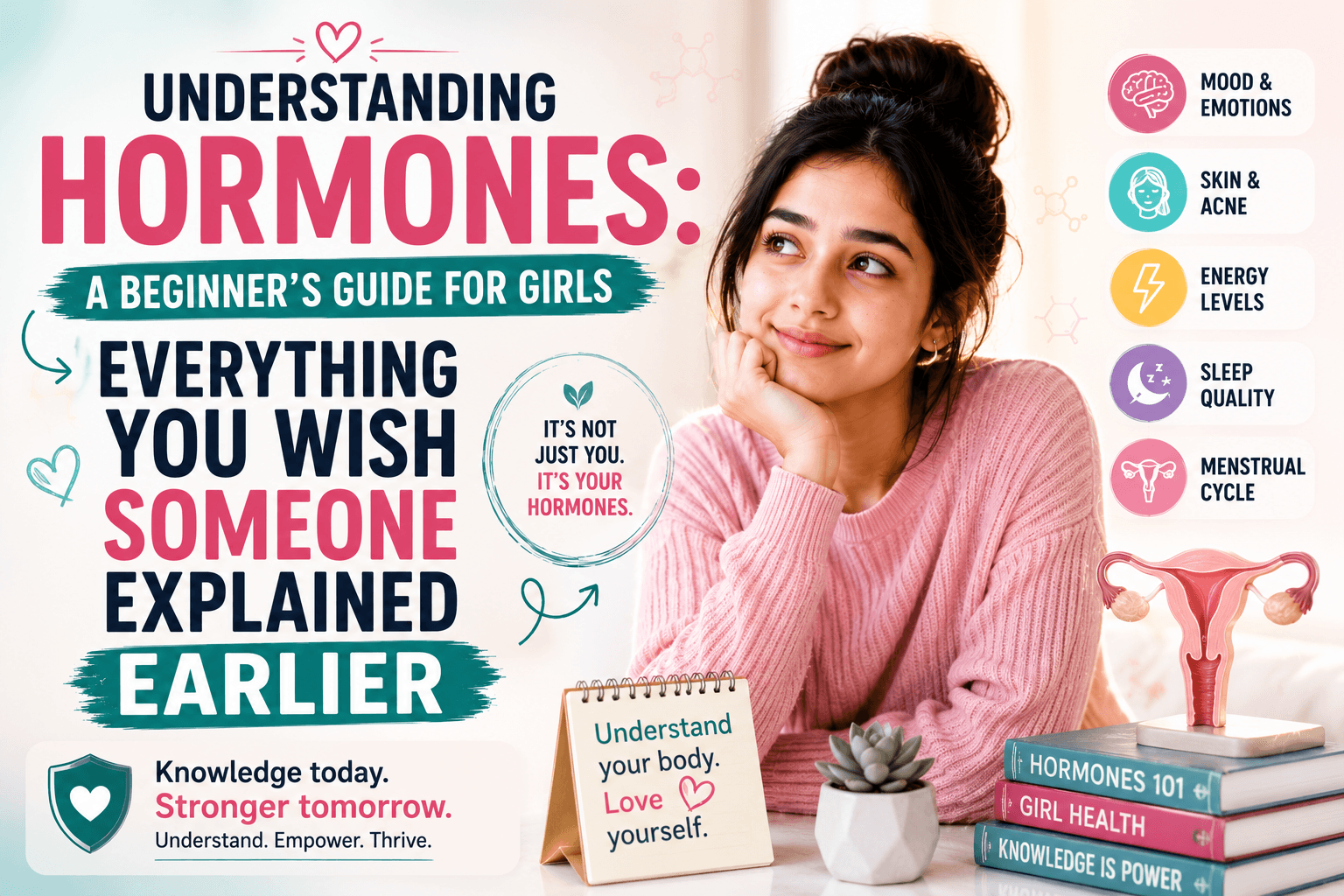
Unravel the mystery of hormones and their impact on young girls' lives. This guide explores how hormones influence health, mood, and more.

Maryam Mumtaz
Co-Founder & CEO
12 min read•7/10/2026
🌸 Marsa Empower · Health Education · For Girls Aged 13–25 · ~10 min read
"A girl who understands her hormones understands herself. And that knowledge protects her health for life."
| # | Section | Theme |
|---|---|---|
| 1 | Introduction — Nobody Connected the Dots | 🌱 The Problem |
| 2 | What Are Hormones — In Simple Terms? | 💡 The Basics |
| 3 | The Key Hormones Every Girl Should Know | 🔑 The Players |
| 4 | How Hormones Change Everything During Puberty | 🌸 Growing Up |
| 5 | What Hormones Affect Every Day | 📅 Daily Life |
| 6 | Mood & Emotions | 😊 Feelings |
| 7 | Skin & Acne | 🧴 Skin Health |
| 8 | Energy Levels | ⚡ Vitality |
| 9 | Sleep Quality | 🌙 Rest |
| 10 | The Menstrual Cycle | 🩸 Your Cycle |
| 11 | Signs Your Hormones May Need Attention | ⚠️ Warning Signs |
| 12 | Habits That Support Hormonal Balance | ✅ Action Plan |
She was told her acne was because she did not wash her face properly.
She was told her mood swings meant she was being dramatic.
She was told her fatigue was laziness.
She was told her period pain was something every woman simply endured.
Nobody told her it was all connected.
Nobody told her it was all hormones.
The word "hormones" is used constantly — in conversations about mood, about skin, about periods, about puberty. Yet most girls never receive a real explanation of what hormones actually are, what they do, or why they matter so deeply to every aspect of health and daily life.
They are left to piece it together from incomplete conversations, social media posts, and the quiet assumption that eventually it will all make sense on its own.
It does not have to be this way.
This guide is the explanation every girl deserved sooner — clear, honest, and complete.
Think of your body as an incredibly complex city. Millions of processes are happening simultaneously — cells are growing, organs are functioning, energy is being produced, emotions are being regulated, sleep is being initiated. For all of this to work together, the different parts of the city need to communicate.
Hormones are the messengers that carry those communications.
They are chemical substances produced by glands throughout the body — including the thyroid, the adrenal glands, the ovaries, and the pituitary gland. Once produced, they travel through the bloodstream and deliver specific instructions to organs, tissues, and cells throughout the body.
One hormone tells the body to store energy. Another tells it to release energy. One signals the brain to feel calm. Another signals it to feel alert. One initiates the growth of the uterine lining. Another triggers its release.
| What Hormones Regulate | Examples |
|---|---|
| 🌱 Growth | Growth hormone during childhood and adolescence |
| 😴 Sleep | Melatonin — signals sleep onset |
| 😊 Mood | Oestrogen supports serotonin production |
| ⚡ Energy | Thyroid hormones regulate metabolic rate |
| 🧴 Skin | Androgens influence oil gland activity |
| 🩸 Reproduction | Oestrogen and progesterone govern the menstrual cycle |
| ⚖️ Metabolism | Insulin regulates blood sugar and fat storage |
| 🍽️ Appetite | Leptin and ghrelin signal fullness and hunger |
| 🛡️ Immune function | Cortisol and oestrogen both influence immune response |
Everything. Regulated, at least in part, by hormones.
💛 Key Insight
"Hormones are not just about periods. They are the chemical language your body uses to run itself — every hour of every day. When you understand that language, so much about how you feel stops being confusing and starts making complete sense."
Before exploring what hormones do, it helps to know who the main players are. These are the hormones most directly relevant to girls' health, mood, energy, and development:
| Hormone | Produced By | Primary Role |
|---|---|---|
| 🌸 Oestrogen | Ovaries | Reproductive development · Mood · Bone density · Skin health |
| 💚 Progesterone | Ovaries (after ovulation) | Prepares uterus for pregnancy · Supports sleep · Regulates mood |
| ⚡ Testosterone | Ovaries & adrenal glands | Motivation · Confidence · Energy · Libido (yes — girls have it too, in smaller amounts) |
| 😰 Cortisol | Adrenal glands | Stress response · Energy mobilisation · Immune regulation |
| 🌙 Melatonin | Pineal gland | Sleep onset · Circadian rhythm regulation |
| 🦋 Thyroid Hormones | Thyroid gland | Metabolic rate · Energy production · Body temperature · Mood |
| 🍬 Insulin | Pancreas | Blood sugar regulation · Energy storage |
| 🧠 FSH & LH | Pituitary gland | Trigger ovulation · Regulate the menstrual cycle |
💛 Key Insight
"Most girls are only ever told about oestrogen and progesterone — and even those are only discussed in the context of periods. In reality, at least eight major hormones are working together every day to shape how you feel, how you look, how you sleep, and how much energy you have."
Puberty is not simply a social event or a rite of passage. It is a profound biological transformation — driven almost entirely by a dramatic shift in hormonal activity.
Before puberty, levels of oestrogen, progesterone, and testosterone are relatively low and stable. During puberty — typically beginning between ages 8 and 13 in girls — the brain sends a signal to the ovaries and adrenal glands to begin producing these hormones in significantly greater quantities.
| Hormonal Change | Physical Effect | Emotional Effect |
|---|---|---|
| 📈 Rising oestrogen | Breast development · Widening hips · Growth spurt | Increased emotional sensitivity · Mood variability |
| 📈 Rising progesterone | Preparation of the uterus for potential pregnancy | Calming effect in some phases; anxiety-linked in others |
| 📈 Rising androgens | Pubic & underarm hair · Oily skin · Acne | Increased motivation & confidence in some phases |
| 🩸 Hormonal cycling begins | First menstrual period (menarche) | Monthly emotional and energy pattern established |
Because it genuinely is a lot. The body is restructuring itself at the hormonal level — building a new biological rhythm that it will follow every month for decades. The physical changes, the emotional intensity, the skin changes, the new monthly cycle — they are all happening simultaneously because they are all driven by the same underlying hormonal shift.
This is not dramatic. This is development.
💛 Key Insight
"Puberty feels significant because it is significant. Your body is not just growing — it is establishing an entirely new hormonal operating system that will govern your health, your energy, your mood, and your reproductive function for the next three to four decades. That is genuinely a big deal."
Understanding hormones is not just about understanding your period. It is about understanding why you feel the way you feel on any given day — why some days feel effortless and other days feel impossible, why your skin has good weeks and bad weeks, why you sleep deeply sometimes and restlessly other times.
All of this — every bit of it — is hormonally influenced. Here is how.
One of the most important things a girl can learn about her emotional life is this: the way she feels at different times of the month is not random, and it is not weakness. It is hormonal.
Oestrogen directly supports the brain's production and activity of serotonin — the neurotransmitter most associated with mood stability, optimism, and emotional resilience. When oestrogen is rising — during the follicular phase and around ovulation — serotonin is well-supported, and mood tends to be more stable, positive, and energetic.
When oestrogen drops — as it does in the days before menstruation — serotonin activity drops with it. The result is the emotional sensitivity, tearfulness, irritability, and low mood that many girls experience premenstrually.
Progesterone, produced after ovulation, has a naturally calming, anti-anxiety effect on the brain — through its influence on GABA receptors (the brain's "calm down" system). In the first part of the luteal phase, when progesterone is high, many girls feel calmer and more grounded. When progesterone drops sharply before menstruation, that calming effect disappears — contributing to premenstrual anxiety and emotional instability.
| Cycle Phase | Dominant Hormones | Typical Emotional Tone |
|---|---|---|
| 🩸 Menstruation | Both low | Introspective · Vulnerable · Need for rest |
| 🌱 Follicular | Rising oestrogen | Positive · Sociable · Clear-minded |
| ☀️ Ovulation | Oestrogen peaks | Confident · Energetic · Motivated |
| 🍂 Early Luteal | Progesterone rises | Calm · Grounded · Creative |
| 🌑 Late Luteal | Both drop | Emotional · Sensitive · PMS symptoms |
💛 Key Insight
"When you feel more emotional, anxious, or tearful in the week before your period — your brain chemistry has literally changed. Serotonin is lower. GABA activity is reduced. This is not you being difficult. This is you experiencing a neurochemical shift that happens every single month — and that you can learn to work with rather than fight against."
Teenage acne is one of the most universal experiences of adolescence — and one of the most misunderstood. For generations, girls have been told their spots are caused by not washing properly, eating chocolate, or having dirty skin. For most girls, this is simply not true.
During puberty, rising androgen levels stimulate the sebaceous glands (oil glands) in the skin to produce more sebum. This increase in oil production, combined with accelerated skin cell turnover, creates the conditions for clogged pores and breakouts.
This process has nothing to do with how often you wash your face. It is a direct hormonal response to the same puberty hormones that are driving every other physical change happening in your body.
| Type | Cause | Where It Appears | What Helps |
|---|---|---|---|
| 🌸 Hormonal acne | Androgen excess · Menstrual cycle fluctuations | Jawline · Chin · Cheeks | Gentle skincare · Hormonal support · Dermatologist |
| 🍔 Diet-related acne | High glycaemic diet · Dairy sensitivity | Forehead · Cheeks | Dietary adjustment |
| 😰 Stress acne | Cortisol increasing oil production | Mixed locations | Stress management · Consistent skincare |
💛 Key Insight
"Treating hormonal acne as a hygiene problem will never fully resolve it — because hygiene is not the cause. Understanding the hormonal driver allows you to choose treatments and habits that actually address what is happening beneath the surface of your skin."
Have you ever noticed that your energy seems to follow a pattern throughout the month? That there are weeks when you feel capable of almost anything — and weeks when the same tasks feel exhausting?
This is not inconsistency. It is your hormonal cycle shaping your energy availability in predictable, repeating patterns.
Oestrogen supports mitochondrial function — the process by which cells produce energy. When oestrogen is rising (follicular phase) and peaks (around ovulation), cellular energy production is at its highest. This is why many girls feel their most energetic and capable in the first half of their cycle.
Thyroid hormones regulate the overall metabolic rate — the speed at which the body converts food into energy. When thyroid function is optimal, energy is stable and consistent. When thyroid function is low (hypothyroidism), metabolism slows and persistent fatigue results.
Cortisol follows a natural daily rhythm — high in the morning to support waking and alertness, falling through the day to allow rest at night. When this rhythm is disrupted by chronic stress, energy patterns become erratic — tired in the morning, wired at night.
| Phase | Energy Level | Why |
|---|---|---|
| 🌱 Follicular | ⬆️ Rising | Oestrogen rises — cellular energy increases |
| ☀️ Ovulation | ⬆️ Peak | Oestrogen peaks — energy and motivation highest |
| 🍂 Early Luteal | ➡️ Stable | Progesterone rises — calmer, steady energy |
| 🌑 Late Luteal | ⬇️ Lower | Both hormones drop — energy decreases before period |
💛 Key Insight
"Your energy is not random. It follows a monthly hormonal pattern that you can learn to predict and work with. Planning demanding tasks during your follicular and ovulation phases — and giving yourself gentler expectations in the late luteal phase — is not indulgence. It is intelligent self-management."
Sleep is one of the most hormonally sensitive experiences in your body. The quality and depth of your sleep changes throughout the menstrual cycle — shaped directly by the rise and fall of progesterone, oestrogen, and cortisol.
Progesterone has a natural sedative quality — it promotes calm and supports deeper, more restorative sleep. In the second half of the cycle (the luteal phase), when progesterone is high, many girls sleep more deeply. When progesterone drops sharply before menstruation, sleep quality deteriorates — producing lighter sleep, more frequent waking, and more vivid or anxious dreams.
Melatonin — the hormone that initiates sleep — is directly suppressed by blue light from screens and by elevated cortisol. This is why stress and late-night screen time do not just make you feel awake — they chemically delay sleep onset by interfering with melatonin release.
Cortisol and melatonin are designed to work in opposition — cortisol rises to support waking, melatonin rises to support sleep. When cortisol is chronically elevated through stress, it suppresses melatonin and keeps the brain in an alert state precisely when it should be winding down.
| Phase | Sleep Quality | Primary Reason |
|---|---|---|
| 🌱 Follicular | 🟢 Good | Stable, lower hormone levels |
| ☀️ Ovulation | 🟢 Good | Oestrogen peak supports mood and rest |
| 🍂 Early Luteal | 🟢 Best | Progesterone at its highest — most sedating |
| 🌑 Late Luteal | 🔴 Disrupted | Progesterone drops — lighter, more restless sleep |
💛 Key Insight
"If you sleep badly in the week before your period — every month, predictably — this is not a coincidence. It is progesterone withdrawal. Knowing this allows you to prepare: prioritising earlier bedtimes, reducing screen time, and managing stress more actively in that specific week."
The menstrual cycle is the most visible and most discussed hormonal event in a girl's life — and also one of the least understood. Most girls are taught that a period is "bleeding once a month." Almost none are taught that the period is just one part of a complete monthly hormonal system.
Phase 1 — Menstruation (Days 1–5) The uterine lining, built up during the previous cycle, sheds because no pregnancy occurred. Oestrogen and progesterone are both at their lowest. Energy is typically low. Rest is appropriate and beneficial.
Phase 2 — Follicular Phase (Days 6–13) The pituitary gland releases FSH — follicle-stimulating hormone — which signals the ovaries to develop a follicle containing an egg. As the follicle grows, it produces increasing amounts of oestrogen. Energy rises. Mood improves. The uterine lining begins rebuilding.
Phase 3 — Ovulation (Around Day 14) A surge of LH — luteinising hormone — from the pituitary gland triggers the mature follicle to release its egg. Oestrogen peaks. Energy and confidence typically peak with it. This is the most fertile point of the cycle.
Phase 4 — Luteal Phase (Days 15–28) The empty follicle transforms into the corpus luteum, which produces progesterone. Progesterone prepares the uterine lining for potential implantation. If no pregnancy occurs, the corpus luteum breaks down, progesterone falls, and the cycle begins again.
| Day Range | Phase | Key Hormones | Body | Mood & Energy |
|---|---|---|---|---|
| 1–5 | 🩸 Menstruation | Both low | Lining sheds | Low energy · Introspective |
| 6–13 | 🌱 Follicular | Oestrogen rises | Follicle develops | Rising energy · Positive |
| ~14 | ☀️ Ovulation | LH surge · Oestrogen peaks | Egg released | Peak energy · Confident |
| 15–28 | 🍂 Luteal | Progesterone rises then falls | Lining thickens then sheds | Calm then emotional |
💛 Key Insight
"Your period is not the whole story — it is the ending and beginning of a four-part monthly cycle. When you understand all four parts, you understand why you feel the way you do at every point of the month — and your body stops being a mystery."
Normal hormonal fluctuation creates predictable, manageable changes throughout the month. But there are signs that suggest the hormonal system may be significantly out of balance — and that medical evaluation would be helpful.
| Symptom | What It May Indicate |
|---|---|
| 🩸 Irregular, absent, or very painful periods | PCOS · Thyroid dysfunction · Hormonal imbalance |
| 🧴 Persistent severe acne not responding to skincare | Androgen excess · PCOS · Hormonal imbalance |
| 😴 Unexplained fatigue not resolved by rest | Iron deficiency · Thyroid dysfunction · Hormonal disruption |
| 😰 Significant mood changes affecting daily function | Hormonal imbalance · PMDD · Thyroid dysfunction |
| ⚖️ Unexplained weight changes without dietary changes | Thyroid dysfunction · Insulin resistance · PCOS |
| 💇 Unusual hair growth or hair loss | Androgen excess · Thyroid dysfunction · Nutritional deficiency |
💛 Key Insight
"These symptoms are not things to endure silently or normalise. They are messages — from a hormonal system that is asking for attention. A simple blood test can identify most hormonal imbalances — and most are highly treatable once correctly identified."
You cannot control your hormones directly — but you can powerfully influence the environment in which they operate. These are the habits that most consistently support hormonal health:
Sleep is the single most powerful hormonal regulation tool available. During sleep, the body produces growth hormone, regulates cortisol, restores progesterone's calming influence, and resets the hormonal rhythms that govern the next day. Chronic sleep deprivation disrupts every hormone on the list.
Consistent sleep and wake times — even on weekends — are more important than total hours alone.
Every time you skip a meal, your blood sugar drops, cortisol rises to compensate, and insulin spikes when you next eat. Repeated across a day — or a lifetime — this pattern drives insulin resistance, worsens androgen excess, and disrupts every reproductive hormone downstream.
Eating consistently, with each meal built around protein, healthy fats, and complex carbohydrates, is one of the most direct hormonal interventions available.
Regular, moderate physical movement reduces cortisol, improves insulin sensitivity, supports oestrogen balance, and directly improves mood through endorphin release. You do not need intense exercise — 30 minutes of walking daily produces measurable hormonal benefits.
Very intense training without adequate nutrition can worsen hormonal imbalance — particularly in lean teenage girls. The goal is consistent, joyful movement, not punishing workouts.
Elevated cortisol is the most disruptive hormonal influence in modern women's lives. It suppresses reproductive hormones, worsens insulin resistance, disrupts sleep, and drives skin and mood problems simultaneously.
Stress management is not a luxury. For hormonal health, it is a clinical necessity.
Identify your primary stress sources. Build daily habits that genuinely reduce cortisol — walking, prayer, time in nature, honest conversation, creative expression, adequate rest. Set boundaries on the commitments and relationships that drain you.
Every metabolic and hormonal process in the body requires adequate hydration. Even mild dehydration — a fluid deficit of just 1–2% — measurably impacts energy, concentration, mood, and hormonal transport.
8 glasses of water daily is a starting point — more during physical activity, heat, or menstruation.
High-glycaemic foods — white bread, sugary drinks, packaged snacks, refined flour — cause rapid blood sugar spikes followed by insulin surges. Chronically high insulin drives androgen production in the ovaries, worsens PCOS, fuels hormonal acne, and disrupts the entire reproductive hormone cascade.
Replacing refined carbohydrates with whole grains, vegetables, and protein-rich foods is one of the most direct dietary interventions for hormonal balance.
| Habit | Why It Matters for Hormones |
|---|---|
| 😴 Sleep 8–10 hours | Regulates cortisol, growth hormone, reproductive hormones |
| 🍎 Eat regular balanced meals | Stabilises insulin and blood sugar · Prevents cortisol spikes |
| 🚶 Move daily (30 min) | Reduces cortisol · Improves insulin sensitivity · Supports oestrogen |
| 😌 Manage stress actively | Lowers cortisol · Protects reproductive hormone balance |
| 💧 Stay hydrated | Supports every hormonal process and transport |
| 🚫 Reduce refined sugar | Lowers insulin · Reduces androgen excess · Improves skin and cycle |
The acne was not about hygiene. The mood swings were not drama. The fatigue was not laziness. The period pain was not something to simply endure.
It was all connected. It was all hormones. And the fact that nobody explained this — clearly, honestly, at the right time — has cost many girls years of unnecessary self-blame, shame, and confusion.
You deserve better than that.
Understanding your hormones does not require a medical degree. It requires the right explanation — in language that is accessible, honest, and respectful of your intelligence and your experience.
You have that explanation now. And the girl who understands her hormones understands herself. That knowledge is one of the most powerful things you will ever carry.
"She was never too sensitive. Her skin was never dirty. She was never lazy. She was hormonal — and now, finally, she knows what that actually means."
📌 Educational Disclaimer
This article is for educational and awareness purposes only. It does not constitute medical advice, diagnosis, or treatment. If you are experiencing symptoms that concern you — irregular periods, persistent acne, unexplained fatigue, or significant mood changes — please consult a qualified healthcare professional for personalised evaluation and guidance.
© Marsa Empower · Health Education · Girls' Hormonal Health · Growing Up With Knowledge
Medical Disclaimer
This article is for general informational and educational purposes only and is not a substitute for professional medical advice, diagnosis, or treatment. Always seek the advice of a qualified healthcare provider with any questions you may have regarding a medical condition. Never disregard professional medical advice or delay seeking it because of something you have read on MARSA Empower.
Written By
Maryam Mumtaz
Co-Founder & CEO
Co-Founder of MARSA Empower who leads the visual and strategic evolution of the platform. Maryam bridges technical complexity with human-centric design, architecting the team's official roadmap and ensuring MARSA effectively addresses the real-world needs of women. With deep expertise in agentic AI, full-stack development, and UI/UX design, she has delivered 50+ projects for 30+ satisfied clients.
Enjoyed this story?



