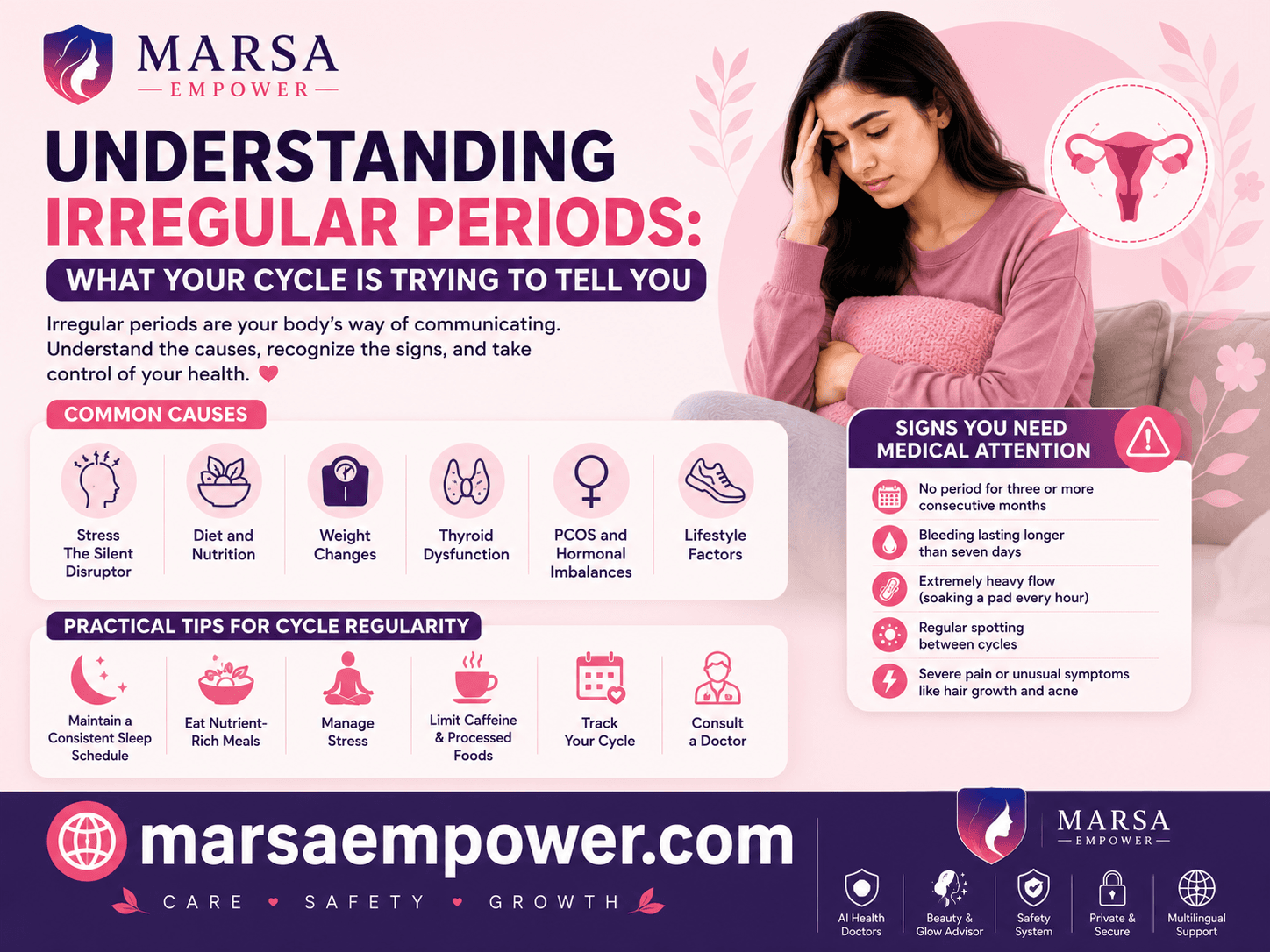
Learn about the causes and implications of irregular periods. Discover expert insights and practical tips to manage your menstrual cycle effectively.

Maryam Mumtaz
Co-Founder & CEO
15 min read•6/26/2026
A comprehensive guide to recognising, understanding, and responding to menstrual irregularity — because your body is not confused. It is communicating.
Her period came fifteen days early this month. Last month it was twelve days late. The month before that, it barely came at all. She tells herself it is fine. That it will regulate on its own. That this is just how her body works. She pushes through the cramping uncertainty, marks another unpredictable date on her calendar, and moves on with her life.
But here is what nobody told her: her body is not confused. It is not malfunctioning. It is not being dramatic. It is communicating — clearly, urgently, and with remarkable consistency — that something in her internal landscape needs attention.
Irregular periods are one of the most important health signals a woman's body can send. They are not merely a calendar inconvenience. They are a window into hormonal health, nutritional status, stress levels, thyroid function, reproductive health, and overall wellbeing. Learning to read that signal — rather than dismiss it — can be transformative.
This guide is for every woman who has ever stared at her phone's period tracker wondering why the predicted date came and went with no sign of bleeding, or who woke up to unexpected spotting two weeks ahead of schedule. It is for women who have been told their irregular cycles are "just stress" without anyone explaining what that actually means, or what to do about it. It is for anyone who suspects her cycle is trying to tell her something — but hasn't yet learned the language.
Let's learn it together.
Before we can understand irregular periods, we need to understand what regular looks like. And the answer might surprise you: regular does not mean a period every 28 days. That figure — repeated in school health classes, textbook diagrams, and app defaults — is an average, not a standard. Real women's cycles vary considerably, and that variation is entirely normal.
A healthy menstrual cycle typically falls anywhere between 21 and 35 days in length, measured from the first day of one period to the first day of the next. A woman with a consistent 23-day cycle is as normal as a woman with a consistent 33-day cycle. What matters far more than the specific number is consistency. If your cycle reliably falls at 26 days every month, that is your normal. If it reliably falls at 32 days, that is your normal.
Irregularity enters the picture when that consistency breaks down — or when the cycle falls persistently outside the 21–35 day range. More specifically, irregular periods include:
The menstrual cycle is sometimes called a woman's fifth vital sign — alongside heart rate, blood pressure, respiratory rate, and temperature. Just as a cardiologist would take an irregular heartbeat seriously as a signal of underlying cardiovascular function, gynecologists and women's health specialists increasingly view cycle irregularity as a meaningful indicator of broader physiological health. Understanding why periods become irregular requires understanding how the cycle works in the first place.
Your menstrual cycle is not simply "bleeding and then not bleeding." It is an extraordinarily complex hormonal symphony involving the brain, the pituitary gland, the ovaries, the uterus, and multiple overlapping hormonal feedback loops — all timed with remarkable precision to create the conditions for potential pregnancy every single month.
The cycle begins in the brain. The hypothalamus — a small structure deep within the brain that serves as the master regulator of hormonal activity — releases gonadotropin-releasing hormone (GnRH) in precisely timed pulses. These pulses instruct the pituitary gland, located just below the hypothalamus, to release two key hormones: follicle-stimulating hormone (FSH) and luteinising hormone (LH).
FSH travels through the bloodstream to the ovaries, where it stimulates a group of follicles — each containing an immature egg — to begin developing. As these follicles grow, they produce increasing amounts of oestrogen, which signals the uterine lining (the endometrium) to thicken and prepare for potential implantation. Rising oestrogen also provides feedback to the brain that follicular development is progressing well.
Eventually — typically around the midpoint of the cycle — oestrogen levels peak dramatically. This triggers a surge of LH from the pituitary gland, which causes the most mature follicle to rupture and release its egg in the process of ovulation. The timing and occurrence of ovulation is arguably the most critical event of the entire cycle, because everything that happens afterward depends upon it.
After ovulation, the ruptured follicle transforms into a structure called the corpus luteum, which produces progesterone. Progesterone prepares the uterine lining for implantation — making it receptive to a fertilised egg — and also suppresses further ovulation. If pregnancy does not occur, the corpus luteum degenerates, progesterone falls, and the uterine lining sheds. That shedding is your period. The fall in progesterone signals the hypothalamus to begin the entire process again.
What this architecture reveals is that menstrual irregularity can originate at any point in this cascade. A disruption in hypothalamic signalling, pituitary function, ovarian response, or the post-ovulatory phase can each produce irregular cycles — but for different reasons and through different mechanisms. This is why understanding the cause of your irregularity matters so much.
Stress is the most common cause of irregular periods that most women never fully understand — not because they do not know stress is bad for their health, but because the specific pathway through which stress disrupts the cycle is rarely explained.
Here is what actually happens. When you experience stress — whether physical, psychological, or emotional — your brain activates the hypothalamic-pituitary-adrenal (HPA) axis, triggering the release of cortisol and adrenaline from the adrenal glands. This is the "fight or flight" response, designed to mobilise energy and sharpen focus in response to immediate threats.
The problem is that the hypothalamus — the same structure that regulates GnRH pulsing for reproductive function — is deeply sensitive to elevated cortisol. When cortisol rises chronically, it directly suppresses GnRH secretion. This disrupts the hormonal cascade at the very first step, leading to delayed or absent ovulation, which in turn leads to irregular, late, or missed periods.
There is an evolutionary logic to this. From the body's perspective, chronic stress signals environmental danger — famine, threat, resource scarcity. These are not ideal conditions for pregnancy. So the reproductive system is temporarily downregulated in favour of survival functions. The body is not malfunctioning when stress delays your period. It is prioritising your survival over reproduction.
The challenge is that modern stressors — relentless work pressure, financial anxiety, relationship strain, disrupted sleep, digital overstimulation, the mental load of managing family and career — are chronic rather than acute. The body cannot distinguish between the acute stress of fleeing a predator (which resolves in minutes) and the chronic stress of an overwhelming workload (which persists for months or years). Both activate the same cortisol response. But chronic cortisol elevation creates sustained suppression of reproductive hormones, leading to persistent cycle irregularity.
Research consistently shows that women in high-stress occupations, caregiving roles, or difficult life circumstances report more menstrual irregularity than their lower-stress counterparts. The mind-body connection here is not metaphorical — it is hormonal, measurable, and clinically significant.
What you eat — and what you do not eat — profoundly affects the hormonal environment that regulates your cycle. The relationship runs in several directions.
First, adequate body fat is essential for oestrogen production. Fat cells (adipocytes) produce and store oestrogen, and when body fat falls too low — through extreme dieting, eating disorders, or rapid weight loss — oestrogen levels drop, and ovulation ceases. This is why women with anorexia nervosa and athletes with very low body fat often stop menstruating entirely, a condition called hypothalamic amenorrhea.
Second, specific nutritional deficiencies directly impact hormonal function. Iron deficiency — extremely common in Pakistani women given dietary patterns and cultural norms around food — can contribute to cycle irregularity as well as dangerously heavy periods. Magnesium deficiency affects over 300 enzymatic processes in the body, including those involved in hormonal synthesis and regulation. Zinc is critical for progesterone production in the second half of the cycle. Vitamin D deficiency — widespread in populations with limited outdoor time or who wear covering clothing — is increasingly linked to PCOS, thyroid dysfunction, and cycle irregularity.
Third, the quality of the diet matters beyond specific nutrients. Diets high in ultra-processed foods, refined carbohydrates, and industrial seed oils drive chronic inflammation and insulin resistance, both of which directly disrupt reproductive hormone balance. Blood sugar instability — caused by irregular eating, skipping meals, or high-sugar diets — creates corresponding instability in hormonal secretion, contributing to cycle irregularity.
Finally, very low calorie intake — whether through intentional restriction or inadvertent under-eating in busy lives — signals nutritional scarcity to the hypothalamus, triggering the same protective reproductive downregulation as stress. The body does not distinguish between deliberate dieting and genuine famine.
Body weight has a complex, bidirectional relationship with menstrual regularity, and both extremes can cause significant disruption.
In women who are significantly underweight, oestrogen production falls below the threshold needed to maintain the endometrium and trigger regular cycles. The hypothalamus essentially hits pause on reproductive function. This is the mechanism behind amenorrhea in women with eating disorders and in female athletes with very low body fat — sometimes called the "female athlete triad" of low energy availability, menstrual dysfunction, and low bone density.
At the other end of the spectrum, significant overweight or obesity creates a different kind of hormonal disruption. Excess adipose (fat) tissue produces excess oestrogen, which can interfere with the hormonal feedback loops governing ovulation. Additionally, obesity is strongly associated with insulin resistance, which elevates insulin levels. High insulin signals the ovaries to produce more androgens (testosterone-like hormones), which disrupts follicular development and ovulation. This is a core mechanism in polycystic ovary syndrome, which we will explore shortly.
Rapid weight change in either direction is often more disruptive than stable weight at either end of the spectrum. The hypothalamus appears sensitive to the rate of change as well as absolute weight — a woman who loses 10 kilograms over three months may experience more cycle disruption than a woman who has been stable at that lower weight for years.
The thyroid gland — a butterfly-shaped structure in the front of the neck — produces hormones that regulate metabolic rate, energy production, and body temperature. What is less commonly known is that thyroid hormones also play a critical role in reproductive function. Every tissue in the body, including the ovaries and uterus, has receptors for thyroid hormones.
Both hypothyroidism (underactive thyroid) and hyperthyroidism (overactive thyroid) disrupt menstrual regularity, though through different mechanisms.
Hypothyroidism — in which the thyroid produces insufficient hormone — is associated with heavy, prolonged, or frequent periods in some women, and with absent or very infrequent periods in others. It elevates prolactin (a hormone normally associated with breastfeeding), which suppresses ovulation. It also slows the liver's clearance of oestrogen, leading to oestrogen excess relative to progesterone, which can cause heavy or irregular bleeding.
Hyperthyroidism — in which the thyroid is overactive — more commonly causes light, infrequent periods or complete cessation of menstruation. The excess metabolic activity disrupts the delicate hormonal timing of the cycle.
Thyroid disorders are among the most common endocrine conditions in women, and they are dramatically under-diagnosed — particularly in Pakistan, where iodine deficiency (the most common dietary cause of hypothyroidism) has historically been prevalent. Many women with thyroid dysfunction spend years attributing their symptoms — fatigue, weight changes, hair loss, mood disturbances, cycle irregularity — to stress or simply "how their body is," when the underlying cause is entirely treatable.
A simple blood test measuring TSH (thyroid-stimulating hormone) and thyroid hormones can identify thyroid dysfunction. If you have irregular periods alongside fatigue, temperature sensitivity, hair changes, or unexplained weight changes, thyroid function testing is an essential first step.
PCOS is the most common endocrine disorder in women of reproductive age, affecting approximately 10–15% of women globally, and likely significantly more in Pakistan and South Asia where dietary patterns, genetic predisposition, and diagnostic rates converge. Yet it remains deeply under-diagnosed and widely misunderstood.
Despite its name, PCOS does not necessarily involve cysts on the ovaries (the "cysts" are actually small, undeveloped follicles that have not released eggs). The condition is fundamentally characterised by three things: irregular or absent ovulation, elevated androgens (male hormones like testosterone), and the appearance of multiple small follicles on ultrasound.
The root cause of PCOS involves complex interactions between insulin resistance, elevated insulin levels, androgen excess, and disrupted hypothalamic-pituitary signalling. Elevated insulin stimulates the ovaries to produce excess androgens. These androgens interfere with follicular development, preventing eggs from maturing and being released normally. Without regular ovulation, the second half of the cycle — the progesterone phase — does not occur properly, leading to cycle irregularity.
The hallmark symptoms of PCOS extend well beyond irregular periods. Many women with PCOS experience acne (particularly along the jawline and chin), excessive facial or body hair (hirsutism) due to elevated androgens, difficulty maintaining a healthy weight, scalp hair thinning, skin darkening around the neck or underarms (acanthosis nigricans), and mood disturbances including anxiety and depression.
PCOS is not a disease in the traditional sense — it is a syndrome, meaning it presents differently in different women and has multiple contributing factors. Lifestyle, diet, stress, sleep, and metabolic health all influence how severely PCOS expresses itself. This is both challenging (there is no single fix) and empowering (many of the contributing factors are modifiable).
Beyond the major causes above, a cluster of lifestyle factors exerts significant influence on cycle regularity — often in ways that are cumulative rather than individually dramatic.
The cumulative effect of several moderate lifestyle disruptions — poor sleep plus high stress plus inadequate nutrition, for example — can be considerably greater than any single factor in isolation. This is why cycle irregularity often emerges during periods of significant life transition: starting university, beginning a demanding job, navigating relationship difficulties, or experiencing bereavement. The combined stress load tips the hormonal balance.
Not every instance of cycle irregularity demands immediate medical evaluation. A single delayed period during an exceptionally stressful month, or a slightly shorter cycle when travelling across time zones, is unlikely to indicate a serious underlying condition. But there are clear signals that indicate it is time to consult a healthcare provider:
It is worth naming something important here: in many parts of Pakistan and South Asia more broadly, there is a cultural tendency to normalise menstrual suffering. Women are told their heavy, painful, irregular periods are simply "part of being a woman." They are not. Menstrual irregularity and significant menstrual pain are medical issues that deserve the same attention and concern as any other health problem. Advocating for your own menstrual health is not vanity or hypochondria — it is essential self-care.
While the right treatment for irregular periods depends entirely on the underlying cause — which is why medical evaluation matters — there are meaningful evidence-based lifestyle approaches that support cycle regularity across a wide range of causes.
Seven to nine hours of quality, consistent sleep is not a luxury. It is a hormonal imperative. During sleep, the body performs essential maintenance on its hormonal systems — releasing growth hormone, resetting cortisol rhythms, consolidating insulin sensitivity. Consistent sleep deprivation is one of the most reliable ways to dysregulate reproductive hormones.
Aim for a consistent sleep and wake time, even on weekends. Create a wind-down routine in the hour before bed that signals to your nervous system that the day is ending. Reduce screen exposure in the evening — the blue light emitted by screens suppresses melatonin, the hormone that initiates sleep. Keep your bedroom cool, dark, and quiet.
If you struggle with sleep quality despite good sleep hygiene practices, this too may be worth discussing with a healthcare provider — sleep disorders including obstructive sleep apnoea are significantly under-diagnosed in women and can contribute to both metabolic and hormonal disruption.
The word "diet" has become so intertwined with restriction that it is worth stepping back and reframing: what your body needs for cycle regularity is not less food, but better nourishment delivered consistently.
Eat at regular intervals and avoid prolonged fasting periods that signal nutritional stress to the hypothalamus. Build meals around whole foods — vegetables, legumes, whole grains, quality proteins, healthy fats — rather than ultra-processed alternatives. Pay particular attention to iron-rich foods (lentils, spinach, red meat, fortified grains), which are especially important if your periods are heavy. Magnesium-rich foods (leafy greens, nuts, seeds, whole grains) support hormonal balance and also reduce period pain.
If you suspect nutritional deficiencies — and given the prevalence of vitamin D, iron, zinc, and magnesium deficiency in Pakistani women, this is not an unreasonable suspicion — blood testing can confirm this, and targeted supplementation under medical guidance can be genuinely transformative for cycle regularity.
Crucially: do not restrict calories dramatically, particularly if you are already lean. The reproductive system reads severe caloric restriction as famine, and responds accordingly.
This is perhaps the most important and most consistently underestimated recommendation. Stress is not a personal failing or a sign of weakness. It is a physiological state that has direct, measurable consequences for hormonal health. Managing it is not optional extra — it is essential healthcare.
Identify your primary stress sources honestly and consider which are modifiable. Implement boundaries around work hours where possible. Build regular physical movement into your day — even 20–30 minutes of moderate walking has been shown to reduce cortisol and improve mood. Invest in social connection, which is one of the most powerful biological buffers against stress. Consider whether talking therapy, mindfulness practices, or other professional support might be beneficial.
Physical movement deserves a specific note here: moderate, regular exercise is genuinely beneficial for cycle regularity — it reduces insulin resistance, supports a healthy weight, lowers chronic inflammation, and improves mood. But there is an important caveat: very intense, very frequent exercise combined with insufficient caloric intake can exacerbate cycle irregularity rather than improve it. The goal is joyful, sustainable movement, not punishing training schedules.
You cannot understand a pattern you are not observing. Consistent cycle tracking — recording not just the start and end dates of your period, but also symptoms like pain, mood changes, energy levels, and cervical mucus — creates a data set that is genuinely useful both for personal insight and for conversations with healthcare providers.
Many women discover through tracking that their "random" cycles are not random at all — they are consistently correlated with identifiable factors. A period that always arrives late following high-stress work periods. Heavier flow during months of poor sleep. Spotting that coincides with a particular phase of the cycle. These patterns are invisible without observation, but meaningful once identified.
Tracking also enables you to identify when irregularity is worsening or improving in response to lifestyle changes, and to notice the warning signs that warrant medical attention.
All the lifestyle strategies above are valuable, but they are not substitutes for professional evaluation when it is warranted. If your cycles have been irregular for more than three months, if you have the warning signs described earlier, or if lifestyle adjustments have not improved things after a few months, see a doctor.
A basic hormonal workup for cycle irregularity typically includes blood tests for FSH, LH, oestrogen, progesterone (timed to the appropriate cycle phase), testosterone, DHEAS, prolactin, TSH, thyroid hormones, and often insulin and fasting glucose. A pelvic ultrasound can assess ovarian appearance and uterine structure. These investigations are straightforward, relatively accessible, and provide the information needed to identify treatable causes.
In Pakistan, access to women's health specialists has expanded significantly in recent years, including through digital and telemedicine platforms. There is no longer a valid reason to leave a three-month absence of periods or persistently irregular cycles unexamined simply because attending a clinic feels difficult.
The insights from experts reveal a profound understanding of the interplay between lifestyle factors and hormonal health. Experts agree that addressing stress and nutrition can lead to significant improvements in cycle regularity. Understanding the role of the hypothalamic-pituitary-gonadal axis offers a window into why stress management and adequate nutrition are pivotal.
What causes irregular periods?
Can stress really delay my period?
Is it normal to have different cycle lengths each month?
When should I see a doctor about irregular periods?
Can lifestyle changes really help regulate my period?
If there is one message worth carrying from everything in this guide, it is this: your menstrual cycle is a vital sign, not an inconvenience. Its regularity — or irregularity — reflects the state of your hormonal health with remarkable fidelity. When it is irregular, it is not failing. It is communicating.
The causes of cycle irregularity are many and varied — stress, nutrition, weight, thyroid function, PCOS, lifestyle — but they are largely identifiable and largely addressable. Many women who have experienced years of cycle irregularity find, after appropriate evaluation and support, that their cycles normalise with targeted lifestyle changes, nutritional support, or medical treatment.
The most important step is simply to start listening. Track your cycle. Note the patterns. Pay attention to the associated symptoms. And when the signals your body is sending warrant professional attention — and they often do — seek it without apology.
Your body is not confused. It is communicating. And it deserves to be heard.
This article is intended for informational and educational purposes. It does not constitute medical advice. If you are experiencing persistent menstrual irregularity, significant changes in flow, pain, or associated symptoms, please consult a qualified healthcare provider for personalised evaluation and guidance.
MARSA Empower is an AI-powered women's empowerment platform offering private, multilingual tools for health, beauty, and safety. From 11 specialized AI health doctors and a personalized Beauty & Glow advisor to a built-in safety system with SOS alerts, MARSA helps women take charge of their wellbeing — accessibly and securely.
Medical Disclaimer
This article is for general informational and educational purposes only and is not a substitute for professional medical advice, diagnosis, or treatment. Always seek the advice of a qualified healthcare provider with any questions you may have regarding a medical condition. Never disregard professional medical advice or delay seeking it because of something you have read on MARSA Empower.
Written By
Maryam Mumtaz
Co-Founder & CEO
Co-Founder of MARSA Empower who leads the visual and strategic evolution of the platform. Maryam bridges technical complexity with human-centric design, architecting the team's official roadmap and ensuring MARSA effectively addresses the real-world needs of women. With deep expertise in agentic AI, full-stack development, and UI/UX design, she has delivered 50+ projects for 30+ satisfied clients.
Enjoyed this story?



