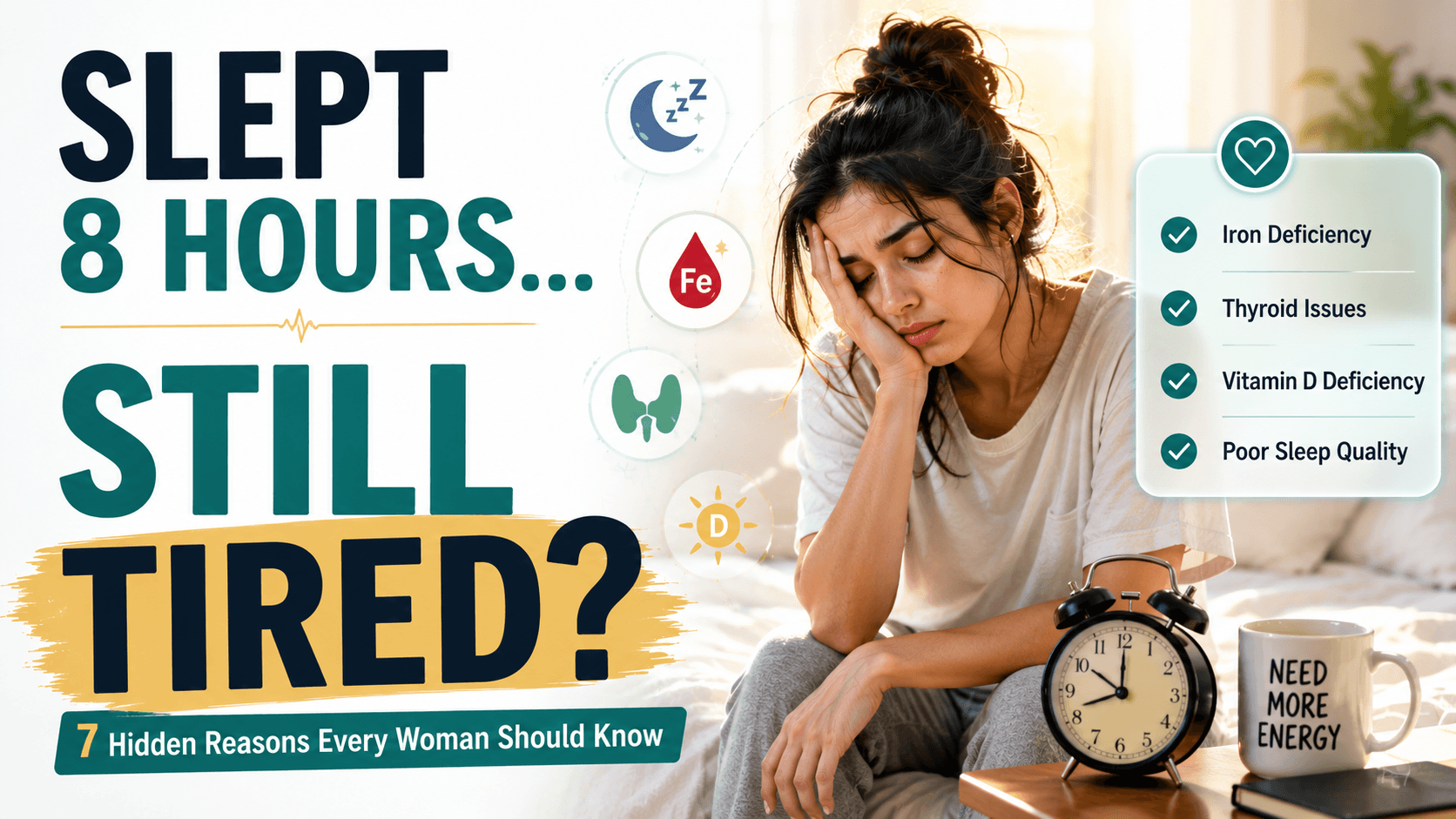
Feeling tired despite getting 8 hours of sleep? Uncover hidden causes of fatigue and learn actionable steps to restore your energy.

Maryam Mumtaz
Co-Founder & CEO
12 min read•7/8/2026
🌿 Marsa Empower · Women's Health · Energy & Sleep Wellness · ~10 min read
"Sleeping 8 hours and waking exhausted is not normal. It is a signal. And it deserves to be investigated."
| # | Hidden Cause | Key System Affected |
|---|---|---|
| 1 | Poor Sleep Quality — Not Just Duration | 🧠 Sleep Architecture |
| 2 | Iron Deficiency Anaemia | 🩸 Oxygen Delivery |
| 3 | Thyroid Dysfunction — Hypothyroidism | 🦋 Metabolism |
| 4 | Chronic Stress & Cortisol Dysregulation | 😰 Adrenal System |
| 5 | Hormonal Imbalances | 🌸 Reproductive Hormones |
| 6 | Vitamin & Nutritional Deficiencies | 💊 Cellular Energy |
| 7 | Undiagnosed Sleep Disorders | 🫁 Sleep Continuity |
| ✅ | What To Do Right Now | 🩺 Action Plan |
She slept 8 hours last night.
She woke up exhausted.
She drank coffee. She pushed through. She collapsed into bed that evening — and did it all again.
She has been telling herself it is just her lifestyle. Just her schedule. Just life. That if she could only get more sleep, things would improve.
But she is already sleeping 8 hours. And it is not improving.
Here is what nobody told her: the problem is almost certainly not the number of hours she is sleeping. It is what is — or is not — happening during those hours. And underneath the sleep quality problem, there is almost always an identifiable cause — hormonal, nutritional, physiological, or psychological — that no amount of extra time in bed will resolve.
Fatigue despite adequate sleep is one of the most common and most dismissed health complaints among women globally. The reason most women never resolve it is simple:
They address the hours of sleep. Not the quality. Not the cause.
This guide addresses the cause.
| # | Cause | The Simple Explanation |
|---|---|---|
| 😴 1 | Poor Sleep Quality | Hours in bed ≠ restorative sleep |
| 🩸 2 | Iron Deficiency Anaemia | Low iron = insufficient oxygen to every cell |
| 🦋 3 | Thyroid Dysfunction | Underactive thyroid slows everything — including recovery |
| 😰 4 | Chronic Stress & Cortisol | High night cortisol prevents deep sleep; low morning cortisol causes exhaustion |
| 🌸 5 | Hormonal Imbalances | Oestrogen & progesterone directly shape sleep architecture |
| 💊 6 | Nutritional Deficiencies | Vitamin D, B12, magnesium & zinc are essential for restorative sleep |
| 🫁 7 | Undiagnosed Sleep Disorders | Sleep apnoea silently destroys sleep quality in women |
The single most important thing to understand about sleep is this: what matters is not how long you sleep, but how deeply and completely you move through the sleep stages.
Sleep is not a single uniform state. It is a structured cycle of distinct stages, each serving specific biological functions:
| Sleep Stage | What Happens | Duration Per Night |
|---|---|---|
| 🌊 Light Sleep (N1 & N2) | Body temperature drops, heart rate slows, brain prepares for deep sleep | ~50% of total sleep |
| 🔵 Deep Sleep (N3 — Slow Wave) | Physical repair, immune strengthening, growth hormone release, energy restoration | ~20–25% |
| 🌙 REM Sleep | Memory consolidation, emotional processing, cognitive restoration | ~20–25% |
It is specifically during deep sleep and REM that the body restores energy, repairs tissue, consolidates memory, and regulates hormones. If these stages are consistently disrupted — even while total sleep hours remain adequate — the body does not complete its restoration cycle.
The result: waking exhausted, regardless of how long you were in bed.
| Disruptor | How It Damages Sleep |
|---|---|
| 📱 Screen exposure before bed | Blue light suppresses melatonin — delaying and reducing deep sleep |
| 😰 Stress & anxiety | Elevated cortisol prevents transition into deep sleep stages |
| 🌸 Hormonal fluctuations | Progesterone drops and oestrogen shifts fragment sleep architecture |
| 🔊 Environmental noise or light | Triggers micro-arousals that interrupt deep sleep without full waking |
| ☕ Caffeine after midday | Blocks adenosine receptors for up to 8–10 hours — reduces deep sleep significantly |
💛 Key Insight
"The question to ask is not 'did I sleep 8 hours?' — it is 'did I complete enough deep sleep and REM cycles to allow full restoration?' These are different questions with very different answers."
Iron is essential for producing haemoglobin — the protein in red blood cells that carries oxygen from the lungs to every cell, organ, and tissue in the body. When iron levels are insufficient, every cell receives less oxygen. Less oxygen means less energy — in muscle, in brain, in every system the body uses to function.
No amount of sleep compensates for insufficient cellular oxygenation. This is why iron-deficient women wake exhausted regardless of how many hours they have slept.
Women lose iron every month through menstruation. Women with heavy periods lose considerably more — sometimes far more than dietary intake can replace. The result is a slow, progressive iron depletion that may develop over months or years before producing symptoms visible enough to seek investigation.
Standard blood tests measuring haemoglobin alone can miss iron deficiency in its early stages. The more sensitive marker is serum ferritin — which measures the body's iron stores and can reveal deficiency weeks or months before haemoglobin falls. Many women with severe fatigue have normal haemoglobin but critically low ferritin.
Always ask specifically for ferritin when investigating fatigue.
💛 Key Insight
"Iron deficiency is the most common nutritional deficiency among women globally — and one of the most reversible causes of persistent fatigue. The fix requires a blood test, a correct diagnosis, and treatment — not more sleep."
The thyroid gland — a small, butterfly-shaped structure in the front of the neck — produces hormones that govern the metabolic rate of virtually every cell in the body. Think of it as the body's internal thermostat and energy regulator.
When the thyroid is underactive (hypothyroidism), it produces insufficient hormone. The body's metabolic processes — including energy production, cellular repair, and the physical restoration that should happen during sleep — slow dramatically. Sleep cannot compensate for metabolic insufficiency, which is why hypothyroid women wake exhausted regardless of how long they sleep.
| Symptom | Description |
|---|---|
| 😴 Unrestorative sleep | Waking after adequate hours feeling heavy, foggy, and unrefreshed |
| ⚖️ Unexplained weight gain | Gaining weight without changes in diet or activity |
| 🧊 Cold sensitivity | Feeling cold when others are comfortable |
| 💇 Hair thinning | Diffuse hair loss across the scalp and outer eyebrows |
| 🐢 Constipation | Slowed gut motility from reduced metabolic activity |
| 🧠 Brain fog & low mood | Cognitive slowing and depression-like symptoms |
Hypothyroidism is significantly more common in women than men and is consistently under-diagnosed — particularly in Pakistan, where thyroid screening is not routine and where iodine deficiency (a primary cause of hypothyroidism) has historically been prevalent. Many women live with untreated hypothyroidism for years, attributing their symptoms to stress, aging, or simply "how their body is."
💛 Key Insight
"Thyroid-related fatigue is distinct from ordinary tiredness — it is heavy, persistent, and entirely unresponsive to sleep. A blood test measuring TSH and free thyroid hormones provides clarity within days. If you have unresolved fatigue alongside weight changes, hair loss, or cold sensitivity — this test is non-negotiable."
Cortisol is the body's primary stress hormone — produced by the adrenal glands and designed to follow a precise daily rhythm: high in the morning to support waking and alertness, and low at night to allow deep, restorative sleep.
Chronic stress disrupts this rhythm entirely.
When stress is sustained over weeks and months, cortisol levels stop following their natural daily curve. Instead:
The result is the pattern many chronically stressed women know well: lying in bed feeling wired but exhausted, sleeping restlessly, waking before fully rested, and facing the day already depleted — regardless of the hours spent in bed.
Many women do not recognise how much stress they are carrying because it has become their baseline. The invisible labour of managing family, career, relationships, finances, and social obligations creates a chronic low-grade cortisol elevation that steadily erodes sleep quality without any single dramatic stressor to point to.
💛 Key Insight
"Chronic stress does not just make you feel tired — it physiologically prevents the deep sleep stages through which energy is actually restored. Addressing the stress load is not optional for resolving this kind of fatigue. It is the essential intervention."
The menstrual cycle creates a monthly hormonal environment that directly affects sleep architecture — the quality, depth, and composition of sleep stages. When this hormonal environment is disrupted, sleep suffers in ways that hours in bed cannot compensate for.
Progesterone has a natural sedative quality — it promotes calm and supports deep sleep. In the second half of the menstrual cycle, as progesterone rises and then drops sharply before menstruation, sleep quality often deteriorates — producing lighter sleep, more frequent waking, and more vivid dreams.
Oestrogen supports the regulation of body temperature during sleep. When oestrogen fluctuates significantly — as in perimenopause, or in conditions like PCOS — night sweats and temperature dysregulation can cause repeated micro-awakenings that fragment sleep without the woman being fully conscious of waking.
| Condition | How It Affects Sleep |
|---|---|
| 🌸 PMS / PMDD | Progesterone drop in late luteal phase fragments deep sleep stages |
| ⚖️ PCOS | Insulin resistance and androgen excess disrupt sleep-wake regulation |
| 🔥 Perimenopause | Night sweats from oestrogen fluctuation cause repeated micro-awakenings |
| 🦋 Thyroid imbalance | Both hypo and hyperthyroidism alter metabolic rate and sleep architecture |
| 👶 Postpartum | Dramatic hormonal drop alongside disrupted sleep schedule compounds exhaustion |
💛 Key Insight
"If your sleep quality consistently worsens at a predictable phase of your menstrual cycle — or if unrestorative sleep arrived alongside a hormonal change — the cause is hormonal, not habitual. Treating the habit without addressing the hormone will not resolve the fatigue."
The body's ability to produce energy and to sleep restoratively both depend on an adequate supply of specific micronutrients. When these nutrients are deficient — as they commonly are in Pakistani women due to dietary patterns, limited sun exposure, and widespread nutritional gaps — the result is fatigue and poor sleep quality that persists regardless of sleep hours.
| Nutrient | Role in Energy & Sleep | Signs of Deficiency |
|---|---|---|
| ☀️ Vitamin D | Regulates sleep-wake cycles; supports cellular energy production | Fatigue · Low mood · Muscle weakness · Poor sleep |
| 💉 Vitamin B12 | Essential for neurological function and energy metabolism | Brain fog · Fatigue · Tingling extremities · Low mood |
| 🥜 Magnesium | Activates over 300 enzymes including those for energy production; supports deep sleep | Muscle cramps · Poor sleep · Fatigue · Anxiety |
| 🦪 Zinc | Supports immune function and is involved in sleep regulation | Frequent illness · Poor wound healing · Sleep disturbances |
Skipping meals, irregular eating, and low dietary diversity all compound these deficiencies — making nutritional causes of fatigue more common than most women realise.
💛 Key Insight
"Nutritional deficiencies are silent. They build gradually and produce symptoms — fatigue, poor sleep, brain fog — that are easily attributed to lifestyle rather than biology. A blood test identifying your specific deficiencies allows targeted, effective treatment rather than general supplements that may miss what your body actually needs."
Some women wake exhausted despite adequate sleep hours because their sleep is being physically interrupted throughout the night — by a sleep disorder they are not aware of, because they do not feel themselves waking.
Obstructive sleep apnoea (OSA) is a condition in which the airway repeatedly collapses or narrows during sleep, causing breathing to stop for seconds at a time — sometimes hundreds of times per night. Each episode triggers a brief arousal that prevents the body from completing deep sleep cycles.
The result: waking exhausted regardless of how many hours were spent in bed — because those hours were fragmented into shallow, unrestorative sleep that the body never had the opportunity to complete.
Sleep apnoea in women presents differently than in men — and the medical understanding of the condition has historically been based on male presentations. Women with sleep apnoea are less likely to report loud snoring (the most recognised symptom in men) and more likely to report:
These symptoms are frequently attributed to stress, depression, or hormonal issues — delaying the correct diagnosis by years.
| Condition | Key Features |
|---|---|
| 😴 Restless Legs Syndrome (RLS) | Uncomfortable leg sensations at rest that disrupt sleep onset and continuity |
| ⏰ Circadian Rhythm Disorder | Internal clock misaligned with the sleep schedule — common in shift workers and students |
| 🧠 Periodic Limb Movement Disorder | Involuntary leg movements during sleep causing micro-arousals |
💛 Key Insight
"If you consistently wake unrefreshed despite sleeping adequate hours, and no nutritional, hormonal, or stress-related cause has been found — a sleep study should be considered. Sleep disorders in women are significantly under-diagnosed and highly treatable when correctly identified."
Do not guess. A targeted blood panel identifies the most common treatable causes of sleep-despite-fatigue within days:
| Test | What It Reveals |
|---|---|
| 🩸 Serum Ferritin | Iron stores — the most sensitive marker; request specifically |
| 🩸 Full Blood Count (FBC) | Anaemia and overall blood health |
| 🦋 TSH + Free Thyroid Hormones | Thyroid function — hypo or hyperthyroidism |
| ☀️ 25-Hydroxyvitamin D | Vitamin D status |
| 💉 Vitamin B12 + Folate | Neurological and energy markers |
| 🍬 Fasting Glucose + Insulin | Blood sugar regulation and insulin resistance |
| 🌸 Reproductive Hormones | If cycle-linked symptoms are present |
| Change | Why It Matters |
|---|---|
| 📵 No screens 60 minutes before bed | Removes blue light that suppresses melatonin |
| 🌡️ Keep bedroom cool and dark | Supports the temperature drop needed for deep sleep |
| ⏰ Consistent sleep and wake time daily | Regulates cortisol rhythm and sleep-wake cycle |
| ☕ No caffeine after 2pm | Caffeine blocks deep sleep for up to 10 hours |
| 🧘 Wind-down routine before bed | Signals the nervous system to transition out of alert mode |
Managing stress is not optional lifestyle advice for women with cortisol-driven sleep disruption — it is the essential intervention. Even 20–30 minutes of daily moderate walking measurably reduces cortisol and improves sleep quality. Consistent bedtime routines, boundaries on work hours, and adequate social support all contribute to cortisol regulation.
If exhaustion persists beyond 2–3 weeks despite lifestyle adjustments — or if it is significantly affecting your ability to function — consult a healthcare professional. Ask specifically for a fatigue panel (ferritin, TSH, vitamin D, B12, fasting glucose) and raise the possibility of a sleep study if sleep quality remains poor after addressing other causes.
| If Your Fatigue Looks Like... | It May Be... | First Step |
|---|---|---|
| 😴 Waking unrefreshed, vivid dreams, light sleep | Poor sleep quality / sleep disorder | Sleep hygiene + consider sleep study |
| 🩸 Exhaustion + pale skin + breathlessness | Iron deficiency anaemia | Serum ferritin test |
| 🦋 Heavy fatigue + weight gain + cold + hair loss | Hypothyroidism | TSH + free thyroid hormones |
| 😰 Tired + wired at night + anxious + stressed | Cortisol dysregulation | Stress management + sleep routine |
| 🌸 Fatigue worse before period or with cycle changes | Hormonal imbalance | Cycle tracking + hormonal panel |
| ☀️ Fatigue + low mood + muscle weakness | Vitamin D / B12 deficiency | Vitamin D + B12 blood test |
| 🫁 Waking exhausted + morning headaches + mood changes | Sleep apnoea | Sleep study / GP referral |
The most important shift in thinking about persistent fatigue is this:
Stop asking "how do I sleep more?" Start asking "why is my sleep not restoring me?"
These are entirely different questions — and they lead to entirely different solutions. More hours in bed will not resolve iron deficiency. More hours in bed will not fix a thyroid condition. More hours in bed will not stabilise cortisol dysregulation or correct a nutritional deficiency or diagnose sleep apnoea.
Only investigation — followed by appropriate, targeted treatment — does that.
Waking exhausted despite 8 hours of sleep is not something to push through. It is not a character trait. It is not just life.
It is a signal from your body that something specific needs attention. You deserve to find out what it is.
"8 hours of sleep should leave you rested. If it doesn't — your body is not failing you. It is asking you for something it has not yet been given. Find out what that is."
📌 Educational Disclaimer
This article is for educational and awareness purposes only. It does not constitute medical advice, diagnosis, or treatment. If you are experiencing persistent fatigue that affects your daily functioning, please consult a qualified healthcare professional for personalised evaluation and guidance.
© Marsa Empower · Women's Health · Sleep Wellness · Energy & Vitality
Medical Disclaimer
This article is for general informational and educational purposes only and is not a substitute for professional medical advice, diagnosis, or treatment. Always seek the advice of a qualified healthcare provider with any questions you may have regarding a medical condition. Never disregard professional medical advice or delay seeking it because of something you have read on MARSA Empower.
Written By
Maryam Mumtaz
Co-Founder & CEO
Co-Founder of MARSA Empower who leads the visual and strategic evolution of the platform. Maryam bridges technical complexity with human-centric design, architecting the team's official roadmap and ensuring MARSA effectively addresses the real-world needs of women. With deep expertise in agentic AI, full-stack development, and UI/UX design, she has delivered 50+ projects for 30+ satisfied clients.
Enjoyed this story?



