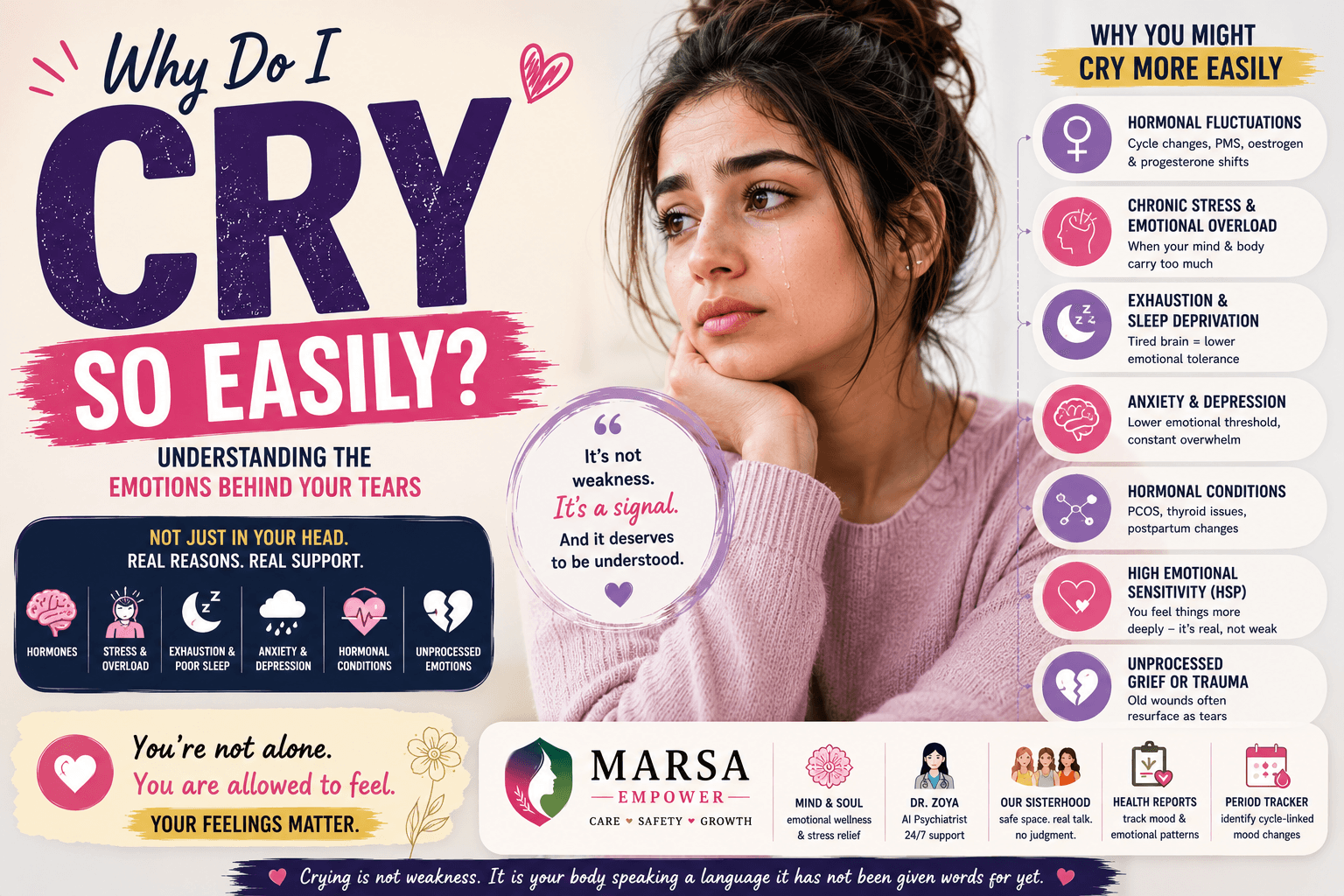
Frequent crying is not a weakness. It's a signal of emotional sensitivity influenced by hormones, stress, and more. Understand the reasons to empower yourself.

Maryam Mumtaz
Co-Founder & CEO
13 min read•7/7/2026
🌸 Marsa Empower · Emotional Wellness & Mental Health · ~10 min read
"Crying is not weakness. It is your body speaking a language it has not yet been given words for."
| # | Section | Theme |
|---|---|---|
| 1 | Introduction — You Are Not Overreacting | 🌱 Awareness |
| 2 | Hormonal Fluctuations | 🔄 Biology |
| 3 | Chronic Stress & Emotional Overload | 😰 Overload |
| 4 | Exhaustion & Sleep Deprivation | 😴 Rest |
| 5 | Anxiety & Depression | 🧠 Mental Health |
| 6 | Hormonal Conditions — PCOS, Thyroid, Postpartum | 💊 Hormones |
| 7 | High Emotional Sensitivity — HSP | 🌱 Neurology |
| 8 | Unprocessed Grief or Trauma | 💔 Healing |
| 9 | When Frequent Crying Signals a Need for Support | ⚠️ Recognition |
| 10 | What Helps — A Practical Guide | ✅ Action |
She cried watching a commercial.
She cried when someone raised their voice slightly.
She cried in the bathroom at work — and then spent ten minutes convincing herself she was overreacting.
She was not overreacting.
She was overwhelmed. And nobody had ever explained why.
For millions of girls and women, frequent crying feels like a weakness they cannot explain and cannot control. They apologise for their tears. They hide them. They label themselves "too sensitive" — because the world has consistently told them that emotional intensity is a flaw.
It is not a flaw.
Tears are not evidence of fragility. They are one of the body's most intelligent responses to internal and external pressure — a biological release mechanism, a stress signal, a hormonal response, and sometimes, the first visible sign of something deeper that deserves attention and care.
This article is about understanding your tears — not apologising for them.
| # | Reason | What It Means |
|---|---|---|
| 🔄 1 | Hormonal Fluctuations | Oestrogen & progesterone directly control emotional regulation |
| 😰 2 | Chronic Stress & Emotional Overload | Tears are the body's natural overflow release valve |
| 😴 3 | Exhaustion & Sleep Deprivation | A tired brain loses its capacity to regulate emotion |
| 🧠 4 | Anxiety & Depression | Both lower the emotional threshold significantly |
| 💊 5 | Hormonal Conditions | PCOS, thyroid, postpartum all affect mood resilience |
| 🌱 6 | High Emotional Sensitivity (HSP) | A neurological trait — not a character flaw |
| 💔 7 | Unprocessed Grief or Trauma | The body holds what the mind has not yet had space to process |
If you have ever noticed that you cry far more easily in the week before your period — you are not imagining it, and you are not being dramatic. You are observing a real, measurable hormonal phenomenon.
Oestrogen and progesterone are not simply reproductive hormones. They are powerful neuroactive chemicals that directly influence:
Throughout the menstrual cycle, these hormones rise and fall in a predictable pattern. In the late luteal phase — the week before menstruation — progesterone drops sharply and oestrogen falls. Serotonin falls with them. The emotional regulation system loses its chemical scaffolding.
The result: a lower threshold for emotional reactivity. Smaller triggers produce larger responses. Things that would not normally move you suddenly bring you to tears. This is not a failure of emotional control. It is a direct hormonal consequence.
| Cycle Phase | Hormones | Emotional Tone |
|---|---|---|
| 🌱 Menstruation (Days 1–5) | Low oestrogen & progesterone | Vulnerable, introspective |
| 🌸 Follicular (Days 6–13) | Rising oestrogen | Energetic, emotionally stable |
| ☀️ Ovulation (Day 14) | Oestrogen peaks | Confident, socially open |
| 🍂 Luteal (Days 15–28) | Progesterone rises then falls | Increasingly sensitive, emotional |
💛 Key Insight
"If your emotional sensitivity follows a predictable monthly pattern — peaking in the week before your period — this is a hormonal event, not a personality flaw. Tracking your cycle reveals the pattern and removes the self-blame."
Think about what a woman typically carries in a single day. Professional responsibilities. Family demands. Relationship dynamics. Financial worry. Social expectations. The constant invisible labour of managing, organising, anticipating, and accommodating — for everyone, in every direction.
This load is real. And it accumulates silently.
When stress builds beyond what the mind and body can quietly process, the nervous system looks for release. Tears are one of the most physiologically efficient release mechanisms available — they actually contain stress hormones, and the act of crying measurably reduces cortisol and activates the parasympathetic nervous system — the body's rest and recovery mode.
When a woman cries at something that seems minor — a small frustration, an offhand comment, a moment of unexpected kindness — she is rarely crying about that specific thing. She is releasing the accumulated weight of everything she has been carrying that has had no other outlet.
💛 Key Insight
"The trigger is rarely the cause. The commercial, the raised voice, the small inconvenience — these are not what the tears are about. They are simply the moment the container finally overflowed."
There is a direct, measurable relationship between sleep deprivation and emotional reactivity — and it is one of the most under-appreciated causes of frequent crying in women.
The prefrontal cortex — the region of the brain responsible for emotional regulation, rational thinking, and measured responses — is acutely sensitive to insufficient sleep. When this region is impaired through chronic tiredness:
The result is that a woman who is chronically sleep-deprived will cry more easily, feel more overwhelmed, and have less capacity to regulate emotional responses — not because she is emotionally unstable, but because her brain's regulation system is running on depleted resources.
💛 Key Insight
"If you cry far more easily when you are tired than when you are rested — this is not coincidence. It is the direct neurological consequence of a depleted prefrontal cortex. Sleep is emotional regulation. They are the same system."
Both anxiety and depression lower the emotional threshold — making ordinary situations feel disproportionately overwhelming, and ordinary moments disproportionately moving.
Anxiety keeps the nervous system in a state of sustained hyperarousal — the body is perpetually braced for threat, using significant energy to manage a sense of danger that may have no specific source. When this state is maintained chronically, the emotional system becomes exhausted and reactive. Small additional triggers produce large emotional responses.
Depression reduces the brain's capacity for emotional resilience — it depletes the neurochemical resources that allow a person to process difficulty, recover from setbacks, and maintain equilibrium. Frequent crying in depression is often less about specific sadness and more about a generalised emotional fragility — the sense that everything is slightly too much.
| Signs of Anxiety-Related Crying | Signs of Depression-Related Crying |
|---|---|
| Crying in anticipation of things going wrong | Crying without being able to identify why |
| Crying during or after stressful situations | Crying that does not relieve the feeling |
| Feeling wired and emotional simultaneously | Persistent low mood between crying episodes |
| Racing thoughts alongside tearfulness | Loss of interest in things that previously brought joy |
💛 Key Insight
"Women are diagnosed with depression at twice the rate of men globally — and frequent, unexplained crying is one of the most consistent early presentations. If this pattern is familiar, it deserves professional attention, not dismissal."
Beyond the monthly hormonal cycle, several specific hormonal conditions produce significant emotional dysregulation that is rarely connected to their physical root cause.
PCOS involves elevated androgens and insulin resistance — both of which disrupt the hormonal environment that supports mood stability. Research consistently shows women with PCOS have significantly higher rates of anxiety and depression than those without it — not coincidentally, but because the hormonal imbalance directly affects brain chemistry.
Hypothyroidism — underactive thyroid — produces emotional symptoms that are frequently misattributed to depression or anxiety: low mood, emotional fragility, tearfulness, fatigue, and a general sense that everything is an effort. Hyperthyroidism — overactive thyroid — produces anxiety, emotional volatility, and tearfulness from the opposite hormonal direction.
Many women are treated for depression or anxiety for years before a thyroid condition is identified as the underlying driver.
After childbirth, oestrogen and progesterone fall dramatically within 24–72 hours — one of the most rapid hormonal shifts the human body experiences. The "baby blues" — tearfulness, emotional fragility, and mood instability in the first two weeks postpartum — are a direct hormonal consequence of this crash, not a sign of inadequate mothering or emotional weakness.
Postpartum depression, which is more persistent and more severe, affects approximately 1 in 5 new mothers and is highly treatable when identified.
💛 Key Insight
"If your emotional sensitivity feels physically driven — if it arrived alongside other physical symptoms, or after a hormonal shift — a hormonal evaluation may reveal a treatable underlying cause that has nothing to do with your psychological resilience."
Approximately 15 to 20 percent of the population are what psychologists call Highly Sensitive Persons (HSPs) — individuals whose nervous systems process emotional and sensory information more deeply, more thoroughly, and more intensely than the average person.
HSPs are not broken, weak, or poorly regulated. Their nervous systems are wired differently — processing more information at a deeper level, noticing subtleties others miss, feeling emotional resonance more intensely, and being moved to tears by beauty, injustice, music, or other people's pain in ways that feel disproportionate by the world's standards.
| HSP Characteristics | What It Looks Like |
|---|---|
| 🎵 Moved deeply by music, art, or beauty | Crying at a beautiful piece of music |
| 👥 Strong empathy for others | Crying when someone else is hurt or upset |
| 🔊 Overwhelmed by sensory stimulation | Crowds, loud environments, or conflict feel physically draining |
| 🔍 Deep processing of experiences | Long reflection after emotional events |
| 🌸 Intense emotional responses | Feeling things more deeply than those around you seem to |
Being a Highly Sensitive Person is not a disorder. It is not something to fix. But understanding it — recognising that your nervous system is genuinely more sensitive, not broken — can replace years of self-blame with self-understanding.
💛 Key Insight
"If you have been told your whole life that you are 'too sensitive' — the world may have been naming a trait it did not understand. High sensitivity is not a deficit. It is a different way of experiencing the world — one that comes with both profound depth and genuine difficulty."
Have you ever cried in response to something small — a song, a scene in a film, a brief moment of unexpected kindness — and felt the intensity of it was completely out of proportion to the trigger?
It almost certainly was out of proportion. Because the tears were not about the trigger.
The body stores unprocessed emotional experiences — grief that was never given space to be felt, fear that was suppressed to keep functioning, loss that was pushed aside because life demanded moving forward. These stored experiences do not simply disappear. They wait.
When a current moment carries even a faint emotional resemblance to something unprocessed — a similar feeling, a similar dynamic, a similar sense of helplessness or loss or being unseen — the body uses the present moment as a release point for the accumulated past.
This is not weakness. It is the body's intelligence — finding any available opening to process what it has been holding.
If you find yourself crying in ways that feel disproportionate, or crying about one thing while sensing the tears are really about something else — this is worth exploring, ideally with a professional who can help create a safe space for what has been waiting to be processed.
💛 Key Insight
"Tears that seem too big for the moment are often carrying something much older. The body is not overreacting. It is finally finding a moment to release what it has been patiently holding."
Crying is a normal, healthy, human experience. But there are specific patterns that signal the body and mind need more support than self-management alone can provide.
| Signal | What It May Indicate |
|---|---|
| 😢 Crying daily or multiple times daily without clear reason | Depression · Hormonal imbalance · Burnout |
| 🌊 Feeling unable to control or stop crying once started | Anxiety · Emotional overwhelm · Trauma response |
| 🌑 Crying accompanied by persistent low mood, hopelessness, or withdrawal | Clinical depression requiring assessment |
| 🚫 Emotional sensitivity significantly interfering with daily life or relationships | Anxiety disorder · PMDD · Hormonal condition |
| ⚡ Crying that began suddenly after a major life change or hormonal shift | Postpartum depression · Thyroid condition · Grief |
💛 Key Insight
"There is an important difference between crying as a healthy emotional release and crying as a persistent, uncontrollable sign of distress. If your tears are accompanied by hopelessness, inability to function, or a sense that you cannot cope — please reach out. You deserve support, not just self-management."
If your emotional sensitivity follows a monthly pattern, tracking your cycle makes that pattern visible — removing self-blame and allowing you to prepare and support yourself during predictably difficult phases.
Sleep is the single most powerful emotional regulation tool available. A consistent sleep schedule — same bedtime and wake time every day — restores the prefrontal cortex's capacity to manage emotional responses. Seven to eight hours is not a luxury. It is a neurological requirement.
Research consistently shows that simply naming an emotion — "I feel overwhelmed," "I feel grief," "I feel afraid" — measurably reduces its intensity. This process, called affect labelling, activates the prefrontal cortex and dampens amygdala reactivity. The act of putting language to what you feel is not just therapeutic. It is neurological regulation.
A trusted friend, family member, counsellor, or therapist. Someone who can hear your tears without rushing to fix or dismiss them. The act of being witnessed — of having your emotional experience acknowledged by another person — is one of the most powerful healing experiences available to us.
Caffeine elevates cortisol and heightens anxiety — directly lowering the emotional threshold and increasing emotional reactivity. If you are already prone to easy crying, high caffeine intake amplifies it measurably.
The habit most women need most — and practice least. Notice the internal response to your own tears. "Why am I being so dramatic?" becomes "I am clearly carrying something heavy right now. That is allowed." Self-compassion is not self-indulgence. It is the foundation of emotional resilience.
If your emotional sensitivity feels physically driven — if it arrives predictably before your period, or alongside physical symptoms like fatigue, hair changes, or weight shifts — ask your doctor to check: TSH, thyroid hormones, reproductive hormones, vitamin D, and B12. Hormonal causes of emotional dysregulation are treatable, and finding them can be genuinely transformative.
| If You Cry Most... | It May Be... | What Helps |
|---|---|---|
| 🩸 In the week before your period | Hormonal fluctuation (PMS/PMDD) | Cycle tracking · Hormonal evaluation |
| 😰 When overwhelmed or exhausted | Chronic stress · Sleep deprivation | Sleep · Boundaries · Rest |
| 🧠 For no clear reason, persistently | Anxiety · Depression | Professional support |
| 💊 Since a hormonal change | PCOS · Thyroid · Postpartum | Hormonal evaluation |
| 🎵 At beauty, music, others' pain | High sensitivity (HSP) | Self-understanding · Self-compassion |
| 💔 At things that seem unrelated | Unprocessed grief or trauma | Therapy · Safe space to process |
There is a world that has spent a very long time telling women that their tears are too much. That crying is weakness. That emotional sensitivity is a flaw to be managed and apologised for.
This is wrong.
Tears are intelligent. They are the body's response to hormonal shifts, to accumulated stress, to inadequate rest, to grief that has not yet been heard, to a nervous system that feels deeply, to a mind that is signalling that it needs support.
Understanding why you cry easily is not about stopping the tears. It is about replacing the shame and self-blame that surround them with something far more useful: curiosity, self-compassion, and the knowledge that your emotional experience makes complete sense.
You were never too sensitive.
You were simply never given the explanation you deserved.
"She was not overreacting. She was overwhelmed. And now — finally — she understands why."
📌 Educational Disclaimer
This article is for educational and awareness purposes only. It does not constitute medical advice, diagnosis, or treatment. If you are experiencing persistent emotional distress, frequent uncontrollable crying, or symptoms of anxiety or depression, please consult a qualified mental health or healthcare professional. You deserve support — not just information.
© Marsa Empower · Emotional Wellness · Women's Health · Mind & Soul
Medical Disclaimer
This article is for general informational and educational purposes only and is not a substitute for professional medical advice, diagnosis, or treatment. Always seek the advice of a qualified healthcare provider with any questions you may have regarding a medical condition. Never disregard professional medical advice or delay seeking it because of something you have read on MARSA Empower.
Written By
Maryam Mumtaz
Co-Founder & CEO
Co-Founder of MARSA Empower who leads the visual and strategic evolution of the platform. Maryam bridges technical complexity with human-centric design, architecting the team's official roadmap and ensuring MARSA effectively addresses the real-world needs of women. With deep expertise in agentic AI, full-stack development, and UI/UX design, she has delivered 50+ projects for 30+ satisfied clients.
Enjoyed this story?