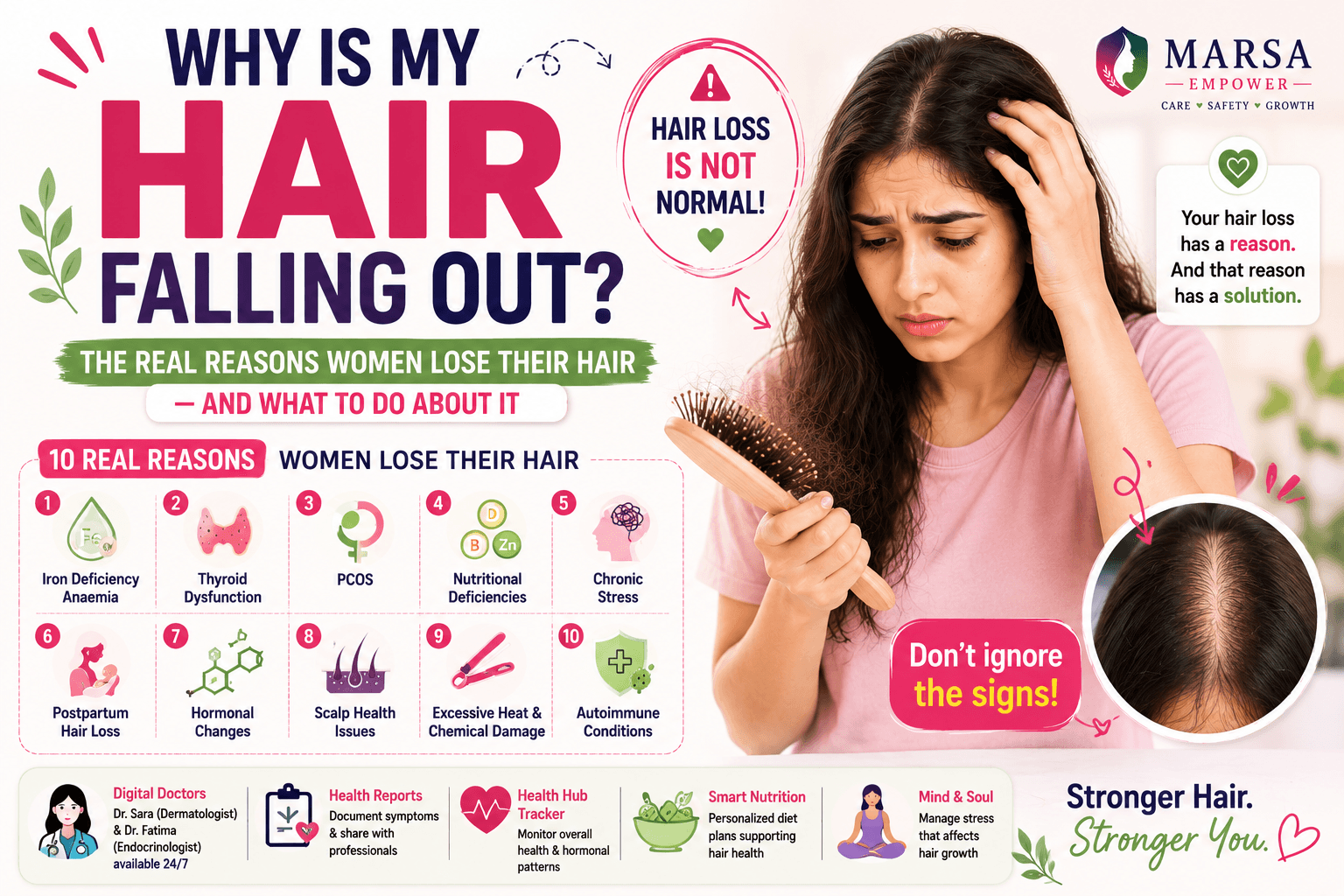
Discover the common causes of hair loss in women and practical solutions to regain healthy hair. Learn from expert insights and actionable tips.

Maryam Mumtaz
Co-Founder & CEO
12 min read•7/2/2026
"Your hair loss has a reason. And that reason has a solution."
She notices more hair in the shower drain every morning. Her brush collects far more than it used to. She can see her scalp now — in places where she never could before.
She tells herself it is seasonal. She switches shampoos. She tries a new hair oil, a new routine, a new supplement she read about online. She waits.
But the hair keeps falling.
Hair loss is one of the most emotionally distressing health concerns a woman can experience — because hair is deeply tied to identity, femininity, and self-image in ways that go far beyond vanity. Watching it fall out, handful by handful, with no clear explanation, is quietly devastating. And yet most women who search for answers are met with generic advice about shampoo and scalp massage, while the actual cause — the medical, hormonal, or nutritional reason driving the shedding — goes completely uninvestigated.
That changes today.
The truth is that hair loss in women is almost always a symptom of something else happening in the body. It is rarely about your hair care routine. It is about what is happening internally — in your blood, your hormones, your thyroid, your nutritional status, your stress levels. Understanding the real cause is the only route to an effective solution.
Here are the ten most important real reasons women lose their hair.
| # | Real Cause | Type of Hair Loss |
|---|---|---|
| 1 | Iron Deficiency Anaemia | Diffuse shedding across the scalp |
| 2 | Thyroid Dysfunction | Diffuse thinning, including eyebrows |
| 3 | PCOS & Androgen Excess | Crown and temple thinning |
| 4 | Nutritional Deficiencies | Diffuse shedding and weakened hair |
| 5 | Chronic Stress | Sudden diffuse shedding (telogen effluvium) |
| 6 | Postpartum Hair Loss | Sudden diffuse shedding after childbirth |
| 7 | Hormonal Changes | Cycle or menopause-related thinning |
| 8 | Scalp Health Issues | Shedding from inflamed follicle environment |
| 9 | Heat & Chemical Damage | Breakage and shaft damage |
| 10 | Autoimmune Conditions | Patchy or sudden asymmetric loss |
Before exploring each cause, it helps to understand what normal hair loss looks like. Losing between 50 and 100 hairs per day is considered normal — hair naturally cycles through growth, transition, and resting phases, and daily shedding is part of that cycle. Concern begins when daily loss consistently exceeds 100 to 150 hairs, when visible thinning appears, or when the scalp becomes visible through previously dense hair.
If there is one cause of hair loss in women that is simultaneously the most common, the most overlooked, and the most treatable — it is iron deficiency. Iron is not simply a nutrient for blood health. It is directly essential for healthy hair growth at the follicle level.
Hair follicles are among the most metabolically active cells in the body — they divide rapidly and require a rich, constant supply of oxygen and nutrients to sustain growth. Iron is required to carry oxygen in the blood via haemoglobin. When iron stores drop, even before anaemia fully develops, the body begins a triage process — redirecting available iron toward essential organs and deprioritising "non-essential" functions like hair growth. Hair follicles enter the resting phase prematurely, and shedding accelerates.
Women lose iron every month through menstruation. Women with heavy periods — clinically defined as soaking a pad or tampon more frequently than every hour, or periods lasting longer than seven days — lose substantially more iron than the average diet can replace. The result is progressive iron depletion that may take months or years to produce visible symptoms, by which time hair loss, fatigue, breathlessness, and pallor are already well established.
Standard blood tests measuring haemoglobin alone can miss iron deficiency in its early stages. Serum ferritin — which measures the body's iron stores — is the more sensitive marker and can reveal deficiency weeks or months before haemoglobin falls. Many women with significant hair loss have normal haemoglobin but critically low ferritin. Always ask for ferritin specifically.
Iron deficiency is the most common and most reversible cause of hair loss in women. If you have heavy periods and are losing hair — a ferritin test is the single most important first step.
The thyroid gland produces hormones that regulate the metabolic rate of virtually every cell in the body — including the cells of the hair follicle. Both an underactive thyroid (hypothyroidism) and an overactive thyroid (hyperthyroidism) directly disrupt the hair growth cycle, making thyroid dysfunction one of the most significant and most under-diagnosed causes of hair loss in women.
Thyroid hair loss is typically diffuse — meaning it occurs evenly across the entire scalp rather than in patches. The overall density of the hair reduces gradually, making individual strands appear finer and the scalp increasingly visible under normal lighting. In hypothyroidism, the outer third of the eyebrows may also thin — a hallmark sign that is frequently overlooked.
Unlike iron-deficiency hair loss, which responds relatively quickly to supplementation, thyroid-related hair loss takes longer to reverse — because the hair growth cycle must restart and complete a full growth phase before visible regrowth occurs. This typically takes six to twelve months after thyroid function has been restored to normal with appropriate treatment.
Thyroid-related hair loss develops slowly and is easily dismissed as aging, stress, or seasonal change. The associated symptoms — fatigue, weight gain, cold sensitivity, constipation, dry skin, low mood — are similarly gradual and non-specific, making it easy for both women and doctors to attribute them to other causes.
A blood test measuring TSH and free thyroid hormones is essential if you have diffuse hair thinning — particularly if combined with fatigue, weight changes, or cold sensitivity. Thyroid conditions are highly treatable, and hair typically regrows once thyroid function is normalised.
Polycystic Ovary Syndrome is the most common hormonal condition in women of reproductive age, affecting approximately one in ten women. Among its many symptoms, the hair-related effects are some of the most distressing — because PCOS causes scalp hair loss and unwanted facial or body hair simultaneously, through the same hormonal mechanism.
PCOS is characterised by elevated androgens — testosterone-like hormones that, in women, are normally present in small amounts. When androgen levels rise, the hair follicles most sensitive to DHT (dihydrotestosterone — a potent androgen derivative) begin to miniaturise. These follicles are concentrated at the temples and crown of the scalp, producing a pattern of thinning that resembles male-pattern baldness — receding hairline at the temples and thinning at the crown, while the back and sides of the scalp remain relatively dense.
The cruelty of androgenic hair loss in PCOS is that the same androgen excess simultaneously stimulates hair growth in androgen-sensitive areas of the face and body — resulting in the distressing combination of losing hair where you want it while gaining it where you do not.
Managing the underlying androgen excess through lifestyle, nutrition, and medical treatment — rather than solely addressing the hair loss topically — is the only approach that addresses the root cause. Anti-androgen medications, inositol supplementation, and insulin-sensitising strategies can all reduce androgen levels and, over time, slow or partially reverse androgenic hair loss.
If your hair loss is concentrated at the temples and crown, and you also have irregular periods, acne, or excess facial hair — PCOS and androgen excess should be investigated as the primary cause.
Hair is built from protein — specifically keratin — and its growth is sustained by a continuous supply of vitamins, minerals, and amino acids delivered through the bloodstream. When the diet is deficient in any of the key nutrients supporting hair growth, the follicle's ability to produce and maintain healthy hair strands is compromised.
Protein is the structural building block of hair itself. Severe protein restriction — through restrictive dieting, eating disorders, or simply inadequate intake — causes diffuse shedding as the body prioritises protein for essential organ function over hair production.
Vitamin D plays a role in hair follicle cycling and the activation of new hair growth. Deficiency — extremely prevalent among Pakistani women — has been directly linked to increased hair shedding and reduced hair density.
Biotin (Vitamin B7) supports keratin production and is one of the most commonly cited nutrients in hair loss discussions. True biotin deficiency is relatively rare in women with varied diets, but low-level insufficiency can contribute to brittle hair and increased breakage.
Zinc regulates oil glands around the follicle and supports the repair of hair tissue. Deficiency — common in women with low meat intake or high phytate diets — impairs follicle function and accelerates shedding.
Iron (see Reason 01) and B12 complete the essential nutritional picture — both critical for oxygen delivery to follicles and cellular energy production.
Before investing in expensive hair supplements, a blood test identifying your actual nutritional deficiencies allows targeted, evidence-based supplementation rather than guesswork. Not all hair loss supplements address the deficiency driving your specific hair loss.
Stress-related hair loss is real, measurable, and remarkably common — but it operates on a delay that makes it confusing to identify. The condition is called telogen effluvium, and understanding how it works explains why women often notice hair loss months after a stressful event rather than during it.
Under significant physical or psychological stress — a major illness, surgery, extreme emotional trauma, bereavement, rapid weight loss, or prolonged chronic stress — the body shifts a large proportion of hair follicles prematurely from the active growth phase (anagen) into the resting phase (telogen). This is a survival response: the body diverts energy away from "non-essential" functions like hair growth toward managing the stressor.
The hair that entered the resting phase does not shed immediately. It sheds two to three months later, when the resting phase completes — which is why women experiencing telogen effluvium often report sudden, alarming hair loss seemingly out of nowhere, without connecting it to the stressful period they experienced weeks or months earlier.
Telogen effluvium is typically self-limiting — once the triggering stressor is resolved and the body returns to equilibrium, the follicles re-enter the growth phase and hair density gradually returns over six to twelve months. Managing ongoing stress, supporting nutrition, and giving the body time are the primary tools.
If you experienced a highly stressful period two to four months before your hair loss began — the two are almost certainly connected. Telogen effluvium is not permanent, but addressing the underlying stress and nutritional status supports faster recovery.
Many women notice during pregnancy that their hair looks fuller, thicker, and more lustrous than ever before. This is not imagination. Elevated oestrogen levels during pregnancy extend the active growth phase of the hair cycle, reducing normal daily shedding and allowing hair to accumulate density.
After childbirth, oestrogen levels drop dramatically and rapidly. This signals the hair follicles that had been held in the extended growth phase to enter the resting phase simultaneously — and two to four months later, to shed. The result is sudden, often alarming hair loss that can feel far more dramatic than it actually is, because several months' worth of retained hair sheds in a compressed period.
Postpartum hair loss is temporary and normal — though the degree to which it is normalised in women's healthcare often leaves new mothers genuinely frightened by the volume of shedding. It typically resolves within six to twelve months of childbirth. Supporting recovery through adequate iron intake (particularly important after blood loss during delivery), good nutrition, and sufficient sleep supports faster follicle recovery.
Postpartum hair loss is a hormonal adjustment, not a permanent condition. If hair loss continues beyond twelve months postpartum, or is accompanied by other symptoms, thyroid dysfunction — which commonly develops after childbirth — should be investigated.
Beyond pregnancy, the relationship between oestrogen and hair health is ongoing throughout a woman's reproductive life. Oestrogen supports hair growth by prolonging the active growth phase of the hair cycle. When oestrogen fluctuates or declines — during the menstrual cycle, in perimenopause, or after stopping hormonal contraceptives — hair density can reduce noticeably.
Perimenopause — the years of hormonal transition preceding menopause, typically beginning in the mid-forties — brings progressive oestrogen decline alongside increasing androgen relative dominance. This hormonal shift can produce thinning similar to, though generally milder than, the androgenic pattern seen in PCOS. Many perimenopausal women notice their hair becoming finer and less dense during this period.
Women who stop combined oral contraceptives — which contain synthetic oestrogen and progestogen — sometimes experience a period of hair shedding in the months following cessation. This is another form of telogen effluvium triggered by the hormonal shift, and it generally resolves as the body re-establishes its own hormonal balance.
If your hair loss coincides with a hormonal transition — stopping the pill, approaching perimenopause, or significant cycle changes — hormonal evaluation can confirm the connection and guide appropriate support.
The scalp is the environment from which every hair grows. When the scalp is unhealthy — inflamed, infected, or chronically irritated — the follicles embedded within it cannot function optimally, and hair growth and retention are compromised.
Seborrheic dermatitis — a chronic inflammatory condition producing flaking, redness, and itching — creates chronic low-grade inflammation around the follicles that accelerates shedding.
Scalp psoriasis produces thick, scaly plaques that can physically block follicles and, in severe cases, cause scarring that permanently affects regrowth in affected areas.
Tinea capitis — a fungal infection of the scalp — causes patchy hair loss with scaling and is more common in women who frequently wear tight hairstyles or share hair accessories.
Traction folliculitis — inflammation caused by chronic pulling from tight braids, ponytails, or extensions — damages follicles over time and can, if sustained, cause permanent hair loss along the hairline and part.
If your hair loss is accompanied by scalp itching, flaking, redness, or tenderness — the scalp itself needs treating before hair loss can be addressed effectively. A dermatologist can diagnose and treat scalp conditions that are silently compromising your hair health.
Not all hair loss originates from within the body. Physical and chemical damage to the hair shaft and follicle can cause significant breakage and visible thinning that, while distinct from the internal causes above, is no less distressing.
Heat styling — straighteners, curling irons, and blow dryers used at high heat — progressively weaken the protein bonds within the hair shaft, causing it to become brittle, prone to snapping, and increasingly thin in appearance.
Chemical treatments — relaxers, perms, bleach, and frequent colouring — alter the hair's structural integrity at the molecular level. Repeated chemical processing without adequate recovery time causes cumulative damage that manifests as breakage, split ends, and reduced hair density.
Tight hairstyles — worn consistently over months or years — place sustained tension on the follicle. Traction alopecia, the hair loss that results, begins as reversible follicle damage but can become permanent if the traction continues long enough.
Damage-related hair loss responds to removing the damaging practice and allowing the hair to recover — but the recovery timeline is slow, because hair grows approximately one centimetre per month. Early intervention prevents progression to permanent follicle damage.
Autoimmune hair loss — where the body's own immune system incorrectly identifies hair follicles as foreign and attacks them — is less common than the causes above but produces some of the most distinctive and distressing patterns of hair loss.
Alopecia areata presents as sudden, patchy, well-defined circular areas of complete hair loss on the scalp or anywhere on the body. It can develop rapidly — patches appearing within days — and its course is unpredictable. Some women experience a single episode with full regrowth; others experience progressive or recurrent loss.
Systemic lupus erythematosus (SLE) can cause both diffuse hair thinning and more localised hairline recession, often alongside other systemic symptoms including joint pain, skin rashes, and fatigue. Other autoimmune conditions including Hashimoto's thyroiditis (the most common cause of hypothyroidism) produce hair loss through their effects on thyroid function.
Patchy, sudden, or asymmetric hair loss — particularly if it develops rapidly or is accompanied by systemic symptoms — warrants prompt medical evaluation to rule out autoimmune conditions. Early diagnosis and management significantly improve outcomes.
Understanding the cause is step one. Here is how to begin:
Ask your doctor to include the following in a hair loss evaluation:
| Test | What It Reveals |
|---|---|
| Serum Ferritin | Iron stores — the most sensitive iron marker for hair loss |
| Full Blood Count | Anaemia and overall blood health |
| TSH & Free Thyroid Hormones | Thyroid function |
| Testosterone & DHEAS | Androgen levels — relevant if PCOS is suspected |
| 25-Hydroxyvitamin D | Vitamin D status |
| B12 & Folate | Nutritional markers affecting hair and energy |
| Fasting Insulin & Glucose | Metabolic health and insulin resistance |
While investigation results are pending, implement these evidence-based foundations:
There is a tendency to minimise hair loss in women as a cosmetic concern — as though caring about losing your hair is trivial or superficial. It is neither. Hair loss is almost always a signal of something happening internally that deserves investigation. And the emotional impact of watching your hair thin — the loss of confidence, the anxiety, the careful styling to conceal what others might see — is a very real, very legitimate health burden.
You do not have to simply accept hair loss as inevitable or untreatable. For the vast majority of women, hair loss has an identifiable cause. And identifiable causes have solutions — whether that is correcting a nutritional deficiency, treating a thyroid condition, managing PCOS, addressing scalp health, or simply giving the body the time and nutrients it needs to recover.
Your hair loss has a reason. You deserve to know what it is.
"Most hair loss in women is not about the hair. It is about what is happening beneath the surface — in the blood, in the hormones, in the body's internal landscape. Find the cause, and you find the solution."
This article is for educational and awareness purposes only. It does not constitute medical advice, diagnosis, or treatment. If you are experiencing significant or persistent hair loss, please consult a qualified healthcare professional — including a dermatologist or endocrinologist — for personalised evaluation and guidance.
MARSA Empower is an AI-powered women's empowerment platform offering private, multilingual tools for health, beauty, and safety. From 11 specialized AI health doctors and a personalized Beauty & Glow advisor to a built-in safety system with SOS alerts, MARSA helps women take charge of their wellbeing — accessibly and securely.
Medical Disclaimer
This article is for general informational and educational purposes only and is not a substitute for professional medical advice, diagnosis, or treatment. Always seek the advice of a qualified healthcare provider with any questions you may have regarding a medical condition. Never disregard professional medical advice or delay seeking it because of something you have read on MARSA Empower.
Written By
Maryam Mumtaz
Co-Founder & CEO
Co-Founder of MARSA Empower who leads the visual and strategic evolution of the platform. Maryam bridges technical complexity with human-centric design, architecting the team's official roadmap and ensuring MARSA effectively addresses the real-world needs of women. With deep expertise in agentic AI, full-stack development, and UI/UX design, she has delivered 50+ projects for 30+ satisfied clients.
Enjoyed this story?



