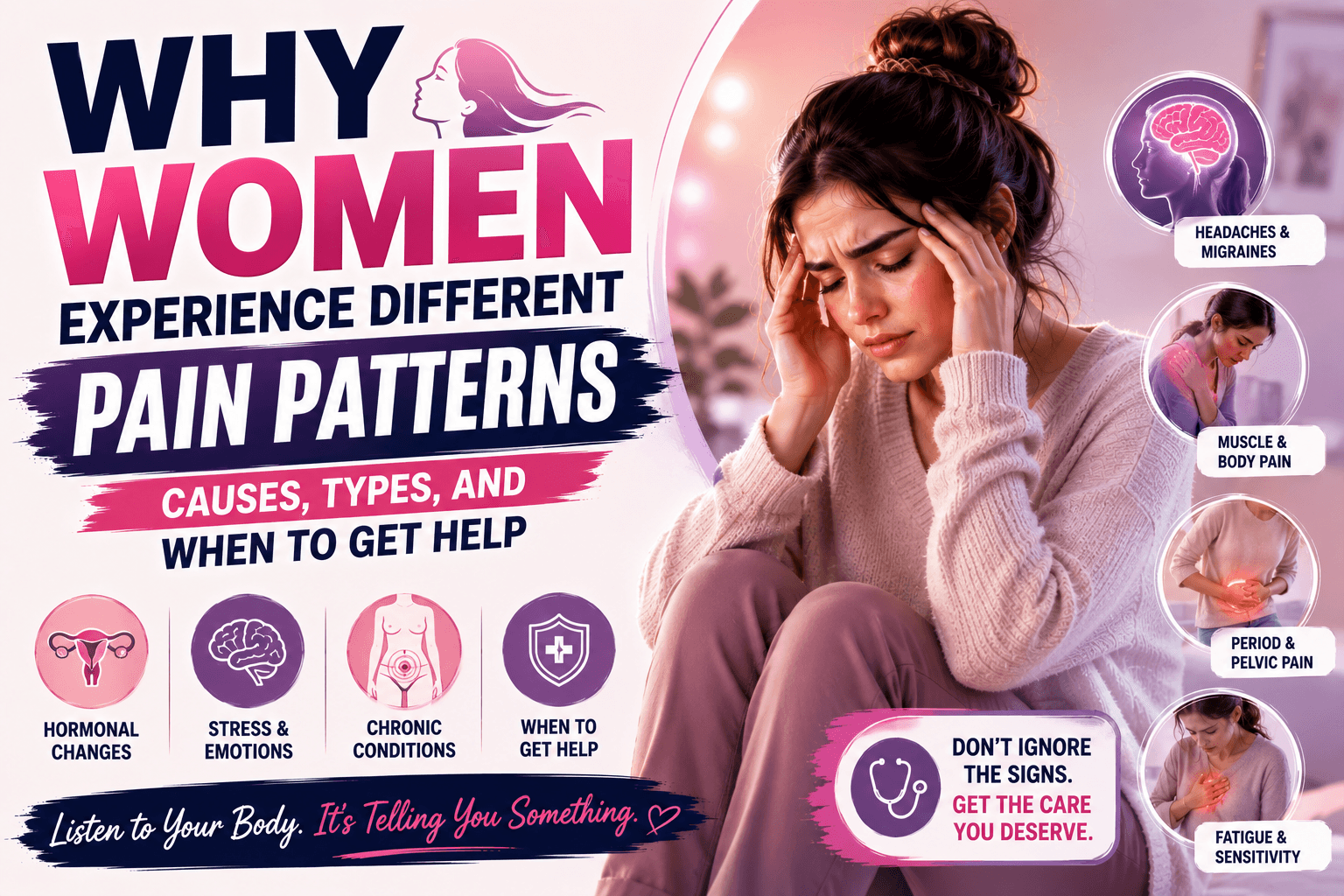
Discover why women's pain patterns differ, the underlying causes, types of pain, and when to seek medical advice. Gain insights into managing and understanding women's health.

Maryam Mumtaz
Co-Founder & CEO
12 min read•9/1/2026
Marsa Empower · Women's Health · Body Awareness · For Girls & Women Aged 13 and Above · 12 min read
Pain is one of the body's most important communication systems. It tells you that something deserves attention, that a process is occurring in the body that the nervous system has judged worth flagging. But pain is also one of the most misunderstood and most frequently dismissed aspects of women's health.
Women are statistically more likely than men to have their pain dismissed, minimised, or attributed to psychological rather than physical causes. They are more likely to wait longer in emergency departments before receiving pain medication. And they are more likely to have significant pain-causing conditions, including endometriosis, adenomyosis, and fibromyalgia, go undiagnosed for years because their pain has been normalised as "just part of being a woman."
This guide takes a different approach. Pain is real. It varies between women for specific biological, hormonal, and neurological reasons. Understanding your own pain patterns — what they feel like, when they occur, what changes them, and what accompanies them — is genuinely useful health knowledge. And knowing when pain deserves professional evaluation, rather than simply endurance, is one of the most important things a woman can understand about her own health.
A pain pattern describes how, when, where, and how often pain occurs for a specific person. Rather than simply registering that something hurts, recognising the pattern of pain provides information that is far more useful for understanding what is causing it and whether anything has changed.
When you experience pain, try to notice the following. Where exactly it is located, as specifically as possible. What it feels like, whether it is sharp, dull, cramping, throbbing, burning, pressing, aching, or heavy. When it begins in relation to your cycle, your activities, or other factors. How long it lasts. How severe it is on a scale of one to ten. What makes it better. What makes it worse. What other symptoms accompany it.
These details transform "I have pain" into the kind of specific, documented clinical information that allows a healthcare provider to make a meaningful assessment. They also allow you to recognise when your personal pain pattern changes, which is often more clinically significant than the baseline pattern itself.
Pain is not a simple, uniform experience that every person with the same condition registers identically. It is a complex neurobiological experience shaped by many factors that vary between individuals.
Two women with confirmed endometriosis may describe entirely different pain experiences. One finds her pain manageable with over-the-counter medication. The other is unable to function on the most severe days. This does not mean one woman's endometriosis is more real than the other's, or that one is more or less tolerant of pain. It reflects genuine individual differences in the biology of pain processing.
Several factors contribute to this variability. The sensitivity of individual nerve pathways varies between people and changes with time and circumstances. The hormonal environment at the time of pain influences how strongly the nervous system amplifies or dampens the signal. Prior experiences with pain, including trauma and previous significant pain episodes, can sensitise pain pathways in ways that change how future pain is experienced. Inflammation levels, which vary between individuals and are influenced by diet, sleep, and underlying conditions, affect pain intensity. The brain's own pain-modulating systems, including the endogenous opioid system, vary in their activity between individuals.
Understanding that these differences exist removes the invalid comparison of one woman's pain experience to another's. Your pain experience is real and specific to you. It does not require validation by comparison.
Women's hormonal environment changes throughout the menstrual cycle and across different life stages, and these hormonal fluctuations directly influence pain sensitivity and pain patterns.
Oestrogen influences pain through multiple pathways. Higher oestrogen levels are generally associated with lower pain sensitivity in some situations but with increased inflammation and prostaglandin production in others. The cyclical rise and fall of oestrogen across the menstrual cycle creates predictable changes in pain patterns for many women.
Progesterone has mild analgesic (pain-reducing) properties in some contexts, which may explain why the luteal phase of the cycle, when progesterone is highest, is sometimes associated with reduced pain sensitivity despite the increased physical symptoms of this phase.
Prostaglandins, produced in the uterine lining during menstruation, directly drive cramping and also affect other body systems including the gut, producing the nausea, diarrhoea, and headaches that often accompany menstrual pain.
During pregnancy, the hormonal environment produces significant changes in pain sensitivity and pain distribution. Postpartum hormonal shifts affect pain patterns. Perimenopause and menopause bring declining oestrogen that changes pain sensitivity and produces new pain patterns for some women.
For many women, tracking pain alongside their menstrual cycle reveals hormonal patterns they had not previously recognised. Pain that consistently worsens in the premenstrual phase, pain that occurs specifically around ovulation, or pain that is dramatically different in the follicular versus luteal phase all point toward hormonal influences worth documenting and discussing with a healthcare provider.
Period pain, known medically as dysmenorrhoea, is one of the most universally experienced pain patterns among women, and also one of the most variable in its character and severity.
Mild to moderate cramping in the first two to three days of a period is common and expected. It is caused by prostaglandins produced by the endometrial lining as it sheds, which stimulate uterine muscle contractions. The same prostaglandins can produce lower back pain, headaches, nausea, diarrhoea, and fatigue alongside the direct cramping.
However, the range of period pain experience extends from barely noticeable to completely debilitating. This range reflects real differences in prostaglandin production, uterine sensitivity, and in some cases, the presence of underlying conditions that significantly amplify pain.
Conditions including endometriosis, adenomyosis, uterine fibroids, and ovarian cysts can all produce period pain that is significantly more severe than the prostaglandin-driven cramping of uncomplicated menstruation. The critical difference is often in the pattern. Pain that begins before the period, pain that persists throughout the entire period rather than improving after the first two days, pain that has worsened progressively over time, and pain that is accompanied by pain during intercourse or bowel movements all suggest secondary dysmenorrhoea requiring investigation.
The normalisation of severe period pain is one of the most significant barriers to timely diagnosis of conditions like endometriosis, where the average diagnostic delay is seven to ten years. A woman whose period pain prevents her from attending school or work, or who relies on strong pain medication to function on her heaviest days, does not have pain that she simply has to accept. She has pain that deserves proper evaluation.
Headaches are among the most common pain complaints in women, and their presentation varies significantly between individuals and across different contexts.
Tension headaches, the most common type, typically produce a bilateral pressing or tightening sensation around the head, sometimes described as a band around the head. They are associated with stress, muscle tension in the neck and shoulders, eye strain, poor posture, and dehydration.
Migraines are a distinct neurological condition producing moderate to severe throbbing or pulsating pain, typically unilateral (one-sided), and often accompanied by nausea, sensitivity to light and sound, and sometimes visual aura (changes in vision preceding the headache). Migraines are significantly more common in women than men, largely because of the hormonal connection. Many women experience predictable hormonal migraines, occurring in the days before or during menstruation when oestrogen drops sharply.
Cervicogenic headaches originate from the neck and often present as one-sided pain radiating from the back of the head toward the forehead.
Tracking headache patterns, including timing in relation to the menstrual cycle, potential triggers, severity, duration, and accompanying symptoms, helps identify the headache type and potential causes. Headaches that are new, rapidly worsening, severe and sudden, or accompanied by neurological symptoms (confusion, weakness, vision changes) require prompt medical evaluation.
Pelvic pain is a broad symptom that can arise from many different structures and conditions, and its character, timing, and associated symptoms are what differentiate its many possible causes.
Cyclical pelvic pain, occurring predictably in relation to the menstrual cycle, is most commonly associated with conditions of the reproductive system including endometriosis, adenomyosis, and ovarian cysts. Pain around ovulation (mittelschmerz) is a recognised and usually benign cause of brief mid-cycle pelvic discomfort.
Non-cyclical pelvic pain that is persistent or recurrent regardless of cycle phase has a broader differential including urinary tract conditions, digestive conditions (including irritable bowel syndrome and inflammatory bowel disease), musculoskeletal causes, and pelvic floor dysfunction.
Acute, sudden pelvic pain that is severe or escalating requires prompt medical evaluation to rule out conditions requiring urgent treatment, including ruptured ovarian cysts, ectopic pregnancy, appendicitis, and pelvic inflammatory disease.
Because pelvic pain has so many possible causes, proper evaluation by a healthcare provider including clinical examination and appropriate investigation is essential for any pelvic pain that is persistent, severe, new, or changing.
Breast pain (mastalgia) is common in women and is most often cyclical, occurring in the premenstrual phase and resolving after the period begins. This cyclical pattern reflects the normal hormonal changes of the luteal phase and is generally benign, though it can be uncomfortable.
Non-cyclical breast pain, occurring without a predictable relationship to the menstrual cycle, has different possible causes including costochondritis (inflammation of the rib cartilage), musculoskeletal sources, skin conditions, or within the breast tissue itself.
Breast pain that is localised to a specific area and persistent, breast pain accompanied by a lump, skin change, or nipple change, or breast pain that is new and severe warrants medical evaluation. Most breast pain is not caused by breast cancer, but any change in breast symptoms should be properly assessed.
Muscle pain can arise from physical exertion, overuse, injury, poor posture, or generalised conditions including fibromyalgia, which is significantly more common in women than men. Tracking when muscle pain occurs, whether it is localised or generalised, and what activities or postures precede or worsen it provides useful clinical information.
Joint pain in women can be caused by overuse injury, inflammatory arthritis conditions (several of which, including rheumatoid arthritis and lupus, disproportionately affect women), hormonal influences, and other causes.
Abdominal pain requires careful attention to location, character, timing, and associated symptoms. Upper abdominal pain has different potential causes from lower abdominal pain. Right-sided pain differs from left-sided pain. Pain that is constant differs from pain that is colicky. Abdominal pain accompanied by fever, vomiting, significant change in bowel habits, or blood in any form requires prompt medical evaluation.
Stress does not make pain imaginary or less real. But chronic stress genuinely and measurably changes how the nervous system processes pain.
When the body is under sustained stress, cortisol and adrenaline are chronically elevated. This hormonal state lowers the pain threshold, meaning the same level of tissue stimulation produces a stronger pain signal. It also maintains the nervous system in a state of heightened sensitivity that can amplify existing pain conditions.
Women under chronic stress consistently report more severe pain from the same underlying conditions compared to periods of lower stress. This is not a psychological response in the dismissive sense of that phrase. It is a physiological effect of sustained stress hormone elevation on the neural circuits that process and modulate pain.
Managing chronic stress is therefore not just a general wellbeing recommendation. For women with recurring pain conditions, it is a direct component of pain management. Exercise, adequate sleep, breathwork, and, where needed, professional psychological support all reduce the stress-mediated amplification of pain.
The relationship between sleep and pain is bidirectional and clinically significant.
Poor sleep lowers the pain threshold. After even a single night of inadequate sleep, the same pain stimulus is perceived as more intense than it would be after a night of good sleep. The mechanism involves reduced activity in the brain's pain-inhibiting circuits, which function most effectively after adequate restorative sleep.
Pain also disrupts sleep. This creates a cycle in which pain worsens sleep quality, which lowers the pain threshold, which makes the pain feel more severe, which further disrupts sleep. Breaking this cycle often requires addressing both the pain and the sleep quality simultaneously.
Improving sleep quality through consistent sleep timing, appropriate sleep hygiene, and identifying and addressing any specific sleep disorders is a genuinely effective component of chronic pain management.
The nervous system does not process each pain experience in isolation. It processes current pain in the context of previous pain experiences, which can significantly alter how that pain is perceived and reported.
A woman who has had previous significant pain experiences, particularly those that were unexpected, prolonged, or poorly managed, may develop a sensitised pain processing system that produces stronger responses to subsequent pain stimuli. This is a neurobiological phenomenon called central sensitisation, and it is particularly relevant in conditions including fibromyalgia, chronic pelvic pain, and chronic low back pain.
This does not mean that pain arising in the context of central sensitisation is less real or less deserving of treatment. It means that effective management requires addressing the neurological sensitisation, not only the peripheral (tissue-level) sources of pain.
The following summarises common pain patterns in women and their most typical characteristics.
Period-related pain: Cramping in the lower abdomen, often with lower back pain, headache, nausea, and fatigue. Typically most intense in the first one to two days. Driven by prostaglandins. Should improve spontaneously after the first few days. If it does not, or if it is severe, investigation is appropriate.
Ovulation-related pain: Brief, often one-sided pelvic discomfort occurring around mid-cycle (approximately day 14 in a 28-day cycle). Usually mild and lasting a few hours. Associated with the egg release process. Generally benign.
Hormonal headaches: Headaches occurring predictably in the premenstrual days or at the beginning of menstruation, associated with the drop in oestrogen. Often respond to the same approaches as other headache types, with hormonal management sometimes appropriate for women with severe or frequent menstrual migraines.
Pelvic pain: Multiple possible causes depending on character, timing, and associated symptoms. Requires clinical assessment when persistent, severe, or accompanied by other symptoms.
Breast pain: Most commonly cyclical and premenstrual. Non-cyclical or localised breast pain warrants evaluation.
A simple daily pain diary, maintained consistently over two to four weeks, transforms vague symptom descriptions into specific, documented clinical information that is genuinely useful for medical consultations.
For each pain episode, record the date and the cycle day if you are menstruating. The location of the pain as specifically as possible. The character of the pain using descriptive terms such as sharp, dull, cramping, burning, throbbing, pressing, or heavy. The severity on a scale of one to ten, where one is barely noticeable and ten is the worst pain imaginable. The duration of the episode. What you were doing when it began. What made it better or worse. What other symptoms accompanied it. What you took for it and whether it helped.
After two to four weeks of consistent tracking, patterns become visible that were not apparent from individual episodes. Pain that consistently occurs on days two and three of the menstrual cycle. Headaches that reliably precede the period by two days. Pelvic discomfort that clusters around ovulation. These patterns provide the context that makes medical assessment significantly more productive.
Clear, specific communication about pain produces better clinical assessment and better care. The following approach helps make medical consultations about pain as productive as possible.
Rather than saying "it hurts a lot," try to communicate: where exactly it hurts (for example, lower left abdomen, or across the forehead above both eyes). What it feels like (sharp, cramping, throbbing, burning). How severe it is on a scale of one to ten. How long each episode lasts. How often it occurs. When in your cycle or your day it tends to occur. What makes it better or worse. What other symptoms accompany it. How long you have been experiencing it and whether it has changed.
Bringing your pain diary to the appointment, if you have been keeping one, provides specific documented information that supplements this verbal description. It also demonstrates the pattern over time rather than relying on one representative episode.
Do not downplay your pain in medical consultations. Many women minimise their symptoms out of concern about appearing dramatic or wasting a doctor's time. This works against your care. Accurate description of your pain's true impact on your daily life, including whether it prevents normal activities, disrupts sleep, or requires strong medication to manage, is the information a healthcare provider needs to make appropriate clinical decisions.
Not every pain episode signals a serious problem. Normal, expected pain that follows a predictable pattern, responds to simple management, and does not worsen over time does not require urgent medical attention for every episode.
However, professional evaluation is important for pain that is severe and sudden in onset. Pain that is progressively worsening over weeks or months. Pain that is preventing you from attending school, work, or carrying out normal daily activities. Pain accompanied by fever, which may indicate infection. Pain accompanied by unusual bleeding. Pain accompanied by vomiting, significant diarrhoea, or inability to eat or drink. Pain accompanied by dizziness, fainting, or feeling very unwell. Pain during pregnancy, which always warrants prompt evaluation. Pain that has significantly changed from your usual pattern.
Sudden, severe pain that is the worst pain you have ever experienced, or pain accompanied by difficulty breathing, requires emergency medical attention.
Women are frequently told that pain is simply part of their biology and must be accepted. This advice, while sometimes offered with good intentions, is medically incorrect and causes real harm by delaying appropriate care.
Severe period pain is not inevitably and universally what periods feel like. It may be dysmenorrhoea that responds well to appropriate medical management. It may be a symptom of endometriosis, adenomyosis, or another condition that has effective treatments.
Chronic headaches are not inevitably what life with a busy schedule feels like. They may be migraine disorder, which has multiple effective pharmacological and non-pharmacological treatments.
Persistent pelvic pain is not inevitably the price of having a female reproductive system. It may be a condition with a specific diagnosis and a specific management pathway.
When pain is severe, persistent, progressive, or significantly limiting your quality of life, it deserves proper investigation and appropriate management. Listening to your body and seeking care is not being dramatic. It is being an informed advocate for your own health.
One of the most counterproductive patterns in women's pain management is the comparison of one woman's experience to another's. "She has the same condition and she barely notices it, so I should be able to manage too." This comparison is neither fair nor clinically valid.
Pain experience genuinely varies between individuals because of differences in pain processing, hormonal environment, underlying conditions, nervous system sensitisation, and many other factors. Your pain may be more severe than another woman's with the same diagnosis. This does not mean your pain is less legitimate, less real, or less deserving of treatment.
The relevant comparison is not between your pain and someone else's. The relevant comparison is between your pain now and your pain previously. Has it changed? Worsened? Begun occurring in a new location or with new characteristics? This personal comparison, made possible by tracking, is what provides clinically meaningful information.
Marsa Empower supports women in building the pattern awareness that makes pain information clinically useful.
The Health Hub's cycle and symptom tracking allows women to record pain episodes alongside their menstrual cycle, energy levels, sleep quality, and other symptoms, revealing the patterns that connect pain to hormonal changes and other factors over time. Health education resources explain the most common pain patterns in women, their typical causes, and the circumstances that warrant medical attention. AI health guidance through Digital Doctors helps women understand pain symptoms, identify patterns worth discussing with a healthcare provider, and prepare specific questions for medical appointments.
Marsa Empower is an educational and health awareness tool. It does not diagnose the cause of pain, prescribe treatment, or replace clinical assessment by a qualified healthcare professional. Persistent, severe, or significantly changing pain should always be evaluated by a doctor.
When you experience recurring pain, work through the following questions to build a clearer picture of its pattern.
Where exactly does it hurt, as specifically as possible? What does the pain feel like — sharp, dull, cramping, burning, throbbing, heavy? How severe is it on a scale of one to ten? When did it start during this episode? How long did it last? What were you doing when it began? Does it occur at a particular time in your menstrual cycle? How often does it occur? What makes it better? What makes it worse? Are there other symptoms alongside the pain? Has this pattern changed recently? Is it affecting your daily life, your sleep, or your ability to attend school or work?
The more specifically you can answer these questions, the more useful the information becomes both for your own understanding and for any medical consultation.
Why is my period pain worse than my friend's?
Because pain experience is genuinely individual. Differences in prostaglandin production, uterine sensitivity, nervous system pain processing, and the possible presence of underlying conditions like endometriosis all contribute to significant variation between women. Your pain is not exaggerated or less real than someone else's different experience. It is simply your specific biological pain pattern.
Can hormones really cause headaches?
Yes. Hormonal headaches, particularly migraines triggered by the premenstrual drop in oestrogen, are a well-documented clinical phenomenon. Many women experience predictable headaches in the days before their period. Tracking when headaches occur in relation to the cycle reveals whether a hormonal pattern is present.
Is it normal to feel pelvic pain around ovulation?
Mid-cycle pelvic discomfort, known as mittelschmerz, is a recognised and usually benign experience affecting some women around ovulation. It is typically brief, lasting a few hours to a day, and is felt on one side. Severe, prolonged, or worsening mid-cycle pain warrants evaluation.
When should period pain be investigated?
Period pain that prevents normal daily functioning, requires strong pain medication to manage, persists throughout the entire period rather than improving after the first two days, has worsened progressively over time, or is accompanied by pain during intercourse or bowel movements deserves professional investigation. These patterns may indicate endometriosis, adenomyosis, or other conditions with effective treatments.
Can stress make pain worse?
Yes, through a specific physiological mechanism. Chronic stress elevates cortisol, which lowers the pain threshold and increases the sensitivity of pain processing pathways. This is not the same as pain being psychological. It is a measurable neurobiological effect of sustained stress on the systems that regulate pain perception.
Educational Disclaimer
This article is for educational and awareness purposes only. It does not constitute medical advice, diagnosis, or treatment. If you experience severe, persistent, worsening, or concerning pain, please consult a qualified healthcare professional for personalised evaluation and guidance.
Marsa Empower | Care. Safety. Growth.
Visit marsaempower.com to track your symptoms, understand your health patterns, and access educational resources built for every stage of a woman's life.
Medical Disclaimer
This article is for general informational and educational purposes only and is not a substitute for professional medical advice, diagnosis, or treatment. Always seek the advice of a qualified healthcare provider with any questions you may have regarding a medical condition. Never disregard professional medical advice or delay seeking it because of something you have read on MARSA Empower.
Written By
Maryam Mumtaz
Co-Founder & CEO
Co-Founder of MARSA Empower who leads the visual and strategic evolution of the platform. Maryam bridges technical complexity with human-centric design, architecting the team's official roadmap and ensuring MARSA effectively addresses the real-world needs of women. With deep expertise in agentic AI, full-stack development, and UI/UX design, she has delivered 50+ projects for 30+ satisfied clients.
Enjoyed this story?